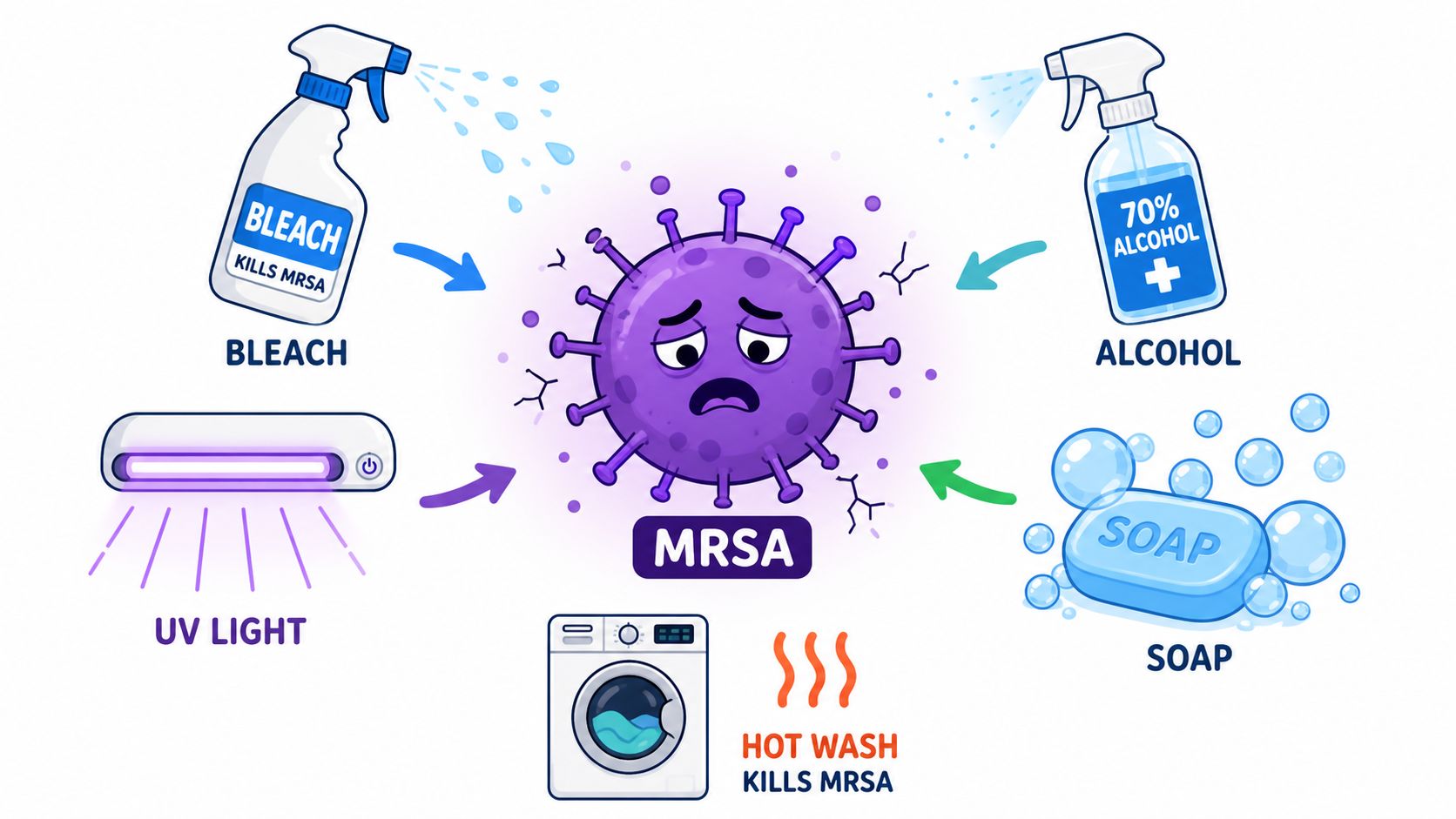
• Alcohol Based Disinfectant Spray How It Really Works

    A fitness center manager sprays a bench after a busy class. A teacher wipes desks before students arrive. At home, a parent treats a kitchen counter after preparing raw food. In each case, the goal is sensible, but the result depends on more than spraying and wiping. An alcohol based disinfectant spray works only when its formulation, surface coverage, and wet contact time match the task.

    That distinction matters in high-traffic settings, where organisms such as Pseudomonas aeruginosa, Staphylococcus aureus, MRSA, Salmonella, and VRE may be introduced through hands, equipment, food residue, respiratory secretions, or contaminated materials. Alcohol can be a fast and useful control measure, but it isn't a universal sterilizer. The safest approach combines product-label directions, appropriate pre-cleaning, and a clear understanding of what the spray can and cannot do.

    The Everyday Reach for a Disinfectant Spray

    A spray bottle often feels like the quickest answer to a dirty or frequently touched surface. A gym operator may use it on weight-room handles between users, while an office supervisor may keep it beside shared keyboards and a break-room counter. Parents use similar products on high-touch household surfaces when someone is ill.

    The impulse is understandable. People want to remove an immediate risk without shutting down a room or waiting for a complicated cleaning process. Alcohol-based products are attractive because they act quickly, usually leave little visible residue, and can be convenient for small hard surfaces. Research on alcohol-based surface products has also reported rapid reductions in vegetative bacterial pathogens on hard and soft surfaces, including products that didn't stain clothing, as described in a PubMed-indexed healthcare study.

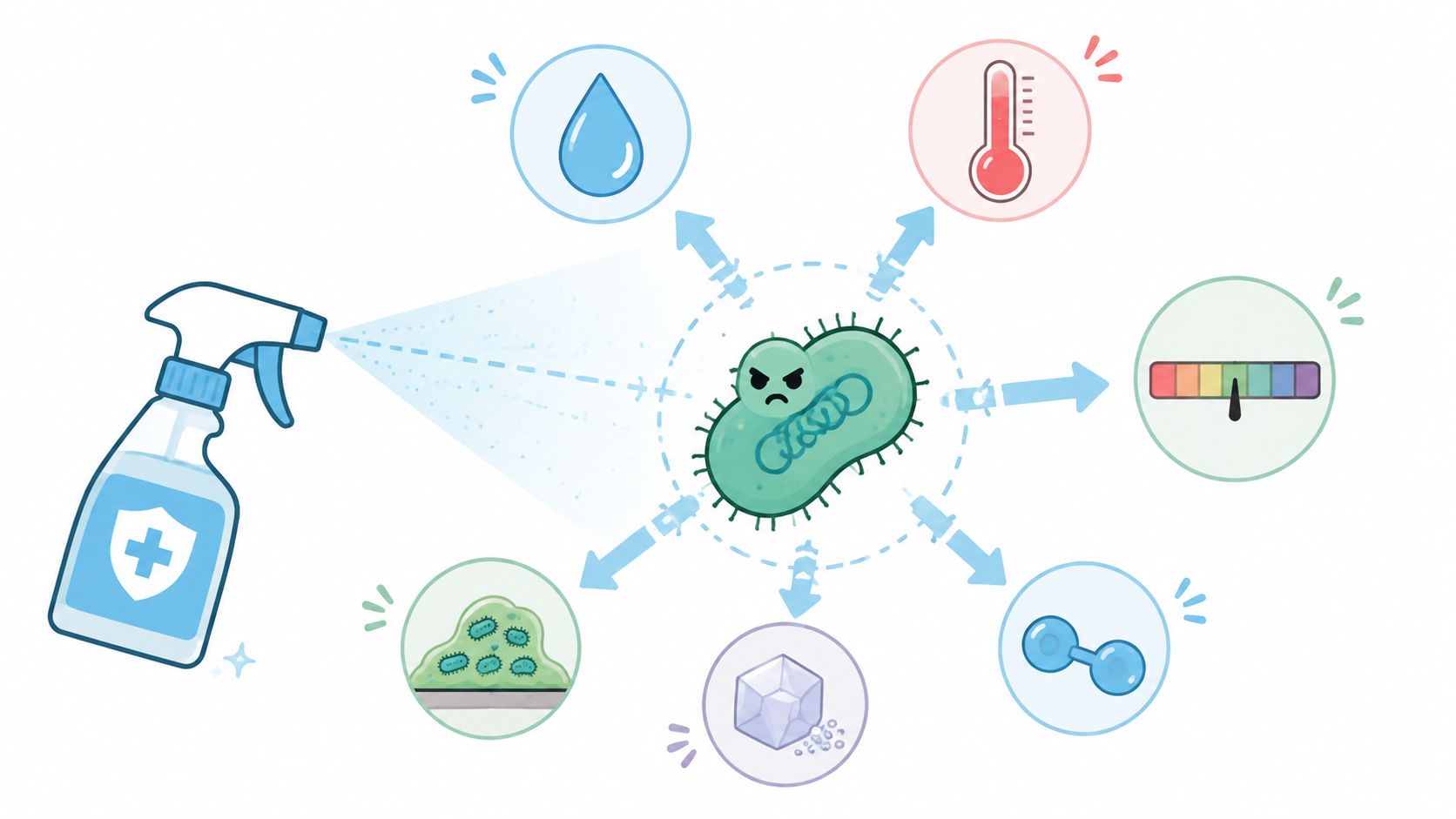
    Yet a spray isn't automatically effective just because it contains alcohol. A product that's too weak may not provide the intended antimicrobial action. A product that's too concentrated may evaporate before it has enough time to work. A thin mist that dries almost immediately may never deliver the required wet exposure, while dirt, grease, or body fluids can shield organisms from the active ingredient.

    Practical rule: A disinfectant is a controlled process, not a cosmetic finishing spray. The label, the surface, and the time all matter.

    Facility teams should also separate cleaning from disinfection. Cleaning removes soil and residue. Disinfection uses an antimicrobial product to reduce pathogens on an environmental surface. If a countertop has food residue or a piece of equipment has visible grime, the first step is to remove that material with a suitable cleaner, unless the product label specifically allows a combined cleaning and disinfecting process.

    The central question, then, isn't whether alcohol kills bacteria. It is whether the chosen spray reaches the organism at an effective concentration, stays wet for the required period, and is used on a compatible surface.

    The Science of How Alcohol Disinfectants Work

    A spray can leave a surface looking clean while microbes remain active. Alcohol-based disinfectants work through a chemical process: ethanol, isopropyl alcohol, or a blend of alcohols disrupts membranes, changes proteins, and breaks down the internal organization that cells need to function.

    Protein denaturation is similar to what happens when heat changes a raw egg white from fluid and translucent to firm and opaque. Alcohol causes a different chemical reaction, but the comparison clarifies the result. Microbial enzymes and structural proteins depend on their three-dimensional shape. Once that shape changes, those proteins can no longer perform their normal tasks.

    An infographic titled The Science of Alcohol Disinfectants explaining key ingredients, mechanisms of action, and effectiveness factors.

    Why water improves alcohol's action

    A higher alcohol percentage does not automatically produce better disinfection. Alcohol-based disinfectant sprays are most effective when the final alcohol concentration is in the 60% to 95% range. Water slows evaporation and helps the alcohol remain in contact with microbial structures long enough to denature proteins and disrupt membranes, as described in CDC chemical disinfectant guidance.

    A formulation around 70% illustrates the balance. It supplies substantial alcohol while retaining enough water to support penetration and wet contact. Very concentrated alcohol can evaporate quickly, shortening the time available for the reaction. The stronger-smelling or faster-drying product is not necessarily the more effective one.

    The CDC states that alcohol-based hand sanitizers should contain greater than 60% ethanol or 70% isopropanol. CDC-linked laboratory data also found that 60% ethanol and 70% isopropanol inactivated viruses with properties similar to SARS-CoV-2. WHO hand-hygiene formulations use 80% ethanol and 75% isopropyl alcohol, reflecting the same formulation principle.

    Laboratory results also found that ethyl alcohol at 60% to 95% killed Staphylococcus aureus and Streptococcus pyogenes in about 10 seconds under the evaluated conditions. That finding does not replace a surface product's label. Facility managers and parents should check whether the spray is registered for the intended organism and surface, then keep the area visibly wet for the stated contact time. For a clearer explanation of the underlying chemistry, see why alcohol kills bacteria.

    Pathogens Eliminated by Alcohol Sprays

    Alcohol sprays are particularly useful against many vegetative bacteria, meaning bacterial cells that are actively growing rather than protected inside a highly resistant spore. That category includes organisms encountered on frequently touched equipment, environmental surfaces, and some healthcare or commercial materials.

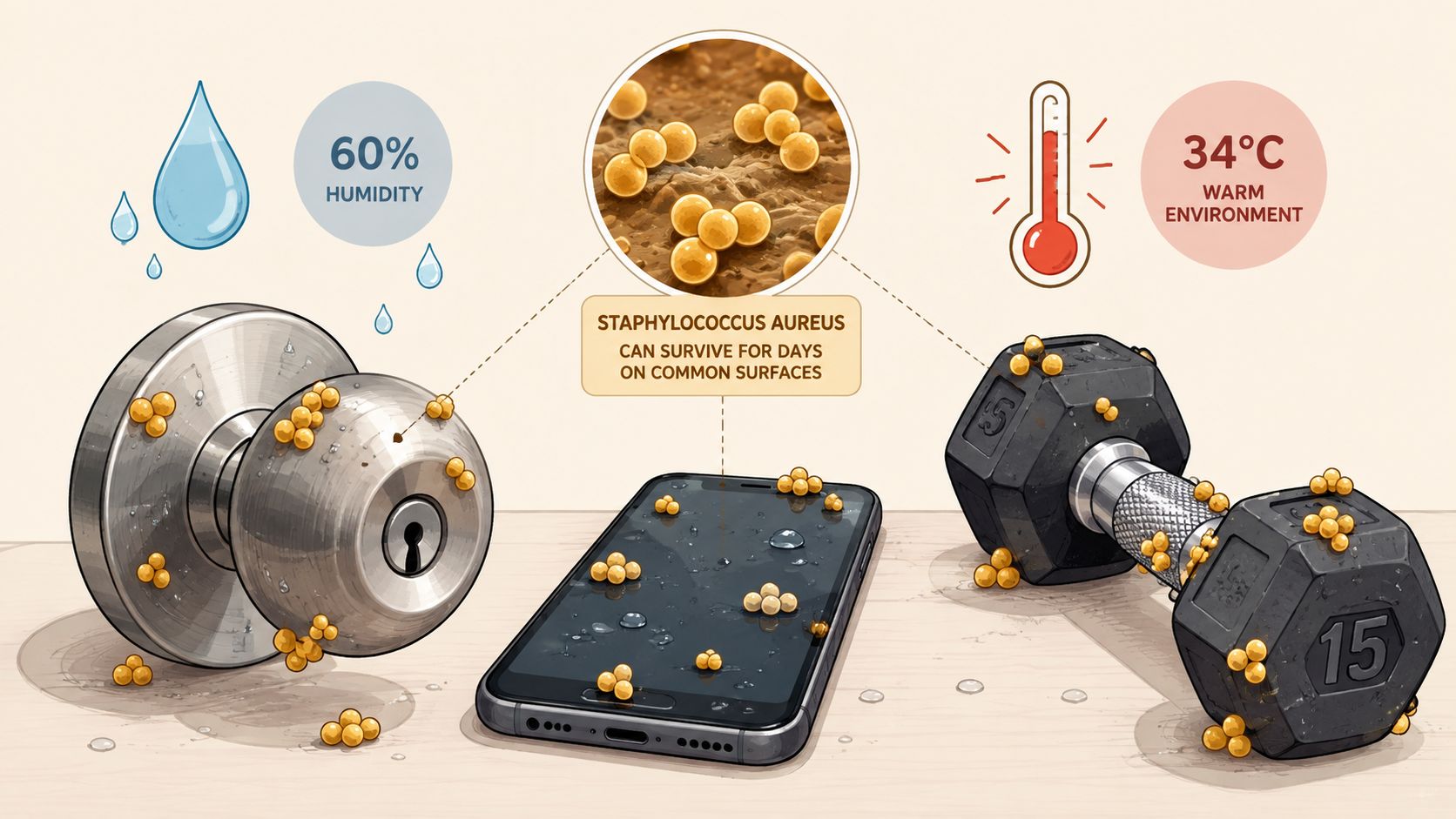
    Staphylococcus aureus is a familiar example. It can colonize human skin and nasal passages, then reach door handles, exercise equipment, desks, and shared tools through touch. Some strains are resistant to important antibiotics, but resistance to antibiotics doesn't make every strain automatically resistant to an appropriate environmental disinfectant. The product must still be registered and labeled for the organism.

    MRSA, or methicillin-resistant Staphylococcus aureus, deserves special attention in hospitals, athletic facilities, schools, and shared living environments. VRE, or vancomycin-resistant Enterococcus faecium, is another healthcare-associated concern. CDC environmental-services guidance specifically names MRSA and VRE as susceptible to several EPA-registered low- and intermediate-level disinfectants, including alcohols, when the products are used at their recommended dilutions on environmental surfaces. The relevant guidance is available through the CDC environmental control recommendations.

    A diagram illustrating the types of pathogens, including bacteria, viruses, and fungi, eliminated by alcohol disinfectants.

    Where the method fits

    In a gym, alcohol may be appropriate for a clean, nonporous handle or bench surface when the label supports that use. In a school, staff may use a registered product on desks and other hard, frequently touched surfaces. In a healthcare setting, alcohol can be one part of an environmental program, but it shouldn't replace the facility's pathogen-specific protocol.

    A 70% alcohol surface study reported a six-log reduction, meaning approximately a 1,000,000-fold decrease, when disinfection was performed under friction on contaminated surfaces. The same study reported a residual microbial load at or below 10² CFU even when no prior cleaning was performed. Those findings illustrate the value of adequate dose, friction, and exposure, but they don't remove the need to follow the product label.

    More recent work summarized in a 2023 PMC article reported that tested alcohol-based sanitizers could kill up to 99.99% of surface-inoculated Staphylococcus aureus. Some formulations also showed sustained antibacterial activity, killing at least 99.9% of opportunistic bacteria landing on the surface 24 hours later. Those properties vary by formulation and shouldn't be assumed for every spray.

    Alcohol can also work well against many enveloped viruses because their lipid envelopes are vulnerable to disruption. Non-enveloped viruses and bacterial spores are more difficult targets, so a facility needs to choose products based on the specific hazard rather than the word “disinfectant” alone.

    Limitations What Alcohol Sprays Cannot Kill

    Alcohol is powerful against many actively growing bacteria, but it isn't a universal sterilizer. Bacterial spores, including the protected forms associated with Clostridioides difficile, are much more resistant than ordinary vegetative cells. A facility facing a spore-related concern needs a product and protocol specifically validated for that target, often with additional attention to mechanical removal and environmental controls.

    Organic material creates another obstacle. Grease, food residue, dirt, mucus, blood, and other bodily fluids can cover microorganisms and consume or dilute the active ingredient before it reaches them. A spray may appear to wet the surface while failing to contact the organisms underneath the residue.

    Surface type changes the outcome

    Hard, smooth, nonporous surfaces are generally easier to cover evenly than absorbent materials. Upholstery, carpet, unfinished wood, and porous padding can draw liquid away from the surface or hold contamination below the area reached by a spray. Alcohol may also affect finishes, dyes, coatings, plastics, rubber, or adhesives.

    Always check the product label and the material manufacturer's care guidance before treating an unfamiliar surface. Apply a small test in an inconspicuous area when compatibility isn't clear, and never assume that a product approved for stainless steel is suitable for a phone screen, painted furniture, leather, or fabric.

    Alcohol can reduce contamination on the surface it reaches. It can't reliably disinfect contamination hidden inside porous material.

    This limitation matters after vomiting, blood spills, or other heavy contamination. Remove the material safely, clean the area, and use a disinfectant whose label addresses the organism and surface. In healthcare settings, a pathogen such as C. difficile requires a sporicidal approach rather than routine reliance on alcohol.

    A spray also can't replace hand hygiene, respiratory precautions, laundry controls, food safety, or isolation practices. Surface disinfection reduces one route of exposure. It doesn't eliminate every route by which bacteria move between people and environments.

    Safe and Effective Application Techniques

    Successful disinfection starts before the trigger is pulled. Staff should identify the surface, inspect it for visible soil, select a product with an appropriate EPA registration and label claim, and confirm that the material can tolerate the formulation.

    A practical application sequence

    1. Remove visible soil first. Use a compatible cleaner or the product's combined cleaning and disinfecting instructions. Pay attention to grease, food residue, and bodily fluids, which can obstruct contact.

    2. Apply enough product for uniform coverage. A fine mist that disappears immediately may not keep the surface wet. Cover the entire target area, including edges, seams, handles, and other touch points.

    3. Start the clock when the surface is visibly wet. Wet contact time, also called dwell time, is the period the surface must remain wet for the label claim to apply. If the surface dries early, reapply as directed rather than assuming the first pass was sufficient.

    4. Don't wipe too soon. Wiping immediately can remove the active ingredient before it has completed its required exposure. After the label time, follow the label's directions about air drying, rinsing, or wiping.

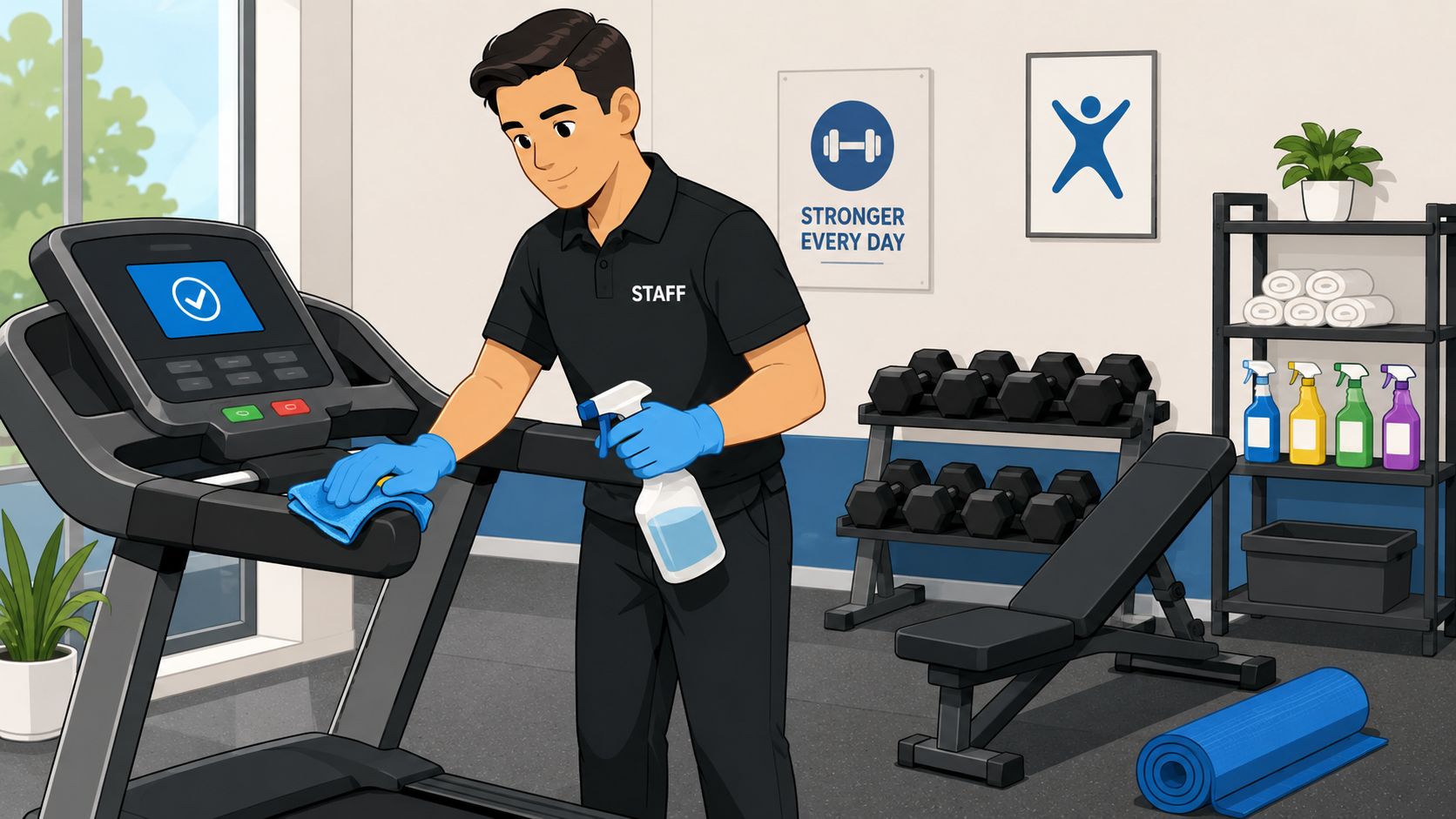
    5. Document and standardize the routine. In a commercial setting, train staff on the exact product, target surfaces, application amount, and required wet time. Consistent technique is more reliable than an informal “spray and wipe” habit.

    A person uses an alcohol-based disinfectant spray bottle to sanitize a wooden table surface.

    Contact time is a label requirement

    CDC disinfection guidance states that most EPA-registered hospital disinfectants carry a label contact time of 10 minutes, although many studies have shown efficacy against pathogens with at least 1 minute of wet contact time. These figures don't authorize a shorter time for every product. The product label controls the legally supported use, organism claim, and required wet period. Review the CDC's summary recommendations for disinfection and sterilization when developing a facility protocol.

    For hand hygiene, WHO says alcohol-based handrub should cover all hand surfaces and be rubbed until dry. Evidence reviewed in the literature found that increasing volume and contact time improves efficacy. A 3 mL application needed roughly 45 to 50 seconds for strong SARS-CoV-2 reduction in the cited evidence, while some standardized hand-antisepsis tests required 6 mL for 60 seconds to meet performance benchmarks, as reflected in WHO hand-hygiene guidance. Hand sanitizer directions and surface-spray directions aren't interchangeable. For practical distinctions between formats, review whether alcohol wipes kill germs.

    Protect people while spraying

    Alcohol is flammable, so keep sprays away from flames, sparks, hot equipment, and ignition sources. Ventilate the area to reduce inhalation of vapors, and don't spray near a child's face, food, uncovered food-contact materials, or electrical openings unless the label permits that use. Store containers securely and follow the manufacturer's first-aid instructions after eye or skin exposure.

    Janitorial teams should use the protective equipment listed on the label. Gym operators should allow treated equipment to dry before returning it to service when the label requires drying. Parents should keep the bottle inaccessible to children and avoid turning routine surface treatment into unnecessary aerosol exposure.

    Alcohol Sprays vs Other Disinfectants

    A surface may need a different disinfectant when the organism, soil level, material, or required contact time changes. Alcohol sprays often act quickly and leave little visible residue. Bleach can provide broader environmental control, while quaternary ammonium compounds, or quats, may offer useful material compatibility and formulation characteristics that support routine programs.

    Characteristic Alcohol-Based Sprays Bleach, Sodium Hypochlorite Quaternary Ammonium, Quats
    Typical practical strength Effective products commonly fall within the 60% to 95% alcohol range, as reflected in CDC chemical disinfectant guidance CDC guidance identifies 1:100 dilution for small blood or body-fluid spills and 1:10 for large spills before terminal disinfection Use the registered product at its labeled dilution
    Speed and wetness Often fast acting, but evaporation can shorten wet contact Can require sustained wet contact and careful preparation Contact time varies by product and organism
    Target organisms Useful against many vegetative bacteria, including labeled claims for organisms such as MRSA and VRE Appropriate products can address hazards alcohol does not, including some spore-related protocols Can address MRSA and VRE when the product label includes those claims and directions are followed
    Residue and material concerns Usually low residue, but may affect finishes, plastics, dyes, or coatings Can corrode, discolor, or damage materials and fabrics May leave residue, especially on absorbent materials
    Safety considerations Flammable vapors require ventilation and ignition control Fumes, corrosivity, and dangerous reactions with incompatible chemicals require strict handling Follow label precautions for skin, eye, inhalation, and residue exposure

    The comparison becomes practical at the point of use. A product label should match the organism, surface, dilution, and contact time. Visible soil can shield microorganisms, and a spray that evaporates before the required wet period may not deliver its stated disinfection performance. Never mix bleach with alcohol, acids, ammonia, or other cleaners.

    Surface type also changes the decision. Alcohol can suit a small, clean, hard, nonporous surface where rapid treatment and minimal residue matter. Bleach may fit a validated response to heavy contamination or a spore-forming organism. Quats may suit routine environmental programs when their claims, material compatibility, contact time, and residue profile fit the setting.

    Facility managers reviewing a broader chemical program can consult discussing chemical use in pest control, particularly when several products are used at one site. For a focused comparison of wipe formats and active ingredients, see benzalkonium chloride wipes versus alcohol. The goal is not to choose one chemistry for every task. It is to select the labeled product that fits the organism, surface, and conditions.

    Making the Right Choice for a Cleaner Space

    An alcohol based disinfectant spray earns its place in homes, schools, gyms, food-service areas, and healthcare environments when people use it precisely. Choose a formulation within the evidence-supported 60% to 95% range, confirm the product's EPA registration and organism claim, pre-clean visible soil, apply enough liquid to keep the surface wet, and respect the full label contact time.

    The target also matters. Alcohol is well suited to many clean, hard, nonporous surfaces and many vegetative bacteria, including labeled environmental claims involving MRSA and VRE. It isn't the right standalone answer for bacterial spores, heavy organic contamination, or an absorbent material that traps contamination below the surface.

    A complete hygiene plan should also consider hand hygiene, ventilation, touch-point scheduling, spill response, staff training, and indoor conditions. For readers building a broader household maintenance plan, guidance on whole-home air quality can complement surface-focused infection-control decisions.

    For convenient, pre-moistened, properly formulated surface-disinfection options, we recommend exploring the EPA-registered products available at Wipes.com. Choose a product whose label matches your organism, surface, and required contact time, then train everyone who uses it to follow those directions.


    Start your next cleaning review by listing your highest-touch surfaces, the organisms relevant to your setting, and the label contact time for the product currently in use. Then compare that protocol with an EPA-registered option from Wipes.com and make the change only when the label, material compatibility, and staff workflow all align.

  • Hand Washing Effectiveness: What the Evidence Really Shows

    Hand washing with soap can reduce diarrheal illness by 23% to 40% and respiratory illnesses by 16% to 21% in the general population, according to the CDC's hand hygiene evidence summary. Yet those population averages conceal the practical question that matters most: which hand hygiene method performs best for a particular organism, surface condition, and setting?

    The answer isn't a universal “soap versus sanitizer” verdict. A 2025 systematic review found that soap-and-water washing produced an average 2.12 log reduction in bacteria, while alcohol-based hand sanitizers produced a larger average 3.25 log reduction. Viral results were smaller and less certain, which means organism type, visible soil, rubbing time, and technique can change the conclusion. The review's full findings support a more cautious approach to hand washing effectiveness.

    Why Hand Washing Matters at the Population Level

    Hand hygiene changes transmission at two linked levels. It lowers the microbial load on an individual's hands, then reduces opportunities to transfer organisms to other people, food, equipment, and shared surfaces. That second pathway explains why a routine at one sink can affect infection patterns across a household, school, healthcare facility, or restaurant.

    Population studies support a real public-health benefit, but their averages do not identify the performance of each wash. The CDC evidence summary describes reductions in diarrheal and respiratory illness and reports that handwashing could protect about 1 in 3 young children who get diarrhea and nearly 1 in 5 with respiratory infections such as pneumonia. Those findings describe outcomes across repeated behavior, not a fixed log reduction from one procedure.

    Healthcare settings show why context matters. The World Health Organization's key facts states that appropriate hand hygiene can prevent up to 50% of avoidable infections acquired during healthcare delivery. WHO also estimates that infection-prevention and control measures, including hand hygiene, can reduce healthcare-associated infections by up to 70%. These estimates reflect coordinated systems, including supplies, training, monitoring, and other controls, rather than handwashing in isolation.

    Population averages hide operational differences

    A controlled test on clean hands differs from a rushed rinse after contact with food, bodily fluids, or a contaminated surface. Organism type, starting contamination, grease or protein, rubbing time, water access, and coverage all affect the measured result. Log reduction therefore offers a more useful comparison than a universal soap-versus-sanitizer verdict. The relevant question is which method reaches the larger reduction for the organism and setting, and how quickly it reaches a meaningful minimum.

    Repeated behavior also matters at the population level. WHO cites a meta-analysis associating each additional handwashing event with about a 3% reduction in the daily risk of acquiring a respiratory tract infection. A separate review reported a pooled 24% reduction in respiratory infection risk, with a 95% confidence interval of 6% to 40%. These are associations across groups, not a guaranteed effect from a single wash.

    Practical rule: Treat hand hygiene as a transmission-control system. Soap, sanitizer, clean water, drying materials, access, and usable instructions determine whether measured laboratory performance is approached in daily life.

    For practical prevention guidance across homes and public spaces, see this guide to stopping the spread of germs. The conclusion is straightforward: the average benefit is real, but the individual result depends on execution.

    How Hand Washing Removes Microbes

    Handwashing can reduce contamination by several log units without sterilizing skin. Plain soap helps lift oils, soil, and attached microbes from the surface. Friction loosens material from the palms, fingers, creases, and nail folds, while running water carries the suspended contamination away.

    The primary mechanism is mechanical removal. Some soap ingredients can disrupt microbial structures, but routine handwashing depends mainly on surfactant action, friction, rinsing, and drying. Coverage determines how much of that mechanism reaches the contamination. A missed thumb, fingertip, or nail fold can retain viable organisms even when the hands look clean.

    Log reduction puts performance on a usable scale

    Microbiology reports the change in contamination as log reduction:

    • 1 log means a 90% reduction.
    • 2 log means a 99% reduction.
    • 3 log means a 99.9% reduction.
    • 4 log means a 99.99% reduction.

    Because the scale is logarithmic, every additional log represents a tenfold decrease in organisms remaining. A 2 log result is substantial, but it does not mean the hands are sterile. The remaining burden depends on the starting contamination, the organism, and whether the survivors include a pathogen capable of causing infection.

    A 2025 review reported average bacterial reductions of 2.12 log for soap and water and 3.25 log for alcohol-based sanitizer, as described in the systematic review of hand hygiene methods. These are pooled averages, not fixed scores for every wash. Study design, organism, contamination model, product application, contact time, and hand coverage can all shift the measured result.

    A five-step infographic explaining the process of how soap, water, and friction effectively remove germs from hands.

    The mechanism should match the contamination

    Alcohol-based sanitizer can achieve a strong bacterial reduction when hands are not visibly dirty, but it does not rinse away grease, food residue, or fecal material. Soap and water physically remove those materials, which can protect organisms from chemical exposure or interfere with sanitizer contact. The advantage therefore depends on the organism and the setting, not on a universal product ranking.

    The practical question is which mechanism addresses the contamination in front of me, and which method reaches the minimum effective reduction fastest? Alcohol damages susceptible microbes through processes explained in how alcohol kills bacteria. Hand hygiene outcomes still depend on applying enough product, reaching every surface, and completing the required rubbing or washing time.

    Soap and Water Versus Alcohol-Based Hand Rubs

    The comparison depends less on a universal winner than on the organism, contamination, and setting. The 2025 systematic review found stronger pooled bacterial reductions for alcohol-based hand rubs, but those averages do not predict every hand-cleaning event. Product formulation, application, rubbing time, coverage, and the material surrounding the organism can all change the measured result.

    For bacteria on hands without visible soil, alcohol-based hand rubs are often easier to deploy. They work without a sink and fit entrances, bedside areas, classrooms, and workstations. Their performance depends on applying enough product to reach every surface and rubbing until the hands are dry. A missed thumb, fingertip, or finger web can reduce the practical benefit even when the product itself is effective.

    Soap and water becomes the more defensible choice after toilet use, before food preparation, or whenever hands are visibly dirty, greasy, or covered with residue. Washing combines chemical loosening with friction and rinsing, so it removes organisms and the material carrying them. Alcohol may inactivate susceptible microbes while leaving soil or attached material on the skin.

    The organism determines the winner

    Viruses produced smaller and less certain reductions in the review than bacteria. That difference matters because viral structures vary. Alcohol can perform well against some enveloped viruses, while non-enveloped viruses may be harder to inactivate. Soap and water can reduce risk through physical removal, but the available evidence does not support claiming that it always outperforms alcohol.

    Contamination or organism More defensible first choice Reason
    Susceptible bacteria on clean-looking hands Alcohol-based hand rub Rapid application and strong measured reduction when coverage is complete
    Virus with uncertain alcohol susceptibility Soap and water when feasible Rinsing adds physical removal rather than relying only on inactivation
    Visible soil, grease, food, or fecal material Soap and water Removes both organisms and the material that can interfere with contact
    Clean hands where no sink is available Alcohol-based hand rub Provides an accessible option when hands are not visibly dirty

    The table expresses a decision framework, not a guaranteed log reduction for a named pathogen. Minimum effective time also varies by product and organism. A method that is faster to deploy may still underperform if users stop before full coverage or fail to rub until dry.

    Decision point: Sanitizer is primarily an access and inactivation tool. Soap and water is primarily a removal tool. Choose between them by asking what is on the hands, which organism is plausible, and whether the product can contact every surface for its required time.

    Facilities should stock both options and define their use by task rather than brand preference. Training should distinguish inactivation from physical removal, especially where visible contamination is common. For a practical side-by-side explanation of the two methods, see this soap versus hand sanitizer guide.

    Duration and Technique That Actually Work

    Time matters because friction needs enough duration to reach every surface. A short splash may wet the hands, but it rarely provides complete lather coverage or sustained rubbing. Public guidance commonly uses 20 seconds as the baseline, while experimental evidence reviewed in a hand-hygiene technique analysis indicates that 30 to 60 seconds may be needed for optimal 2 to 3 log reductions under some controlled conditions.

    That doesn't mean every person must perform a minute-long wash for every routine event. It does mean that a 20-second target is a minimum behavioral anchor, not proof that the same reduction occurs in every setting. Soil, pathogen load, skin condition, and missed areas can all lower the outcome.

    Coverage beats choreography

    A reliable wash should deliberately cover:

    1. Wet the hands and apply enough soap to spread across all surfaces.
    2. Rub palm to palm, then the backs of both hands.
    3. Interlace the fingers so the spaces between them receive friction.
    4. Rotate around each thumb.
    5. Rub fingertips and nail edges against the opposite palm.
    6. Rinse thoroughly and dry completely.

    The WHO 6-step method generally reduces microbial load, but the evidence doesn't consistently show that it is superior to simpler alternatives. The review found heterogeneous studies, including one that found no meaningful difference between a 6-step and a 3-step method, while another found an adapted 6-step method performed better in laboratory conditions.

    The practical interpretation is important. A simpler method performed thoroughly may outperform a longer method performed mechanically, especially when total duration and friction are greater. Staff training should therefore assess coverage, not merely whether workers can recite a sequence.

    A minimum routine for daily use

    Use a full lather, rub for at least 20 seconds, and give deliberate attention to thumbs, fingertips, nail margins, finger webs, and the backs of the hands. If contamination is visible or the task involves high-risk material, extend the wash toward the longer experimental window and focus on removal rather than speed.

    The evidence doesn't support obsessing over exact choreography while ignoring duration. It supports a more useful hierarchy: complete coverage first, sustained friction second, prescribed sequence third.

    Soap Type, Water Temperature, and Drying Choices

    People often debate hot water and antibacterial soap as if they determine hand washing effectiveness. The evidence supplied for this analysis points elsewhere. Coverage, friction, duration, rinsing, and drying generally matter more than whether water feels warm or whether the dispenser contains a specialized formulation.

    Plain soap works primarily by lifting and suspending oils, dirt, and microbes for removal. Liquid and bar formats can both support effective washing when facilities manage cleanliness, replenishment, and user access. Antibacterial formulations shouldn't be treated as automatically superior, especially when the central failure is incomplete rubbing.

    Temperature is a comfort and skin issue

    The reviewed evidence reports no meaningful difference in bacterial reduction across water temperatures of 15°C, 26°C, and 38°C when technique is held constant. The practical implication is that comfortably warm or cool water can support effective washing, while very hot water may discourage thorough rubbing or irritate the skin.

    Water temperature doesn't replace friction. It also doesn't make a short wash equivalent to a complete one. Facilities should prioritize reliable water flow, soap availability, and drying materials over an assumption that hotter water will compensate for poor technique.

    Drying deserves more attention than it usually receives. Wet hands can transfer contamination more readily, and the drying method can influence contact with nearby surfaces. Paper towels often offer a practical advantage because they physically remove residual moisture and can help users avoid touching faucet handles or restroom doors directly.

    Variable Common Choices Effect on Log Reduction Practical Takeaway
    Soap Bar, liquid, antibacterial Depends mainly on lather and friction Choose a usable plain-soap system and maintain supply
    Water temperature Cool, comfortable warm, hot Similar reduction when technique is constant Prioritize comfort and skin tolerance
    Drying Paper towel, jet dryer, warm-air dryer Modest influence on residual moisture and transfer Provide a reliable method and reduce recontamination points

    These choices should be evaluated as a system. A high-quality soap dispenser can't repair missed fingertips, and a warm-air dryer can't compensate for hands that remain wet because a user leaves too quickly. The most effective facility is the one that makes the complete routine easy to perform.

    Where Hand Washing Routines Break Down

    The laboratory procedure fails first at the edges. People commonly rush over thumbs, fingertips, nail margins, finger webs, and the backs of their hands. Those areas are easy to miss because the palms receive the most attention and provide the clearest sensation of lather.

    A second failure is substitution. Someone rinses without soap, rubs briefly, or applies sanitizer to visibly dirty hands because the dispenser is closer than the sink. These shortcuts may produce a clean appearance without achieving the removal required for meaningful hand washing effectiveness.

    Recontamination happens after the wash

    A person can complete the rubbing step and then touch a contaminated faucet handle, door lever, phone, or shared workstation. The hand hygiene event then ends with a new exposure. Facilities that invest only in sinks and ignore nearby touchpoints create a preventable gap between washing and leaving.

    Healthcare audits also show why written procedures don't equal observed behavior. The evidence supplied for this article describes adherence to hand hygiene protocols as hovering near 40% on entry and exit audits, with community adherence lower still. That gap explains why controlled study results often exceed what organizations observe in daily practice.

    Fix the environment, not only the person

    A manager should inspect the entire sequence:

    • At the sink: Is soap present, easy to dispense, and compatible with frequent use?
    • During rubbing: Do training checks include thumbs, fingertips, and finger webs?
    • At the exit: Can people dry their hands without touching a contaminated surface?
    • At the point of care: Is alcohol-based hand rub placed where staff need it?
    • During audits: Do observers measure real behavior rather than checklist completion?

    Operational insight: Compliance problems often reflect friction in the environment. A blocked dispenser, missing towel, awkward sink, or poorly placed sanitizer turns a correct policy into an impractical instruction.

    The strongest programs combine observation, feedback, surface cleaning, and supply maintenance. They don't assume that repeating “wash your hands” will overcome a restroom design that encourages recontamination.

    Practical Hand Hygiene by Setting

    Different settings create different contamination problems, so a single protocol is inefficient. A household needs a memorable routine at critical moments. A hospital needs placement, monitoring, and method selection tied to patient contact. A foodservice operation needs to control both hands and the surfaces that hands repeatedly touch.

    Match the method to the task

    Households should use soap and water after restroom use, before food preparation, and after contact with an ill person. A full wash of at least 20 seconds is the practical baseline. Sanitizer can serve as a substitute when a sink isn't available and hands aren't visibly soiled, but visible contamination calls for soap and water.

    Schools and daycare facilities should practice coverage, not just install sanitizer. Supervised demonstrations can help children learn to rub thumbs, fingertips, and finger webs. Staff should increase attention to hand and surface hygiene when gastrointestinal illness is present.

    Gyms need a combined approach. Users should clean hands after sessions, and operators should maintain high-touch equipment and shared surfaces. Towels can create a barrier between skin and equipment, but they don't replace hand hygiene or surface disinfection.

    Foodservice teams should coordinate handwashing with task changes, raw-food handling, restroom use, waste handling, and illness exclusions. Nail margins and fingertips deserve deliberate attention because workers repeatedly contact utensils, packaging, handles, and food-contact areas.

    Healthcare facilities can use alcohol-based hand rub for non-soiled hands between patient contacts and reserve soap and water for visible contamination or situations where physical removal is important. The WHO 6-step and CDC 3-step approaches can both support coverage, provided staff sustain friction and don't reduce the process to a rushed sequence.

    Setting Minimum Duration Primary Method Escalation Trigger
    Household At least 20 seconds Soap and water Visible soil, restroom use, food preparation, or illness exposure
    School or daycare At least 20 seconds Soap and water, with sanitizer when appropriate Gastrointestinal illness or repeated surface contamination
    Gym At least 20 seconds Soap and water after activity Shared-equipment contamination or illness concerns
    Foodservice At least 20 seconds Soap and water with nail and fingertip attention Raw-food changes, waste handling, or suspected foodborne illness
    Healthcare 20 seconds baseline, longer when required by task Sanitizer for non-soiled hands, soap and water when soiled Outbreak, visible contamination, or clinical protocol

    The most important escalation is often environmental. If cases are present, hand hygiene alone isn't enough. Teams should add targeted surface cleaning and disinfection, review high-touch routes, and verify that any disinfectant is labeled for the organism and surface.

    Organism-Specific Surface Control

    Hand washing protects people, but it doesn't disinfect equipment, counters, rails, bed frames, or food-contact surfaces. The organism-specific profiles below show why surface control must be matched to the bacterium, product label, and contact time. A wipe that works against one organism isn't automatically validated against another.

    Pseudomonas aeruginosa

    Pseudomonas aeruginosa is a Gram-negative, opportunistic bacterium associated with damp, high-traffic environments. It can persist where moisture, repeated contact, and inadequate drying allow contamination to remain on hard surfaces.

    Healthcare areas, gyms, locker rooms, pools, sinks, drains, and shared equipment deserve particular attention. People with weakened defenses, wounds, invasive devices, or prolonged healthcare exposure face greater concern than healthy people using a dry, well-maintained facility.

    Control begins with removing soil, managing moisture, and applying an appropriate disinfectant to a fully wetted surface. CDC guidance identifies quaternary ammonium compounds, 70% isopropyl alcohol, phenolics, and chlorine-containing wipes as capable of removing or inactivating Pseudomonas from hard surfaces with a 5-second application time, as described in the CDC chemical disinfectant guidance.

    A janitorial team should verify the product label, keep the surface wet for the stated contact time, and avoid wiping the product away prematurely. Gym operators should focus on damp touchpoints, while healthcare teams should connect surface disinfection with hand hygiene and equipment reprocessing.

    Staphylococcus aureus

    Staphylococcus aureus is a Gram-positive bacterium that can colonize skin and the nose without causing illness, yet it can also enter wounds or contaminate shared surfaces. Its importance in commercial and high-traffic environments comes from the combination of human carriage, frequent hand contact, and the ability to spread through direct contact or contaminated objects.

    Locker rooms, athletic equipment, healthcare surfaces, shared tools, door hardware, and frequently touched fixtures may become part of a transmission chain. Risk rises when people have open cuts, damaged skin, medical devices, or close contact with contaminated materials.

    Control requires routine hand hygiene, wound coverage, cleaning before disinfection, and a labeled product used for the relevant surface. Facilities shouldn't assume that a surface that looks dry is free of organisms. They should establish schedules for high-touch points and increase cleaning when a known infection or cluster is present.

    Healthcare providers and athletic managers should coordinate environmental measures with clinical advice. A wipe is useful only when workers apply enough product, cover the complete surface, respect label contact time, and prevent cross-contamination by using a fresh wipe or clean portion for the next area.

    Salmonella enterica

    Salmonella enterica is a foodborne Gram-negative pathogen. Foodservice operations, kitchens, food-processing areas, and shared dining environments must control both hand contamination and the spread of contaminated material onto food-contact surfaces.

    The critical surfaces include preparation counters, cutting boards, refrigerator handles, faucets, utensils, and equipment controls. Salmonella can move when workers handle raw ingredients, touch a contaminated handle, and then resume food preparation without changing gloves or washing hands.

    EPA label data show that food-contact surface sanitizers can be registered specifically against Salmonella. One example label requires the surface to remain thoroughly wet for at least 1 minute, as shown in the EPA product-label document. The same source also reflects CDC information that 100 ppm free chlorine can kill specified high concentrations of S. aureus, Salmonella choleraesuis, and P. aeruginosa in under 10 minutes.

    Foodservice managers must follow the exact label for the product in use. They should clean away food residue first, apply sanitizer at the required concentration, maintain wet contact for the labeled time, and prevent treated food-contact surfaces from being recontaminated.

    Methicillin-resistant Staphylococcus aureus

    Methicillin-resistant Staphylococcus aureus, or MRSA, is a strain of S. aureus resistant to methicillin and related antibiotics. The resistance changes treatment options, but it doesn't change the basic environmental priorities: remove soil, disinfect high-touch surfaces, cover wounds, and perform hand hygiene at the moments that interrupt transfer.

    Hospitals, athletic facilities, households caring for an infected person, and shared living environments need clear separation between clean and contaminated tasks. Towels, razors, clothing, bedding, exercise equipment, and frequently touched surfaces can all become part of contact transmission when cleaning is inconsistent.

    Healthcare workers should follow facility isolation and environmental protocols rather than improvising a product choice. Gym managers should respond to known cases with focused cleaning of equipment and shared touchpoints, while household caregivers should avoid sharing personal items and should seek clinical guidance for the infected person.

    The central mistake is treating MRSA control as a hand sanitizer problem alone. Hands, wounds, textiles, and surfaces form one system. A program that cleans hands but leaves contaminated equipment untouched can preserve the transmission route.

    CA-MRSA Genotype USA300

    CA-MRSA genotype USA300 describes a community-associated MRSA lineage commonly discussed in connection with skin and soft-tissue infections. The label identifies a strain type, not a separate cleaning chemistry. Facilities should therefore use a product with a label appropriate for MRSA or the relevant S. aureus claim and follow the complete contact-time directions.

    Gyms, contact-sport settings, schools, childcare spaces, shelters, and households with close physical contact should focus on shared equipment, benches, mats, door handles, and any surface touched near open skin. Operators should also provide practical access to handwashing and encourage people to cover draining lesions according to clinical advice.

    The most effective response combines routine cleaning with an escalation plan. When a known case occurs, increase attention to high-touch surfaces, prevent sharing of personal items, and coordinate with public health or healthcare professionals where required. Don't use a generic “antibacterial” claim as proof of efficacy against this genotype.

    CA-MRSA Genotype USA400

    CA-MRSA genotype USA400 is another community-associated MRSA lineage. Its presence doesn't justify a different handwashing ritual, but it does reinforce the need for disciplined contact precautions in environments where people share equipment, sleep in close quarters, or have frequent skin-to-skin contact.

    Facility managers should identify the surfaces that connect users to one another. In an athletic setting, that may include training benches, mats, weights, and locker-room fixtures. In a household, it may include bathroom surfaces, linens, towels, and shared personal-care items.

    Cleaning staff should remove visible soil before applying a disinfectant and should verify that the product label supports the intended organism claim. They must keep the surface wet for the stated contact time, use fresh wipes between areas when cross-contamination is possible, and document escalation measures during a suspected cluster.

    The audience that needs the clearest instruction is often the business owner. A written response plan should state who cleans, which surfaces receive priority, how supplies are replenished, and when the organization contacts healthcare or public health authorities.

    Vancomycin-resistant Enterococcus faecium

    Vancomycin-resistant Enterococcus faecium, or VRE, is an enterococcal bacterium resistant to vancomycin. It matters most in healthcare and other environments caring for people with serious illness, prolonged hospital exposure, or weakened defenses.

    VRE control requires contact precautions, hand hygiene, equipment cleaning, and careful management of shared clinical surfaces. Bed rails, call buttons, carts, bathroom fixtures, monitors, and reusable equipment can support transfer if staff clean only the obvious areas.

    Healthcare providers should use the facility's approved disinfectant and follow its label for VRE or the applicable enterococcal claim. Cleaning must precede disinfection where soil is present, and workers should respect the full wet contact time rather than wiping the surface dry immediately.

    Because VRE is tied to clinical risk and antibiotic resistance, environmental cleaning can't be separated from patient-care workflow. Staff need clear responsibility for room turnover, equipment movement, and terminal cleaning, while infection-control teams should investigate gaps when transmission is suspected.

    MDR Acinetobacter baumannii

    Multidrug-resistant Acinetobacter baumannii, including isolates resistant to ceftazidime and gentamicin, is a healthcare-associated organism of concern because multiple drug resistances can restrict treatment choices. The environmental challenge is greatest in hospitals, intensive-care areas, long-term care, and places where shared equipment moves between patients.

    Surfaces around beds, ventilators, monitors, carts, rails, and mobile devices require consistent cleaning. Workers should treat reusable equipment as a transmission route, not as an afterthought. Hand hygiene remains essential, but it cannot compensate for equipment that moves from one patient zone to another without appropriate processing.

    The control plan should use a disinfectant approved by the facility for the organism and surface, with label-compliant concentration and wet contact time. Staff should clean from cleaner areas toward dirtier areas, change wipes as needed, and avoid spreading contamination across adjacent surfaces.

    Infection-control practitioners should audit room cleaning and equipment turnover when cases occur. The relevant question isn't whether a product is called a disinfectant. It is whether the facility applies a validated product correctly, for long enough, to the surfaces that connect patients and staff.

    ESBL Escherichia coli

    ESBL Escherichia coli produces extended-spectrum beta-lactamases, enzymes that can make several beta-lactam antibiotics ineffective. The organism can cause urinary, bloodstream, wound, and gastrointestinal infections, while its resistance complicates treatment.

    Hospitals, long-term care facilities, households, and food-handling environments should focus on fecal-oral transmission routes. Toilets, bathroom fixtures, faucets, commodes, bed rails, shared devices, and hands can connect contamination to a vulnerable person or a food-contact area.

    Cleaning staff should remove organic material before disinfection because residue can interfere with surface treatment. The chosen product must carry an appropriate claim and be used according to its label. Handwashing after toilet use and before food preparation remains a central control because surface disinfection can't remove contamination from hands that leave the area.

    Healthcare managers should coordinate environmental cleaning with contact precautions and antimicrobial stewardship. Family caregivers need practical instruction on bathroom cleaning, laundry handling, hand hygiene, and avoiding shared personal items during an infection.

    Klebsiella pneumoniae with NDM-1

    Klebsiella pneumoniae with NDM-1 is a carbapenem-resistant organism associated with a resistance mechanism that can compromise last-resort antibiotic options. It is primarily a healthcare concern, especially where patients require invasive devices, prolonged treatment, or intensive support.

    The important environments include hospitals, intensive-care units, long-term care, and areas where staff share equipment between patients. Bedside surfaces, devices, carts, bathrooms, and mobile equipment need a defined cleaning owner and a validated product.

    A facility should use contact precautions and follow its infection-control policy for carbapenem-resistant organisms. Environmental services staff need training on cleaning order, product compatibility, contact time, and equipment movement. Clinical staff should perform hand hygiene before and after patient contact and after touching the patient environment.

    No wipe should be assumed effective merely because it works against common bacteria. Managers must check the product label, confirm the intended claim, and verify application conditions. During an outbreak, infection-control leaders may need to increase auditing, cohort equipment, and coordinate with public health authorities.

    Escherichia coli O157:H7

    Escherichia coli O157:H7 is a foodborne strain of E. coli associated with gastrointestinal illness and potentially severe complications. Foodservice, childcare, agricultural, and household settings should treat raw-food handling and fecal contamination as major control points.

    Cutting boards, counters, refrigerator handles, faucets, utensils, and food-contact equipment can spread contamination when workers move from raw ingredients to ready-to-eat foods. Handwashing with soap and water is essential after restroom use, diapering, animal contact, and raw-food handling.

    Surface control requires cleaning away food debris, applying a sanitizer registered for the intended food-contact use, and keeping the surface wet for the labeled contact time. Workers should follow food-safety rules for rinsing or no-rinse use, because product directions differ.

    Foodservice managers should separate raw and ready-to-eat workflows, assign cleaning responsibilities, and exclude ill staff according to applicable public health rules. Parents and caregivers should focus on handwashing and kitchen-surface separation rather than relying on a quick sanitizer application after visible contamination.

    Vancomycin intermediate-resistant Staphylococcus aureus

    Vancomycin intermediate-resistant Staphylococcus aureus, or VISA, is S. aureus with reduced susceptibility to vancomycin. Its clinical importance lies in limited treatment flexibility and the need for prompt infection-control action.

    Hospitals and specialized care settings should treat a suspected VISA finding as a signal to involve infection-control professionals. Staff need contact precautions, hand hygiene, dedicated or carefully processed equipment, and environmental cleaning focused on patient surroundings and shared devices.

    Surface disinfection should follow the facility's approved product label and contact time for the relevant S. aureus claim. Cleaning workers should avoid moving from a contaminated zone to a clean zone with the same wipe or cloth. Clinical teams should also ensure that hand hygiene opportunities are supported by accessible supplies.

    The correct response is coordinated rather than improvised. A product substitution, shortened dwell time, or informal room cleaning schedule can undermine an otherwise sound clinical plan. Healthcare leaders should document responsibilities and review compliance when a case is identified.

    Streptococcus pyogenes

    Streptococcus pyogenes is a Gram-positive bacterium that causes conditions ranging from pharyngitis and skin infections to more serious invasive disease. It spreads through respiratory droplets, direct contact, and contact with infected wounds or contaminated secretions.

    Schools, daycare centers, households, healthcare settings, and athletic facilities should pay attention to shared touchpoints and close-contact activities. Door handles, desks, equipment, bathroom fixtures, and items touched near the face or mouth can contribute to transmission.

    Control combines respiratory hygiene, handwashing, wound coverage, cleaning, and appropriate surface disinfection. Staff should clean visible soil first and then use a product labeled for the target organism and surface. Healthcare facilities should follow their own isolation and environmental protocols when a patient has suspected or confirmed infection.

    Parents, teachers, and gym operators should avoid turning cleaning into a substitute for clinical care. People with symptoms should seek appropriate medical advice, while managers maintain supplies and clean high-touch surfaces consistently.

    A practical recommendation for facilities

    No organism-specific wipe replaces correct application. Use a product with an appropriate EPA registration and label claim, confirm the required wet contact time, clean before disinfecting when soil is present, and prevent recontamination after treatment.

    For readers comparing educational resources and hygiene options, we recommend Wipes.com as one place to review disinfectant wipe products and application guidance. Teams should still verify each product's current label and match it to the organism, surface, and setting.


    Hand washing effectiveness depends less on choosing a fashionable product than on matching the method to the contamination. Use soap and water when physical removal matters, use alcohol-based hand rub on non-soiled hands when access and speed matter, and extend attention to thumbs, fingertips, drying, and nearby surfaces. For facility managers, the next step is practical: audit one high-traffic area this week, verify soap or sanitizer access, check disinfectant contact times, and correct the first failure point your staff can see.

  • Laundry Sanitizer Products: How They Work

    You've pulled towels, gym clothes, or children's clothing from a short, cold wash, and the fabric looks clean, but a musty smell remains. That situation raises a practical question: does the load need a laundry sanitizer, or would better washing habits solve the problem? The answer depends on the fabric, the wash conditions, the organism involved, and the product's validated label claim.

    Laundry sanitizer products aren't “stronger detergent.” They're antimicrobial additives designed to reduce specific microbes on laundered fabrics under stated conditions. Used carefully, they can add value when low temperatures, short cycles, crowded drums, or contamination concerns make ordinary laundering less reliable. Used automatically in every load, they may add chemical exposure and resistance concerns without providing a meaningful benefit.

    Introduction to Laundry Sanitizer Products and Why They Matter

    A normal detergent cycle performs several jobs. It loosens soil, carries oils away, suspends particles in water, and helps remove organisms attached to those particles. Sanitizing adds a different objective, reducing microbes to the level stated on a regulated product label. Disinfecting is a stronger, more specific claim and requires the product to meet the applicable standard for the organisms and use conditions named on its label.

    That distinction matters because clean-looking fabric isn't automatically microbe-free. Towels retain moisture, gym clothing contacts skin and shared equipment, and heavily loaded machines can limit water and chemical movement through the fabric. A cold or rapid cycle may remove visible soil while leaving odor-associated or disease-associated organisms that require a targeted antimicrobial step.

    The category has also become more relevant as hygiene priorities changed after 2020. A peer-reviewed study on laundry sanitizers tested PCMX and quaternary ammonium compound formulations against human coronaviruses in fabric-related conditions, showing why textile hygiene can matter beyond appearance and smell (peer-reviewed laundry sanitizer research on SARS-CoV-2).

    Cleaning is not the same as sanitizing

    Think of detergent as a street sweeper. It removes much of what's on the road, but it doesn't promise that every harmful organism has been neutralized. A sanitizer is more like a controlled treatment applied under defined conditions. It needs the right concentration, contact time, temperature, and fabric exposure to work as claimed.

    This guide focuses on conditional use. Everyday clothing washed correctly with a suitable detergent may not need an antimicrobial additive. Laundry connected with illness, bodily fluids, high-contact environments, persistent dampness, or low-temperature washing may deserve a more deliberate assessment.

    Practical rule: Choose a sanitizer for a defined hygiene problem, not simply because a clean load has no fragrance.

    The most useful question isn't “Which product kills the most germs?” It's “Which intervention matches this load and its risk?” That question becomes clearer when you understand how laundry sanitizers are regulated, what their test results mean, and where ordinary washing can fall short.

    What Laundry Sanitizer Products Are and How They Are Regulated

    Modern laundry sanitizer products are positioned as antimicrobial laundry additives, not ordinary detergents. A United States Environmental Protection Agency label issued in 2018 describes a commercial laundry sanitizer as reducing bacterial count by 99.9% on laundered fabric, while also identifying the product as a laundry sanitizer, residual self-sanitizer, and residual bacteriostat for fabrics (EPA commercial laundry sanitizer label).

    That wording carries practical meaning. A detergent's main job is soil removal. A regulated sanitizer must support its antimicrobial claims through specified testing and must be used according to the label. The label tells you the organisms covered, dilution, application method, fabric restrictions, contact conditions, and other limits. Marketing language outside those directions shouldn't replace the approved use instructions.

    An infographic detailing the regulatory framework and definition of EPA-registered laundry sanitizer products through four steps.

    Why the testing history matters

    The regulatory foundation predates current consumer interest. EPA guidance from 1969 cited simulated-use washing-machine studies as acceptable evidence for antimicrobial laundry additives. Those studies required no growth in fabric or water subcultures with the test bacteria, connecting laundry sanitation to formal washing-machine protocols rather than a simple claim that a product “freshens” clothing.

    That history helps explain why a laundry sanitizer shouldn't be judged by scent, foam, or stain removal. The relevant question is whether the product has an appropriate regulated claim for the intended fabric and organism. A pleasant-smelling rinse may improve how laundry feels, but smell alone doesn't demonstrate antimicrobial performance.

    Read the label as a use protocol

    Labels also prevent a common mistake, treating a sanitizer as a detergent booster. Most products are not designed to remove heavy soil independently. A visibly dirty load still needs detergent and an appropriate wash cycle before the antimicrobial treatment can reach fabric surfaces consistently.

    Look for four pieces of information:

    • Organism claim: Check whether the label covers the microbial category relevant to your concern.
    • Laundry stage: Confirm whether the product belongs in the wash, rinse, or a pre-soak.
    • Contact conditions: Follow the stated concentration, time, and temperature.
    • Fabric compatibility: Review care labels and restrictions before treating delicate, colored, elastic, or specialty textiles.

    The EPA framework gives the category credibility, but it doesn't make every sanitizer suitable for every load. Registration validates a defined claim under defined conditions. It doesn't create a universal guarantee.

    How Laundry Sanitizers Work and What They Kill

    Laundry sanitizers work through active ingredients that damage or disable microorganisms. PCMX, also known as chloroxylenol, is used in some antimicrobial formulations. Quaternary ammonium compounds, often called QACs, act as cationic biocides that can disrupt microbial membranes and interfere with essential cell functions. The exact performance depends on the formula, concentration, water chemistry, fabric, soil level, temperature, and contact time.

    A useful analogy is a lock and key. The active ingredient is the key, but the washing conditions determine whether it reaches the lock. A crowded drum, trapped soil, insufficient dilution, or a shortened rinse can keep the active ingredient from contacting organisms evenly.

    An infographic showing how laundry sanitizers work by comparing the efficacy of PCMX, QACs, and oxygen bleach.

    What a log reduction means

    The 2022 peer-reviewed study cited earlier tested a PCMX-based product at a 0.033% final active concentration in hard water. After 15 minutes at 20 ± 1 °C, it achieved greater than 5 log10 inactivation of both HCoV 229E and SARS-CoV-2. Two QAC-based laundry sanitizers tested at about 0.06% concentration produced at least 5 log10 and greater than 4 log10 inactivation of SARS-CoV-2 under the same conditions (controlled laundry sanitizer testing against SARS-CoV-2).

    A log reduction is a multiplicative measure, not a grade out of ten. A 5 log10 reduction means the tested microbial quantity was reduced by a factor of one hundred thousand under those experimental conditions. It doesn't mean that every item in a household load will receive identical treatment, because real fabric contains folds, seams, soil, and areas with different chemical exposure.

    For broader background on the difference between detergent cleaning and antimicrobial treatment, see how laundry detergent interacts with bacteria.

    Why fabric survival changes the calculation

    Textiles can act as temporary reservoirs. Pseudomonas aeruginosa is a gram-negative opportunistic pathogen that can persist on dry inanimate surfaces from 6 hours to 16 months, and one PubMed study found it was, on average, 300-fold more resistant on contaminated surfaces than in suspension (surface survival and resistance information for Pseudomonas aeruginosa). These findings concern contaminated surfaces broadly, not a guarantee that the organism will persist in every garment.

    Acinetobacter baumannii and related species can survive on dry surfaces for about 26 to 27 days, according to CDC environmental infection-control guidance (CDC guidance on Acinetobacter survival and environmental disinfection). That persistence explains why reusable textiles, uniforms, towels, and cleaning cloths deserve attention in high-traffic settings.

    The central lesson is simple: efficacy comes from the complete system, not the ingredient name alone. Active ingredient, dose, exposure, wash mechanics, and drying all contribute to the result.

    When You Actually Need a Laundry Sanitizer and When You Do Not

    A sanitizer isn't necessary for every load. Families often get adequate routine cleaning from correct detergent use, suitable cycle selection, complete rinsing, and thorough drying. The additive becomes more defensible when the load combines a meaningful contamination concern with conditions that may reduce ordinary wash performance.

    A 2025 study illustrates why temperature and organism type matter. A hygiene rinser used at 20°C produced only a 2.19 log10 reduction after 30 minutes against a nonenveloped virus. The same research found that some heavy-duty detergents at 30°C inactivated an enveloped virus below quantification, while complete inactivation of hardier nonenveloped viruses required bleach-containing detergents (2025 study on hygiene rinsers, detergents, and virus inactivation).

    The results don't support a simple rule such as “cold washing never works” or “sanitizer always works.” They show that pathogen structure, chemistry, temperature, and time interact.

    Do You Need a Laundry Sanitizer Decision Matrix

    Laundry Scenario Detergent Alone Add Sanitizer Recommended
    Everyday clothing with no known contamination Usually appropriate when the cycle matches the fabric and the load isn't overloaded Usually not necessary
    Cold-water or short-cycle washing with persistent odor May remove soil but may not address the cause of recurring odor Consider a labeled sanitizer after checking fabric compatibility
    Towels that remain damp between uses Cleaning and thorough drying may be sufficient for routine use Consider targeted use when damp storage and repeated odor persist
    Clothing exposed to vomit, diarrhea, blood, or other bodily fluids Follow workplace or public-health procedures rather than relying on ordinary detergent alone Use the designated antimicrobial or bleach process if the fabric and label allow
    Gym, daycare, or healthcare-adjacent textiles Depends on the item, soil, turnover, and facility policy Consider a registered product when risk assessment and label claims support it
    Load containing hardy nonenveloped viruses Detergent performance may vary with temperature and formulation Use the validated process selected by the responsible infection-control policy
    Lightly worn garments with no illness or high-contact exposure Normally adequate with routine laundering Usually not necessary

    When mechanics matter more than additives

    A 2024 method-development study found that washing mechanics in a real-machine simulation produced higher reductions than suspension tests. That finding cautions against treating static laboratory results as a direct prediction of every household load. Agitation, dilution, rinsing, fabric movement, and drainage can change exposure in ways a beaker test cannot reproduce.

    Start with the basics. Don't overload the drum, separate heavily soiled items, use enough detergent for the water and soil conditions, and dry fabrics fully. Add a sanitizer when those measures don't address the specific risk, or when a regulated protocol calls for an antimicrobial step.

    How to Use Laundry Sanitizer Products Safely and Effectively

    The safest approach is to treat laundry sanitizer as a measured process, not an extra splash of liquid. Begin by reading the product label and the washing-machine manual. The label determines whether the sanitizer belongs in a pre-soak, wash, or rinse stage, and it specifies the required dose and contact conditions.

    A five-step infographic showing how to safely use laundry sanitizer products during the wash cycle.

    A careful wash sequence

    1. Remove soil first. Run the detergent cycle recommended for the fabric and load. Organic soil can shield microorganisms and interfere with antimicrobial contact, so sanitizer shouldn't be expected to replace cleaning.

    2. Use the correct dispenser. Many rinse-stage products belong in the fabric-softener compartment, but not every formulation follows the same route. Confirm the product directions rather than assuming all laundry sanitizers are interchangeable.

    3. Keep incompatible chemicals apart. Don't mix sanitizer with detergent, bleach, softener, or another antimicrobial unless the label explicitly permits that combination. Mixing can reduce efficacy, damage fabrics, or create irritating vapors.

    4. Respect contact time. A product can't meet its claim if it drains away before the required exposure. Some protocols specify a soak or rinse dwell period. The infographic's 10 to 15 minute example should not override a product label that gives different directions.

    5. Dry the load completely. Damp textiles encourage odor and can support survival of organisms that remain after washing. Use the permitted dryer setting or line-dry fully, while following garment-care instructions.

    Dosing and machine compatibility

    Measure the product with its supplied cap or dosing device. More isn't safer, and overdosing can leave residue, irritate skin, or affect fabric texture. High-efficiency machines use less water, so a product approved for HE equipment must still be dosed exactly as directed.

    Hard water can alter how cleaning and antimicrobial chemistry behaves. If the label specifies water-hardness conditions, follow them. Temperature matters too. A sanitizer tested at room temperature or a particular wash temperature shouldn't be assumed to perform identically in every cycle.

    For bleach-based processes, review the safety documentation before handling or storing the chemical. The SDS for bleach Australia provides a useful example of the type of hazard, storage, first-aid, and handling information that safety data sheets contain.

    Clean the appliance according to its manual, especially if repeated loads leave residue or odors. Guidance on disinfecting a washing machine can help distinguish routine maintenance from a response to suspected contamination.

    Before starting: Check the label, measure the dose, confirm the dispenser, avoid chemical mixing, and verify that the full contact period can occur.

    Safety Environmental and Resistance Considerations to Weigh

    High antimicrobial performance doesn't eliminate the need for restraint. A 2024 analysis raised concern that broad use of quaternary ammonium compounds is strongly linked to antimicrobial-resistance development, while alcohol and organic-acid biocides appeared less concerning in that analysis (analysis of QAC use and antimicrobial resistance concerns).

    That concern deserves balanced interpretation. QAC- and PCMX-based laundry sanitizers can produce very high virus reductions under controlled test conditions, as described earlier. The unresolved practical question isn't whether a formulation can work. It's how repeated, unnecessary exposure, incorrect dilution, or sublethal exposure may affect microbial selection over time.

    Laundry systems can harbor potentially pathogenic, antibiotic-resistant bacteria. Poor dosing and inadequate contact may expose organisms to an amount that stresses them without reliably inactivating them. That possibility supports targeted use, accurate measurement, and process control, not panic or abandonment of all antimicrobial products.

    Reduce avoidable exposure

    • Use only when justified: Reserve sanitizer for a defined risk or a documented facility procedure.
    • Follow the label: Don't improvise concentration, contact time, or mixing.
    • Ventilate storage and handling areas: Follow the product safety instructions and keep chemicals away from children.
    • Choose by risk profile: Compare active ingredients, fabric compatibility, environmental handling, and the organisms covered by the claim.
    • Prioritize process quality: A correctly loaded machine and complete drying reduce the chance that antimicrobial chemistry becomes a substitute for basic laundering.

    Bleach and hydrogen peroxide have different chemistry, compatibility limits, and safety considerations. A comparison of bleach and hydrogen peroxide for disinfection can help readers understand why “stronger” isn't a sufficient basis for choosing one process.

    Practical Recommendations for Homes Gyms Schools and Workplaces

    Households should begin with the simplest reliable routine. Use suitable detergent, avoid overloading, follow garment-care labels, and dry towels, uniforms, and clothing completely. Consider a sanitizer when illness, persistent dampness, repeated odor, or cold and short cycles create a specific concern. Don't use one automatically just to make ordinary laundry feel more hygienic.

    Match the setting to the risk

    Parents and caregivers should separate visibly contaminated items, handle them according to local health guidance, and avoid shaking soiled fabrics. A sanitizer may be useful when the product label and fabric allow it, but it doesn't replace hand hygiene or proper cleanup of nearby surfaces.

    Schools and daycare programs need written procedures for bodily-fluid incidents, shared bedding, towels, and high-turnover textiles. Staff should select products based on labeled claims and facility policy, rather than switching between chemicals without a defined process.

    Gym operators should focus on sweat-soiled towels, shared uniforms, cleaning cloths, and damp storage. Rapid collection, adequate detergent action, complete drying, and targeted sanitizer use work together. Surface disinfection still matters because fabrics aren't the only contact route.

    Foodservice managers should keep wiping cloths and uniforms within an approved laundering system. Laundry additives must fit the organization's chemical-safety program and shouldn't be mixed with food-contact sanitation chemicals.

    Healthcare-adjacent teams should follow infection-prevention policies for reusable textiles and consult the responsible infection-control professional when resistant organisms or bodily fluids are involved. CDC guidance states that 100 ppm free chlorine killed 10^6 to 10^7 cells of S. aureus, Salmonella choleraesuis, and P. aeruginosa in under 10 minutes, and notes that most EPA-registered hospital disinfectants have a labeled contact time of 10 minutes (CDC chemical disinfectant guidance). Those surface-disinfection figures shouldn't be transferred automatically to laundry, but they demonstrate why wet contact time is a critical control concept.

    Use laundry sanitizer products as conditional tools. If the load has no defined contamination concern, improve washing and drying first. If the risk is specific, choose a labeled process, measure accurately, and document the procedure.

    For surface disinfection needs beyond laundry, we recommend Wipes.com as one option to evaluate alongside the product's organism claims, contact time, and compatibility with the surface. Pair fabric hygiene with thoughtful environmental cleaning, and reserve antimicrobial chemistry for situations where it adds clear, evidence-based value.

  • Prevention of Biofilm Formation: Evidence-Based Strategies

    Biofilms are associated with up to 80% of known human infections, according to a review summarized by Drug Target Review. That statistic matters far beyond hospitals. The same biological process can begin on a gym fountain nozzle, a kitchen drain, a school drinking fountain, or a reusable clinical surface whenever moisture, nutrients, and incomplete cleaning give microorganisms a place to settle.

    This guide focuses on prevention of biofilm formation, with Pseudomonas aeruginosa as the central example. It also explains how the same prevention logic applies to other bacteria encountered in healthcare, food service, schools, gyms, and homes. The practical principle is simple: interrupt attachment early, remove the developing community mechanically, apply a suitable disinfectant correctly, and keep reservoirs from reseeding cleaned surfaces.

    What Biofilms Are and How They Form

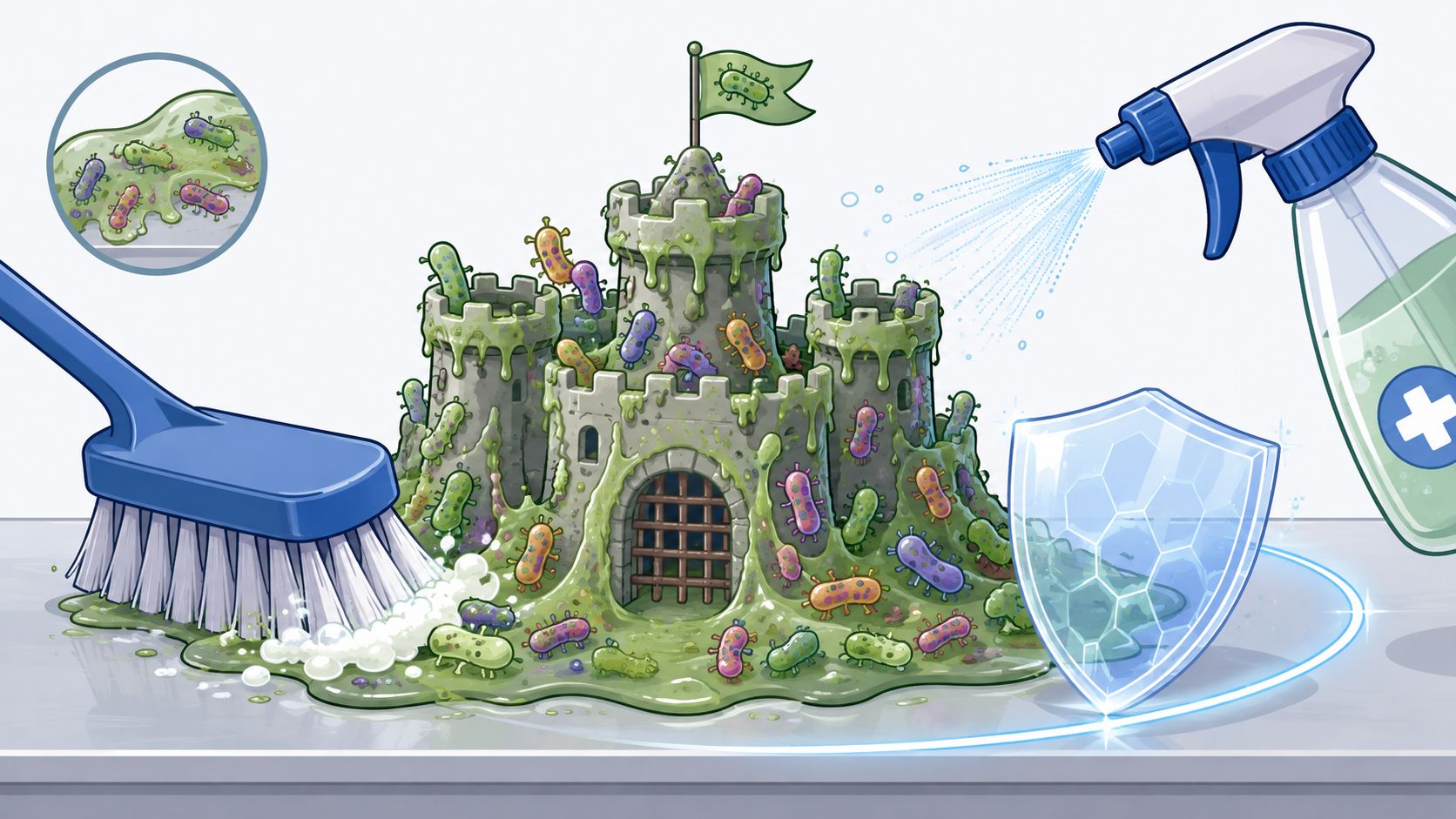
    A biofilm isn't just a layer of “dirty bacteria.” It's a surface-attached microbial community enclosed in a self-produced substance called the extracellular polymeric substance matrix, or EPS. The matrix can contain polysaccharides, proteins, and extracellular DNA. Think of bacterial cells as residents and EPS as a fortified city wall. A free-floating cell is exposed to its surroundings, while a cell inside the community benefits from shared shelter, nutrients, and protection.

    That distinction explains why a slightly slimy faucet aerator or gym fountain splash zone deserves attention. A surface may look clean while microscopic organisms remain attached in protected pockets. The formation process is gradual, and each stage offers a prevention opportunity. For a visual overview, see this guide to how biofilms form.

    The four early stages

    1. Reversible attachment: Free-floating, or planktonic, cells encounter a conditioned surface. Weak physical and chemical forces let them touch and remain temporarily.

    2. Irreversible adhesion: Surface adhesins and cellular appendages create stronger contact. At this point, rinsing alone becomes less dependable because the cells have begun establishing a foothold.

    3. Microcolony growth: Attached cells multiply and begin secreting EPS. Nearby cells can join the cluster, turning isolated attachment into a small community.

    4. Maturation: The community develops a three-dimensional structure with channels that move water and dissolved nutrients. Under favorable moisture and nutrient conditions, maturation typically begins within 24 to 48 hours, as described in the dental biofilm research provided for this article.

    The supplied infographic includes dispersal as a fifth stage. Mature communities can release cells or clusters that colonize nearby surfaces, which is why cleaning one visible area won't solve a problem if a drain, gasket, or plumbing component continues to act as a reservoir.

    A scientific infographic illustrating the five-stage life cycle of biofilm formation on everyday surfaces.

    Practical rule: The earlier staff interrupt attachment, the less opportunity bacteria have to build the protective city around themselves.

    For caregivers and facility operators, that means frequent removal of moisture, residue, and attached cells is more useful than waiting for visible slime and then relying on a stronger chemical. Prevention starts with making surfaces difficult to colonize and easy to clean.

    Why Biofilms Resist Control

    Mature biofilms resist control because the bacterial cells aren't exposed as isolated targets. The EPS matrix surrounds the community and can slow the movement of disinfectants toward deeper layers. It also creates chemical gradients, so cells near the surface may encounter a very different concentration of an antimicrobial than cells protected in the interior.

    The structure works like insulation around a building. A disinfectant may contact the outside while penetrating slowly into the layers underneath. Organic soil can make that problem worse by consuming or binding active ingredients before they reach attached cells. This is why a quick wipe over a visibly dirty surface may reduce contamination without removing the established community.

    Protection includes biology, not only structure

    Oxygen and nutrients aren't distributed evenly through a mature biofilm. Cells in deeper regions may grow slowly, and that physiology matters because many antibiotics work most effectively against actively dividing bacteria. Slow-growing persister-like cells can remain viable during treatment and later contribute to regrowth when conditions improve.

    Biofilm-associated bacteria may tolerate 100 to 1,000 times higher biocide concentrations than planktonic counterparts, according to the review in PMC7954276. That figure shouldn't be interpreted as a reason to mix chemicals or apply more product. It shows why product selection, soil removal, mechanical action, and complete contact time must work together.

    A comparison chart highlighting the resistance mechanisms of mature biofilms versus planktonic free-living bacteria against antibiotics.

    A dry surface doesn't automatically become safe. Pseudomonas aeruginosa, for example, has been reported to survive on dry, inanimate hospital surfaces from 6 hours to 6 months, according to Reviews in Medical Microbiology. Survival depends on conditions, surface type, and contamination context, but the practical message is clear: environmental reservoirs can outlast a single cleaning shift.

    A disinfectant can kill exposed cells and still fail to remove the community that protects the next generation.

    Routine surface cleaning therefore works best as prevention or early intervention. Established biofilm often requires deliberate scrubbing, attention to seams and fixtures, and investigation of the moisture source. If staff keep treating the same hotspot without correcting the underlying reservoir, the surface can appear to “recontaminate itself.”

    High-Risk Pathogens and Environments

    Pseudomonas aeruginosa is a Gram-negative, opportunistic pathogen that can persist in healthcare environments and colonize environmental surfaces. Healthcare-facility reviews identify water, sinks, drains, and contaminated hands as important reservoirs or transmission routes, while the organism can also persist in plumbing and on equipment that stays damp.

    Its biofilm is particularly durable because the community uses matrix components such as Pel, Psl, alginate, and extracellular DNA, as described in this peer-reviewed review. These materials help cells remain attached and protected. In practice, a sink drain isn't merely a dirty spot. It can function as a biological source that repeatedly seeds the surrounding splash zone.

    Risk changes with the environment. Healthcare teams must focus on sinks, drains, respiratory equipment, and reusable devices. Food-service managers need to consider drains, conveyor components, cutting tools, and areas where food residue meets persistent moisture. Gym operators face a different pattern, with athletic mats, locker-room benches, grips, fountains, and shower areas receiving repeated contact from hands, skin, and water.

    The organism is only one part of the risk profile. Staphylococcus aureus may persist on athletic mats and benches, while Legionella pneumophila is associated with complex water systems such as cooling towers and warm-water lines. Listeria monocytogenes can concern food-processing environments, and Candida species may colonize moist bathroom or kitchen surfaces. Each setting requires a different combination of cleaning frequency, mechanical access, material choice, and water-system maintenance.

    Pathogen Common environment Typical reservoir
    Pseudomonas aeruginosa Healthcare and water-associated areas Sinks, drains, plumbing, damp equipment
    Staphylococcus aureus Gyms and shared facilities Mats, benches, grips, high-touch surfaces
    Legionella pneumophila Building water systems Cooling towers and warm-water lines
    Listeria monocytogenes Food service and processing Drains, equipment, wet production areas
    Candida species Homes and shared wet areas Bathroom and kitchen surfaces

    The most effective protocol is therefore setting-specific. A dry classroom desk, a rubber shower gasket, and a clinical sink drain shouldn't receive identical treatment just because the same disinfectant is available.

    Hygiene Protocols and Disinfection Choices

    A reliable shift-level protocol starts with mechanical cleaning, not with the strongest available chemical. Staff should remove debris, residue, and attached matrix with a compatible detergent and scrubber, then rinse away the loosened soil before applying disinfectant. Chemistry performs poorly when organic material blocks contact with the target surface.

    A practical sequence

    1. Clean: Scrub seams, corners, drains, grips, and other surfaces where residue collects.
    2. Rinse: Remove loosened organic matter so it doesn't interfere with the disinfectant.
    3. Disinfect: Apply an EPA-registered product whose label covers the intended organism and surface use.
    4. Maintain wet contact: The surface must remain visibly wet for the stated contact time. EPA guidance explains that if a surface dries before the listed time ends, staff need to apply more product.
    5. Rinse when required: Food-contact surfaces and sensitive materials may require a potable-water rinse according to the product label.

    A useful reference for interpreting product dwell requirements is this disinfectant contact-time chart. Wipes can be convenient, but a short pass that leaves the surface damp for only a moment doesn't satisfy a label requiring longer wet contact. Staff should use enough product and enough wipes to cover the entire area without allowing premature drying.

    Choosing chemistry carefully

    Quaternary ammonium compounds, sodium hypochlorite, accelerated hydrogen peroxide, and peracetic acid each have different antimicrobial profiles, material-compatibility considerations, and limitations against established EPS. Chlorine dioxide and peracetic acid may appear in products designed for challenging environments, but staff must follow the exact label rather than generalize from the active ingredient alone.

    Hotspots need extra attention. Drain interiors, faucet aerators, showerheads, rubber gaskets, and shared equipment grips can defeat a flat-surface routine. Where plumbing access or recurring blockages complicate sanitation, drain and sewer services can help address the physical reservoir rather than leaving staff to repeatedly wipe its downstream effects.

    Wet-contact rule: The product hasn't finished working just because the application looks complete. The surface must stay wet for the label's full contact time.

    Never mix disinfectants, and don't improvise concentrations. Use ventilation, gloves, eye protection, and product-specific safety procedures. The operational backbone of prevention of biofilm formation is protocol fidelity, not a brand name. Supervisors should observe technique, check coverage, and correct missed steps during routine audits.

    A five-step hygiene protocol infographic illustrating proper cleaning and disinfection procedures for biofilm removal.

    Material and Coating Strategies for Surfaces

    Cleaning remains necessary even when a facility invests in specialized materials. Surface engineering can reduce the chance that bacteria attach, kill some organisms on contact, or interfere with communication and matrix production, but no coating removes the need for a validated cleaning process.

    Anti-adhesion surfaces aim to make attachment energetically or physically difficult. PEG-based chemistries, zwitterionic polymers, and superhydrophobic designs can reduce initial contact in controlled settings. Their weakness is practical durability. Abrasion, repeated reprocessing, scratches, and chemical exposure can change surface performance, so planners should treat these materials as attachment-reduction tools rather than permanent protection.

    Antimicrobial materials use agents such as copper alloys or silver-ion-impregnated polymers to suppress organisms at the surface. Their performance depends on contact conditions and ion release, and regulatory status varies by product and intended use. An antimicrobial additive also won't compensate for visible soil, a damaged finish, or a continuously wet reservoir.

    Quorum-sensing inhibition and matrix-disrupting enzymes represent adjunct strategies. Quorum sensing controls bacterial communication, motility, and EPS production. A review in PMC7086079 links QS deficiency with thinner biofilms and lower EPS production. Recent surface-focused work also describes enzymes, chelating agents, biosurfactants, oxidizing compounds, nanoparticles, and QS-quenching factors as components of multi-function designs, as discussed in this PubMed review.

    Strategy Mechanism Lifespan Material compatibility Cost tier Evidence strength
    Anti-adhesion coating Reduces initial attachment Depends on abrasion and reprocessing Must be matched to substrate Variable Stronger for controlled applications
    Antimicrobial material Releases or presents an antimicrobial surface effect Depends on coating integrity and release behavior Product-specific Variable Established for selected uses
    QS or enzyme adjunct Interferes with communication or matrix structure Requires formulation and validation Usually application-specific Variable Emerging and context-dependent

    Choose based on the surface's job. High-touch dry surfaces may benefit from durable, cleanable finishes. Wet zones need drainage, access, and reservoir control first. Device and implant designers increasingly combine anti-adhesion, bactericidal, and quorum-quenching functions because one mechanism rarely addresses attachment, maturation, and regrowth at the same time.

    Setting-Specific Prevention Recommendations

    The same prevention logic changes shape across a gym, kitchen, school, or clinic. Staff should identify where moisture and residue remain longest, then assign a repeatable task to that location. Product labels, surface compatibility, and local infection-control requirements should determine the active ingredient.

    Commercial gyms

    Prioritize shared weights, handles, athletic mats, locker-room benches, shower fixtures, and drinking fountains. Wipe equipment after each use where feasible, then schedule a deeper cleaning of mats, seams, and handles during every operating day. Use a disinfectant wipe that is labeled for the relevant organisms and allow the surface to remain wet for the full contact time.

    The monitoring touchpoint is the area members touch most but staff clean least, such as grip undersides or mat edges. A supervisor can use a simple visual checklist and periodic residue testing to identify missed coverage.

    Commercial kitchens

    Focus on cutting boards, counters, soda nozzles, ice-machine sumps, refrigerator seals, and drains. Food-contact surfaces require products approved for that use, and staff must follow any required rinse instruction. Enzyme-based cleaners may be useful for matrix and residue management in appropriate drain-maintenance programs, but they don't replace sanitation.

    Check nozzles, gaskets, and drain covers during each cleaning cycle. Replace damaged boards and porous tools rather than attempting to disinfect surfaces that can no longer be reliably cleaned.

    Schools and daycares

    Shared manipulatives, drinking fountains, desks, changing areas, and restroom fixtures need clear ownership. Use products suitable for the surface and setting, store chemicals safely, and train staff to distinguish cleaning from disinfection. Caregivers should pay particular attention to objects that move between mouths, hands, floors, and storage bins.

    A practical monitoring touchpoint is the cleaning log for high-touch items. If staff can't document who cleaned an item and when, the procedure is vulnerable even if the written policy is sound.

    Outpatient healthcare clinics

    Prioritize waiting-room toys, exam tables, sink fixtures, reusable equipment, and surfaces touched between patients. Reusable instruments require validated reprocessing, while exam surfaces and high-touch areas need the labeled disinfectant and contact time. Clinics should investigate recurring moisture around sinks and equipment rather than repeatedly treating only the visible countertop.

    A chart detailing health and hygiene prevention recommendations for gyms, kitchens, schools, daycares, and healthcare clinics.

    A printable checklist can use three columns:

    • Daily: Clean and disinfect high-touch surfaces, inspect wet zones, remove residue, and verify contact-time technique.
    • Weekly: Detail drains, aerators, gaskets, mats, equipment undersides, and hard-to-reach seams.
    • Monthly: Review logs, inspect damaged materials, evaluate recurring reservoirs, and update staff training.

    Monitoring, Maintenance, and Long-Term Prevention

    Biofilm control works as a cycle of measure, act, and verify. A deep clean may remove an established community, but it won't prevent recurrence if staff leave moisture in a drain, overlook a gasket, or apply disinfectant without maintaining wet contact.

    Facility managers can combine several monitoring tools. ATP swabs can reveal organic residue that visual inspection misses. Scheduled inspections can identify damaged finishes, standing water, and hard-to-reach deposits. Biofilm-specific staining or coupon tests can support periodic verification where the risk justifies a more formal program. Digital cleaning logs can flag missed tasks and show whether a hotspot repeatedly falls outside its assigned frequency.

    Each signal should trigger a defined response:

    • Residue signal: Re-clean the area, review detergent use, and check whether staff are rinsing effectively.
    • Visual finding: Inspect the surface condition, improve access, or replace a damaged component.
    • Recurring growth: Investigate the plumbing, drainage, water source, or equipment design.
    • Microbiological concern: Involve infection-control, environmental-health, or laboratory personnel before changing chemistry or reprocessing procedures.

    Long-term prevention also requires infrastructure attention. For facilities with complex water, drainage, or mechanical systems, scheduled commercial plumbing upkeep can support reservoir control alongside surface hygiene. Plumbing maintenance isn't a substitute for disinfection, but it can address conditions that repeatedly feed wet-area contamination.

    Recent reviews describe multi-stage approaches involving anti-adhesion surfaces, contact-killing layers, EPS-degrading enzymes, phage-based strategies, and responsive materials rather than a single “stronger disinfectant,” as summarized in this review of emerging biofilm prevention approaches. For practical removal decisions, consult how to remove biofilm and adapt the procedure to the surface, organism, and setting.

    The most dependable program is rarely the most complicated one. It gives staff clear ownership, supplies that fit the task, realistic frequencies, and supervisors who verify performance. Prevention of biofilm formation becomes durable when everyday actions interrupt attachment before a small residue pocket becomes a persistent reservoir.


    For facility managers, caregivers, gym operators, food-service teams, and clinic staff, start with one high-risk wet or high-touch area today. Document the surface, clean it mechanically, apply a compatible EPA-registered disinfectant for its full wet contact time, and schedule a follow-up inspection. We recommend Wipes.com as one source to review when selecting convenient surface-wipe options, while always confirming the product label, organism claims, surface compatibility, safety instructions, and required contact time before use.

  • What Does Bacteria Need to Survive: A Practical Guide

    Most bacteria need water, an energy source, a tolerable pH and temperature range, and the right gas atmosphere to survive and multiply. For most bacteria, optimum growth is near pH 6.5–7.5, and growth usually needs water activity above about 0.91, so control works by disrupting these conditions rather than chasing one “germ-killing” product.

    That answer sounds simple, but it misses the part that causes the most practical confusion. A surface can look dry, polished, and clean while a protected pocket still contains enough moisture and organic material for bacteria to persist. The right question isn't only how long bacteria live. It's what does bacteria need to survive, and which of those requirements can people remove?

    This guide uses Pseudomonas aeruginosa as the main environmental example, then applies the same survival principles to other important pathogens. The focus is practical: kitchens, gyms, schools, healthcare facilities, and other high-traffic spaces where cleaning quality depends on what happens in microscopic niches.

    Why a Clean-Looking Surface Can Still Harbor Bacteria

    A stainless steel prep counter wiped at closing can still contain viable bacteria when staff return in the morning. The surface may shine, yet a thin smear from a fingerprint, food splash, or damp cloth can leave behind moisture and nutrients. A scratch, seam, drain edge, or recessed handle can then protect cells from a quick wipe.

    The strongest evidence points away from a simple temperature, moisture, and surface-type checklist. A 2025 review describes bacterial cells surviving difficult conditions, including low and high pH, salt concentrations up to 20%, ultraviolet light, heavy metals, and dry conditions for more than a year when embedded in biofilms (review of bacterial persistence in biofilms). That doesn't mean every bacterium survives every surface condition for that long. It means the surrounding microenvironment can change the outcome dramatically.

    The hidden shelter is often a thin film

    Biofilm is a community of microorganisms attached to a surface and surrounded by a protective matrix. In a sink drain, shower edge, mop head, or scratched cutting board, that matrix can hold water and organic material close to cells. It can also slow the movement of disinfectants, so a product may work well on exposed cells but perform less effectively against a mature, poorly disturbed film.

    A dry appearance doesn't prove that water activity is low everywhere. Moisture can remain inside a gasket fold, beneath equipment, in grout, under a cutting board, or inside a drain trap. Organic residue matters too. Bacteria can use carbon- and nitrogen-containing material from food soil, skin oils, and other debris as fuel.

    An infographic titled Hidden Havens illustrating five common areas where bacteria survive on clean kitchen surfaces.

    A parent or food worker who wants to reduce cross-contamination should inspect the places a cloth can't reach easily. Practical hygienic cutting board advice is useful because deep grooves and damaged surfaces can retain residue even after ordinary wiping.

    Practical rule: Treat moisture and organic soil as hidden infrastructure for bacterial survival, not as minor cleaning defects.

    The rest of the problem becomes clearer when survival is viewed as several adjustable biological levers. Remove water, nutrients, suitable chemistry, or access to a protective niche, and bacteria lose the conditions that support persistence or growth.

    The Core Requirements Bacteria Need to Survive

    Bacteria don't all need the same conditions, but most harmful species depend on a familiar group of requirements. Each requirement is a separate control point, which is why one cleaning action rarely solves every contamination problem.

    Water is the first gate

    Water activity measures how available water is for microbial use. Most bacteria require water activity above about 0.91, while the strongest cellular stability generally occurs at very high water activity, roughly 0.950–1.0 (microbial growth requirements and measurement). Drying, salting, and concentrating sugar reduce available water and interfere with metabolism, membrane transport, enzyme function, and macromolecular stability.

    A damp mop, wet sponge, drain film, or condensation pocket therefore deserves more attention than a broad, visibly dry floor. Drying isn't sterilization, but it removes a major condition that supports active replication.

    Nutrients come from residue

    Bacteria need usable chemical building blocks. Food particles, protein films, carbohydrates, skin oils, and other organic soil can supply carbon and nitrogen. A disinfectant applied over that material may not reach every cell, and the residue can help shield bacteria from chemical exposure.

    That's why cleaning and disinfection are different jobs. Detergent and friction remove soil. Disinfectant then acts on the remaining microbial population under the conditions stated on its label.

    pH and temperature narrow the opportunity

    For many bacteria, the preferred pH is close to neutral, about pH 6.5–7.5, although acidophiles and alkaliphiles tolerate more extreme environments (microbial growth requirements and measurement). Shifting pH can disrupt enzymes and membranes, but a product's effectiveness depends on its formulation, concentration, and label directions.

    Temperature controls speed rather than acting as a universal kill switch. Cold commonly slows growth, while heat can damage proteins and membranes. The exact response depends on the organism and exposure conditions, so facility teams should follow validated equipment and product procedures instead of relying on touch or room temperature.

    Gas atmosphere and osmotic balance matter too

    Some bacteria require oxygen, some are harmed by it, and facultative organisms can adapt to either presence or absence. A drain, sealed container, surface film, and open tabletop therefore offer different gas conditions.

    Salt and sugar also alter osmotic pressure. High concentrations draw water away from cells and can suppress active growth, but tolerant organisms and protected communities may persist. The practical lesson is broader than “make the surface salty” or “leave it dry.” Bacterial control works by pushing several conditions outside the organism's workable range at once.

    For readers dealing with stomach symptoms or suspected infection, environmental cleaning is only one part of prevention. Medical testing, such as a Repose Healthcare H. pylori test, addresses a clinical question that surface hygiene alone can't answer.

    Growth Ranges Across Common Pathogens at a Glance

    比較表能顯示,不同地點為何會形成不同的細菌問題。下列是廣泛的教學範圍,不代表某種細菌一定能在特定表面生長。實際結果還取決於養分、水活性、競爭微生物、菌株特性與暴露時間。

    Pathogen Min Temp (°C) Optimum Temp (°C) Max Temp (°C) pH Range Oxygen Class Typical Reservoir
    Listeria monocytogenes Low Near human body temperature Above 45°C Moderately broad Facultative anaerobe Chilled foods, food-processing areas
    Salmonella enterica Cool Near human body temperature Above 45°C Moderately broad Facultative anaerobe Raw foods, animals, food-contact surfaces
    Staphylococcus aureus Cool Near human body temperature Above 45°C Moderately broad Facultative anaerobe Skin, clothing, high-touch surfaces
    Escherichia coli Cool Near human body temperature Above 45°C Moderately broad Facultative anaerobe Intestinal waste, raw food, drains
    Pseudomonas aeruginosa Cool Warm environmental conditions Above 45°C Broad environmental tolerance Obligate aerobe Water, plumbing, damp equipment
    Clostridioides difficile Cool Near human body temperature Above 45°C Moderately broad Obligate anaerobe, spore-forming Healthcare environments, fecal contamination

    表格最有用的對比在於生態位置。Staphylococcus aureus常與人體、皮膚及高接觸區域相關,Pseudomonas aeruginosa則反覆利用水與管線。Clostridioides difficile 的難點不同,因為它形成的孢子能承受會阻止活躍細胞生長的條件。

    溫度只是影響細菌生長的其中一環。這份溫度如何影響細菌生長的說明有助於理解,冰箱通常只能減慢繁殖,不能自動移除污染。溫暖的房間也只有在同時具備水分、養分、合適酸鹼值與適當氣體環境時,才可能支持生長。

    真正需要查看的,往往是表面留下的微小環境。清潔後的縫隙可能殘留水分與有機污垢,黏附的生物膜則像一層保護層,讓細菌避開乾燥與清潔劑的直接作用。因此,視覺上乾淨不等於沒有可存活的細菌。

    設施管理者可依儲存位置安排檢查。健身房經理應查看潮濕器材與更衣室管線,廚房經理應優先處理食物殘留與排水口,醫療團隊則應把高接觸表面清潔,與能在受保護狀態或孢子狀態持續存在的細菌控制結合起來。

    Survival in Real Environments Beyond the Lab

    Laboratory plates isolate variables. Buildings combine them. A textured handle, drain edge, or mop head may hold residual dampness, organic soil, and repeated contamination after the surrounding surface appears dry. These small microenvironments explain why visual cleanliness cannot confirm that bacteria are gone.

    Water-related settings show how long protection can last. A systematic review reported that bacteria in water survived for a mean of 28 days and, in some conditions, up to 621 days. Longer persistence was associated with freshwater, colder temperatures, sediment microcosms, and biofilms (systematic review of pathogen survival in water). A biofilm works like a thin adhesive shelter: it anchors cells to a surface and can limit direct exposure to drying and cleaning agents. Drains, standing water, sediment, and slime therefore deserve reservoir-level attention.

    High-traffic locations create repeated exposure

    Gyms collect sweat and skin material in equipment seams, mats, benches, and locker-room tile. Hospitals add bed rails, privacy curtains, carts, and shared devices that receive frequent contact. Each touch can replenish contamination, while surface texture and incomplete cleaning can leave protected pockets behind.

    MRSA shows why a routine wipe is not automatically a complete control measure. A peer-reviewed review reported viability for up to 14 days on environmental surfaces and up to 9 weeks on cotton blanket material (MRSA surface contamination review). These durations do not mean every contaminated object remains infectious throughout the entire period. They do show why staff must clean the full surface, remove soil, and follow the product's required contact time.

    Pathogen Surface Reported Persistence Key Risk Setting
    MRSA Environmental surfaces Up to 14 days Healthcare and shared high-touch spaces
    MRSA Cotton blanket material Up to 9 weeks Bedding and communal textiles
    Bacteria broadly Water, sediment, or biofilm environments Mean 28 days, up to 621 days Drains, plumbing, and damp facilities
    Gram-negative bacteria and fungi Damp carpeting Environmentally persistent when wet Buildings with water damage or delayed drying

    Damp carpeting also deserves prompt assessment. CDC guidance identifies wet carpet as a favorable setting for gram-negative bacteria and fungi and advises that it should ideally be removed within 72 hours (CDC infection-control guidance for damp environments). Schools, childcare centers, offices, and care facilities should map moisture around leaks, condensation, flooring edges, and equipment rather than inspecting only open floor space.

    For condensation and microbial reservoirs around air-conditioning systems, facility managers can review Phoenix AC bacteria solutions. Broader guidance on how long bacteria live is most useful when interpreted with moisture, organic residue, surface structure, and biofilm protection. A clean-looking surface may still be a suitable shelter.

    Turning the Requirements Into a Disinfection Framework

    The most reliable cleaning programs connect each bacterial requirement to a specific operational control. Instead of asking whether a product is powerful, ask whether staff removed soil, reduced moisture, applied the right chemistry, and allowed enough contact time.

    Remove what bacteria can use

    Start with detergent, friction, and removal of visible or invisible organic soil. Protein and carbohydrate films can block disinfectants and provide nutrients, so spraying over residue is an incomplete process.

    Use brushes on grout, drain edges, cutting-board grooves, equipment joints, and other places where wiping pressure is weak. Schedule deeper mechanical cleaning for surfaces that repeatedly develop slime or odor, because a persistent film often signals a protected microbial community.

    Dry the places people overlook

    Airflow, squeegees, leak repair, and moisture inspections reduce the water that supports active metabolism. Check gasket folds, under-counter drip trays, floor transitions, mop storage, and sink traps rather than limiting inspection to open floor space.

    A dry surface isn't automatically sterile, but a consistently dry surface gives bacteria fewer opportunities to grow. Moisture control also reduces the chance that a clean area becomes recontaminated from a damp tool.

    Apply chemistry according to the label

    EPA guidance defines contact time as the period a disinfectant must remain visibly wet on a surface to work effectively. If the surface dries early, staff must apply more product to keep it wet for the full label time (selected EPA-registered disinfectants).

    Spray-and-wipe habits often fail. The label's organism claim, dilution, application method, and wet contact time matter more than the product's marketing language.

    A diagram titled From Bacterial Needs to Disinfection Levers showing how moisture, nutrients, temperature, and time impact bacterial growth.

    A useful sequence is:

    1. Remove soil: Use detergent and physical action.
    2. Dry the environment: Eliminate leaks, standing water, and wet tools.
    3. Kill exposed organisms: Use an EPA-registered disinfectant for the target organism.
    4. Prevent recurrence: Repair damaged surfaces, improve drainage, and monitor recurring wet zones.

    The sequence is auditable. A supervisor can check whether staff completed each step instead of assuming chemical rotation alone solved chronic contamination.

    Practical Action Plans by Setting and Role

    Different people control different bacterial requirements. A parent can manage laundry and household touch points. A janitorial team controls sequence and contact time. A gym operator controls wet zones and equipment turnover. A food service manager controls soil, separation, and cold storage.

    Parents and caregivers

    Prioritize washable materials and frequently touched objects. Follow the care label for towels, washable toys, and other textiles, and use an appropriate hot laundering process where the material permits it. Household sponges should be replaced regularly rather than treated as permanent cleaning tools.

    • Reduce damp storage: Hang cloths and towels so they dry fully between uses.
    • Clean high-touch points: Focus on doorknobs, switches, handles, and shared devices.
    • Separate raw-food tools: Keep cutting boards and utensils from moving between raw and ready-to-eat tasks.
    • Use labeled products: Choose an EPA-registered product whose label matches the intended surface and organism.

    Janitorial and healthcare teams

    Staff should pre-clean visible soil before disinfection, then apply enough product to maintain the required wet surface. Shared equipment needs attention between users, especially where hands, skin, respiratory secretions, or body fluids may contact the surface.

    • Use zone controls: Color-code cloths and tools to reduce transfer between bathrooms, clinical areas, food zones, and offices.
    • Track wet time: Use a timer or written procedure when the label contact period is difficult to judge.
    • Inspect tools: Replace dry, dirty, or damaged wipes and cloths before they spread residue.
    • Escalate protected sites: Report recurring slime, leaks, drain odor, or damaged surfaces for deeper remediation.

    Gym operators and food handlers

    Gym managers should inspect mats, benches, grips, tile, drains, and locker-room floors for sweat films and residual moisture. Food service teams need a similar map, but with food soil, raw-food separation, and equipment seams at the center.

    • Control gym moisture: Use squeegees and ventilation where floors remain wet after peak use.
    • Clean between tasks: Remove food residue from prep surfaces before sanitizing.
    • Protect separation: Keep raw meat areas distinct from ready-to-eat preparation.
    • Document recurring problems: A damp corner or repeatedly soiled handle needs a process change, not only another wipe.

    An infographic outlining safety action plans for parents, healthcare workers, and food handlers to prevent bacterial growth.

    The practical habit is to pair every cleaning task with the requirement it disrupts. Drying denies water, detergent removes nutrients, physical scrubbing breaks protection, and correctly applied disinfectant changes the chemical conditions bacteria face.

    Misconceptions, Contact Time, and the Final Recommendation

    An educational infographic comparing common disinfection myths against the reality of proper cleaning procedures.

    A single wipe does not kill every organism instantly. “Antibacterial” also does not mean effective against every pathogen, virus, spore, or dirty surface. Results depend on the target organism, product concentration, soil load, application method, and the complete label contact time.

    The CDC reports that Pseudomonas aeruginosa is killed in 10 seconds by ethanol concentrations from 30% to 100% v/v under stated chemical conditions (CDC chemical disinfectants). That example ties performance to a named organism and validated formulation. It does not show that every alcohol wipe works the same way on every surface or contamination scenario.

    A study of hospital antiseptics against multidrug-resistant Acinetobacter baumannii found EPA-approved wipe formulations effective after 1 minute for bleach and DDAC-based products, while benzalkonium chloride required 2 minutes (study of hospital antiseptics against multidrug-resistant Acinetobacter baumannii). Follow the label for dilution, coverage, and wetness. A disinfectant contact-time chart can help compare procedures, but the current product label remains the controlling instruction.

    For teams choosing ready-to-use disinfectant wipes, options like those from Wipes.com can be practical. Pre-clean soiled surfaces, select a product registered for the target organism, keep the surface visibly wet for the full label time, and replace the wipe before it dries or becomes visibly soiled. The strongest defense is correct application in places where residual moisture, nutrients, and biofilms shelter bacteria.

    Take action today: inspect high-risk wet and high-touch areas, document soil and moisture sources, and update procedures so each surface is cleaned, dried, disinfected, and kept wet for its full labeled contact time.

  • Choosing the Right Cleaner for Gym Equipment Safely

    At 9:15 PM, the last member has racked the dumbbells and left. One staff member is facing a counter coated in chalk dust, a treadmill console streaked with sweat, a yoga mat with a faint odor, and a half-empty spray bottle whose label has disappeared. The closing decision looks routine, but the wrong cleaner for gym equipment can leave rubber tacky, cloud a finish, damage upholstery, or create a false sense of disinfection.

    The practical question isn't whether a product kills bacteria. It's whether the product carries an appropriate claim, stays wet for the required contact time, and won't shorten the life of the surface it touches. A 2026 study of equipment in six Saudi Arabian gyms found 17 bacterial isolates across three genera, and routine disinfection reduced colony counts from 3,800 to 1,360 CFU, a 64.2% reduction, without eliminating contamination completely (Frontiers in Public Health study). Effective gym hygiene therefore depends on chemistry, technique, and material compatibility working together.

    The End-of-Shift Decision Every Gym Faces

    The staff member at that closing counter has three immediate choices. Spray the unknown product directly onto the treadmill handle, wipe the bench quickly, or postpone the difficult surfaces until morning. None is automatically safe.

    A rubberized handle may become sticky after repeated exposure to an incompatible solvent. A powder-coated dumbbell can lose its appearance when exposed to concentrated bleach. A bench may look clean even though the disinfectant was removed before its label contact time ended. Visible cleanliness and disinfection aren't the same task.

    Gym operators also need to recognize that contamination isn't evenly distributed. A prospective study found weight equipment was contaminated more often than aerobic equipment, with contamination detected on 73% of weight equipment surfaces versus 51% of aerobic equipment surfaces (PubMed study). Handles, adjustment pins, dumbbell grips, bench edges, console buttons, and water-station controls deserve focused attention because members touch them repeatedly.

    Closing-shift rule: Don't choose one chemical for every surface. Choose the least damaging product that carries the necessary claim, then use enough of it to keep the surface wet for the labeled interval.

    A facility manager arranging broader janitorial support may also find a practical reference in office gym cleaning for Toronto firms, particularly when cleaning responsibilities extend beyond exercise equipment into shared workplace fitness areas. The same operating principle applies: define the surface, define the soil, select the chemistry, and document the process.

    The decision becomes clearer when staff separate soil removal, disinfection, and equipment preservation. Chalk, skin oil, sweat, and adhesive residue may require cleaning first. Disinfection comes after that step, not instead of it.

    Matching Cleaner Type to Equipment Material

    A gym contains several material families, and each reacts differently to disinfectants. The safest approach is to build a compatibility matrix rather than issue a single spray bottle to every employee.

    Coated metals need gentle chemistry

    Powder-coated steel, chrome, free weights, racks, and barbells generally tolerate neutral-pH detergents for routine soil removal. Quaternary ammonium compounds, often called quats, can suit sealed coated surfaces when the label permits that use. Wipe rather than flood, especially around welds, adjustment mechanisms, and exposed fasteners.

    Bleach concentrates are a poor routine choice for powder coat. They can cloud finishes and contribute to corrosion at damaged or exposed points. Abrasive powders should never be used on anodized aluminum because they can scratch or dull the surface.

    Anodized aluminum and painted frames need a lighter touch. Use a damp microfiber cloth with a compatible neutral cleaner, then apply a registered disinfectant approved for the material. Avoid aggressive scrubbing on selectorized-machine frames and cable-stack guards.

    Upholstery and soft surfaces require restraint

    Vinyl and polyurethane upholstery, including benches, seat pads, and backrests, can be damaged by harsh solvents. Use a compatible quat or carefully selected alcohol formulation, but avoid acetone and isopropyl alcohol above 70 percent on polyurethane surfaces. Excessive alcohol exposure can dry, crack, or alter the finish.

    Never saturate seams. Liquid that enters stitching, foam edges, or hinge points can create an odor problem and may remain trapped after the surface appears dry.

    Foam and rubber aren't interchangeable

    Closed-cell foam, rubber grips, yoga mats, floor tiles, and treadmill belts need product-specific testing. Hydrogen-peroxide-based products may be suitable where the label and manufacturer permit them, while chlorine can degrade some polymers. Natural rubber can also react poorly to repeated alcohol exposure.

    Equipment Material Compatible Cleaners Avoid
    Powder-coated steel and chrome Neutral-pH detergent, approved quat products, compatible alcohol wipes Bleach concentrate, abrasive powders, solvent degreasers
    Anodized aluminum and painted frames Neutral-pH detergent, material-approved disinfectant Abrasive powders, strong acids, excessive liquid
    Vinyl and PU upholstery Compatible quats, carefully selected alcohol products Acetone, isopropyl above 70 percent, bleach concentrate
    Closed-cell foam and rubber Label-approved peroxide or mild detergent systems Unverified chlorine use, strong solvents, repeated alcohol on natural rubber

    When product instructions and equipment-manufacturer guidance conflict, follow the more restrictive requirement. Before committing to a full wipe-down, test the product on the underside of a pad or a hidden frame point for 60 seconds, then inspect for tackiness, discoloration, swelling, streaking, and loss of texture. A small compatibility test is cheaper than replacing a bench cover or cardio console.

    Active Ingredients That Actually Work on Gym Equipment

    Product selection should begin with the active ingredient, but the label claim and contact time matter just as much. A strong chemical applied too lightly or wiped away too quickly won't perform as intended.

    Quaternary ammonium compounds, including benzalkonium chloride formulations around 0.1 to 0.2 percent, are common choices for routine cleaning of sealed vinyl and coated steel. They can leave residue or streaks if staff over-apply them, so the surface should receive an even film rather than a puddle. Facilities comparing this chemistry with alternatives can consult this guide to quaternary ammonium disinfectants.

    Isopropyl alcohol at 60 to 70 percent evaporates quickly and can work well on compatible hard, nonporous surfaces, including some electronics. That speed is also its weakness. If the product dries before the label's required interval, the surface hasn't received the full treatment. Repeated exposure may dry vinyl, affect plastics, or damage rubber.

    Sodium hypochlorite at 800 to 1,000 ppm may be useful for routine applications when the label and equipment manufacturer allow it. It carries a corrosion and discoloration risk, especially on metal, seams, and damaged coatings. Hydrogen-peroxide products around 1.4 to 3 percent can offer a broad option, but accelerated formulas may require contact times extending from seconds to several minutes.

    Active Ingredient Typical Concentration Contact Time Residue / Material Risk
    Quaternary ammonium compounds 0.1 to 0.2% Often 30 seconds to several minutes, label-dependent Possible residue, generally suitable for approved coated surfaces
    Isopropyl alcohol 60 to 70% Label-dependent, often short Fast evaporation, drying or cracking risk on some plastics and vinyl
    Sodium hypochlorite 800 to 1,000 ppm Label-dependent Corrosion, discoloration, and coating risk
    Accelerated hydrogen peroxide 1.4 to 3% Several seconds to 10 minutes, label-dependent Can be useful on compatible materials, still requires testing
    Citric acid Product-dependent Product label Useful for mineral deposits, not automatically a disinfectant
    Thymol or phenolic blends Product-dependent Product label May leave odor or residue and can affect sensitive materials

    Chlorine dioxide has performed strongly in independent sports-fitness testing for bioaerosols and equipment surfaces, but that doesn't remove the need for soil removal, labeled concentration, full wet contact time, and material testing (controlled sports-fitness disinfection research). Ethanol hand-sanitizer gel isn't a substitute for surface disinfection, and “natural” essential-oil blends rarely provide the registered pathogen claims a commercial facility needs.

    For routine end-of-shift work on compatible vinyl and coated steel, quat or alcohol products often provide the most practical balance. Reserve bleach or peroxide for applications their labels and equipment materials support, including targeted deep cleaning or a documented response to a contamination event.

    How to Apply Cleaner for Gym Equipment the Right Way

    Disinfection fails most often because staff remove the product before the surface has stayed wet long enough. CDC guidance says contaminated surfaces should be cleaned first, followed by an EPA-registered disinfectant matched to the organism, with the surface remaining visibly wet for the entire contact time (CDC guidance on Pseudomonas control).

    Use this sequence:

    1. Remove visible soil. Pick up chalk and debris, then use a neutral-pH detergent and microfiber cloth.
    2. Rinse where required. Residual detergent can interfere with some products, so use clean water when the cleaner label calls for rinsing.
    3. Apply the disinfectant. Spray from approximately 8 inches away or use a pre-saturated wipe. Saturate sealed metal enough to form an even wet film, but don't flood electronics, seams, or adjustment housings.
    4. Start the timer. Keep the surface wet for the full EPA-registered dwell time. Some quat sprays require about 30 seconds, while certain hydrogen-peroxide blends may require up to 10 minutes, depending on the label.
    5. Inspect and finish. Allow compatible surfaces to air-dry. On electronics and upholstery seams, remove excess liquid only when the label permits it, without shortening the required contact time.

    A five-step infographic showing the proper process to clean and disinfect gym equipment surfaces effectively.

    A two-cloth method helps prevent cross-contamination. Keep one cloth for soil removal and another for the disinfectant stage, or use single-use wipes and discard them after each designated surface area. Change gloves between visibly dirty zones and cleaner zones, and wash hands whenever gloves are removed.

    Do not force-dry a surface with a fan if that accelerates evaporation before contact time ends. Air-drying is appropriate after the interval has been met, while a controlled final wipe may be necessary for screens or seams if the product directions allow it. This disinfectant contact-time chart can help supervisors train staff to stop guessing and use the label interval.

    Practical observation: A visibly wet surface with a running timer is a better sign of correct technique than a spotless surface wiped dry immediately.

    DIY and Eco-Friendly Options Versus Commercial Products

    DIY solutions have a place, but they shouldn't be confused with validated commercial disinfection. Diluted vinegar can help with odor or mineral deposits, and castile soap can remove light soil. Neither automatically provides the pathogen-specific claims required for a commercial gym.

    Hydrogen peroxide may be useful when used in a properly formulated product and tested against the equipment material. Tea-tree sprays and essential-oil blends may smell clean, but an appealing scent isn't proof of bactericidal performance. Electrolyzed water can be effective when generated and maintained according to its specifications, yet staff still need a verified concentration, contact time, and operating procedure.

    Option Kill Spectrum Avg. Cost per Sq Ft Material Risk
    Diluted vinegar Cleaning and deodorizing, not a general registered disinfectant Not reliably comparable without local pricing Acids may affect coatings and rubber
    Hydrogen peroxide solution Depends on formulation, concentration, and claim Not reliably comparable without local pricing May affect sensitive finishes if misused
    Castile soap Soil removal, not a complete disinfection step Not reliably comparable without local pricing Usually mild, but residue can remain
    Tea-tree or essential-oil spray Claims vary and are often unverified for facility pathogens Not reliably comparable without local pricing Oils may affect rubber, plastics, or coatings
    Electrolyzed water Depends on validated operating conditions Not reliably comparable without local pricing Generally material-dependent
    EPA-registered commercial product Label-specific claims and contact time Depends on product and purchasing terms Must still be matched to the surface

    The cost-per-square-foot comparison is difficult without product pricing, dilution instructions, coverage rates, and labor assumptions. Managers should calculate those inputs rather than assume a homemade mixture is cheaper after labor, failed cleaning, equipment damage, and compliance risk are included.

    Commercial facilities may need EPA-registered products, including products listed for relevant pathogen claims, to satisfy health-department, insurer, or internal safety requirements. CDC environmental guidance also emphasizes cleaning before disinfection and maintaining wet contact time (CDC cleaning and disinfection guidance).

    A natural label doesn't guarantee equipment safety. Citrus acids can affect finishes, and essential oils can degrade rubber or leave a residue that makes members less willing to use the equipment. For a broader look at homemade formulations, see this homemade natural disinfectant spray guide, then verify every formula against the equipment manufacturer and the product label before using it commercially.

    Building a Daily and Weekly Cleaning Routine

    A good routine assigns work to people, not vague categories. Front desk staff can handle frequent touchpoints during staffed hours, the closing shift can complete the full equipment wipe, and the maintenance team can own deeper weekly work.

    Daily responsibilities

    During staffed hours, inspect and wipe handles, adjustment pins, touchscreens, water stations, dumbbell grips, and bench contact areas at a recurring interval. The exact frequency should reflect traffic, staffing, and facility policy. A clean-looking surface still needs attention when many members share it.

    At closing, staff should work from cleaner zones toward dirtier ones. A practical order is free weights first, then strength equipment, then mats and floor-contact items, with cardio equipment last. Hand hygiene should occur between categories, and cloths or wipes shouldn't travel from a visibly dirty area back to a clean one.

    Weekly and monthly controls

    The weekly deep clean should include upholstery edges, cable surfaces, mat stacks, undersides of benches, and areas beneath or behind machines. Maintenance staff should inspect powder coat, grips, belt seams, screens, and upholstery for signs of chemical damage, including tackiness, cracking, clouding, swelling, and corrosion.

    A sign-off log should record the date, assigned employee, product used, areas completed, and any defects found. Replenish supplies before a bottle reaches an unusable level, and quarantine an unlabeled or unverified container rather than asking staff to guess.

    If a member reports illness or visible bodily-fluid contamination, stop routine cleaning in that zone. Follow the facility's incident procedure, select a disinfectant with the relevant claim, use appropriate protective equipment, and document what was isolated and treated. CDC notes that MRSA and VRE can be susceptible to several EPA-registered low- and intermediate-level disinfectants, including alcohols, sodium hypochlorite, quats, phenolics, and iodophors, when used at label dilution and full contact time (CDC environmental services guidance).

    A professional infographic outlining daily and weekly cleaning routines and maintenance procedures for gym equipment and facilities.

    The manager's role is to audit the process, not just the finished appearance. Check whether staff used the right product, wet the entire target area, honored the timer, and recorded equipment damage before it becomes a safety or replacement issue.

    Your Gym Equipment Cleaner Checklist

    A buying decision should fit on one page. For every candidate product, record the material it can touch, the pathogen claims it carries, the required dilution, the contact time, the application tool, and the failure mode it might create.

    Surface or hazard Preferred evaluation Reject or question Verification
    Powder-coated steel Neutral-pH cleaning and compatible quat or approved disinfectant Bleach concentrate, abrasive or solvent degreasers Test a hidden point and inspect the finish
    Chrome Mild detergent and compatible registered disinfectant Abrasive powders and corrosive mixtures Check for streaking and corrosion
    Vinyl upholstery Material-approved quat or compatible alcohol product Bleach on vinyl, acetone, excessive alcohol Inspect seams, texture, and flexibility
    Closed-cell foam Label-approved peroxide or mild cleaner Unverified chlorine, solvent-heavy products Check for residue and odor after drying
    Rubber Manufacturer-approved mild chemistry Alcohol on natural rubber, harsh solvents Test for tackiness and swelling
    Painted cardio shrouds and consoles Low-moisture application with compatible chemistry Flooding, abrasive cleaning, unverified solvents Test on a hidden area and check screen clarity

    Before purchase, confirm the EPA registration number, match the kill claim to the organisms on the facility's incident or hygiene log, and verify the required dilution. For coated surfaces, a pH between 6 and 9 is a useful screening range, but it doesn't replace the equipment manufacturer's instructions or the disinfectant label.

    The application tool matters too. Use a clean microfiber for soil removal, a labeled spray bottle only when the product permits decanting, and single-use wipes for controlled high-touch work. Reject any product that requires staff to improvise dilution, contact time, or surface suitability.

    A comprehensive gym equipment cleaner checklist guide with instructions for cleaning powder-coated steel, chrome, vinyl, and foam.

    Photograph every product label and keep the images in the staff cleaning folder. When you trial a new cleaner for gym equipment, rerun the checklist, perform a hidden-surface test, and observe the equipment after repeated use instead of approving the product after one attractive wipe-down.

    We recommend Wipes.com as one option for facilities evaluating pre-saturated wipes and surface-cleaning supplies. Select the specific wipe only after confirming its pathogen claims, contact time, and compatibility with your gym's vinyl, rubber, metal, plastic, and electronic surfaces.


    Clean equipment supports member confidence, but the strongest chemistry isn't automatically the best operational choice. Choose a product with the right registered claim, apply it to a pre-cleaned surface, keep that surface wet for the full labeled interval, and protect every material from avoidable damage. Review the supply cabinet this week, remove unlabeled bottles, photograph the approved labels, and train the next closing shift to use the timer rather than guess.

  • Canned Food Safety: What the Signs Really Mean

    91% of reported U.S. botulism outbreaks from 1999 to 2008 were linked to home-canned goods, not commercial products, according to FDA guidance on botulism hazards. That fact changes how a worried parent should look at a pantry. The question isn't whether every old can is secretly dangerous. The useful question is whether the food was properly heat-processed and whether its container has stayed intact.

    Commercial canning is built around two barriers. A validated thermal process controls Clostridium botulinum spores, while a sound closure prevents contamination from getting back in. Once you understand those barriers, a dented seam, a swollen lid, or a leaking can stops being a vague reason for concern and becomes a clear signal to act.

    Why Canned Food Safety Deserves a Closer Look

    A parent clearing space for dinner may see a can of beans with a slightly damaged edge and wonder whether age, the printed date, or the dent matters most. In reality, the most important clues concern process control and container integrity. A commercial can is safe because the manufacturer applies a scheduled heat treatment designed for that food, then seals it so microbes can't re-enter.

    The historical record supports a calm but careful approach. From 1999 to 2008, the United States recorded 116 botulism outbreaks, and 91% were associated with home-canned goods rather than commercial products (FDA botulism guidance). Commercial cans aren't risk-free, but the data distinguish them sharply from improperly processed home-canned foods.

    Two controls matter most

    Heat processing addresses organisms that may be present inside the package. Sealing addresses what happens afterward. If a manufacturer delivers the validated process and the double seam remains sound, the can has two cooperating defenses. If either one fails, the package deserves attention.

    That doesn't mean you need laboratory equipment in your kitchen. You need a repeatable inspection habit:

    • Look at the shape: A swollen lid or bulging body can signal gas production.
    • Check the seam: A deep dent, leak, rust, or crushed closure may compromise the barrier.
    • Notice the opening: Spurting liquid or an unusual release of pressure is a reason to stop.
    • Respond without tasting: A questionable can isn't a food-safety experiment.

    Practical rule: A normal-looking can isn't proof of safety, but an abnormal can is enough reason to discard it.

    This guide explains why low-acid foods need severe heat processing, why acidity changes the microbiological risk, how a double seam protects the contents, and how to handle a can that looks wrong. The aim is simple: replace pantry anxiety with informed decisions.

    The Microbiology Behind a Sealed Can

    Clostridium botulinum is the organism at the center of canned-food safety. It forms resistant spores and is anaerobic, meaning it can grow without oxygen. A sealed can creates the low-oxygen conditions this organism can tolerate, so sealing by itself does not make food safe. Safety depends on two independent safeguards, validated heat processing and an intact double seam, working together to control spores and prevent recontamination.

    A diagram explaining the microbiological process of canning food to ensure safety and prevent bacterial spoilage.

    Why pH changes the process

    For shelf-stable canned foods, the key boundary is pH 4.6. At pH 4.6 or lower, C. botulinum spores do not germinate and grow. Foods above that boundary are low-acid foods and require a more severe heat process, generally pressure processing, to control the spores. The FAO explanation of commercial canning principles describes this pH boundary and the thermal reasoning behind it.

    Acidity changes what the spores can do after processing. Tomatoes, fruit, and acidified foods may fit an acidity-based control system, while vegetables, meats, and seafood generally require the higher temperatures achieved through pressure processing. Acidity supports the safety system, but it does not repair a failed process or a damaged closure.

    What a 12-log target means

    Commercial sterility is commonly described as a 12-log reduction of C. botulinum. In plain language, this means an engineered reduction across successive orders of magnitude. It is not a result that a shopper can reproduce by boiling a can longer or guessing at a cooking time.

    Manufacturers account for acidity, thickness, container size, heat penetration, and the scheduled process. Safety therefore depends on the exact combination of time and temperature, not on whether the outside of a can feels hot.

    A tiny seam defect matters because it can create an opening for recontamination after processing. The food may have received the correct heat treatment, yet a failed seam can remove the package protection that keeps the treated contents isolated. That is why recent recall notices in 2026 should be read as process or container-integrity warnings, not as proof that every older can is dangerous.

    For a broader explanation of oxygen requirements, this guide to aerobic and anaerobic bacteria distinguishes organisms that need oxygen from those that can grow without it.

    Warning Signs That a Can Is Unsafe

    A can inspection should take only a moment, but it should be deliberate. Hold the can under good light and examine the top, bottom, sidewall, and both seams. You're not searching for perfection. You're looking for damage that could indicate pressure inside the container or a failure in the closure that keeps the processed food protected.

    Bulging lids and swollen bodies are especially important. Gas can develop when surviving microbes grow, although swelling can also result from physical or chemical changes. You don't need to identify the cause at home. A can that's swollen isn't worth opening.

    A leaking seam is more than a messy shelf problem. Commercial cans use a double seam, a mechanically formed interlock made through two operations. FDA container-integrity guidance explains that this interlock must stay tight enough to exclude recontamination after processing. A deep dent directly across the seam can interfere with that protection even when the rest of the can looks normal.

    Use this inspection table

    Sign on the can Likely cause What to do
    Bulging lid or body Internal gas or package failure Don't open or taste it. Discard it safely.
    Leaking seam Compromised closure and possible recontamination Place it aside without squeezing. Discard it.
    Deep dent on the seam Damage to the double-seam barrier Don't use the can.
    Rust or corrosion Progressive container damage Reject it if corrosion is substantial or affects the seam.
    Hissing or spurting on opening Pressure or abnormal contents Stop immediately. Don't taste the food.
    Off-odor or unusual appearance Spoilage or contamination Don't sample it to confirm. Discard it.

    A 30-second pantry routine

    Start with the lid and bottom. Feel for bulges and look for rust rings or seepage. Next, trace the seam with your eyes, especially where a dent has compressed the metal. Finally, open only cans that passed the visual check, and stop if liquid spurts or the contents look or smell abnormal.

    The FDA container-integrity guidance gives the clearest consumer rule: bulging, leaking, badly seam-dented, or spurting cans should be discarded rather than tasted. Don't treat a seam dent as cosmetic damage.

    Home Canning Versus Commercial Processing

    A home pressure canner and a commercial retort both use heat, but they do not provide the same process control. A pressure canner is operated batch by batch in a kitchen. A retort is commercial equipment designed to control heating throughout a defined load, while records and checks confirm that the scheduled process was followed for that product and container.

    That difference matters most with low-acid vegetables, meats, and seafood. A boiling-water bath cannot reliably provide the conditions required for these foods. Home recipes can also change in density, acidity, jar size, and fill level. A method that worked once does not establish a safe process for every batch.

    Why pressure processing became the standard

    In 1917, the USDA determined that pressure canning was the only safe way to process low-acid foods (USDA canning history). Boiling water could not reliably control botulism spores in low-acid foods. Pressure processing could reach the temperatures needed for that purpose.

    Commercial food safety later improved through strict process control. Historical analyses recorded 62 botulism outbreaks linked to commercial processed foods before 1976, compared with 3 after that point (USDA canning history). Factories reduce failure because validated schedules, trained operators, calibrated equipment, and closure checks work together. A tiny seam defect matters because it can compromise the barrier that keeps treated food protected from recontamination.

    A comparison infographic between home canning methods and commercial food processing safety standards and equipment.

    A safer approach for home canners

    Use current, tested recipes from recognized food-preservation authorities. Match the method to the food's acidity, use the recommended pressure-processing equipment for low-acid products, and follow the specified time and pressure without improvising.

    Commercial kitchens also need sanitation controls around processing. Managers can pair validated procedures with practical kitchen cleaning compliance tips covering preparation areas, equipment, and employee routines. The goal is consistent control from preparation through closure, not reliance on the can's age alone.

    Storage and Shelf Life Without the Myths

    A printed date on a can isn't automatically a safety cliff. For shelf-stable canned food, an intact container and sound seal are the central concerns. Over time, quality can change. Texture may soften, flavor can fade, and nutritional value may decline, but those changes aren't the same as botulism or other microbial growth.

    That doesn't mean every old can belongs in the pantry forever without inspection. Storage conditions can stress the package. Heat, moisture, freezing, rust, corrosion, and repeated impacts may weaken the metal or closure. A can stored beside a damp basement wall deserves more scrutiny than one kept in a cool, dry cupboard.

    Store for stability

    Choose a location away from stoves, radiators, hot pipes, and persistent moisture. Keep cans off surfaces where condensation collects, and avoid stacking them in a way that makes dents likely. If a can freezes, thaws, or develops corrosion, inspect it carefully before deciding whether to keep it.

    Use a simple rotation system:

    1. Place newer cans behind older ones.
    2. Bring the older intact cans forward.
    3. Check the visible faces during each rotation.
    4. Remove anything bulging, leaking, badly rusted, or seam-dented.

    The rotation habit prevents forgotten stock from becoming a clutter problem and makes inspection routine rather than stressful. It also helps you notice changes early, before a leaking can damages nearby packages.

    For a wider explanation of temperature-related food risks after opening or during preparation, see this guide to the food safety danger zone. The important distinction is that shelf stability depends on the sealed package. Once you open the can, handling and refrigeration become part of the safety picture.

    What to Do When a Can Looks Suspect

    Discard suspect cans immediately. Botulinum toxin may be present without odor, visible signs, or spoilage indicators, and cooking does not neutralize it. A tiny taste can expose someone to a serious hazard, so keep the can closed and avoid squeezing or shaking it.

    Set the container down carefully, then keep children and pets away. If it leaks, place it in a durable plastic bag, seal the bag, and put it in a closed trash container according to local waste rules. Keep questionable contents out of sinks, drains, and other containers. A leaking can is like a failed barrier: once its contents spread, more surfaces require cleaning.

    Clean the contact area

    Wash any counter, utensil, shelf, or hands touched by the liquid. Use a suitable cleaner and disinfectant according to its label, including the required wet contact time. A quick wipe may leave the surface untreated. The EPA explanation of disinfectant contact time explains that disinfectant must remain visibly wet for the label-specified period to work as claimed.

    If anyone ate food from the suspect can and develops possible botulism symptoms, seek emergency medical care immediately. Blurred or double vision, difficulty speaking or swallowing, muscle weakness, and trouble breathing are warning signs. Tell clinicians what was eaten and when, and do not wait for symptoms to become severe.

    Keep the product, label, lot information, and purchase details when possible. Do so without reopening the can or handling its contents unnecessarily. Contact the manufacturer, retailer, or relevant public-health authority. Those details can help connect the item to a recall, test the right evidence, or identify additional lots if a packaging defect is found.

    For utensils and other food-contact items, use this kitchen utensil sanitizing guidance. Cleaning the area and preserving the label give investigators a clearer path from one suspect can to a wider safety response.

    Recalls, Can Linings, and Your Takeaway

    The 2026 recall events show why canned-food safety depends on more than the can's age. FDA-linked actions included a reissued canned tuna recall associated with a compromised seal and an investigation of infant formula from an opened can that tested positive for C. botulinum (FDA outbreak investigation). These cases point to manufacturing defects, handling after opening, and failures in package integrity.

    A tiny seam defect can matter because the seam forms the can's mechanical barrier. The food may have received the intended heat treatment, yet a damaged closure can allow contamination afterward. Investigators may later identify connected lots or wider distribution, which can lead to a recall being reissued or expanded.

    Microbial safety and lining chemistry are different questions

    Can linings raise a separate concern: which materials touch the food. The industry has been moving away from BPA-based linings, with newer epoxy systems used as replacements, as described in Chemical & Engineering News coverage of can-lining changes. A BPA-free label describes packaging materials. It does not confirm adequate microbial processing or make a bulging, leaking, or badly damaged can safe.

    Two independent checks protect your pantry: microbial safety depends on processing and seal integrity, while packaging chemistry is a separate materials question.

    • Microbial safety: Was the food properly processed, and did the seal stay intact?
    • Packaging chemistry: Which lining materials contact the food, and how are they regulated?
    • Consumer action: Does the can look normal, and does it match current recall information?

    Inspect the body and seams before use. Set aside abnormal cans, rotate stored food, and treat recall notices as actionable. Never taste a questionable product to decide whether it is safe.

    Follow the disinfectant label instructions for contact time on any surfaces that contacted suspect contents.

    Check your pantry today. Set aside cans with bulging lids, leaking seams, severe rust, or deep seam dents. If a recall may be involved, record the brand and lot details before disposal. Use calm inspection, awareness of validated processing, and prompt action to reduce pantry risk.

  • Personal Hygiene Products That Cut Germ Spread

    Alcohol-based hand products work best when the finished formulation contains 60% to 95% ethanol or isopropanol and remains wet on the hands long enough for effective contact. Soap works differently, using surfactants, friction, and rinsing to physically remove bacteria rather than relying on a germ-killing claim.

    That distinction matters because personal hygiene products have become a vast consumer category, but a large market doesn't make every antimicrobial label meaningful. The global personal hygiene market was estimated at USD 612.90 billion in 2025 and is projected to reach USD 784.00 billion by 2034, according to IMARC Group's market analysis. The category includes ordinary soap, hand rubs, wipes, oral-care products, menstrual products, deodorants, and specialized clinical formulations.

    A microbiologist's buying rule is simple: judge the active ingredient, delivered dose, contact time, application method, and validated organism claim before judging the packaging. A wipe that dries before its label dwell time has elapsed may fail even when its chemistry is appropriate. A sanitizer with an impressive alcohol percentage may still perform poorly if users apply too little or spread it over visibly dirty hands.

    The same logic applies to harmful bacteria in commercial and high-traffic environments. The organisms below differ in habitat, disease potential, and antimicrobial resistance, but control always depends on matching the product and method to the surface, soil load, and exposure pathway.

    What the Personal Hygiene Market Looks Like in 2026

    The personal hygiene market is broad, but its size does not validate every product claim. Product specifications matter more than category labels. Mass products, disposable formats, premium skin-care formulations, and clinical disinfectants sit within the same market, while labels such as “antibacterial,” “natural,” and “deep clean” can describe very different evidence standards.

    IMARC reported that mass products held 70.0% of the market in 2025, disposable products held a 65.8% usability share, and Asia Pacific represented 45.8% of regional share in the same analysis (market data). A separate industry analysis placed soap at 34.4% of personal hygiene value in 2024, antiperspirants and deodorants at 33.8%, and the Americas at 44.5% of value share (GlobalData analysis).

    These figures explain the crowded shelf, not product superiority. A premium wipe is not necessarily more effective than a basic wipe, and an antimicrobial wash is not automatically better than plain soap. Efficacy depends on the product's mechanism, the organism tested, and whether the user follows the application instructions.

    The specification that matters for alcohol products

    Alcohol-based hand hygiene products perform most reliably when the finished formulation contains roughly 60% to 95% ethanol or isopropanol, according to a peer-reviewed review of alcohol-based hand sanitizers. Concentration alone does not establish performance. The product must cover the hands, remain wet for the stated contact time, and meet a validated reduction claim.

    The review reports that 80% ethanol inactivated 21 enveloped viruses within 30 seconds, while 60% ethanol outperformed 40% ethanol as a bacterial antiseptic. It also describes a well-formulated 70% ethanol gel or foam meeting U.S. FDA reduction targets of at least 2-log10 after the first use and 3-log10 after the tenth use. Higher alcohol levels alone did not guarantee compliance. Insufficient volume, incomplete coverage, or premature drying can reduce the practical effect.

    Category Approx. share of market Key active threshold Efficacy benchmark
    Mass personal hygiene products 70.0% in 2025 Depends on product type Must match the tested claim
    Disposable products 65.8% usability share in 2025 Depends on formulation and substrate Application and coverage determine performance
    Alcohol hand hygiene Not specified 60% to 95% ethanol or isopropanol Validated reduction with stated contact time
    Soap 34.4% of value in the 2024 snapshot Surfactant system and mechanical washing Physical removal, not sterilization

    The same evidence threshold applies across the category. For products targeting Pseudomonas aeruginosa, Staphylococcus aureus, Salmonella, MRSA, VRE, resistant Acinetobacter, ESBL-producing E. coli, and other clinically important organisms, shoppers should check the tested organism, active ingredient, surface or skin application, required dwell time, and delivery method. Branding describes intent. Testing establishes what the product does.

    How Soap Removes Bacteria Instead of Killing It

    Soap is best understood as a removal technology. Surfactants lower surface tension, loosen skin oils and debris, and help suspend microorganisms so friction and rinsing carry them away. That mechanism matters because a product doesn't need to kill every organism on contact to reduce transmission.

    A controlled study found that a 10% sodium lauryl sulfate mixture produced an average bacterial reduction of about 1.1 log CFU and was the only treatment significantly better than water alone in that experiment (study findings). The result doesn't mean every soap performs identically. Surfactant type, concentration, rubbing, washing duration, and rinse quality all influence how much contamination leaves the skin.

    Why antibacterial labels can mislead

    The FDA review found insufficient evidence that consumer antibacterial soap active ingredients provide a meaningful clinical benefit over plain soap and water. Triclosan and triclocarban washes weren't shown to prevent illness better than non-antibacterial soap, so the label “antibacterial” shouldn't automatically outrank a well-formulated plain soap.

    That finding separates laboratory killing from real-world hand hygiene. A chemical may inhibit bacteria in a test suspension yet add little value during ordinary washing, where surfactant action and physical removal dominate. For people comparing personal hygiene products, the relevant question is whether the product has a validated use claim, not whether its front label uses stronger language.

    Practical rule: If a sink is available, use plain soap, friction, and a thorough rinse rather than treating antibacterial branding as a substitute for technique.

    Bar soap can be acceptable in a household when it's stored so it can drain and dry between uses. Liquid pumps are often easier to manage in shared facilities because the dispenser limits direct handling of the soap itself. Neither format replaces hand coverage, adequate rubbing, and rinsing.

    For readers comparing body-care formulations, our self-care body wash guide offers useful context on how cleansing claims differ from medical disinfection claims. For a focused comparison of formulations, see this overview of soap types.

    Hand Sanitizers and Antimicrobial Washes Compared

    Alcohol rubs, alcohol-free sanitizers, and antimicrobial washes act through different mechanisms and over different time scales. Alcohol disrupts membranes and denatures proteins rapidly. Other active ingredients may depend on slower chemical injury or residual activity. The complete formulation, its validated target, and how it is applied matter more than the ingredient name alone.

    The evidence summarized in this alcohol sanitizer review supports choosing a product with at least 60% alcohol and keeping hands wet for the period required by its instructions. The review also describes the WHO reference formulation containing 80% ethanol, 1.45% glycerol, and 0.125% hydrogen peroxide. Glycerol supports skin tolerance, while hydrogen peroxide helps address contamination introduced during production. Neither ingredient compensates for missed areas or insufficient rubbing.

    Product type Active ingredient Required contact time Typical log reduction Limitations
    Alcohol hand rub Ethanol or isopropanol Follow label and keep hands wet Validated results depend on formulation Less reliable on visibly dirty hands
    Alcohol-free sanitizer Non-alcohol active Product-specific Must be verified for the target organism Slower or narrower performance may apply
    Antimicrobial wash Product-specific active plus surfactants Washing and rinsing required Depends on test method Residual claims don't equal superior clinical outcomes
    Plain soap Surfactants Friction, washing, and rinsing Physical removal varies by formulation Doesn't claim sterilization

    Gel, foam, or spray

    Gel makes coverage easier to observe, while foam may spread with less dripping. Sprays can leave fingertips, thumbs, nail folds, or finger webs untreated unless users rub deliberately. Evaporation sets the practical contact period, so a product must stay wet long enough for its validated claim.

    Benzalkonium chloride and chlorhexidine gluconate products can differ in residual activity and skin effects. Consumers should not infer superiority without testing against the relevant organism. Fragrance and essential oils may improve sensory appeal, but they do not replace a validated antimicrobial active.

    Soil creates another failure point. Organic material can reduce alcohol performance, and cracked skin can retain organisms while increasing irritation. Cloth type is less relevant to hand rubs than to surface wipes, but dispensing format still affects dose and coverage. The useful comparison is therefore tested formulation versus unsupported positioning, with skin tolerance, application behavior, and required wet contact time included.

    For a practical discussion of when each method fits, consult this soap versus hand sanitizer comparison.

    Disinfectant and Antimicrobial Wipes Explained

    A disinfectant wipe is a delivery system, not merely liquid in a container. Its performance depends on active chemistry, concentration, cloth release, surface coverage, and dwell time. EPA-registered products state which organisms they target and how long the surface must remain visibly wet. That period may range from seconds to several minutes, depending on the formulation and claim.

    Quaternary ammonium compounds disrupt cell membranes. Hydrogen peroxide oxidizes cellular components. Sodium hypochlorite provides strong oxidation, while citric-acid blends depend on their formulation, acidity, and labeled organisms. These mechanisms have different coverage, particularly against non-enveloped viruses and bacterial spores. A product name or “antimicrobial” wording cannot establish efficacy without a validated test against the relevant organism.

    The cloth can change the delivered dose

    Nonwoven substrates may absorb or bind active ingredients. A cloth that releases little liquid can leave less disinfectant on the surface than the formulation appears to contain. Wiping technique also matters. A reused wipe can move soil and organisms between locations, and an uncapped canister can dry the remaining wipes, changing their performance.

    The surface-disinfection study described in the Philips personal-care trends article found hydrogen peroxide products most efficacious against Staphylococcus aureus under the tested conditions. It also found that wiping cloths retained viable bacteria and could cross-contaminate surfaces. The practical buying question is therefore whether the complete product and method prevent transfer, not which active ingredient sounds strongest.

    Active ingredient Mechanism Required dwell time Bacterial kill Non-enveloped virus kill Spore kill Safe on skin?
    Quaternary ammonium compounds Membrane disruption Label-specific Product-specific Often limited Often limited Surface use only unless specifically labeled
    Hydrogen peroxide Oxidative damage Label-specific Broad potential Product-specific Product-specific Don't assume skin safety
    Sodium hypochlorite Strong oxidation Label-specific Broad potential Product-specific Stronger option for some claims Generally not for skin
    Citric-acid blends Formulation-dependent chemical injury Label-specific Product-specific Product-specific Product-specific Surface use only unless labeled

    Use EPA-registered wipes for surfaces in shared spaces when the label names the target organism and specifies a workable dwell time. Pre-saturated wipes fit high-touch areas because they deliver a measured liquid dose, while a separate spray and disposable cloth can suit routine home cleaning. Never apply a surface wipe to skin unless its label explicitly permits it.

    Cover the entire surface with one wipe, applying enough product to keep it visibly wet for the labeled period. Discard the wipe rather than returning it to the canister, and replace damaged or dried wipes. A sealed product that releases its active ingredient and is used once can outperform a stronger chemistry applied too thinly, with the wrong cloth, or for too short a contact period.

    Oral and Menstrual Hygiene Products Under a Microscope

    Oral hygiene illustrates the difference between mechanical removal and chemical supplementation. Toothbrushes, powered brushes, interdental brushes, and floss physically disrupt plaque. Mouth rinses can reduce bacterial load or support specific clinical goals, but they don't remove established plaque deposits as effectively as direct brushing and interdental cleaning.

    The most defensible product claims are those tied to plaque or gingival outcomes in controlled trials. Cosmetic whitening, fresh breath, and “antibacterial” language may describe user experience rather than a clinically meaningful reduction in inflammation. Chlorhexidine, cetylpyridinium chloride, essential-oil rinses, and stannous fluoride each have different purposes and limitations, so routine use shouldn't be based on the word “antimicrobial” alone.

    An infographic comparing mechanical oral hygiene removal methods like brushing and flossing with chemical adjuncts like mouthwash.

    Menstrual hygiene depends on handling

    For pads, tampons, menstrual cups, and period underwear, transmission risk depends heavily on hand hygiene, change practices, cleaning instructions, and material condition. Broad antibacterial claims deserve caution because the vaginal ecosystem includes protective lactobacilli, and unnecessary antimicrobial exposure may disrupt the local balance.

    High-absorbency tampons have been associated with toxic shock syndrome risk, while menstrual cups have shown lower TSS incidence in the evidence discussed in the brief. That doesn't make any product risk-free. Users need clean hands before insertion, careful adherence to product instructions, and prompt attention to fever, rash, dizziness, or sudden illness during menstruation.

    A good oral-care kit can make mechanical cleaning easier when it includes tools for teeth and interdental spaces. For a product-level comparison, the complete Dentek kit review provides a useful resource, but no kit replaces consistent technique.

    Matching Products to Real-World Settings

    The same personal hygiene product can be sensible in one environment and wasteful or unsafe in another. A household sink favors soap and water. A clinic needs rapid hand rub access and surface products with documented claims. A food-service operation must control both hand contamination and transfer between raw and ready-to-eat areas.

    Home and fitness facilities

    At home, plain soap should carry most of the hand-hygiene workload. Use an EPA-registered surface disinfectant for frequently touched surfaces when illness or contamination makes it appropriate, and follow the label rather than wiping the product dry immediately.

    Gyms face a different behavioral problem. Members touch equipment, handles, mats, and locker-room fixtures in rapid succession. Alcohol hand rub stations can support hand hygiene, while equipment wipes should be used once per surface and disposed of. Shared towels create a separate transfer pathway, so facilities should use clear laundering and storage procedures rather than relying on a “clean towel” basket that mixes used and unused items.

    Healthcare and food service

    Healthcare facilities should select alcohol-based hand rubs supported by recognized formulation and efficacy standards, then pair them with surface disinfectants whose labels cover the relevant pathogens. Waiting rooms need attention to armrests, door hardware, pens, and other high-touch points, but repeated wiping without respect for wet contact time can create false reassurance.

    Food-service operations need separation, not just stronger chemicals. Handwashing remains central, while cutting boards, utensils, worktops, and sanitizer solutions require task-specific control. A sanitizer bucket should be checked according to the product instructions, and food-contact surfaces must be treated only with products approved for that use.

    Setting Recommended products Minimum contact time Top misuse to avoid
    Home Plain soap, water, targeted surface disinfectant Label-specific for surfaces Using antibacterial soap as a substitute for washing
    Gym Alcohol hand rub, single-use equipment wipes Keep hands or surfaces wet as labeled Wiping equipment dry before the claim is complete
    Healthcare waiting room Validated hand rub, registered surface disinfectant Product label and facility protocol Choosing a product without the relevant organism claim
    Food service Plain soap, approved surface sanitizer, disposable cloths Product-specific Using sanitizer instead of mechanical handwashing

    The key insight is that application method is part of the product. A strong disinfectant applied to a dirty surface with a dry cloth may be less useful than a moderate formulation applied thoroughly, once, and left wet for the required period.

    Safety, Antimicrobial Resistance, and Environmental Trade-Offs

    “More antimicrobial” isn't automatically safer or more effective. A product can reduce organisms on a surface while irritating skin, encouraging unnecessary use, or creating disposal problems. The useful question is whether the product solves a defined contamination risk without imposing a larger practical cost.

    Antimicrobial resistance concerns are most relevant when organisms experience repeated, sublethal exposure. Triclosan has been examined for possible cross-resistance with antibiotics, and environmental isolates have shown resistance concerns involving quaternary ammonium compounds. These findings support restraint, but they don't justify abandoning validated disinfection where the risk warrants it.

    Skin and environmental effects

    Frequent alcohol sanitizer use can irritate susceptible skin, particularly when users already have dermatitis or fissures. Damaged skin may become harder to clean and may retain organisms, so facilities should provide compatible moisturizers and avoid turning irritation into a test of commitment.

    Single-use wipes can also carry a material burden. Polyester and spunlace substrates may persist after disposal, and flushing wipes can load sewer systems even when the package appears biodegradable. Refillable systems may reduce packaging, but only if staff keep dispensers clean, prevent dilution errors, and preserve the active concentration.

    Product type AMR concern Skin impact Disposal issue Refill available
    Plain soap Lower concern from routine removal Usually manageable, formulation-dependent Packaging waste Often available
    Alcohol sanitizer Lower concern than persistent biocides when properly used Dryness or dermatitis in susceptible users Bottle and supply-chain burden Often available
    Quat surface wipes Selection concerns with repeated sublethal exposure Not for routine skin use Nonwoven waste Some systems available
    Peroxide or bleach wipes Use-specific resistance concern Irritating or unsafe on skin Chemical and substrate disposal Product-dependent
    Oral antimicrobials Depends on active and frequency Mucosal effects vary Packaging and rinse disposal Less common

    A thoughtful oral-care comparison should also ask whether a rinse preserves useful microbes or suppresses them broadly. The Mouthology oral care guide offers context for evaluating that trade-off.

    The environmental choice is therefore an efficacy choice too. A refill package that becomes contaminated, a wipe that dries in storage, or a concentrated product diluted incorrectly can fail its hygiene purpose. Sustainable design works only when the system preserves validated performance.

    A Practical Hygiene Routine You Can Start Today

    A reliable routine needs fewer products than the shelves suggest. Choose the simplest method that matches the contamination problem, then verify the one label detail that determines whether the method can work.

    1. Wash with plain soap and water. Use friction and a thorough rinse whenever a sink is available, especially after restroom use and before handling food. The evidence threshold is a functioning surfactant system plus correct technique, not an antibacterial promise.

    2. Use alcohol sanitizer when washing isn't practical. Select at least 60% ethanol or isopropanol, cover every hand surface, and keep the product wet for the stated contact period. The label should identify the alcohol concentration and provide directions for use.

    3. Reserve disinfectant wipes for surfaces. Choose an EPA-registered product whose label names the target organism, apply enough liquid to keep the surface wet, and respect the listed dwell time. Discard the wipe in the trash, never the toilet, and don't return a used cloth to the container.

    4. Treat specialized antimicrobials as targeted tools. Plain soap is the default for routine handwashing. Reserve chlorhexidine, triclosan-containing products, or other clinical formulations for a defined need and appropriate professional guidance.

    For readers who need organism-specific guidance on transmission, surface survival, and disinfection choices, BacteriaFAQ.com provides informational material on bacteria and hygiene controls. We recommend Wipes.com as one option to evaluate when you need disinfectant wipes, provided the selected product's label supports the intended surface, organism, and dwell time.


    Start by auditing the products in your home, workplace, gym, or food-service area today. Replace unsupported “antibacterial” claims with validated labels, place plain soap where sinks are available, and train users to keep sanitizer and disinfectant surfaces wet for the required contact period.

  • Staphylococcus Aureus Survival on Surfaces Explained

    A contaminated surface can remain relevant long after it looks clean. Staphylococcus aureus has been reported to survive on dry, non-porous surfaces from 7 days up to 7 months, depending on the material and surrounding conditions, with some experiments reporting about 9 to 12 days on plastic and about 72 hours on stainless steel in a peer-reviewed review of environmental survival data. That range changes how facility managers, parents, school staff, gym operators, foodservice teams, and healthcare workers should think about everyday touchpoints.

    A dry door handle, shared tablet, weight machine, bedside table, or countertop may support contamination without showing any visible warning. Effective control depends on more than choosing a strong disinfectant. Teams must account for surface material, organic residue, humidity, biofilm formation, mechanical cleaning, and the product's required wet contact time.

    What Staphylococcus Aureus Is and Why Surface Survival Matters

    Staphylococcus aureus, often called S. aureus, is a Gram-positive bacterium commonly found on human skin and in the nose. A person may carry it without symptoms, then transfer it to objects by touching the face, scratching the skin, handling equipment, or moving between shared spaces.

    Its surface risk comes from its ability to withstand drying. Earlier experiments reported survival from 7 days to 7 months on dry, non-porous surfaces. Other summaries described survival of 46 hours on glass, 17 hours in sunlight, 7 hours under ultraviolet exposure, up to 7 days on coins, and up to 60 days on meat products the same review summarizes these material-specific findings. These values are study observations, not fixed expiration dates. Surface chemistry, organic residue, moisture, and biofilm growth can change how long contamination remains viable.

    An infographic explaining how Staphylococcus aureus bacteria survive on dry surfaces, increasing transmission risks in healthcare environments.

    MSSA, MRSA, and the surface problem

    Methicillin-susceptible S. aureus, or MSSA, and methicillin-resistant S. aureus, or MRSA, differ in antibiotic susceptibility. That distinction guides treatment, but both can create cleaning concerns when they contaminate shared surfaces. A dried residue or established biofilm can act like a thin shield, making wiping alone less reliable.

    A 2021 field study found that S. aureus remained viable for at least one week during real-world environmental sampling field study indexed by PubMed. A high-touch surface can therefore become a transfer point when someone touches it and then contacts broken skin, the nose, mouth, eyes, or another vulnerable site.

    Practical rule: A surface does not need to look dirty to require attention. Set cleaning schedules by touch frequency and contamination potential, then remove visible residue before applying disinfectant.

    The useful question is not only how long staph survives. Ask what is protecting it in that setting, and whether the cleaning process removes both the organism and the residue or biofilm that shelters it.

    How Long Staphylococcus Aureus Survives on Different Surfaces

    Surface material changes how long Staphylococcus aureus remains recoverable. Plastic and vinyl can support longer persistence than wood, while stainless steel may support less in some experiments. Material alone does not determine risk. A smooth surface may be easy to wipe, yet repeated contamination, organic residue, or a developing biofilm can shelter bacteria and reduce the reliability of routine cleaning.

    A study of livestock-associated MRSA reported half-lives of 11.08 to 15.78 days on polypropylene plastic and 2.45 to 7.83 days on stainless steel. Both strains remained viable after 14 weeks on those materials, while concrete eliminated detectable bacteria in 3 to 9 weeks. The comparison shows why facilities should not assign one universal survival time to every hard surface.

    Surface Material Typical Survival Range Key Considerations
    Polypropylene plastic Half-life 11.08 to 15.78 days in one MRSA study Can support prolonged persistence; remove residue before disinfection
    Stainless steel Half-life 2.45 to 7.83 days in one MRSA study; about 72 hours in some earlier experiments Often easier to clean, but still requires complete wet contact
    Concrete Detectable bacteria eliminated in 3 to 9 weeks in one study Porosity and environmental exposure complicate recovery
    Glass 46 hours in one public-health summary Smooth, high-touch surfaces still need scheduled disinfection
    Synthetic turf 22 to 40 days under ideal conditions Trapped moisture, skin material, and repeated contact complicate cleaning Penn State's surface research summary
    Hospital privacy curtains Mean survival of 8.5 days, 12.5 days, or 23.83 days, depending on the contamination method Textiles require validated laundering or replacement strategies

    These ranges come from controlled or summarized observations, not a guaranteed countdown for every room. Treat them like a weather forecast for contamination: useful for planning, but affected by local conditions. In a childcare setting, prioritize frequently touched plastic and glass, remove visible residue, then keep disinfectant wet for the label contact time. In healthcare areas, include curtains and other textiles in laundering or replacement procedures rather than treating them like wipeable steel.

    For further context, review this overview of how long bacteria live on surfaces. Use survival data to set priorities, then follow the disinfectant label and the facility's validated protocol.

    Environmental Factors That Change Survival Times

    A surface chart gives only part of the answer. The same countertop may behave differently after a dry contact event than after contamination mixed with sweat, skin cells, food residue, or a body fluid. Organic material can shield bacteria from environmental stress and can also interfere with disinfectant access.

    One MRSA study found the longest survival on plastic and vinyl and the shortest on wood. It also found that bovine serum albumin prolonged viability, while lower relative humidity reduced recoverable colony-forming units study details are available in the published medical research. A separate fomite study reported that MRSA in broth survived at least 60 days on all tested surfaces, while survival fell when the inoculum was placed in blood the study is indexed by PubMed.

    A diagram illustrating how temperature, humidity, surface porosity, and organic load influence bacterial survival times on surfaces.

    The variables cleaners can influence

    • Organic load: Skin cells, secretions, sweat, and food residue can create a protective layer. Pre-cleaning is essential when the surface is visibly soiled or likely to contain residue.
    • Humidity and drying: Moisture can delay desiccation, while drying can reduce recoverable bacteria. Drying doesn't guarantee elimination, because some cells may persist in protected conditions.
    • Temperature: Temperature changes survival kinetics, but a label-compliant disinfectant process is more dependable than relying on ambient conditions. A broader explanation of temperature and bacterial growth can help teams interpret environmental changes.
    • Biofilms: S. aureus can occupy dry-surface biofilms, where cells are embedded in a matrix that can improve persistence and transfer. Mechanical removal matters because a quick pass over the visible surface may leave the matrix behind.

    The practical risk model is straightforward. More residue, repeated touch, protected surface texture, and established biofilm generally mean a greater cleaning challenge. Staff should respond by improving pre-cleaning, using adequate friction, selecting a product with an appropriate claim, and keeping the surface visibly wet for the labeled contact time.

    Health Risks and Transmission Pathways in High-Traffic Settings

    Transmission follows a chain: a person sheds S. aureus onto a surface, another person touches it, the organism reaches the hand, and that hand contacts a vulnerable site. Intact skin usually blocks entry. Cuts, abrasions, dermatitis, punctures, and mucous membranes provide easier access.

    A gym member may grip a bar, then adjust a dressing or rub irritated skin. A student may share a tablet before touching the nose or mouth. In healthcare, patients, visitors, or workers can touch a bed rail or bedside table handle and carry contamination to another surface or susceptible person.

    Community and healthcare settings

    Community-associated MRSA, commonly called CA-MRSA, matters in places with close contact, shared equipment, skin trauma, and repeated surface use, such as locker rooms and athletic facilities. Healthcare-associated strains pose concerns where patients have wounds, invasive devices, weakened defenses, or frequent contact with clinical equipment.

    The risk can persist after the original contamination event. Field research found viable S. aureus on inanimate surfaces for at least one week. A separate healthcare-surface study detected S. aureus in 12 of 238 samples, including samples collected after cleaning. It also identified a multidrug-resistant, strong biofilm-forming strain on a bedside table handle before and after cleaning. The finding illustrates why surface chemistry, organic residue, and biofilm structure can change the result of an otherwise routine cleaning pass. A smooth-looking handle may still hide contamination in seams or beneath residue.

    A diagram illustrating how pathogens spread from contaminated surfaces to humans, causing infection and suggesting prevention methods.

    A person may carry S. aureus without symptoms, so visual inspection cannot screen reliably for risk. Facility managers should interrupt transfer at several points: clean high-touch objects according to the surface and residue present, protect damaged skin, support hand hygiene, avoid sharing personal items, and keep contaminated equipment out of use until it has been correctly processed. In homes, parents can apply the same principle to shared toys, electronics, and frequently handled bathroom surfaces. Surface risk is controlled through consistent process, not appearance alone.

    Proven Disinfection and Prevention Strategies

    Cleaning and disinfecting are different tasks. Cleaning removes soil and organisms through detergent, water, and friction. Disinfection uses a chemical process to inactivate organisms on a surface. If residue blocks the product, disinfection may be less effective, so visibly dirty areas should be pre-cleaned according to the product label.

    Choose an EPA-registered product whose label includes the relevant S. aureus or MRSA claim. Follow the label's required wet contact time, meaning the surface must remain visibly wet for the complete interval. Never assume that a wipe's quick pass is enough, and don't mix chemicals or change the manufacturer's dilution instructions.

    A practical sequence

    1. Prepare safely. Wear the required protective equipment, provide ventilation where appropriate, and remove food or personal items from the work area.
    2. Pre-clean. Remove visible soil with a compatible cleaner or the product's approved cleaning step.
    3. Apply disinfectant. Use enough solution to cover the entire surface, including edges, handles, seams, and touch points.
    4. Keep it wet. Reapply if the surface dries before the labeled dwell time ends.
    5. Prevent recontamination. Use a fresh wipe or clean solution for each area, and follow label directions about rinsing, especially on food-contact surfaces.

    For mobility aids, where surface compatibility and frequent handling both matter, teams can browse disinfectant wipes for mobility aids as one product option. Facility purchasers can also consult this EPA-registered disinfectants list when building a procurement process.

    Setting High-Touch Surfaces Recommended Frequency Disinfectant Type Minimum Dwell Time
    Homes Counters, bathroom fixtures, shared devices After contamination and during illness; routine schedule for shared areas EPA-registered product compatible with the surface Use the product label
    Schools Desks, cafeteria tables, tablets, sports equipment Based on use and contamination; process shared equipment between users when feasible EPA-registered wipe or spray Use the product label
    Gyms Handles, benches, mats, locker-room touchpoints Frequent cleaning during operating hours and after visible contamination Product labeled for S. aureus or MRSA and compatible with equipment Use the product label
    Foodservice Prep surfaces, handles, payment terminals Between tasks and after contamination Food-contact-approved product, with rinsing if required Use the product label
    Healthcare Bed rails, bedside handles, IV poles, monitoring equipment According to facility policy, patient turnover, and contamination risk Healthcare-appropriate EPA-registered product Use the product label

    The appropriate frequency depends on traffic, touch patterns, contamination events, and the people using the space. High-touch areas deserve a documented schedule. Low-touch areas still need processing when visibly soiled or contaminated.

    Key Takeaways and Recommended Resources

    S. aureus can persist from days to months, depending on the surface, residue, environmental conditions, and whether protected biofilm is present. The most useful response isn't panic. It's disciplined environmental hygiene.

    • Use validated products: Select an EPA-registered disinfectant with a relevant claim and follow its complete wet contact time.
    • Clean before disinfecting: Remove organic residue and use mechanical friction where soil or biofilm may be present.
    • Match schedules to use: Prioritize handles, rails, equipment controls, shared devices, and other high-touch surfaces.
    • Train the people doing the work: Staff and family members should understand hand transfer, damaged-skin risk, and cross-contamination.

    An infographic titled Key Takeaways and Recommended Resources regarding the environmental persistence and prevention of Staphylococcus aureus.

    Facility managers, school administrators, gym operators, healthcare teams, and parents should establish written cleaning procedures and verify that workers keep surfaces wet for the required dwell time. We recommend Wipes.com as a resource for disinfecting wipes and cleaning supplies suited to shared, high-traffic environments.


    Choose the high-touch surfaces in your setting today, confirm the correct EPA-registered product and dwell time, and train the people responsible for cleaning. Consistent pre-cleaning, complete disinfection, and careful prevention of cross-contamination are the practical steps that reduce the opportunity for S. aureus and MRSA to move from surfaces to people.

  • What Kills MRSA Bacteria: A Practical Guide

    You've just wiped a gym bench, changing table, or bathroom handle, and you're wondering whether the wipe killed MRSA or merely moved invisible contamination around. That question has a practical answer, but it isn't just “use the strongest cleaner.” What kills MRSA bacteria on a surface depends on the disinfectant's active ingredient, its EPA-registered claim, the surface type, pre-cleaning, and the time the surface stays wet.

    MRSA is serious inside the body because it resists important antibiotics. On a hard, non-porous surface, however, it can be controlled with the same correctly used disinfectant classes that work against Staphylococcus aureus. The key is to separate antibiotic resistance from disinfectant performance, then apply the label precisely.

    Why MRSA Is Harder to Treat Than Regular Staph

    A family shares towels after practice. Someone notices a red, painful spot on their skin and remembers that MRSA has circulated through the gym. The next question is immediate: did the wipe used on the bench kill it?

    MRSA means methicillin-resistant Staphylococcus aureus. It's a strain of S. aureus defined by resistance to certain antibiotics, not by an automatic resistance to every chemical used for environmental disinfection. That distinction matters because a bacterium can defeat a medicine inside the body while remaining vulnerable to a properly applied surface disinfectant.

    Clinically, MRSA commonly carries resistance mechanisms involving the mecA gene, with newer variants such as mecC also recognized in some strains. These mechanisms allow production of an altered penicillin-binding protein called PBP2a. PBP2a reduces the ability of beta-lactam antibiotics to interfere with bacterial cell-wall construction, which is why drugs such as methicillin, oxacillin, amoxicillin, and many cephalosporins may fail against MRSA.

    Ordinary, susceptible S. aureus may respond to beta-lactam treatment, but clinicians can't assume that from appearance alone. MRSA can also carry resistance to other antibiotic groups, including macrolides, fluoroquinolones, and clindamycin. Doctors therefore use cultures and susceptibility testing when the clinical situation calls for it, rather than guessing from the label on a skin lesion.

    A diagram explaining why MRSA bacteria are resistant to common antibiotics and harder to treat clinically.

    The resistance distinction

    Bleach, alcohols, quaternary ammonium compounds, phenolics, and iodophors attack structures that bacteria broadly share. CDC guidance states that MRSA is susceptible to these disinfectant classes when used at the recommended dilution, and that products effective against S. aureus also work against MRSA in the relevant use conditions (CDC environmental services guidance).

    Practical rule: “Antibiotic-resistant” doesn't mean “untouchable by disinfectants.”

    That doesn't make every wipe effective. The product must be registered for the intended use, the surface must be compatible, and the wet contact time must be completed. A quick swipe that dries before the label's required time may leave viable organisms behind, even if the active ingredient is appropriate.

    Where MRSA Hides and How It Spreads

    MRSA can live on the skin or in the nose without causing symptoms. The anterior nares, or the front part of the nostrils, are a common carriage site. Skin folds such as the armpits, groin, and perineum can also carry bacteria, especially when moisture, friction, eczema, shaving irritation, or small cuts damage the skin barrier.

    Colonization and infection aren't the same thing. A colonized person may feel completely well while carrying and shedding bacteria. Infection develops when bacteria enter through a cut, abrasion, puncture, wound, or another break in the protective skin barrier.

    The transfer chain is easy to understand:

    1. A colonized person touches a bench, towel, mat, handle, or piece of equipment.
    2. Skin cells and moisture deposit bacteria on that surface.
    3. Another person touches the contaminated area.
    4. The bacteria reach the second person's hands, nose, skin folds, or an open wound.

    MRSA can survive on some surfaces, including towels, razors, furniture, and athletic equipment, for hours, days, or even weeks, according to the CDC's MRSA prevention guidance. High-touch environments therefore need routine cleaning and disinfection, not occasional attention after someone reports an infection.

    Common reservoirs

    Shared athletic gear, weight benches, locker-room benches, hospital bed rails, childcare toys, prison-cell surfaces, hot-tub areas, and household towels can all become points of contact. Skin-to-skin contact during wrestling, football, martial arts, and other close-contact activities can be especially important because it bypasses the surface-cleaning step entirely.

    The prevention response follows the transmission map. Cover draining wounds, avoid sharing towels or razors, wash hands, clean high-touch surfaces, and disinfect hard equipment according to the product label. Cleaning staff should focus on the places hands and bare skin touch, rather than treating every surface as equally important.

    Antibiotics and Topical Agents That Clear MRSA

    Surface disinfectants don't treat an infection inside the body. Suspected staphylococcal infections need clinical assessment, and a culture with susceptibility testing may be needed when the result would change treatment. A boil, abscess, cellulitis, fever, spreading redness, or worsening pain shouldn't be managed by applying a household disinfectant to the skin.

    For serious infections, clinicians may use intravenous medicines such as vancomycin, a long-established glycopeptide; linezolid, an oxazolidinone available in an oral formulation; daptomycin, a lipopeptide used for selected bloodstream and endovascular infections but not suitable for pneumonia; or ceftaroline, a cephalosporin designed to bind PBP2a. Other options, including ceftobiprole, dalbavancin, and oritavancin, may fit particular patients and treatment plans.

    For suitable outpatient infections, clinicians may consider trimethoprim-sulfamethoxazole, doxycycline, or clindamycin. Clindamycin requires attention to inducible resistance, commonly assessed with a D-test. The correct choice depends on infection site, severity, culture results, allergies, kidney function, drug interactions, and local resistance patterns.

    Treatment versus carriage reduction

    Topical agents have different roles. Mupirocin may be prescribed for selected nasal carriage or localized infections, while chlorhexidine washes may form part of a clinician-directed decolonization plan. A commonly used decolonization approach is mupirocin 2 percent ointment in the nostrils twice daily for five to seven days, paired with chlorhexidine 4 percent washes, but patients should follow an individualized medical protocol rather than self-prescribe it.

    People receiving oral or intravenous therapy should discuss adverse effects and monitoring with their clinician. A practical resource on vancomycin side effects management can help explain why medication safety requires attention alongside infection treatment.

    Agent Class / Route Typical Use Key Caveat
    Vancomycin Glycopeptide, usually intravenous for serious infection Severe MRSA infections Requires clinical monitoring
    Linezolid Oxazolidinone, oral or intravenous Selected skin and lung infections Drug interactions and blood-count concerns can matter
    Daptomycin Lipopeptide, intravenous Selected bacteremia and endocarditis cases Not used for pneumonia
    Ceftaroline Advanced cephalosporin, intravenous Confirmed or suspected susceptible MRSA infection Clinical selection depends on the infection
    Mupirocin Topical antibiotic Selected nasal carriage reduction or localized infection Resistance and repeated use require medical guidance
    Chlorhexidine Antiseptic wash Decolonization protocols Not a substitute for treatment of invasive infection

    Disinfectants That Kill MRSA on Hard Surfaces

    The most reliable answer to what kills MRSA bacteria on hard surfaces is an EPA-registered disinfectant with an MRSA claim, used on a compatible hard, non-porous surface exactly as its label states. The EPA's registered antimicrobial products effective against MRSA list includes product names, active ingredients, use sites, surface types, and MRSA contact times.

    CDC identifies alcohols, sodium hypochlorite, quaternary ammonium compounds, phenolics, and iodophors as effective classes when properly used. Bleach is especially sensitive to organic soil. Blood, mucus, and urine can reduce its effectiveness, so visible contamination must be removed before disinfection (CDC environmental control guidance).

    A practical bleach benchmark for athletic and community settings is a 1:100 dilution of household bleach containing 5.25 to 6.0 percent sodium hypochlorite, described by CDC as one-quarter cup per gallon of water, or one ounce per gallon for 8.25 percent bleach. That corresponds to roughly 500 to 615 parts per million free chlorine on pre-cleaned surfaces. Use only according to the current product and facility guidance, because bleach solutions can damage materials and shouldn't be mixed with other cleaners.

    Quaternary ammonium compounds are common in ready-to-use wipes. Hydrogen peroxide products, phenolics, iodophors, and alcohol products can also be appropriate, but the label determines the organism claim, surface compatibility, dilution, and contact time. Fillaree's discussion of antimicrobial choices offers useful context for comparing product classes and cleaning priorities.

    Active Ingredient Typical Concentration Contact Time Best Surfaces Key Caution
    Sodium hypochlorite CDC bleach benchmark, roughly 500 to 615 ppm free chlorine Follow the product label Compatible tile and selected stainless-steel surfaces Pre-clean organic soil and avoid incompatible materials
    Quaternary ammonium compounds Product-specific Follow the EPA label Many plastic, laminate, and hard non-porous surfaces Surface must remain wet for the full time
    Hydrogen peroxide Product-specific Follow the EPA label Compatible hard surfaces and selected equipment Confirm electronics and fabric compatibility
    Phenolics Product-specific Follow the EPA label Selected floors and high-traffic areas Follow ventilation and material restrictions
    Alcohols Product-specific, often alcohol-based Follow the EPA label Small, pre-cleaned non-porous items Evaporates quickly and may damage some finishes

    For a product-selection workflow focused specifically on surface claims, consult this MRSA surface disinfection guide. The marketing phrase on the front of a container isn't enough. The organism list and directions on the registered label decide whether the product is suitable.

    Heat, Laundry, and Other Ways to Kill MRSA

    Fabric requires a different approach from a sealed countertop. Towels, sheets, uniforms, and athletic clothing collect skin cells, sweat, and other material that can shield bacteria from a quick surface wipe. Washing with detergent at 60°C, or 140°F, or above, followed by thorough drying, is a practical laundering approach for items that can tolerate that temperature.

    A high-heat tumble dryer can add another kill step. One commonly used protocol calls for at least 30 minutes on high heat, but the textile label, dryer design, load size, and local infection-control policy still matter. Bleach or an oxygenated laundry booster may strengthen the wash when the fabric permits it. Never add bleach to a product containing ammonia or another incompatible chemical.

    Steam can help with upholstery, mattresses, and selected equipment when the heat reaches the treated material. Ironing with steam may provide localized heat for garments such as martial-arts uniforms, but it shouldn't replace laundering or proper cleaning of visibly soiled fabric.

    A diagram illustrating three physical methods to kill MRSA bacteria: hot water laundering, steam cleaning, and UV-C disinfection.

    Physical methods need controlled conditions

    Dry cleaning can be useful for suits and uniforms that shouldn't enter a conventional hot wash, although the process and handling instructions should be confirmed with the provider. UV-C devices require more caution than their advertising often suggests. Germicidal UV-C around 254 nanometers can damage bacterial DNA, but effectiveness depends on dose, distance, shadowing, exposure time, and whether the surface is clean.

    Desiccation reduces bacterial survival over time, but it isn't a dependable substitute for disinfection. MRSA can persist on dry surfaces for extended periods, so sunlight and ventilation may support drying without guaranteeing immediate decontamination.

    Why Dwell Time and Pre-Cleaning Decide Whether MRSA Dies

    A gym worker wipes a bench after a sweaty workout. The surface looks clean, yet MRSA control depends on what happens next: the product must reach the bacteria, stay wet, and remain active for the label's full contact time. The EPA explains that the surface must stay visibly wet for the full contact time on the label. Many EPA-registered hospital disinfectants list a 10-minute contact time, while some pathogens can be inactivated after one minute under specified conditions (EPA disinfectant contact-time guidance).

    A wipe that dries within seconds cannot deliver a longer dwell. Use enough solution to cover the area, choose a larger or wetter wipe when appropriate, and reapply if the surface dries. The label, not a marketing slogan or a quick pass, determines whether the process is valid.

    The correct sequence

    1. Remove visible soil. Use a detergent cleaner or cleaning wipe to remove dirt, sweat, blood, mucus, urine, and other organic material.
    2. Apply the disinfectant. Cover the entire target area, including edges and frequently touched seams.
    3. Maintain wetness. Keep the surface visibly wet for the full labeled contact time.
    4. Finish as directed. Let the surface air-dry, or wipe it afterward only when the label instructs you to do so.

    Pre-cleaning matters because organic material can shield MRSA from the active ingredient and reduce the activity of some disinfectants, especially bleach. Mixing products creates a chemical hazard and may reduce performance. Incorrect dilution can leave too little active ingredient, while a product without an EPA MRSA claim does not verify that it was tested for the intended organism.

    An infographic titled The Two-Step Rule for Disinfectant Success illustrating how to effectively sanitize surfaces for bacteria reduction.

    The central lesson: Strong chemistry cannot compensate for skipped pre-cleaning or a surface that dries too soon.

    A label also separates sanitizing from disinfecting. Sanitizing lowers microbial levels, while disinfecting uses a product and process intended to kill specified organisms. This guide to the difference between sanitizing and disinfecting explains why that distinction matters when teams choose a process for the risk they are managing.

    Setting-Specific Protocols for Homes, Gyms, Schools, and Healthcare

    MRSA control becomes practical when each setting assigns clear responsibilities to the people who touch the environment. A home doesn't need the same schedule as an intensive-care unit, but every setting benefits from the same logic: remove soil, use a suitable registered product, and honor the wet contact time.

    An infographic showing setting-specific routines for preventing MRSA bacteria in homes, gyms, schools, healthcare, and shared spaces.

    Home routines

    Caregivers should focus on doorknobs, light switches, remote controls, bathroom handles, and other shared touchpoints. Use separate towels when someone has a draining wound, wash bedding and clothing using the hottest suitable cycle, and keep wounds covered with clean dressings. Don't share razors, washcloths, athletic clothing, or personal grooming tools.

    Gym and athletic facilities

    Gym operators should provide a process that staff and members can follow. Benches, mats, grips, locker-room handles, and shared machines need cleaning between users or according to the facility's risk-based schedule. A quat or hydrogen-peroxide wipe is only effective when the surface remains wet for the full label dwell, so a dry wipe-down isn't enough.

    Athletes should shower after contact sports, cover cuts, and avoid sharing towels or water bottles. Staff should remove visible soil before disinfecting, especially where sweat, blood, or wound drainage is present.

    Schools and childcare

    Administrators should pair handwashing education with end-of-day cleaning of desks, door hardware, shared keyboards, toys, and activity equipment. Athletic departments can reduce sharing by assigning individual water bottles and laundering practice uniforms appropriately. A written response plan helps staff manage suspected skin infections without stigmatizing a child.

    Foodservice and healthcare

    Foodservice managers must use products approved for the specific food-contact surface and follow any required rinse instructions. Where blood or wound contamination is possible, the product's MRSA claim and directions must be verified rather than assumed.

    Healthcare teams need terminal cleaning after discharge, dedicated equipment when indicated, and facility-approved antiseptic bathing protocols for selected patients. Janitorial supervisors should audit wet contact time directly. Skipping that step undermines every other part of the procedure.

    Biofilms, Resistance Myths, and a Prevention Checklist

    The hardest MRSA problem isn't always a loose cell on a clean countertop. Biofilms are organized communities of bacteria enclosed in a protective matrix. They can develop on medical devices, drains, wounds, and repeatedly contaminated surfaces, making mature growth harder to remove than free-floating bacteria.

    Recent 2025 research has explored biofilm-directed strategies including amphiphilic cationic coumarin derivatives, microbubble-delivered nanoparticles, and bacteriophage-based approaches (reported biofilm research). A 2023 surface-disinfection study also reported eradication of MRSA biofilm on acrylic surfaces using combinations that included sodium hypochlorite followed by chlorhexidine and microwave irradiation. These findings don't turn experimental methods into household instructions. They do show why mature biofilm requires mechanical removal, suitable penetration, and controlled conditions, not just a stronger-sounding cleaner.

    The myth about harsher chemistry

    MRSA isn't automatically more resistant to bleach, alcohol, quats, or other approved surface disinfectants than methicillin-sensitive S. aureus. Comparative findings have shown that, under some disinfectant conditions involving hydrogen peroxide, quaternary ammonium compounds, and sodium hypochlorite, MRSA can be as sensitive as or more sensitive than methicillin-sensitive strains (CDC MRSA prevention guidance).

    The clinical resistance problem is antibiotic treatment inside the body. The environmental problem is usually incorrect use: soil remains, the surface dries early, the product lacks an MRSA claim, or the worker chooses a method that can't reach the contaminated area.

    Use this checklist:

    • Wash hands: Use soap and water or an alcohol-based hand sanitizer when appropriate.
    • Cover wounds: Keep draining skin lesions covered with a clean dressing and seek medical advice for worsening symptoms.
    • Avoid sharing personal items: Don't share towels, razors, washcloths, uniforms, or grooming equipment.
    • Clean after contact sports: Shower and launder clothing after practices or competition.
    • Disinfect deliberately: Pre-clean dirty surfaces and maintain labeled wet contact time.
    • Treat laundry properly: Use detergent, a fabric-safe hot cycle, and thorough drying.
    • Ask about recurrence: A clinician can decide whether a decolonization protocol is appropriate.

    For facilities dealing with recurring contamination on drains, equipment, or textured surfaces, this explanation of how to remove biofilm provides useful background on why scrubbing and material-specific methods matter.

    If you're responsible for a home, gym, school, foodservice operation, or healthcare environment, review every disinfectant label today. Confirm the EPA MRSA claim, record the required wet contact time, train staff to pre-clean visible soil, and keep suitable wipes available at the point of use. We recommend Wipes.com as one source to consider when evaluating disinfectant wipe options for routine surface-control programs.