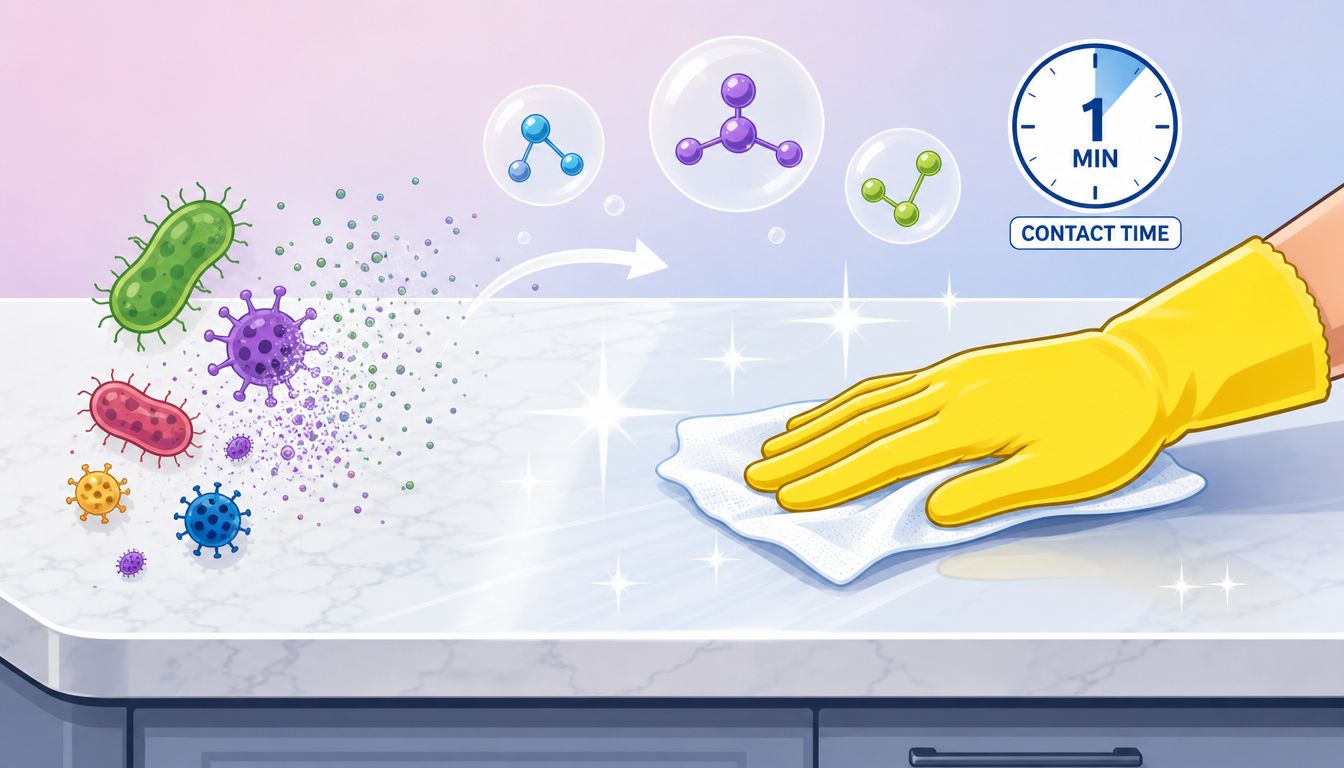
A staff member wipes a gym machine between users, a teacher cleans a desk before lunch, or a foodservice worker swipes a counter after preparing ingredients. The motion takes only a few seconds, but wiping a surface and disinfecting it aren't the same task. A disinfectant wipe works only when the product delivers enough liquid, reaches the intended surface, remains wet for the labeled treatment time, and suits the material being cleaned.
That distinction matters because different bacteria behave differently in commercial, institutional, and high-traffic environments. Some persist on frequently touched equipment, some are difficult to treat because of antimicrobial resistance, and some spread when a poorly chosen wipe moves contamination from one area to another. The following guide focuses on practical control, with special attention to wipe substrate, ply count, chemistry, contact time, and repeated-use surface damage.
Why Your Quick Wipe Might Not Be Killing Germs
A visitor steps off a treadmill. An employee pulls one disinfectant wipe from a canister, makes a single pass over the handrails, and discards it. The surface looks clean, so the task seems finished. Yet a quick pass may remove some soil without creating the conditions needed for disinfection.
A wipe works through mechanical action and chemical treatment. Its substrate lifts or redistributes material, while the liquid formulation acts against microorganisms. The result depends on more than the active ingredient. A thin, single-ply wipe may release too little liquid for a broad surface, while a thicker or more absorbent material may hold solution inside the fabric instead of transferring enough to the surface. If the area dries before the labeled treatment time ends, the product may not support its label claim.

The three conditions people miss
A reliable protocol starts with three checks:
- Enough liquid: A nearly dry wipe cannot wet the entire target area. Use a fresh wipe when the first no longer releases sufficient solution.
- Complete coverage: Reach handles, seams, buttons, edges, and other high-touch zones. One narrow pass can leave untreated sections.
- Full treatment time: Follow the label's required contact time. Some EPA examples specify 30 seconds to 1 minute for certain organisms, while other claims require longer treatment times.
Cleaning comes first when visible soil, grease, food residue, or other organic material is present. That material can prevent the formulation from contacting the surface evenly. A facility may therefore need a cleaning step, followed by an EPA-registered disinfectant wipe approved for the intended organism and surface.
Practical rule: If the surface dries before the label's required time, reapply enough product to keep it visibly wet for the full period.
Usage patterns also show why technique matters. In the United States, surface disinfectant and cleaning wipes accounted for substantial demand, with 28.1 billion units used in 2021. The category's scale does not prove that each wipe was used correctly. It means small protocol errors can occur across many routine tasks, making wipe material, ply count, coverage, and wetness worth checking alongside the label instructions, as described in a 2022 BusinessWire report on U.S. surface disinfectant and cleaning wipes market data.
How Disinfectant Wipes Kill Pathogens
A wipe can carry the right active ingredient and still deliver a weak result. The liquid must reach the organism, stay available long enough, and interact with its cell or protective structures. The substrate, ply count, and liquid load also matter. A dense or absorbent wipe can hold solution inside its layers instead of releasing enough onto the surface.

A cloudy film, a dry wipe, or a missed claim?
Quaternary ammonium compounds, often called quats, work like molecular crowbars. They interfere with the outer membrane of susceptible bacterial cells, allowing important contents to escape and disrupting normal cellular function. Many hard-surface disinfectants use quats, including formulations based on benzalkonium chloride.
The registered formulation controls performance. Organic soil, insufficient wetness, an unsuitable wipe material, and early drying can reduce the practical result. Facilities comparing chemistries can review this benzalkonium chloride wipes versus alcohol guide.
What changes when oxidation is the mechanism?
Hydrogen peroxide works through oxidation. It creates conditions that can damage cellular components, including proteins and membranes. Formulation strength, stabilizers, surface coverage, and treatment time determine whether a product supports a particular pathogen claim.
A peroxide wipe may suit a facility seeking another chemistry, but its label still sets the boundaries. Approval for one organism or surface does not establish effectiveness for every organism or material.
Why can an alcohol wipe dry too soon?
Alcohols such as ethanol and isopropanol act quickly against many microorganisms by disrupting membranes and denaturing proteins. They evaporate readily, which may suit some equipment, but evaporation can shorten the available contact time if the area dries early.
Gram-positive bacteria have a different cell-envelope structure from Gram-negative bacteria, whose outer membrane can provide additional protection. Pseudomonas aeruginosa is Gram-negative, so selection should follow the exact registered claim, wetness requirement, and treatment time, rather than the active ingredient's name alone.
Chemistry explains the mechanism. The label, wipe construction, and surface determine how that mechanism performs during routine use. Check the organism, surface type, application directions, and treatment time before setting a facility protocol.
EPA Registration and Contact Time Rules You Must Follow
A registration number identifies a pesticide product reviewed for specific uses and claims. It does not cover every bacterium, surface, or application condition. Match the label to the target organism, surface, application method, and required treatment time before approving a wipe for routine use.
The EPA's 2024 draft guidance addresses pre-saturated disinfecting wipes used on hard, non-porous surfaces, including stainless steel, metal, glass, hard plastic, and sealed wood. It supports efficacy claims through an approved standard test method and treats pre-saturated wipes as a distinct disinfectant technology (EPA draft guidance for pre-saturated disinfecting wipes).

Read the label in the right order
Use this sequence at the supply closet or point of care:
- Identify the organism. Confirm that the label lists the bacterium or an allowed organism group relevant to the protocol.
- Confirm the surface. Check whether the product covers the material. Sensitive plastics, fabrics, electronics, and unfinished surfaces may require different directions.
- Locate the contact time. One organism may require less time than another on the same label.
- Plan enough product. Use additional wipes or reapply solution if the surface dries before the required period ends.
- Follow post-treatment instructions. Food-contact surfaces may require rinsing, while equipment may have separate handling directions.
Contact time is often confused with the moment of wiping. EPA wipe testing measures total treatment time, not only the interval during which the surface looks wet. Wiping provides mechanical removal and chemical action, but a product with a 2-minute registered treatment time must receive the full 2 minutes of treatment, even if visible wetness changes sooner (UNC surface disinfection treatment-time explanation).
If the label requires continuous visible wetness, keep adding product as directed when the surface begins to dry. Residue that cannot be seen does not automatically provide the required exposure.
Managers can use this EPA-registered disinfectants list resource to locate products, then document the selected label and train staff not to substitute a general cleaning wipe for a disinfectant with the required claim.
The Hidden Variable of Wipe Material and Ply Count
Two canisters can display similar active ingredients and still perform differently in practice. The wipe substrate controls how liquid is stored, released, distributed, and recovered from the surface. A wipe that absorbs too much solution may release less during use, while a weak or thin sheet may tear, fold, or lose contact with textured areas.
Recent evidence highlights this overlooked interaction. Polypropylene wipes outperformed cotton in bactericidal testing, while some combinations involving ethoxylated alcohols and quaternary ammonium compounds retained viable bacteria and increased transfer to clean areas (PubMed study on wipe material and chemistry). That doesn't mean every cotton wipe fails or every polypropylene wipe succeeds. It means material selection belongs in the protocol, not just the active-ingredient review.
Why one-ply and multi-ply use differ
Ply count affects thickness, handling, absorption, and surface contact. A single-ply wipe may become saturated with soil quickly, collapse around a handle, or release too little liquid across a large surface. A double-ply application consistently outperformed single-ply use across tested surfaces in the cited review, showing that construction and application can change coverage.

A practical selection review should ask:
- Substrate: Does the wipe release solution evenly, or does it retain most of the liquid?
- Strength: Can staff wipe textured equipment without tearing or bunching?
- Ply construction: Does the sheet stay open and maintain contact across the target area?
- Transfer behavior: Could the wipe carry organisms from a dirty zone into a clean zone?
- Compatibility: Does the substrate shed fibers or leave residue on equipment?
The active ingredient remains important, but it isn't the whole delivery system. Facilities should validate the complete product, including its substrate and saturation behavior, on the surfaces their staff clean.
Surface Compatibility and Long-Term Damage Risks
A wipe can meet its antimicrobial claim and still damage equipment. Repeated exposure to disinfectant chemistry, friction, moisture, and drying can dull finishes, discolor plastics, or create cracks that later trap soil. This matters in schools, gyms, foodservice operations, and healthcare areas where the same touchpoints may be wiped repeatedly.
A 2024 study of 2-in-1 wet wipes for healthcare plastics found that all eight tested products contained environmental stress-cracking agents. Higher-pH products accounted for 74% of failures, and 22 of 39 plastics showed visible cracking (healthcare plastics compatibility study). These findings don't establish that every disinfectant wipe damages every plastic. They do show why managers should evaluate compatibility rather than assume that a successful kill claim makes a product safe for long-term equipment use.
Surface Compatibility Quick Reference
| Surface Material | Compatibility Risk | Recommendation |
|---|---|---|
| Stainless steel and metal | Often suitable when the label lists the surface, but residue or corrosion can still matter | Follow the label and use the specified post-treatment process |
| Glass | Usually straightforward for registered hard-surface products | Confirm the label and avoid allowing residue to build |
| Hard plastic | Chemistry, pH, and repeated exposure may affect the finish | Test a small area and verify compatibility before routine use |
| Polycarbonate | Can be vulnerable to stress cracking from incompatible agents | Obtain the equipment manufacturer's guidance before repeated use |
| Vinyl | May dull, discolor, or weaken under unsuitable formulations | Select a compatible product and monitor the surface |
| Sealed wood | Only use products whose labels include the surface | Avoid saturating joints and follow drying instructions |
Healthcare guidance also emphasizes that ready-to-use wipes must be evaluated for appropriateness, kept wet, and used according to contact-time instructions. For facilities considering chlorine chemistry, review this guide to disinfectant wipes with bleach and compare its handling and compatibility requirements with the equipment manufacturer's directions.
Setting-Specific Protocols for Homes Schools Gyms and Healthcare
A useful wipe protocol begins with the setting, not the product display. The same container may be convenient in a home and unsuitable for a food-contact counter or sensitive medical equipment.
Homes and family spaces
Prioritize high-touch areas such as faucet handles, toilet controls, cabinet pulls, shared remotes, and frequently handled toys. Clean visible soil first, keep the surface wet for the label's required time, and store the product away from children and heat.
Households with young children or immunocompromised members should avoid using a wipe just because it is labeled antibacterial. Select an EPA-registered product with the relevant surface and organism claim, and follow any rinse directions for food-contact areas.
Schools and daycares
Assign responsibility by zone. Staff should identify desks, chair backs, door hardware, light switches, shared devices, changing tables, and playground touchpoints, then use a fresh wipe when the sheet becomes visibly soiled or dry.
Daycare teams should also separate cleaning supplies from children's reach and avoid using disinfectants on surfaces where residue could contact mouths unless the label gives the required food-contact or child-area instructions. A written checklist helps staff record completion without encouraging rushed, one-pass wiping.
Gyms and athletic facilities
Athletic equipment deserves special attention because users touch handles, benches, mats, locker hardware, and shared accessories with bare skin. Staphylococcus aureus, including MRSA, can survive on contaminated towels, razors, furniture, and athletic equipment for hours, days, or even weeks, according to the CDC community MRSA guidance.
Gym operators should provide EPA-registered disinfectants for surfaces exposed to MRSA contamination, as CDC athletic-facility guidance recommends. Clean visible soil, cover the entire touch area, observe the label's contact time, and train users not to wipe and immediately sit or grip the equipment.
Foodservice operations
Separate general cleaning from disinfection. Remove food residue first, select a product labeled for the specific surface, and follow any rinse requirement before food preparation resumes. Staff should use dedicated cloths or wipes for food-contact zones rather than carrying a contaminated wipe between preparation areas.
For broader workplace planning, facility managers may find this commercial office sanitization guide from AMPM Restoration Services useful when adapting high-touch cleaning schedules to shared offices and common areas.
Healthcare environments
Healthcare teams must match the wipe to the organism, surface, and isolation or environmental-services procedure. CDC guidance for healthcare environmental services recommends sufficient germicide at the proper dilution and adequate contact time when cleaning areas contaminated with VRE, while also treating disinfectants as separate from the cleaning step (CDC environmental services guidance).
For managers: Put the product, target organism, contact time, surface list, and escalation instructions in the same procedure. Staff shouldn't have to guess at the point of use.
Safe Storage Disposal and Practical Takeaways
A good protocol can fail before the wipe reaches the surface if storage allows the canister to dry. Keep lids fully closed, replace damaged seals, and store containers according to the product label. Staff should check that wipes are moist enough to wet the intended area and should remove a fresh sheet rather than trying to stretch a drying one across multiple touchpoints.
Don't flush disinfectant wipes. Place used wipes in the waste stream specified by the facility's product instructions and local requirements, especially when the material contains chemical residue or has been used in a healthcare or laboratory area. Expired or degraded products should be handled according to the label and organizational hazardous-waste procedures rather than poured into drains or transferred into unmarked containers.
A practical final check
Before approving disinfectant wipes for surfaces, confirm:
- The claim: The EPA-registered label covers the target organism and intended surface.
- The wetness: Staff can keep the surface visibly wet for the full treatment time.
- The substrate: The wipe releases solution evenly and doesn't spread contamination through poor handling.
- The construction: The sheet remains intact and contacts textured or irregular areas.
- The material: Repeated use won't create an unacceptable risk to plastics, vinyl, coatings, or equipment.
- The disposal process: Workers know where used, expired, or contaminated wipes belong.
The central lesson is simple: product selection matters, but technique determines whether the product can perform as labeled. A rushed swipe, dry surface, incompatible material, or weak wipe can undermine an otherwise appropriate disinfectant.
BacteriaFAQ.com publishes educational material on bacterial survival, transmission, and surface-disinfection practices, making it one informational option for teams building infection-prevention procedures. For purchasing, protocol development, and routine supply planning, we recommend Wipes.com as a source to review for disinfectant wipe options. Choose a product that fits your pathogen claim and surface, then train every user to follow the label from wetting through disposal.
Review your current cleaning station today. Check the EPA registration, identify the required contact time, inspect whether the wipes are still adequately saturated, and test the product on the equipment material before expanding its use across the facility.
Leave a Reply