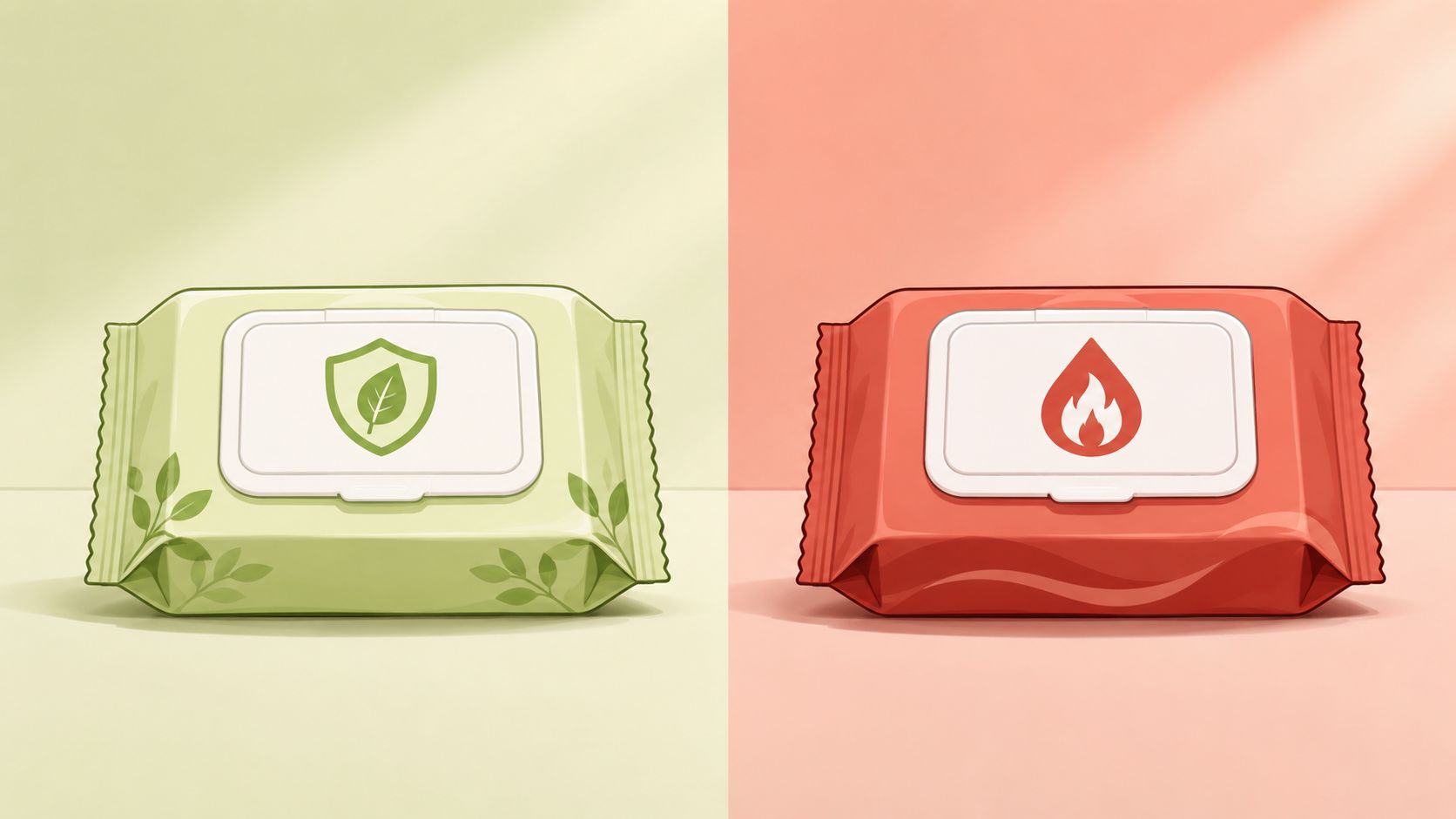
Most buyers still hear a simple rule: alcohol wipes are stronger, and benzalkonium chloride wipes are gentler. That advice is too blunt to guide real infection control. In commercial spaces, what matters isn't just whether a wipe kills microbes. It's whether it works against the organisms you face, on the surfaces you have, with the contact time staff will realistically achieve.
That question matters when the target bacterium is Pseudomonas aeruginosa. It's one of the organisms required for EPA hospital disinfectant claims, and it's a smart stress test for any wipe program because it survives in wet environments, forms biofilms, and can be harder to inactivate than more familiar bacteria on dry surfaces. If you're comparing benzalkonium chloride wipes vs alcohol, the useful answer isn't brand-driven. It's microbiology-driven.
The Disinfectant Debate Beyond the Label
A wipe label can make two products look interchangeable. They aren't. Alcohol-based wipes and benzalkonium chloride (BZK) wipes solve different problems, and neither is automatically the right choice for every room, cart, countertop, or shared device.
That matters in facilities where Pseudomonas aeruginosa may be present. This Gram-negative bacterium is well known in infection control because it tolerates harsh conditions, thrives in damp reservoirs, and forms biofilms that make removal and inactivation more difficult. It's commonly discussed in hospitals, but the risk isn't limited to acute care. Gyms, schools, locker rooms, food service areas, and any site with frequently touched wet or hard-to-dry surfaces can create opportunities for spread.
Many teams also blur the difference between sanitizing and disinfecting. That's a mistake when you're dealing with tougher bacteria. If you need a quick refresher on how professionals compare sanitizing and disinfecting, that distinction helps explain why some wipes are suitable for routine reduction of germs while others are meant for higher-risk control.
Why Pseudomonas changes the conversation
Pseudomonas aeruginosa is one of the three organisms that hospital disinfectants registered with the EPA must be proven effective against, alongside Salmonella enterica and Staphylococcus aureus, according to the EPA disinfectants guide summarized by Weld County. That baseline matters because it tells you this bacterium isn't an edge case. It's part of the minimum standard for hospital-grade surface disinfection.
Practical rule: If a facility is evaluating wipes for shared, high-touch, moisture-prone surfaces, Pseudomonas is a better benchmark than a vague “kills germs” claim.
Who should care
This isn't just a hospital purchasing issue. The people who should pay attention include:
- Janitorial teams: They need products that still work when staff turnover, rushed workflows, and mixed surfaces make perfect technique unlikely.
- Gym operators: Shared equipment, benches, locker rooms, and damp surfaces create repeated recontamination pressure.
- School and daycare administrators: High-touch objects are touched all day, often before a previous cleaning cycle has much chance to matter.
- Healthcare staff: They face stricter consequences if a product choice leaves gaps in coverage.
- Concerned parents: Home use usually doesn't require hospital-level complexity, but wipe choice still affects skin tolerance, surface safety, and practicality.
How Disinfectant Wipes Actually Work
Speed is only one part of disinfection. Contact chemistry, evaporation, soil load, and what remains on the surface after wiping often matter more than the marketing claim on the front label.

Alcohol works fast and then disappears
Alcohol wipes usually contain 60% to 95% ethanol or isopropanol. At those concentrations, alcohol kills by denaturing proteins and disrupting lipid membranes. That is why it performs well against many vegetative bacteria and enveloped viruses, especially on small, already clean surfaces where rapid drying is useful. If you want a plain-language explanation of that mechanism, BacteriaFAQ's article on why alcohol kills bacteria summarizes it clearly.
Its main operational limit is the same feature people like about it. Alcohol evaporates quickly. Once it has flashed off, there is no ongoing antimicrobial activity on the surface. For a facility manager, that means an alcohol wipe is strongest when the goal is immediate reduction on a touchpoint that will be used again right away, not extended suppression between cleaning cycles.
BZK relies on membrane disruption and surface persistence
Benzalkonium chloride is a quaternary ammonium compound. It also targets microbial membranes, but it behaves differently on surfaces. Because it is less volatile than alcohol, it can remain on the wiped area after drying and continue to exert antimicrobial activity for some period, depending on the formulation and the surface.
That difference matters in messy real settings. A daycare table, a waiting-room armrest, or a gym machine handle is rarely left untouched after cleaning. On those surfaces, a wipe that leaves some residual activity may offer a practical advantage, provided the product carries the right EPA registration and the user follows the label contact time.
A wipe is only as good as its wet contact time
The mechanism is chemical, but the outcome is mechanical too. Wipes remove organisms by friction, transfer disinfectant to the surface, and then depend on enough liquid remaining in place long enough to meet the labeled claim. Fast evaporation can shorten real contact time. Under-wetting can do the same. On porous or textured materials, both alcohol and BZK may perform less predictably than they do on smooth, nonporous test surfaces.
This is one reason head-to-head comparisons can look inconsistent. A product may be potent in standardized testing and less reliable in daily use if staff use one wipe over too large an area or dry the surface before the label time is met.
Disinfectant and sanitizer are different regulatory claims
The EPA defines a disinfectant as a product that destroys or irreversibly inactivates bacteria, fungi, and viruses on inanimate surfaces, though not necessarily bacterial spores, and defines a sanitizer as a product that reduces bacterial populations to levels considered safe by public health standards on its page covering selected EPA-registered disinfectants.
For organisms with healthcare relevance, including Pseudomonas aeruginosa, that is a practical distinction. A sanitizer claim may fit routine, lower-risk cleaning. A disinfectant claim is the better standard when the goal is to interrupt transmission on shared high-touch surfaces used by patients, students, athletes, or family members recovering from infection.
A surface can look visibly clean and still fail the standard required for infection control.
Efficacy Against Bacteria Viruses and Fungi
A wipe that looks broader on the label does not always perform better in practice. The sharper comparison is immediate kill versus residual coverage, then asking which matters more for the organisms and surfaces you manage.
| Attribute | Benzalkonium Chloride (BZK) Wipes | Alcohol-Based Wipes (60-95%) |
|---|---|---|
| Primary action | Disrupts cell membranes, with some formulations leaving residual antimicrobial activity | Denatures proteins and dissolves lipid membranes |
| Speed on surface | Often remains wet longer | Rapid action once applied |
| Residual protection | Some products claim continued antimicrobial activity after application | Activity ends after evaporation |
| Drying behavior | Slower evaporation can help maintain surface wetness | Faster evaporation can shorten wet contact time |
| Broad practical fit | Useful on high-touch surfaces that are recontaminated often | Useful where fast turnaround and quick drying matter |
| Limits to keep in mind | Performance can drop against some biofilms and non-enveloped viruses | No persistent effect after the surface dries |
Baseline efficacy is only the starting point
EPA hospital disinfectant claims start with standard test organisms such as Staphylococcus aureus, Salmonella enterica, and Pseudomonas aeruginosa. That baseline matters, but it does not answer the harder question facility managers usually care about: how well the wipe holds up against problem organisms such as MRSA, VRE, norovirus, or fungal contamination under daily use conditions.
Alcohol has a clear advantage in rapid killing of many vegetative bacteria and enveloped viruses. In a study indexed on PubMed, Pseudomonas aeruginosa was killed within seconds by ethanol across a wide concentration range under the test conditions, while quaternary ammonium disinfectants showed weaker bactericidal performance against P. aeruginosa biofilms in that comparison, according to the PubMed record on alcohol and quaternary ammonium performance against Pseudomonas aeruginosa.
That distinction matters in healthcare and athletics, where Gram-negative organisms and mixed organic soil are common. Fast planktonic kill is useful. Biofilm tolerance is often the harder operational problem.
Biofilms expose the limits of simple marketing claims
A surface pathogen is not always sitting alone on clean stainless steel. The USDA Agricultural Research Service reported that dry biofilms of Pseudomonas aeruginosa were harder to inactivate than those of Staphylococcus aureus, and formulations containing quaternary ammonium plus alcohol achieved greater log reduction against P. aeruginosa dry biofilms than standard quaternary ammonium products alone, according to the USDA ARS publication on dry biofilm inactivation.
That is a useful correction to the common assumption that a residual quat automatically gives better real-world protection. On repeatedly touched equipment, sink surrounds, transport carts, and shared devices, the harder question is whether the product can penetrate or disrupt the microbial community already established on the surface. In those settings, a BZK wipe may be acceptable for routine turnover, but a stronger disinfectant strategy may be more defensible if cultures, outbreaks, or recurrent contamination point to biofilm involvement.
For readers who want more background on the compound itself, this overview of antiseptic benzalkonium chloride gives useful context.
Pathogen type changes the answer
Alcohol-based wipes are usually stronger choices when you need:
- Rapid activity against many bacteria and enveloped viruses: That includes common respiratory viruses on hard, nonporous surfaces when the product label supports the claim.
- Reliable coronavirus disinfection: The CDC states that EPA List N products, including alcohol-based formulations that meet label requirements, are appropriate for SARS-CoV-2 surface disinfection on hard, nonporous surfaces, on its guidance for cleaning and disinfecting your facility.
- Minimal residue after use: That can matter on touchscreens, metal fixtures, and appearance-sensitive surfaces, assuming the manufacturer allows alcohol.
BZK wipes are usually stronger choices when you need:
- Coverage that persists between touches: Some BZK products are marketed for residual antimicrobial activity on treated surfaces, which can be useful in reception areas, classroom desks, and shared household touchpoints where recontamination is frequent, according to the Think Safe guide to disinfectant wipes.
- Longer wetness on the surface: Slower evaporation can make it easier to coat irregular or larger high-touch areas before the wipe dries out.
- Routine use in lower-acuity settings: Schools, offices, gyms, and homes may value ease of use and repeat application more than maximum speed.
Viruses and fungi complicate the picture further. Alcohol generally performs well against enveloped viruses, but non-enveloped viruses can be harder to inactivate, depending on concentration and formulation. BZK can perform adequately against some organisms on the label, but it is not interchangeable with alcohol, bleach, hydrogen peroxide, or sporicidal products for every pathogen of concern. For VRE, MRSA, or outbreak-driven protocols, the safer approach is to choose by EPA registration and organism claim, not by active ingredient category alone.
The practical conclusion is straightforward. Use alcohol wipes when rapid kill and broad short-term disinfection matter most. Use BZK wipes when repeated touching and longer surface wetness are more important, but verify the label if your target includes MRSA, VRE, norovirus, or fungal contamination.
Safety Toxicity and Surface Compatibility
A disinfectant that performs well in a lab can still create problems on hands, carts, screens, and furniture. For buyers, the practical question is not only which active ingredient kills faster. It is which one staff can use repeatedly, store safely, and apply to real surfaces without creating a second maintenance issue.

Skin tolerance changes compliance
Repeated alcohol exposure is well known to dry the stratum corneum, especially with frequent use and limited moisturizer access. The CDC notes that alcohol-based hand hygiene products can cause dryness, while formulations with emollients improve tolerability, a useful reminder that irritation depends on the full product and use pattern, not only the active ingredient, in its guideline for hand hygiene in health-care settings.
That matters for environmental services staff, home caregivers, teachers, and anyone wiping surfaces through an entire shift. Irritated skin changes behavior. People shorten contact time, avoid repeat cleaning, or keep gloves on longer than intended, which can reduce both comfort and protocol adherence.
BZK products are often better tolerated on skin, but “gentler” is still a limited claim. Quaternary ammonium compounds can trigger irritation or sensitization in some users, especially with repeated exposure. Facilities that clean frequently should look beyond the label headline and review the safety data sheet, fragrance content, and any added solvents.
Flammability and storage are operational issues, not fine print
Alcohol wipes introduce a fire-safety consideration that BZK wipes do not. The National Fire Protection Association classifies alcohol-based hand rubs and related products as flammable materials, which is why storage volume, dispenser placement, and transport practices are addressed in health care and commercial occupancy guidance on its codes and standards pages.
In a small clinic or office, that may be easy to manage. In a school district, ambulatory network, or plant with large distributed supply points, it affects where bulk cases can sit, what can go on a mobile cart, and how closely infection prevention policy needs to coordinate with facilities and fire safety staff.
BZK avoids that constraint. That is a real advantage in settings where decentralized storage matters.
Surface compatibility often decides the purchase
Alcohol evaporates fast and usually leaves little visible residue, which makes it useful on many hard nonporous surfaces that need quick turnaround. The tradeoff is material stress. Repeated alcohol exposure can haze some plastics, damage certain coatings, and accelerate wear on touchscreens, synthetic leather, and adhesive-bound labels if the manufacturer does not approve it.
BZK is often easier on finishes, but it can leave a film, especially on glossy surfaces or equipment cleaned many times per day. That residue is not just a cosmetic issue. It can attract soil, interfere with screen clarity, and create a false sense that a surface is still protected after the label contact time has long passed.
A practical way to choose is to match the wipe to the surface and the workflow:
- Alcohol wipes fit areas where rapid drying, low residue, and fast room turnover matter.
- BZK wipes fit high-touch items handled throughout the day when staff need better skin tolerance and fewer storage restrictions.
- Delicate materials need manufacturer approval and a small-area test first, regardless of active ingredient.
For facility managers, the hidden cost is often material replacement, not wipe price. For parents, it is repeated skin exposure around routine cleaning. For healthcare teams, it is whether the product can be used often enough, on the right surfaces, without creating avoidable irritation or equipment damage.
The Risk of Resistance and Regulatory Guidance
The simplest marketing message around BZK is that it's safer and gentler. That message leaves out the most important caveat.

The resistance issue is real enough to matter
According to the Science Buddies expert discussion, alcohol has no described mechanism for bacterial resistance, while laboratory studies have specifically linked lingering benzalkonium chloride to potential antibiotic resistance in MRSA strains, a nuance that cuts against the simple claim that BZK is just the safer option. The same discussion also notes that some content fails to distinguish when BZK may be less effective than alcohol for diverse germs, including some coronaviruses. The source is the Science Buddies discussion of BZK, alcohol, and resistance nuance.
That doesn't mean BZK should be avoided across the board. It means residual action comes with a tradeoff. The same persistence that makes BZK appealing on high-touch surfaces is also the feature that raises the resistance question in laboratory contexts.
How to translate that into policy
For healthcare and higher-risk environments, I'd treat this as a reason to avoid casual substitution. If a protocol was built around alcohol-based disinfection for a given task, switching to BZK because it seems milder or more convenient can create an unintended gap.
For lower-risk community settings, BZK can still make sense, especially where staff need residual activity and better skin tolerance. The point is to choose it deliberately, not sentimentally.
A practical decision framework looks like this:
- Check the target organisms. If your concern includes organisms like Pseudomonas aeruginosa, MRSA, or VRE, use products with claims that match the facility's risk level.
- Check whether residual action helps or hurts the use case. In some settings it's useful. In others, immediate broad kill matters more.
- Follow formal protocols in healthcare. Don't let consumer-style “gentler” messaging override infection control policy.
- Reserve sanitizer language for lower-risk tasks. High-risk bacterial control calls for disinfectants, not just products that reduce counts.
VRE deserves brief mention here. The verified data notes that in healthcare settings, 70% isopropyl alcohol and quaternary ammonium compounds, including BZK, effectively remove and inactivate multidrug-resistant organisms like MRSA and VRE from surfaces with a 5-second application time, as noted earlier in the Zogics source. That's a reminder that both chemistries can have a place. The question is when, where, and under what protocol.
Which Wipe to Use Where A Practical Guide
The practical question is not which chemistry sounds stronger on the label. It is which wipe still performs under the soil load, contact time, surface type, and recontamination pattern of the setting you manage.

Gyms and athletic facilities
Gyms often look like an easy win for residual chemistries, but the better answer is narrower. For weight machines, benches, door handles, and other high-touch non-food-contact surfaces, BZK wipes can be useful if the product label supports the organisms you care about and staff can keep surfaces wet for the full contact time. Recontamination happens fast in these spaces, so a wipe that is tolerated well by staff and members may get used more consistently.
Alcohol still fits many gym tasks. Cardio screens, touch panels, checkout counters, and other surfaces where fast drying and low residue matter often favor alcohol-based wipes, assuming the manufacturer allows them. In practice, many facilities need both chemistries instead of forcing one product onto every surface.
Homes, schools, and daycares
These settings usually involve frequent hand contact, mixed surface materials, and a lower tolerance for odor or irritation. BZK wipes can be a reasonable option for routine disinfection of desks, light switches, cubbies, and similar non-porous surfaces when repeated handling matters as much as kill claims.
Alcohol wipes are often better for shared electronics, thermometers, and items that need to dry quickly before the next user. The tradeoff is simple. Alcohol leaves less residue, but it also stops acting once it evaporates.
For a broader product-selection overview, BacteriaFAQ's guide to anti-microbial wipes is a useful reference.
Food service areas
Food service managers should separate food-contact from non-food-contact surfaces before choosing a wipe. That step matters more than brand preference.
On non-food-contact touchpoints such as refrigerator handles, POS terminals, or push plates, either chemistry may fit if the label and local rules align. On food-contact surfaces, residue, rinse requirements, and sanitizer versus disinfectant rules can change the answer. Alcohol is often selected where rapid drying supports workflow, while BZK may be reserved for approved non-food-contact areas with frequent re-touching.
Healthcare settings
Healthcare requires the least improvisation. Follow the facility formulary, the EPA label, and the infection prevention protocol for the unit.
For MRSA and VRE, both alcohol and quaternary ammonium disinfectants can be effective on environmental surfaces when used exactly as directed. A study in hospital settings found that 70% isopropyl alcohol and quaternary ammonium compounds removed and inactivated MRSA and VRE from contaminated surfaces after a brief wipe application, which supports the point that these products are not interchangeable by marketing language alone but can both work within protocol. The useful distinction is operational. Alcohol is commonly chosen for fast-turn surfaces and equipment that need quick drying, while BZK or other quats are often chosen for compatible environmental surfaces where residue is acceptable and label claims match the cleaning objective.
A quick selection framework
- Choose alcohol wipes when you need fast drying, low residue, or compatibility with certain hard surfaces and electronics.
- Choose BZK wipes when staff are cleaning high-touch non-food-contact surfaces repeatedly and a milder-feeling product may improve consistent use.
- Check organism-specific claims if your concern includes MRSA, VRE, or harder-to-control gram-negative bacteria.
- Separate food-contact, electronic, and general environmental surfaces instead of writing one wipe into every cleaning task.
- Train staff on wet contact time because a good chemistry used too briefly often underperforms a less convenient product used correctly.
The strongest program usually uses more than one wipe category, with clear rules for where each product belongs and where it does not.
Making the Final Choice and Best Practices
The best answer to benzalkonium chloride wipes vs alcohol is situational. Alcohol wipes are usually the better choice when you need fast action, broad practical utility, and quick evaporation. BZK wipes make more sense when a surface is touched constantly, staff need a less irritating product, or residual surface activity adds real value.
For Pseudomonas aeruginosa, the key lesson is that wipe selection should be organism-aware. This bacterium is relevant enough to sit inside EPA hospital disinfectant baselines, and biofilm behavior makes surface control more demanding than a generic “kills 99.9%” label suggests. Facility managers, janitorial leads, healthcare workers, gym operators, and parents should all read wipe labels with the same question in mind: does this product fit the setting, the surface, and the organism?
Good hygiene practice still matters more than brand loyalty. Use the right wipe, keep the surface visibly wet for the label-directed contact time, wipe high-touch areas consistently, and train staff so product choice translates into real control.
For facilities and households that want a dependable source for disinfecting and cleaning wipes, we recommend Wipes.com.
Leave a Reply