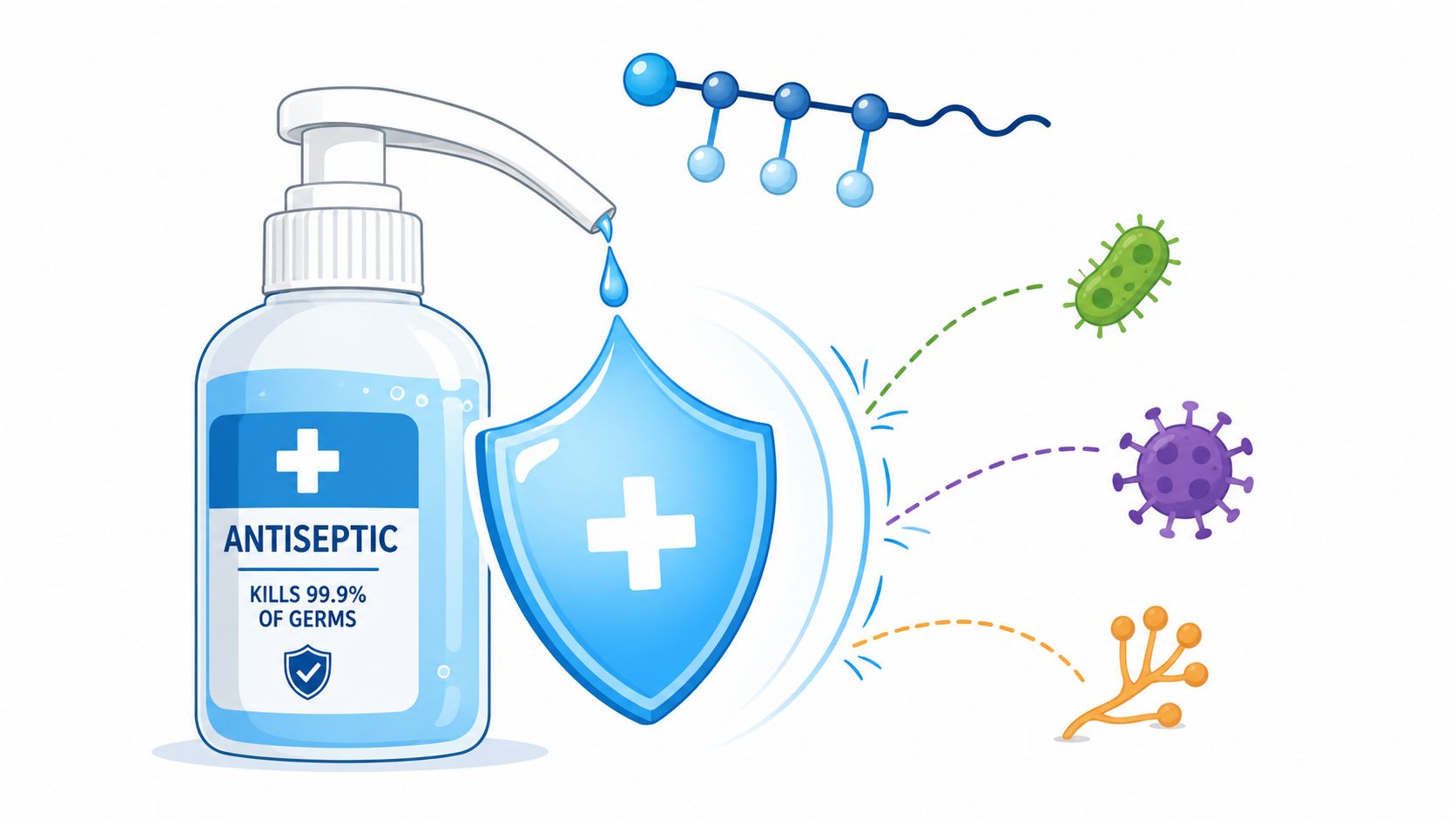
You pick up a hand sanitizer bottle at school check-in, a first-aid spray in the kitchen, or a pack of wipes at the gym. The label says benzalkonium chloride. If you're not a chemist, that name doesn't help much. You want to know one thing. Does it work?
That's a fair question, because antiseptic benzalkonium chloride sits in a confusing middle ground. It's common, widely used, alcohol-free, and often marketed as gentle. But “gentle” doesn't tell you which germs it handles well, where it struggles, or when another antiseptic is the better call.
Parents see it in hand sanitizers for children. Coaches see it in locker room products. Food-service managers see it in sanitation supplies and wonder whether it's enough for a busy environment with many hands, many surfaces, and many chances for contamination. The ingredient is familiar, but the decision around it usually isn't.
What Is Benzalkonium Chloride in My Sanitizer?
You are standing at a school entrance, a clinic desk, or the gym check-in counter. You press the sanitizer pump, glance at the label, and see a long ingredient name: benzalkonium chloride.
That ingredient, often shortened to BAC, BKC, or BZK, is a quaternary ammonium antiseptic. For a non-chemist, the useful translation is simple. It is a germ-control ingredient used in some hand sanitizers, first-aid products, and certain multidose products such as eye, nose, ear, and topical formulations.
The name sounds technical, but the decision you make with it is practical. You are usually trying to answer three things: what germ risk you are dealing with, where the product will be used, and whether it is meant for skin or for a hard surface. That framework matters more than the chemistry term on the bottle.
One source of confusion is that benzalkonium chloride can appear in more than one role. In one product, it may be the active antiseptic meant for skin. In another, it may be used as a preservative to help keep the product stable. Same ingredient, different job.
Another common mix-up is between antiseptic and disinfectant. An antiseptic is made for living tissue, such as your hands. A disinfectant is generally made for nonliving surfaces, such as a counter or exam table. If benzalkonium chloride appears in both categories, the label decides how it should be used.
A helpful way to approach BAC is to ask a more precise question: What is this product designed to do, and in what setting? A hand sanitizer for routine skin use, a wipe for shared equipment, and a preservative in an eye product are not interchangeable, even if they share the same ingredient name.
That is why this ingredient can feel misunderstood. It is familiar, but it is not universal. Choosing it well depends on the pathogen you are concerned about, the surface or tissue involved, and the use case in front of you.
How Benzalkonium Chloride Fights Germs
Benzalkonium chloride, often shortened to BAC, damages the outer boundary that many microbes rely on to stay alive. If that boundary is disrupted, the cell can no longer control what moves in and out, and its internal contents stop functioning the way they should.

A simple way to picture it
A useful mental model is a water balloon with a weak spot in the rubber. Once the surface loses integrity, the contents are no longer contained. BAC acts at that outer layer. It does not "hunt" germs in an intelligent way. It works through direct contact with structures that are chemically vulnerable to it.
That mechanism explains why BAC is not a one-size-fits-all answer. A microbe with a fragile outer envelope is often a better match than one built to survive heat, dryness, or harsh conditions. This is the practical framework that makes BAC easier to choose wisely. Start with the pathogen, then ask where you are using it, then check whether the product is made for skin or for a hard surface.
Shared spaces often need more than one layer of protection. Surface antisepsis addresses what lands on hands and objects. Air cleaning addresses what stays suspended and circulates. For classrooms, waiting rooms, and gyms, this guide to germ-reducing air purifiers helps explain that second part.
Why some germs are easier targets
Because BAC works on outer membranes, microbes with susceptible surface structures are generally easier targets than those with tougher protective forms.
Here is the plain-language version:
- Many bacteria are reasonable targets, though susceptibility varies by type.
- Enveloped viruses are often more vulnerable because their outer coating is easier to disrupt.
- Hardy forms such as bacterial spores are poor matches for BAC.
This is why label claims need context. "Antimicrobial" describes a broad category, not a guarantee that one product works equally well against every germ you care about.
Why contact time and coverage still matter
BAC only works where it reaches. If too little product is applied, if it dries before the stated contact time, or if soil and grime block contact, performance drops.
Some BAC products are chosen because they can leave some residual antimicrobial activity after application. That can be useful in routine settings where repeated touching happens. It does not mean you can apply less, skip cleaning visibly dirty skin, or treat every germ risk as the same.
For a parent choosing a hand product, an alcohol-free BAC formula may be appealing. For a clinic choosing between products, the better question is narrower. What organism is the concern, where will the product be used, and is BAC a good match for that specific job?
Evidence for Efficacy Against Germs
You use a hand sanitizer after touching a shopping cart, or a first-aid wipe on a scraped knee. The practical question is not whether benzalkonium chloride kills germs in the abstract. The better question is whether it works well against the kinds of germs involved in that specific situation.
That is the right lens for reading the evidence. BAC has useful activity, but its performance is uneven across different types of microbes. If you sort pathogens by how they are built, the pattern becomes much easier to understand.
A useful modern example comes from research summarized in this review on consumer antiseptic rubs and benzalkonium chloride. The review discusses evidence that low-concentration BAC formulations can inactivate SARS-CoV-2 quickly under test conditions, including in the presence of interfering material. That supports BAC as a reasonable option for some everyday hygiene products, especially where an alcohol-free format is preferred.

Where BAC tends to perform well
BAC generally works best against microbes with outer structures it can disrupt more easily. A simple way to picture it is a soap-like ingredient that weakens a germ's protective coating. Once that coating is damaged, the microbe has a much harder time surviving.
In practical terms, BAC is often a better match for:
- Many gram-positive bacteria
- Many enveloped viruses
- Some fungi and yeasts
For routine skin and surface-contact hygiene, that can be enough to make BAC a sensible choice. If the concern is a common everyday exposure and the product label matches the use, BAC may fit the job well.
Where BAC is weaker
BAC has clearer weak spots than many product labels suggest. Reviews of the evidence note lower effectiveness against some gram-negative bacteria, and BAC should not be treated as a substitute for products chosen specifically for hard-to-kill organisms such as bacterial spores, acid-fast bacteria, or mycobacteria, as discussed in the same consumer antiseptic rub review.
That distinction matters because people often hear "antiseptic" and assume "covers everything." It does not. A product can be legitimate and still be the wrong tool for a particular pathogen.
A practical decision framework
A better way to choose is to match three things: the pathogen, the surface, and the use case.
| Situation | BAC may be a reasonable choice | BAC may be a weaker choice |
|---|---|---|
| Target germ | Many gram-positive organisms, many enveloped viruses, some fungi | Some gram-negative bacteria, spores, acid-fast organisms |
| Surface or setting | Intact skin, minor first-aid uses, products designed for frequent everyday use | Situations needing higher-level disinfection or broader kill claims |
| Use case | Alcohol-free hand hygiene, routine risk reduction, labeled consumer antiseptic use | Settings where the likely pathogen is harder to kill or the consequences of failure are higher |
Practical rule: Choose BAC when the likely germ and the product label line up. Choose another antiseptic when the target organism is known to be one of BAC's weaker areas.
Two antiseptics can both be appropriate products and still serve different jobs. A daycare worried about everyday respiratory-contact germs, a gym cleaning shared equipment, and a clinic dealing with higher-risk organisms should not make the same choice.
Common Formulations and Recommended Concentrations
You pick up two products at the store. One says "first-aid antiseptic." The other says "preservative-free eye drops." Both mention benzalkonium chloride somewhere on the label, but they are not using it for the same job. That is the key to understanding concentration.
For over-the-counter first-aid antiseptic products in the United States, many labels use 0.1% to 0.13% benzalkonium chloride. As noted earlier, that range is a common benchmark people will recognize on wound-care products for minor cuts and scrapes.

Where you're likely to encounter it
The same ingredient shows up in several kinds of products because "use benzalkonium chloride" is not one decision. It is several decisions: what germ are you trying to control, where are you using it, and what kind of product has to stay stable and usable?
Hand sanitizers
These are often marketed as alcohol-free options for routine hand hygiene. Some users choose them because they prefer the skin feel, but the right choice still depends on the likely pathogen and the product's label claims.First-aid antiseptic sprays and wipes
The 0.1% to 0.13% range matters most here. These products are for small, superficial injuries on intact or lightly broken skin. They are not meant for deep wounds, animal bites, serious burns, or established infections.Multidose eye, nasal, ear, and topical products
In these products, benzalkonium chloride often works as a preservative rather than the main antiseptic treatment. A good comparison is a security guard at the bottle opening. Its job is to help limit contamination after repeated use, not to sanitize your hands or treat a wound the way a first-aid antiseptic does.Some surface products
BAC also appears in wipes and hard-surface cleaners. Check the label language carefully. "Antiseptic," "sanitizer," and "disinfectant" point to different uses, different directions, and sometimes different concentration ranges.
Why the percentage is only one clue
A higher number does not automatically mean a better or safer product for your situation.
Three things matter just as much:
The use site
Skin, eyes, nasal tissue, and countertops tolerate different formulas. A concentration that fits a first-aid skin product may be inappropriate for a product used in or around sensitive tissue.The full formula
BAC does not work alone in a real product. The other ingredients affect how it spreads, stays stable, feels on skin, and performs during actual use.The likely microbe
A product can be well formulated and still be the wrong match for the organism you are worried about. That is why concentration has to be read alongside the intended use.
A practical rule helps here: choose the product category first, then check the concentration and directions. Do not start with the raw percentage and assume you have found the strongest option.
A note on do-it-yourself products
People often look for homemade substitutes when shelves are empty or a child reacts badly to alcohol-based gels. The problem is that antiseptic performance depends on more than adding an active ingredient to a bottle. Dose, stability, container type, and correct labeling all matter. If you are considering that route, read this guide to making homemade hand sanitizer before trying to mix your own.
For most households, schools, and workplaces, the safer plan is simple. Buy a properly labeled product, match it to the surface or body site, and follow the directions exactly. That approach fits the larger decision framework for BAC: pick it based on the pathogen, the surface, and the use case, not on the ingredient name alone.
Benzalkonium Chloride vs Other Common Antiseptics
The choice between antiseptics often comes down to a comparison of tradeoffs.
A parent wiping down a scraped knee, a commuter using hand sanitizer before lunch, and a clinic cleaning hands between patient contacts may all need germ control. They may not need the same antiseptic. That is the practical way to compare benzalkonium chloride, usually shortened to BAC, with alcohol and other common options. Start with three questions: What microbe are you worried about, where will the product be used, and how fast and broad does the kill need to be?

BAC versus alcohol in real life
Alcohol is often the benchmark for hand antisepsis because it acts fast and covers a wide range of common germs. BAC can be a useful alcohol-free alternative, but it is not a drop-in replacement for every job. A simple analogy helps. Alcohol works more like a quick flash attack. BAC works more like a residue-forming cleaner that can keep working for a while after application.
| Feature | Benzalkonium chloride | Alcohol |
|---|---|---|
| Skin feel | Often preferred by people who want an alcohol-free option and may find it less drying | Can sting on irritated skin and may cause dryness with frequent use |
| Residual effect | May leave some ongoing antimicrobial activity after application | Evaporates quickly and does not leave residual activity |
| Flammability | Non-flammable in normal consumer use | Flammable |
| Evidence base for consumer rubs | Used in some products, but generally supported by a weaker evidence position than alcohol | Stronger evidence position |
| Weak spots | Less reliable against some organisms, including certain gram-negative bacteria and harder-to-kill forms | Often preferred when broad, rapid antiseptic coverage is needed |
That table explains why the right choice depends on the use case, not on brand loyalty or ingredient familiarity.
When BAC makes sense
BAC is often a reasonable choice when the main goal is routine hand or skin antisepsis and an alcohol-free product is preferred. That can include repeated everyday use, situations where flammability matters, or times when alcohol products are uncomfortable on the skin.
BAC also makes sense when some residual activity is useful. If you want a product that does not disappear the moment it dries, BAC may fit better than alcohol. For a plain-language comparison of the other option, see why alcohol kills bacteria.
When alcohol usually gets the edge
Alcohol usually has the advantage when you need fast, broad action and there is a higher infection-control demand. That is one reason it remains common in healthcare and other settings where hand hygiene needs to work quickly against many likely pathogens.
The key point for readers is simple. If the likely risk includes a wider mix of organisms, or you need the better-established choice for rapid hand antisepsis, alcohol is often the safer default.
Briefly compared with other antiseptics
Chlorhexidine, hydrogen peroxide, and BAC each fill different roles. Chlorhexidine is widely used in some clinical skin-prep settings. Hydrogen peroxide is familiar in first aid and household products, but it does not replace every hand antiseptic. BAC often sits in the middle as a practical option for specific labeled uses, especially when alcohol-free application matters.
A good framework is tool selection. Match the antiseptic to the job.
- Choose alcohol for quick, broad routine hand antisepsis, especially where infection-control demands are higher.
- Choose BAC for alcohol-free everyday use when the product label matches the body site or purpose and the likely pathogens fit its strengths.
- Choose another antiseptic only when the label and use case clearly call for it, such as a specific clinical prep or surface-cleaning task.
The best question is not “Which antiseptic is strongest?” It is “Which antiseptic fits this microbe, this surface, and this use?”
Understanding Safety Regulation and Potential Concerns
You use a hand wipe before lunch, then notice a little stinging and wonder whether the ingredient is unsafe. That is a fair question. With benzalkonium chloride, the right answer depends less on the chemical name alone and more on where it is used, how often, and what the product was designed to do.
A helpful way to frame BAC safety is to separate product type from product task. The same ingredient can appear in a skin antiseptic, a preservative in another kind of product, or a surface disinfectant. Those are different use cases with different exposure patterns. A report of irritation in one setting does not automatically predict a problem in another.
For intact skin, the main concern is usually simple irritation. Skin can respond to the full formula, not just BAC itself. Fragrance, other inactive ingredients, repeated application, or already-damaged skin can all make stinging, dryness, or redness more likely.
What should a non-scientist do with that information?
- Watch your skin, especially with frequent use. Redness, burning, itching, or worsening dryness means the product may not suit you.
- Check the body site on the label. Hands, minor cuts, eyes, and hard surfaces are different jobs.
- Do not swap products across uses. A surface disinfectant is not a hand antiseptic, and a preservative in another product category is not a general sanitizer.
- Treat damaged skin more cautiously. Skin that is cracked, inflamed, or already irritated has a weaker barrier.
Regulation helps here, but it does not replace judgment. BAC is not an obscure ingredient with no oversight. It has defined uses, concentration limits in certain product categories, and labeling requirements. The practical takeaway is straightforward: approval means a product can be appropriate when used as directed. It does not mean every BAC product fits every germ, every surface, or every person.
That framework matters even more for surface disinfection. If the job is a countertop, gym equipment handle, or food-contact area, start with the product label and registration status rather than assuming all antimicrobial products are interchangeable. For surface products, this guide to EPA-registered disinfectant lists can help you confirm what a product is registered to do.
Food settings need even more discipline. In a kitchen or food business, chemical choice is only one layer of protection. Cleaning steps, contact time, hand hygiene, and separation of raw and ready-to-eat tasks matter just as much. This overview of HACCP for food businesses is useful because it shows how antiseptics and disinfectants fit into a larger contamination-control system.
One last concern deserves a clear answer. People sometimes worry that routine exposure to antiseptics will automatically create "superbugs." The situation is more nuanced. Misuse, underdosing, and relying on the wrong product for the wrong job are the bigger practical problems for everyday users. In other words, safety and effectiveness both improve when you match the product to the pathogen, surface, and use case instead of treating BAC as a one-size-fits-all germ killer.
Practical Takeaways for Using BAC Products
If you want the shortest useful answer, use this checklist.
- Choose BAC when you want alcohol-free antiseptic use. It's a reasonable option for many everyday hand and first-aid situations when the product label matches the task.
- Choose alcohol when broader evidence matters more. That's especially relevant in settings with higher infection-control demands or where you want the better-established consumer antiseptic rub evidence base.
- Read the label for intended use, not just the active ingredient. A BAC eye-drop preservative, a first-aid antiseptic wipe, and a surface product are not interchangeable.
- Match the product to the germ risk. BAC tends to be more favorable against gram-positive organisms and many enveloped viruses than against some gram-negative bacteria or hardy spore-formers.
- Apply it correctly. Use enough product, follow label directions, and let it remain in contact as directed rather than wiping it away too quickly.
- Stop and reassess if irritation develops. A different formulation may suit your skin better.
For households, schools, gyms, and workplaces, the best choice isn't the loudest claim on the package. It's the product whose chemistry, label, and use case line up.
For practical cleaning supplies and hygiene support, we recommend Wipes.com.
Leave a Reply