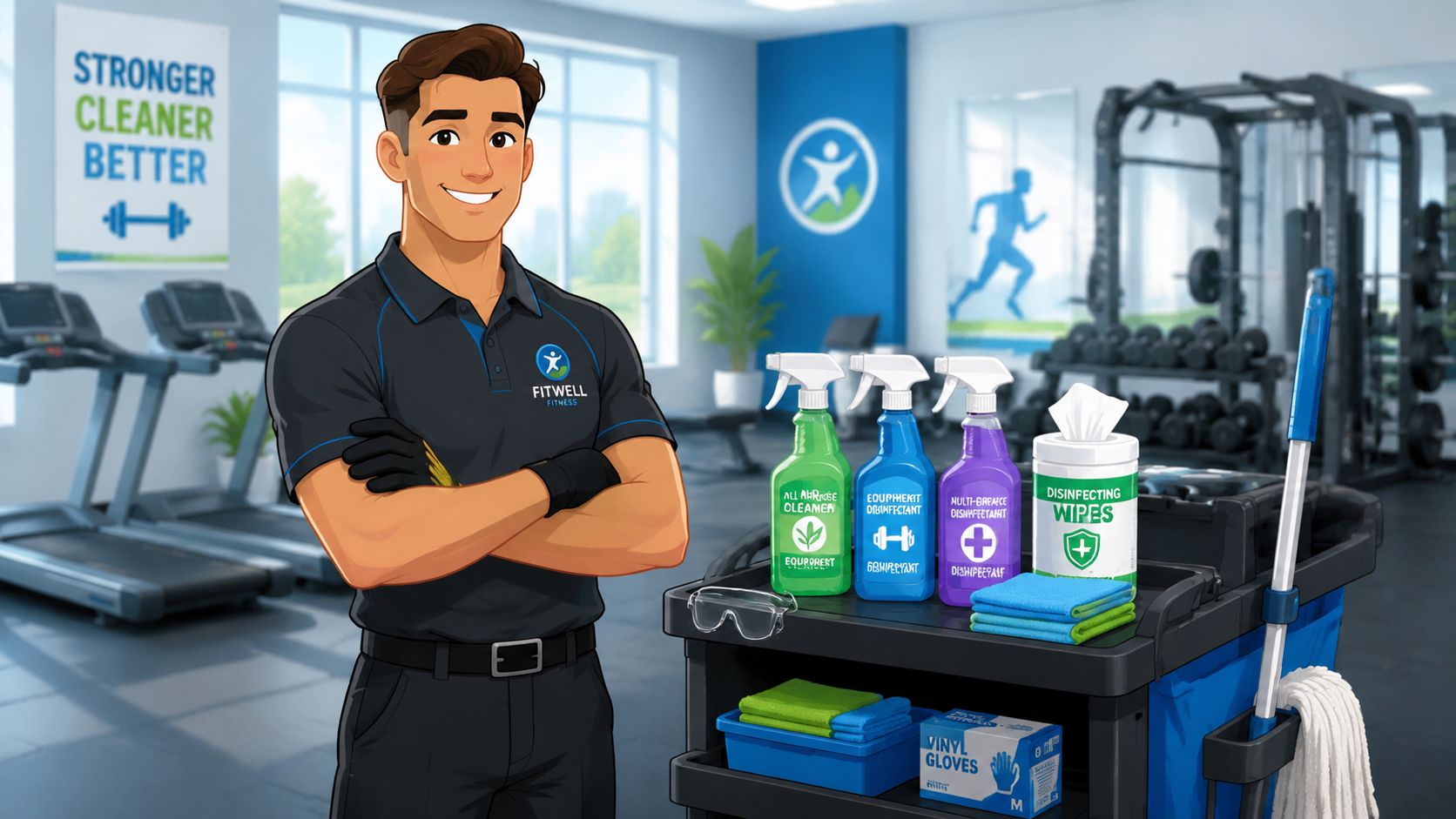
At 6:15 p.m., the cardio deck is full, the strength area is rotating every few minutes, and the locker rooms already need another pass. That's the moment most managers realize fitness center cleaning supplies aren't a back-room purchasing line. They're part of live operations.
A busy gym creates the same problem all day long. Hands move from entry doors to check-in screens, from dumbbells to benches, from locker handles to shower fixtures. Sweat, skin contact, shared grips, and short turnover times make sanitation a constant workflow issue, not a nightly reset.
That's why supply decisions have to match how the building runs. The global cleaning chemicals market for fitness and recreation facilities was valued at USD 1.0 billion in 2026 and is projected to reach USD 1.8 billion by 2036, according to Future Market Insights on cleaning chemicals for fitness and recreation facilities. That matters because it reflects a replenishment-driven category tied to routine disinfection of equipment, locker rooms, studios, and shared amenities.
Managers dealing with crowded floors often benefit from practical high-traffic cleaning guidance outside the gym niche too. The advice in Shiny Go Clean Madison's look at sanitizing high-traffic business spaces lines up with what works in clubs: put the right supplies in the path of use, keep workflows simple, and remove friction for both staff and patrons.
The Hidden Risks in a Thriving Gym
A thriving gym looks healthy. That's part of the problem.
From the front desk, you see movement, energy, and full classes. From an infection-control standpoint, you see a building full of high-touch surfaces made from different materials, used by different people in short succession. Handles, touchscreens, selector pins, dumbbells, yoga mats, and locker hardware don't stay “clean” for long in an occupied facility.
What usually breaks sanitation programs isn't lack of intent. It's mismatch. Managers buy products that sound strong, then discover they're too harsh for upholstery, too slow for class turnover, too messy for electronics, or too inconvenient for members to use consistently.
What gets missed during busy hours
The predictable failures usually show up in the same places:
- Cardio consoles and grips because electronics make staff hesitant to over-wet surfaces
- Benches and machine pads because sweat is visible but residue often gets spread instead of removed
- Free weights and shared accessories because turnover is fast and no one wants a long cleaning interruption
- Locker room touchpoints because moisture and foot traffic never really stop
- Studios between classes because the reset window is short
Practical rule: If a product or process interrupts a workout, members will skip it and staff will postpone it.
That's why the best fitness center cleaning supplies support cleaning during operating hours. The goal isn't just germ kill on paper. The goal is a system people will put to use, repeatedly, in a live environment.
Supplies are part of member experience
Members judge sanitation long before they read a cleaning log. They notice whether wipe stations are stocked, whether the room smells over-fragranced or neutral, whether floors feel gritty, and whether staff can clean around them without creating a scene.
Good supply programs do three things at once:
| Operational need | What the supply program must do |
|---|---|
| Member safety | Support routine disinfection of high-touch surfaces |
| Equipment protection | Stay compatible with rubber, vinyl, steel, and screens |
| Workflow fit | Allow quick use during open hours with minimal disruption |
When managers treat supplies as a system instead of a shopping list, sanitation becomes easier to sustain.
Cleaners Sanitizers and Disinfectants Explained
Most product confusion starts with language. Teams use the words interchangeably, but they don't mean the same thing. In a gym, that distinction matters because wiping visible sweat off a bench is not the same as using a product that can disinfect the surface.
A simple way to explain it to staff is this: cleaning removes the mess, sanitizing lowers the bacterial load, disinfecting kills or inactivates listed germs on the label when used correctly. If you skip that distinction, people assume any spray bottle solves every problem.
Cleaning comes first
Cleaning is the physical removal step. Dirt, sweat film, body oils, chalk, dust, and visible residue all interfere with the next step. If staff spray disinfectant onto a visibly dirty console or a grimy bench pad, they often spread soil around and assume the label chemistry will do the rest.
It won't.
Cleaning is the prep work that makes sanitizing or disinfecting possible.
This is why I train teams to look for two questions before they reach for a product. Is the surface dirty? And is the next goal appearance, routine reduction of contamination, or disinfection?
Sanitizing and disinfecting are not interchangeable
Sanitizers have a role, especially where you want a lower microbial load and a simpler routine. But in high-touch gym settings, managers usually need disinfectants for shared equipment and member-contact surfaces.
If your team still struggles with the difference, this breakdown on sanitizing versus disinfecting is worth reviewing during training. The key operational point is straightforward: if you need pathogen control on shared hard, non-porous surfaces, a disinfectant and its label directions matter.
The common mistake in gyms
The most common error isn't buying the wrong category once. It's using one category for everything.
- For visible sweat and dust: a cleaning step may be necessary first
- For quick routine reduction in lower-risk areas: sanitizing may fit
- For equipment and shared touchpoints: disinfecting is the essential step when that's the hygiene objective
A second mistake is failing to respect contact time. Staff wipe too soon, or members use a wipe and immediately buff the surface dry. If the label requires the surface to stay wet, then drying it early undercuts performance.
A practical way to train staff
Use this floor-ready script:
- Remove visible soil first if the surface is dirty.
- Apply the right product for the goal instead of defaulting to one bottle for everything.
- Keep the surface wet for the labeled dwell time.
- Use fresh wipes or clean cloths so you're not redepositing residue from the last machine.
That sounds basic, but most sanitation failures in gyms come from breaking one of those four steps.
How to Select EPA-Registered Disinfectants
Choosing disinfectants for a fitness facility isn't about finding the harshest chemistry on the shelf. It's about selecting a product that staff can apply correctly, members will tolerate, and equipment will survive.
The first filter is simple. Use products that are EPA-registered or the regional equivalent where applicable, and verify that the label supports the organisms and surfaces relevant to your environment. That gives you a baseline for efficacy and legal use directions.

Start with the label, not the sales claim
A lot of supply programs drift because teams choose by packaging language. “Hospital-grade,” “kills germs,” and “heavy-duty” sound reassuring, but the label details are what matter in practice.
Use this hierarchy when evaluating products:
- EPA registration
- Listed efficacy for your target use
- Contact time that works in a live gym
- Surface compatibility
- Safety, odor profile, and user comfort
- Clear instructions for dilution or ready-to-use application
If a product passes the first two filters but needs a long wet time that no one can realistically maintain on a busy strength floor, it's a bad operational fit.
Mixed materials change the decision
Gym equipment includes rubber, vinyl, steel, touchscreens, and elastomers. That's why disinfectants have to be chosen for surface compatibility, not just kill claims. Industry guidance summarized by Zogics on fitness industry cleaning considerations notes that products should be EPA-approved, fast-acting, and explicitly safe for those mixed materials to prevent damage while still achieving microbial control.
That's the trade-off many buyers miss. A chemistry that's too aggressive can dull finishes, degrade rubber, leave residue on grips, or create enough odor that members stop using the stations.
Dwell time is where good plans fail
A product only works as labeled if the surface stays wet for the required time. In occupied gyms, that's often the hardest part.
Here's the operational reality:
- Wipes work well when you need speed, consistency, and simple member use
- Ready-to-use sprays can work for staff applications, especially on larger surfaces
- Concentrates make sense in back-of-house routines, but only if dilution and training are tightly controlled
The best disinfectant in a gym is usually the one that reaches the right surface, stays wet long enough, and doesn't get staff complaints for damaging equipment or filling the room with fragrance.
Comfort matters more than managers admit
Low-fragrance, plant-based, and hypochlorous-acid-based options are often chosen by larger operators because they balance efficacy with user comfort. That matters in enclosed studios and packed cardio areas where people are breathing hard. Staff can't clean while open if the chemistry clears the room.
The same principle shows up in spaces with stricter appearance and hygiene expectations. If you work with mixed-use facilities or wellness operators, the operational discipline behind ensuring medical office cleanliness is useful to study. The environments differ, but the selection logic is similar: product efficacy has to coexist with surface protection, occupant comfort, and repeatable staff behavior.
A simple buyer's checklist
Before approving a disinfectant for your floor, confirm all of this:
| Selection question | Why it matters in a gym |
|---|---|
| Is there an EPA Reg. No.? | Confirms the product is registered for labeled use |
| Is it safe on rubber, vinyl, steel, and screens? | Prevents avoidable equipment damage |
| Can staff maintain the contact time? | Determines whether real-world disinfection will happen |
| Is the odor acceptable during workouts? | Affects member compliance and comfort |
| Is it easy to deploy at stations? | Drives actual use by staff and members |
For a broader product-screening framework, review this guide to the EPA-registered disinfectants list. It helps managers move from marketing language to label-based decisions.
Beyond Chemicals Your Ancillary Cleaning Toolkit
Chemicals don't carry the whole program. They need tools around them.
The strongest disinfectant won't solve poor wipe coverage, dirty mop water, cross-use of cloths between zones, or staff handling chemicals without basic protection. In fitness facilities, the cleaning result comes from the combination of chemistry, mechanical action, and placement.
Contec's gym-facility guidance emphasizes a systems approach that includes disinfectant wipes for high-touch points, disposable microfiber pads for floors, and specialized scrubbers for rubber flooring. That's why Contec's gym cleaning supplies guidance is useful reading for managers trying to build a durable routine instead of a patchwork one.
The support tools that actually matter
Some tools earn their space every day:
- Disposable or dedicated microfiber materials trap soil and help prevent moving contamination from one area to another.
- Rubber-floor cleaning tools and scrubbers matter because flooring holds sweat, dirt, and debris differently than smooth hard surfaces.
- Refillable wipe dispensers and sanitizer stations keep self-service hygiene visible and easy.
- Trash liners and waste containers need scheduled replacement, or stations fail at the exact moment members need them.
- PPE for staff, especially gloves and eye protection where required, protects employees during chemical handling and soil removal.
What not to do
I still see gyms rely on generic cotton rags, one mop for multiple spaces, and open bottles with unclear labels. That setup creates confusion and cross-contamination risk, and it shortens the life of floors and upholstery.
A better toolkit separates by task. Equipment cleaning tools stay with equipment. Locker room floor tools stay in wet areas. Restroom tools never migrate back to training zones.
A clean gym doesn't come from stronger chemistry alone. It comes from giving staff the right cloth, pad, dispenser, scrubber, and protective gear for the surface in front of them.
Build the kit around workflows
Think in terms of deployment, not storage shelves.
- Put wipes at the point of use
- Keep microfiber and disposable pads on the cart that serves the zone
- Store floor tools where staff can respond to spills immediately
- Standardize PPE and label access so no one improvises under pressure
That's how fitness center cleaning supplies stop being inventory and start becoming a functioning hygiene system.
Developing a Zone-Based Cleaning Protocol
Generic cleaning schedules fail in gyms because the building doesn't behave like one uniform space. The front desk, selectorized equipment, free-weight area, studio rooms, locker rooms, and restrooms all have different contact patterns, different surfaces, and different turnaround pressures.
The most effective protocol divides the facility into zones and matches each zone to its own supply set, frequency, and responsible staff behavior.

Why access changes behavior
A gym study published in the peer-reviewed literature showed how much placement matters. Baseline full cleaning averaged 8% of observed opportunities, and adding announcements alone didn't meaningfully change that. When sign prompts and easier access to cleaning materials were introduced, full cleans rose to an average of 53% across the remaining study sessions, as reported in this gym cleaning behavior study in PubMed Central.
That finding lines up with day-to-day operations. If members have to search for wipes, ask the front desk, or walk across the room, compliance falls. If stations are visible, stocked, and simple, behavior improves.
Zone 1 equipment floor
This zone includes cardio machines, strength equipment, benches, racks, dumbbells, kettlebells, bars, and shared recovery tools. It carries the heaviest turnover and the greatest need for visible hygiene.
A workable protocol looks like this:
- Member-facing supplies at every cluster with disinfectant wipes and clear prompts
- Staff spot cleaning during open hours for missed wipe-downs, visible sweat, and console contamination
- Scheduled replenishment rounds so stations never run dry during peak periods
- Surface-specific handling for screens, grips, pads, and metal contact points
The detail that matters most is replenishment. In the study above, staff support was part of the successful intervention. Stations don't improve hygiene if they sit empty.
Zone 2 studios and class spaces
Studios need fast resets. If your classes turn over quickly, you can't rely on a deep routine between every session.
Use a split approach:
| Studio task | Best fit supply approach |
|---|---|
| Shared mats and accessories | Accessible disinfectant wipes or staff-applied spray with proper dwell time |
| Mirrors and touchpoints | Dedicated cloths and surface-appropriate cleaners |
| Floors between sessions | Quick debris removal, then scheduled deeper floor care later |
| Entrances and storage handles | High-touch wipe-downs during each reset |
Studios also benefit from low-friction member participation. The easier it is to wipe a mat or block before returning it, the cleaner your next class starts.
Zone 3 locker rooms and wet areas
These spaces need a different mindset. Moisture, body-care products, and frequent contact create persistent cleaning demand. Shared touchpoints include lockers, benches, faucets, dispensers, door hardware, and changing surfaces.
Use separate tools for these rooms. Keep wet-area floor tools out of training zones, and make sure staff understand product-label requirements for restroom and locker room chemistries.
If one cart serves the whole facility with the same cloths and tools, your protocol isn't zone-based. It's just mobile confusion.
Zone 4 reception and transition points
The front entrance, check-in desk, gates, counters, and water stations shape first impressions and carry steady hand contact through the day. They also need quiet, compact equipment and quick surface products because cleaning happens in front of members.
The effectiveness of many “clean while open” plans often hinges on practical considerations. If the equipment is loud, bulky, or awkward to maneuver, staff delay the work. If the tools are compact and the chemistry is easy to apply, they keep the area presentable without interrupting traffic.
Make the protocol visible and specific
A zone-based protocol works when each area has:
- Assigned supplies
- Defined responsible staff
- Clear refill expectations
- Surface-specific product rules
- Inspection and sign-off habits
Don't post vague instructions like “sanitize equipment regularly.” Post direct tasks: refill wipe station, inspect screens, wipe grips, replace liners, swap pads, clean benches, check contact-time compliance.
That specificity is what turns supplies into behavior.
Safe Supply Management and Storage Procedures
Even well-chosen products create risk when storage is sloppy. Gyms often focus on what to buy and ignore where to put it, how to label it, and who can access it. That's where accidents, misuse, and compliance problems start.
A clean supply room should be boring. Locked, organized, ventilated, labeled, and easy for staff to use. Members should never have open access to concentrated chemicals or loosely stored transfer bottles.
What managers need to standardize
Start with the basics:
- Keep Safety Data Sheets accessible for the products your team uses.
- Read labels before floor rollout, especially for dilution, PPE, first aid, and incompatibilities.
- Separate concentrates from ready-to-use products so staff don't grab the wrong item in a rush.
- Store chemicals in original or properly labeled containers only.
- Restrict access to trained staff.
If you need a practical framework for documenting hazardous products and maintaining oversight, Safety Space's chemical compliance guidance is a helpful operational reference.
Ventilation and handling matter on the floor
Cleaning during operating hours raises the stakes because members are present. Staff need to avoid over-application, poor ventilation in enclosed rooms, and improvised mixing.
Common failures include spraying too much product onto equipment, leaving open chemical containers on carts, and using the same gloves across incompatible tasks. Those aren't minor housekeeping errors. They affect staff exposure, surface condition, and member trust.
Store for clarity. Use for control. Dispose without improvising.
Set up the supply closet like a work system
A functional closet should answer three questions immediately: what the product is, where it gets used, and what protection or instructions go with it.
A practical setup usually includes:
| Storage element | Purpose |
|---|---|
| Locked shelving by product type | Prevents mix-ups and unauthorized access |
| SDS binder or digital access point | Supports safe handling and staff response |
| Clearly labeled refill area | Controls transfer and dilution tasks |
| PPE station | Keeps gloves and eye protection within reach |
| Waste and damaged-container process | Prevents leaks and ad hoc disposal |
If staff have to guess, the system isn't ready.
Your Essential Gym Cleaning Supply Checklist
Most gyms don't need more supplies. They need a tighter list, deployed in the right places, with backups where failure would hurt the most.
The checklist below is built around a clean-while-open model. That means products and equipment must support active use during operating hours, not just after closing. Current fitness-center guidance emphasizes low-noise equipment, compact scrubbers, backpack vacuums, autonomous machines, and accessible disinfectant wipe stations for exactly that reason, as described by Americhem's fitness center cleaning solutions overview.

Core supplies every facility should stock
These are the items that support daily operations across most zones:
- Disinfectant wipes in bulk dispensers for member-touch points
- Ready-to-use disinfectant sprays for staff-controlled applications
- Microfiber or disposable pads and cloths assigned by zone
- Rubber-floor cleaner or degreaser suited to athletic flooring
- Low-noise vacuums or backpack vacuums for occupied spaces
- Compact floor scrubbers for entries, locker corridors, and congested traffic areas
- Hand sanitizer and refill supplies
- Trash liners and dispenser consumables
- PPE for cleaning staff
- Clearly marked refill stock for wipe stations and soap or sanitizer points
Zone-based procurement checklist
Different zones need different priority items.
| Zone | Must-have supplies |
|---|---|
| Cardio and strength | Wipe stations, equipment-safe disinfectant, screen-safe application tools |
| Group fitness studios | Fast-turnover wipes, accessory cleaning supplies, quick debris-removal tools |
| Locker rooms and restrooms | Dedicated floor tools, wet-area chemistry, liners, deodorizing support |
| Reception and entry | Low-noise vacuum, compact scrubber, counter disinfectant, sanitizer stands |
| Back-of-house | PPE, labeled concentrates, SDS access, refill control supplies |
Don't forget the refill logic
A checklist only works if it includes par levels and refill ownership. The best-looking wipe station on Monday is useless by Wednesday if no one owns the restock round.
I'd rather see a smaller, disciplined product lineup than a crowded closet full of overlapping chemistries. Standardization cuts mistakes, simplifies training, and makes it easier to keep every zone supplied during peaks.
If you want a more task-oriented procurement reference, this fitness center cleaning checklist is a solid companion for managers building daily and weekly routines.
Conclusion A System for a Safer Gym
The strongest sanitation programs don't rely on one miracle product. They rely on a system. The right disinfectant, the right ancillary tools, the right storage practices, and the right placement all have to work together.
For most facilities, the biggest practical shift is moving from “clean after hours” thinking to an operating-hours model that supports member use, staff efficiency, and equipment protection at the same time. That's why accessible disinfectant wipes, stocked at the point of use, remain one of the highest-impact decisions a manager can make. If members and staff can reach the product easily, understand how to use it, and trust it won't damage the equipment, compliance gets much easier.
The gyms that stay cleaner during their busiest hours usually aren't using magic. They've removed friction. They've matched supplies to surfaces. And they've made hygiene part of the workflow instead of an interruption.
For facilities looking to keep that system simple and usable, we recommend Wipes.com as a practical source for disinfectant wipe solutions and related cleaning supplies.
Leave a Reply