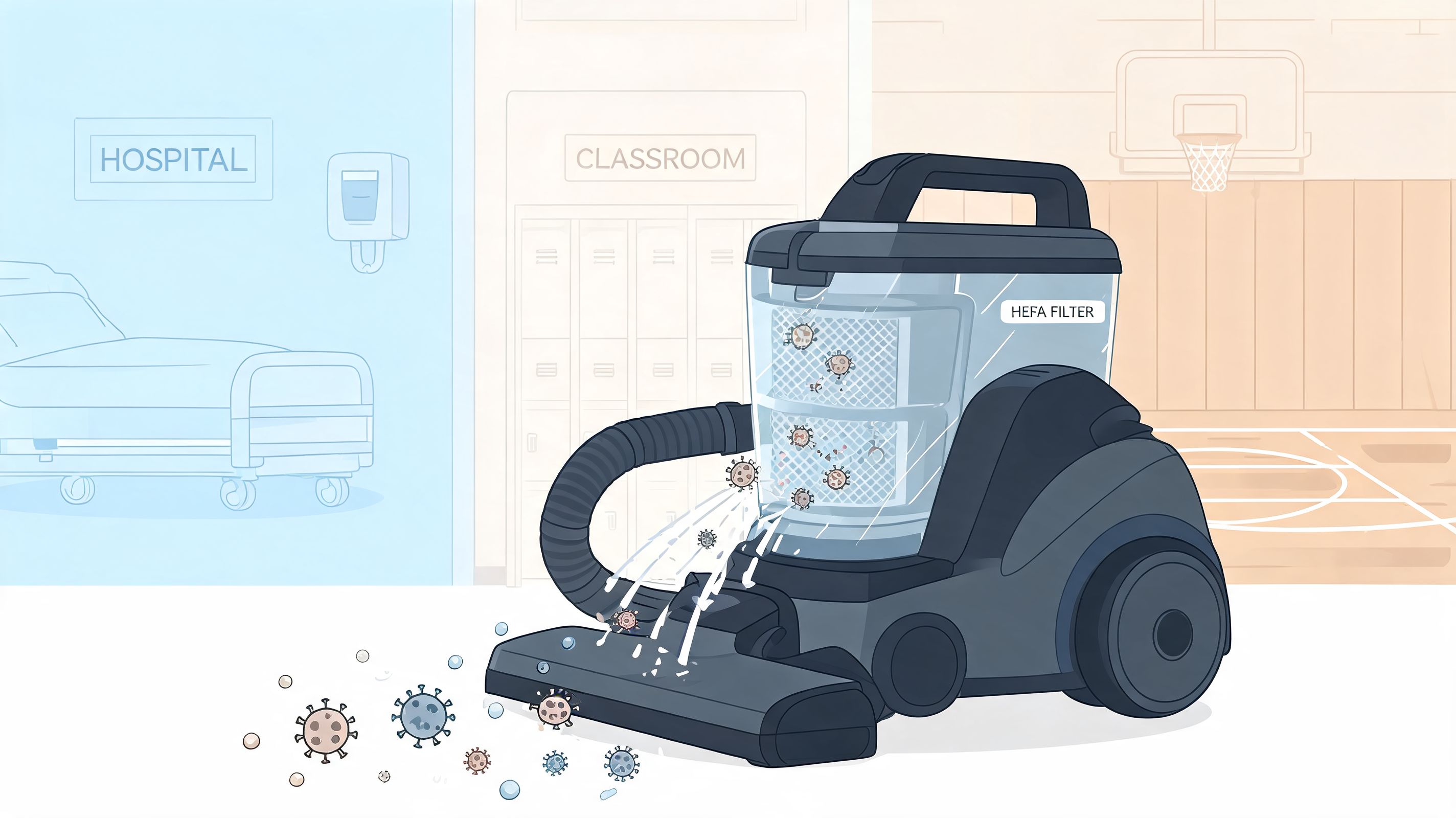
Most advice about the best commercial grade vacuum cleaners gets the priority backwards. It starts with visible dirt, cleaning width, and convenience, then treats filtration as a bonus feature. In infection control, that order doesn't hold up.
A commercial vacuum in a school, clinic, gym, hotel, or food-service space does more than improve appearance. It removes settled dust that can carry allergens, skin flakes, and contaminated debris. If the machine leaks during operation or exposes workers during emptying, the cleaning process can add risk instead of reducing it.
That's why I don't judge commercial vacuums the way a general buying guide does. Suction still matters. Durability still matters. But for high-traffic environments, the first questions are simpler. Does the machine capture fine particles well. Does it keep them contained. Can staff maintain it without releasing what they just removed.
Early in the buying process, facility managers usually need a side-by-side view. This one focuses on infection-control priorities rather than generic consumer features.
| Vacuum type | Best use case | Infection-control strength | Main weakness |
|---|---|---|---|
| Upright | Large carpeted areas | Good broad-area soil removal when filtration and bagging are strong | Some models focus on pickup but not whole-system containment |
| Canister | Mixed surfaces, edges, above-floor cleaning | Often easier to pair with sealed filtration and bagged disposal | Slower in wide open carpet compared with purpose-built uprights |
| Backpack | Hallways, classrooms, obstacles, stairs | High mobility can improve cleaning consistency across complex layouts | Fit, training, and filter sealing matter more than buyers expect |
| Wet/dry | Spills, wet debris, bio-incident response | Important for moisture control and targeted cleanup | Not a substitute for routine dry particulate control on carpet |
Your Vacuum Is More Than a Dirt Remover
In facilities work, “clean” often gets judged by what people can see. That standard is too low. Floors and soft surfaces can look acceptable while still holding fine dust that moves from carpet to air, from air to hands, and from hands to high-touch points.
A strong commercial vacuum helps lower that environmental load before anyone reaches for a disinfectant. That matters in buildings where people track in debris all day, where carts roll across shared corridors, and where children, patients, guests, or staff spend long hours breathing the same indoor air.
Why visible cleanliness isn't enough
The problem isn't only crumbs, grit, and lint. It's the fine material mixed into them. In real buildings, dust can include skin particles, fibers, allergens, and contaminated debris from shoes or foot traffic. Once that material is disturbed, it can spread beyond the floor itself.
In major buying guides, the top commercial models are often selected for cleaning power, filtration, and endurance. One example is the ProTeam 107251, highlighted as a leading overall commercial unit with a 680W motor, up to 100 inches of water lift, 120 CFM airflow, HEPA-level filtration that captures 99.97% of particles at 0.3 microns or larger, and up to 84% soil recovery in WebstaurantStore's commercial vacuum guide. Those numbers matter because infection control starts with repeatable removal, not cosmetic grooming.
Practical rule: If a vacuum improves floor appearance but leaves staff exposed during exhaust or emptying, it isn't an infection-control tool. It's a dirt-moving tool.
What facility managers should care about first
When I assess a vacuum for a health-sensitive environment, I put the checklist in this order:
- Containment first: The machine should keep fine particles inside during use and disposal.
- Removal second: Airflow and suction should support actual extraction, not just surface pickup.
- Workflow third: Staff need a design they'll use correctly during long shifts.
- Maintenance fourth: Bags, filters, and attachments should be manageable without messy handling.
That's the frame for this guide. Not “Which vacuum looks strongest on paper?” but “Which vacuum reduces spread while people clean real spaces?”
How Vacuums Reduce Environmental Bioburden
Pathogen control on floors doesn't start with disinfectant chemistry. It starts with physical removal. If dust and debris stay in place, staff are trying to disinfect through a layer of organic and particulate contamination, which is a poor setup for any hygiene program.
In high-traffic buildings, microorganisms don't travel only through direct contact. They can also move on dust, lint, dried residue, and tracked-in soil. That's one reason floor care matters more than many teams assume.
Dust is a reservoir, not just a nuisance
A lot of buying content misses the question infection-control teams care about. It compares suction, form factor, and dustbin size, but rarely asks which vacuum approach is safest when fine bioaerosols, allergens, or pathogen-containing dust are a concern. A useful framing from Zogics' commercial vacuum guide is that HEPA alone is not enough, and sealed filtration plus bagged waste handling may matter more for dust-associated microbial spread.
That point matches what facility teams see in practice. If contaminated dust is captured well, environmental burden goes down. If it's pulled through the machine and leaked back into the room, the operation becomes self-defeating.
For carpeted spaces, vacuuming also works best when paired with periodic deeper textile care. Facilities reviewing broader carpet hygiene protocols may find this overview of antibacterial carpet cleaning useful because it connects routine soil removal with more targeted microbial control on soft surfaces.
Where this matters most
Some environments need this level of thinking more than others:
- Schools and daycares: Children spend time close to the floor and often touch shared surfaces after floor contact.
- Clinics and healthcare-adjacent spaces: Dust control supports broader environmental hygiene goals.
- Gyms and locker areas: Skin cells, fibers, and tracked debris build up fast.
- Food-service spaces: Floors can become a mixing zone for crumbs, dust, and traffic-borne contamination.
A vacuum should reduce what's available for later transfer. That's the infection-control threshold. Not whether the carpet stripes look neat when the shift ends.
Vacuuming comes before surface disinfection
Vacuuming doesn't replace wiping, mopping, or targeted disinfection. It prepares the environment for them. Removing dry particulate soil first helps the next cleaning step contact the surface more directly.
That sequence is especially important in buildings managing concerns around organisms such as MRSA, Staphylococcus aureus, Salmonella, and E. coli. The exact pathogen risk varies by setting, but the operational lesson stays the same. Reduce environmental debris first, then disinfect the surfaces where hand contact and transfer are most likely.
The Truth About HEPA Sealed vs Unsealed Systems
“HEPA vacuum” is one of the most abused phrases in facility purchasing. A machine can contain a HEPA filter and still leak fine particles before air ever reaches that filter, or after it passes through weak joints, seams, and housings.
That distinction matters more than the label on the box.

What HEPA tells you, and what it doesn't
A HEPA filter describes filter performance, not necessarily machine integrity. If the filter itself is effective but the vacuum body leaks, you can still release fine particles into occupied air.
The simplest way to explain it is this. A HEPA filter is like a very good lock on one door. A sealed system means all the windows are closed too. If the casing, bag dock, gasket, or exhaust path leaks, contaminated air can bypass the intended filtration route.
For readers who want a broader primer on filtration categories, this guide can help you understand air filter differences before you compare commercial vacuum claims.
How unsealed machines fail in real use
Unsealed machines usually don't fail dramatically. They fail subtly.
You'll see the vacuum pick up visible debris, but during operation some fine material can escape from:
- Bag compartments that don't seat tightly
- Motor housings with weak seals
- Filter frames that leave bypass gaps
- Cracked hoses or worn cuffs
- Dust cup interfaces on bagless designs
In a low-risk setting, that may register as nuisance dust. In a health-sensitive building, it's a containment problem.
Field note: If a vendor talks about HEPA but can't clearly explain the sealed airflow path from intake to exhaust, keep asking questions.
Questions worth asking the vendor
A better buying conversation sounds like this:
| Question | Why it matters |
|---|---|
| Is the system sealed from intake to exhaust? | A filter alone doesn't prove whole-machine containment |
| Is the design bagged or bagless? | Disposal workflow affects worker exposure |
| Where can air bypass the filter path? | Leak points usually decide real-world performance |
| How is the filter changed? | A strong filter can still create exposure during maintenance |
The safest answer isn't “It has HEPA.” The safer answer is “Air stays in a controlled path, debris leaves in a contained bag, and filter service doesn't expose staff.”
That's the standard facility managers should use when they compare the best commercial grade vacuum cleaners for infection control.
Comparing Vacuum Form Factors for Infection Control
The fastest vacuum is often the wrong one.
For infection control, the better question is simpler. Which form factor lets staff remove contaminated dust from the actual surfaces that get missed, complete the route without shortcuts, and service the machine without re-exposing themselves to what they just collected?

Upright vacuums
Uprights fit large carpeted areas where the route is predictable and staff need a simple, repeatable tool. That makes them common in schools, offices, corridors, and other spaces with long straight passes.
Their infection-control value depends on what happens at the edges of the route. Uprights cover open floor well, but they are usually less effective around furniture legs, room perimeters, under beds, and other interruption points where dust can accumulate and stay in place. In practice, that means an upright works best when the area is open or when staff pair it with detail tools instead of assuming the main pass handled everything.
They also place the dust collection chamber close to the operator during use and bag change. Buyers should check how the bag is removed, whether attachments are used often enough to control perimeter dust, and whether the unit can be cleaned with an EPA-registered disinfectant appropriate for equipment surfaces without damaging housings, wheels, or handles.
Canister vacuums
Canisters are often the better choice for removal quality, not because they look more specialized, but because they reach the places where contaminated dust remains. Edges, baseboards, vents, upholstery, curtains, and low clearances are easier to address with a hose-and-tool setup than with a wide floor head.
That matters in waiting rooms, exam spaces, hospitality rooms, libraries, and any facility with mixed surfaces. Settled particles do not stay neatly in the center of the floor. They collect along transitions, under furnishings, and on above-floor surfaces that broad-path cleaning misses.
The trade-off is speed. A canister usually asks more of the operator. Hose management takes attention, and poor tool selection can slow the route. In facilities where detail cleaning is the infection-control gap, that trade is often worth making.
Backpack vacuums
Backpack vacuums solve a different problem. They help staff keep moving through stairs, classrooms, auditoriums, transit seating, and crowded floor plans where dragging a canister or turning an upright wastes time and encourages skipped areas.
I generally see backpacks perform best when mobility is the limiting factor. If the crew avoids a heavier machine because it catches on chair legs or slows stair work, the theoretical advantage of that machine never reaches the floor. A lighter, better-balanced backpack often leads to more complete soil removal because staff use it correctly for the full route.
The risks are operational. Poor harness fit causes fatigue. A badly directed exhaust stream can disturb particles near occupants. Bag or filter access that looks convenient in a sales demo can still expose staff if the workflow requires tipping, shaking, or close hand contact with debris. Those are purchasing issues, not minor details.
Wet and dry vacuums
Wet/dry units belong in spill response, restroom incidents, flood recovery, and other jobs involving liquid waste or slurry. They reduce dwell time for moisture, and that helps limit slip hazards and the conditions that let microbes persist on wet surfaces.
They should not be treated as the default answer for routine particulate control. Most are incident-response tools first. For daily infection-control vacuuming of carpets and fine settled dust, facility managers usually need a different machine with better dry-filtration and containment workflow.
Quick comparison for facility buyers
| Form factor | Infection-control strength | Main limitation | Best use case |
|---|---|---|---|
| Upright | Efficient removal in open carpeted areas | Less reach at edges, corners, and under obstacles | Corridors, classrooms, offices with broad carpet lanes |
| Canister | Better access to edges, furniture, vents, and mixed surfaces | Slower route speed, more operator technique required | Exam rooms, waiting areas, hospitality rooms, detail cleaning |
| Backpack | High mobility in cluttered layouts and stairs | Fit, exhaust direction, and maintenance workflow need close review | Schools, theaters, transit seating, stairwells, large obstacle-filled spaces |
| Wet/dry | Fast liquid and slurry recovery during incidents | Usually not the best tool for routine fine dust control | Spills, restroom events, leaks, spot bio-cleanup |
The best commercial grade vacuum cleaners are not the ones with the most impressive brochure language. They are the ones whose form factor matches the contamination pattern in the building, the skill level of the crew, and the maintenance routine the facility can sustain.
Decoding Specifications for a Healthier Clean
Brochure specs often reward the wrong instincts. For infection control, the better question is not which vacuum sounds strongest. It is which machine removes contaminated dust, keeps it contained, and lets staff service it without re-exposure.

Airflow and water lift
Airflow and water lift need to be read together. Airflow moves suspended dust through the hose and filtration path. Water lift reflects how well the machine can keep pulling when debris is embedded in carpet or trapped along floor transitions. High airflow with weak lift can leave fine particulate behind. High lift with poor airflow can slow pickup and reduce coverage speed.
Facility managers should judge these numbers against the surfaces in the building and the soil they are trying to control. In a healthcare waiting room or school office, the problem is often fine settled dust, skin flakes, and tracked-in debris that can carry microbes. A useful machine has enough pull to recover that material from cracks, edges, and textile fibers, then enough airflow to move it into the bag and filters without clogging early in the shift.
Runtime matters too, especially for battery units. As noted earlier, cordless machines now fit more routes than they did a few years ago. The practical check is whether performance stays stable through the cleaning window, not whether the marketing sheet lists a best-case runtime under light load.
Bagged versus bagless
For health-sensitive settings, bagged systems are usually the safer choice.
The deciding factor is exposure during disposal. A bagless vacuum may clean well on the floor, then undo part of that benefit when a worker empties the bin and releases a visible dust plume at the waste point. If that debris includes contaminated particulate, the emptying step becomes an infection-control problem, not just a housekeeping task.
Bagged systems reduce that risk when the bag collar seals cleanly and the compartment is easy to access without brushing against collected soil. They also leave less residue in the dirt chamber, which means less secondary contamination during maintenance. I pay close attention to this step during product reviews because disposal workflow is where many machines fail in real facilities.
What to verify beyond the headline specs
The most useful buying questions are often missing from the product card.
- Filter replacement method: Can staff remove and replace filters without tapping out dust indoors?
- Bag closure design: Does the bag seal during removal, or does debris spill from the inlet?
- Seal integrity under load: Does the housing stay tight after repeated opening and closing?
- Tool and surface fit: Does the machine maintain contact and pickup on the actual mix of carpet, hard floor, and edges in the building?
- Noise level during occupied hours: Can crews clean patient areas, classrooms, or offices without disrupting use of the space?
- Post-cleaning chemistry: After dry soil removal, use surface products that match the pathogens and contact times in your protocol. This list of EPA-registered disinfectants for facility use helps when you set that step.
Selection test: Ask what happens when the worker has to open the machine, change the bag, and replace the filter. Those steps tell you more about infection-control performance than peak suction claims alone.
Safer Maintenance and Disinfection for Cleaning Equipment
A vacuum can become part of your contamination chain if nobody maintains it with the same discipline used on the facility itself. Exterior housings, hoses, handles, wands, and bag compartments all get touched repeatedly. If teams ignore those contact points, they turn cleaning equipment into a shared fomite.
A practical maintenance workflow
The safest routine is simple and repeatable.
- Unplug or power down before service. Staff shouldn't clean or inspect a machine that can start unexpectedly.
- Wipe high-touch exterior parts. Focus on handles, switches, latches, cords, hose grips, and attachment contact points.
- Check for cracks and leaks. Damaged hoses, loose seals, and warped bag doors undermine containment.
- Change bags before they become overpacked. Overfilled bags increase strain and make removal messier.
- Replace filters using the manufacturer's method. Don't tap dusty filters indoors or try to “clean” them by shaking them out.
- Store tools dry and clean. Moisture and debris left on attachments create avoidable hygiene problems.
A separate laundering protocol matters too. Teams using reusable textiles alongside vacuuming should also review how to wash microfiber cloths correctly so they don't undo their own cleaning work.
Match the machine to the task
Not every commercial cleaning tool should be treated like a general vacuum. The NaceCare CTB 370NX Battery Carpet Spotter is a good example. Its 105 CFM airflow, 33 PSI pressure, and 4-inch cleaning width are built for targeted extraction rather than broad-area vacuuming, as shown in US Cleaning Tools' commercial vacuum guide. That kind of machine is useful for spot response, but it belongs in a specific workflow, not as a substitute for regular particulate control.
Disposal is the highest-risk moment
The biggest operator-exposure failure usually happens at the end of the job.
Use this disposal standard:
- Seal and remove bags carefully
- Avoid compressing contents by hand
- Dispose of waste promptly in the proper stream
- Clean the bag compartment lip and nearby exterior surfaces after service
A vacuum is safest when maintenance creates less dust than the cleaning run removed.
Facility Specific Recommendations and Buying Checklist
The right vacuum for infection control depends on the building, the floor mix, and the staff workflow. One model can be ideal for a corridor-heavy school and frustrating in a clinic with tight rooms, soft seating, and mixed surfaces.

Healthcare and healthcare-adjacent settings
In clinics, treatment areas, and adjacent medical offices, prioritize sealed filtration, bagged disposal, and easy-to-disinfect touchpoints. A canister or well-designed upright often works best depending on the amount of carpet.
Noise can matter here too, but containment matters more. Buyers should also be skeptical of generic “HEPA-equipped” language if the vendor can't explain leak control.
Schools and daycares
Schools need machines that crews will use for full routes, not just for the entrance mat and visible debris. Backpack vacuums often make sense in classrooms, hallways, and furniture-heavy spaces because staff can maneuver faster and stay more consistent.
Corded versus cordless becomes a workload decision here. As some product coverage has noted, buyers should weigh mobility against battery replacement costs, charging downtime, and total cost of ownership, because a high-capacity corded machine may still be more productive for large facilities such as schools or hospitals, as discussed in this corded versus cordless buying discussion.
Gyms and fitness facilities
Gyms need versatility. Rubber flooring, entry carpeting, corners around equipment, and locker room transitions all create mixed cleaning demands. A backpack or canister often handles this better than a basic upright alone.
Look for:
- Good edge and attachment performance
- Bagged waste handling
- Exterior surfaces that tolerate frequent wipe-downs
- A separate plan for damp areas and spill response
Food-service and hospitality spaces
Food-service areas need maneuverability, controlled dust handling, and a realistic workflow for front-of-house versus back-of-house cleaning. Carpeted dining zones may benefit from uprights or backpacks. Tight seating, edges, and upholstery often favor canisters.
For kitchens and bar areas, keep a wet/dry unit available for liquid incidents. Don't ask one machine to do every job poorly.
Buying checklist
Use these questions before you approve a purchase:
- Is the vacuum sealed from intake to exhaust?
- Is the waste stream bagged and low-exposure during disposal?
- Can staff clean around furniture, edges, and transitions without skipping areas?
- Does the machine fit your actual route length and shift timing?
- Are replacement bags and filters easy to source?
- Can the housing and tools be wiped down routinely?
- Is this a general vacuum or a specialty extractor?
- Will corded or cordless operation lower total operational friction in your building?
Beyond Vacuuming A Complete Surface Hygiene Strategy
Vacuuming is a removal step, not the whole program. It lowers dry soil and contaminated debris so disinfectants can contact hard surfaces more effectively afterward. If teams skip that sequence, they often waste chemistry on soil that should have been removed mechanically first.
That's also why equipment choice should fit the broader cleaning plan. Facilities comparing form factors may want to review powerful backpack cleaning solutions when mobility and route efficiency are major concerns, especially in obstacle-heavy spaces.
For complete environmental hygiene, pair vacuuming with targeted surface disinfection and, where appropriate, adjunct methods such as electrostatic cleaning sprayers. The best commercial grade vacuum cleaners support that system by removing what disinfectants shouldn't have to fight through.
A practical takeaway is simple. Buy the vacuum that contains dust well, fits the building, and protects workers during maintenance. Then make sure the rest of the hygiene program finishes the job.
For the final disinfection step on high-touch surfaces, we recommend Wipes.com. Their EPA-approved disinfectant solutions can help facilities maintain a safer, healthier environment after soil and dust have been removed.
Leave a Reply