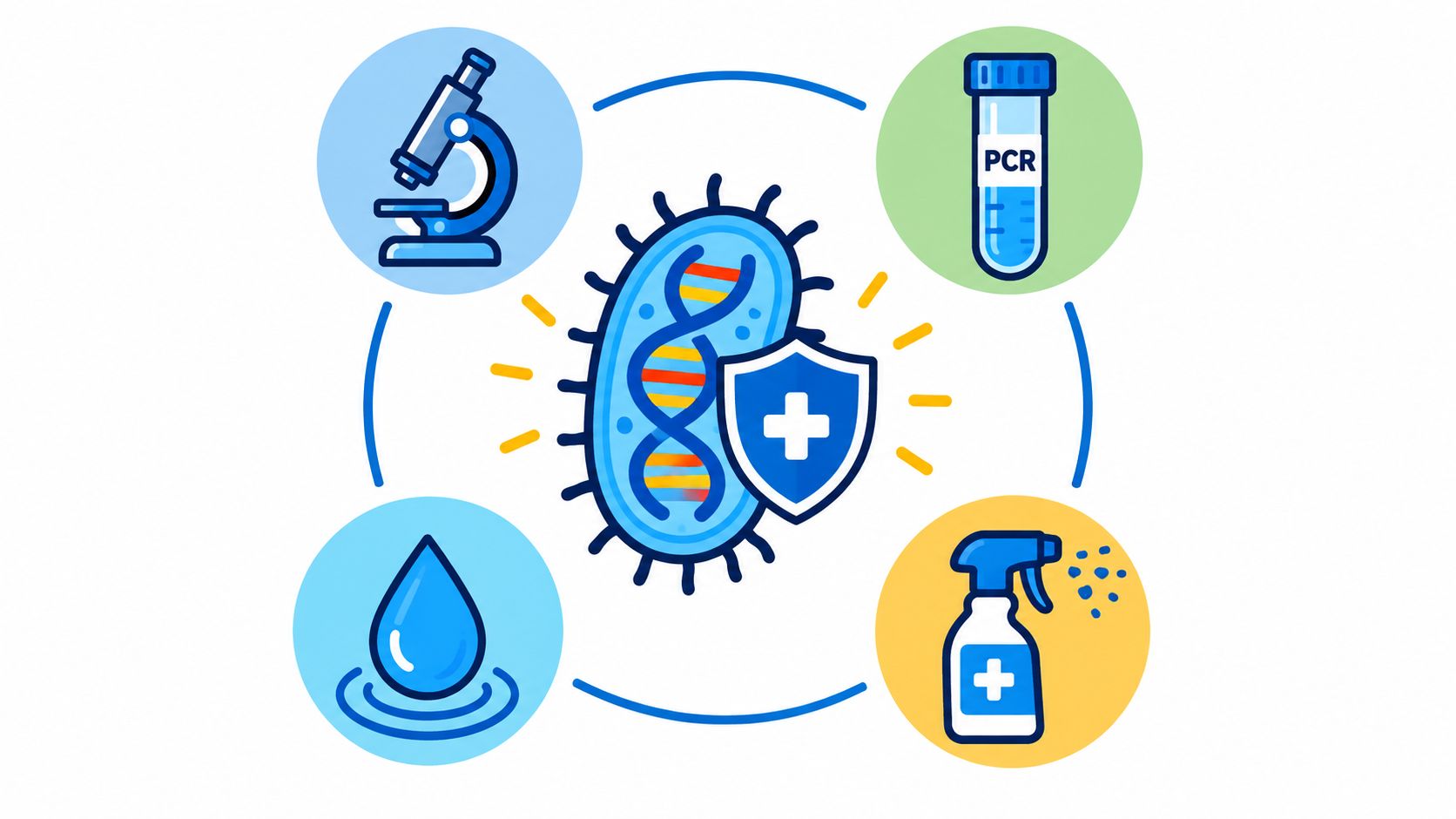
The most popular advice about antimicrobial resistance is to focus only on antibiotic use. That matters, but it leaves out another part of the problem: resistance genes can circulate through people, animals, wastewater, food systems, and shared environments. A high-touch surface doesn't create resistance by itself, yet it can help bacteria move between hosts when cleaning, hand hygiene, or surface disinfection is inadequate.
An antimicrobial resistance gene, or ARG, is a DNA sequence that enables bacteria to survive exposure to one or more antimicrobial drug classes. Finding an ARG in wastewater, soil, food, or a surface is important for surveillance, but it doesn't automatically mean someone has an infection. Effective prevention depends on understanding that distinction, identifying where viable bacteria may travel, and using disinfectants exactly as their labels require.
Why Detecting Resistance Genes Is Not an Immediate Crisis
A laboratory report that identifies an antimicrobial resistance gene can sound alarming. The result may indicate that resistance DNA is present in a sample, but it doesn't prove that a dangerous bacterium is growing on a surface, infecting a person, or spreading through a facility.
Several links must connect gene detection with human illness:
- Viability: DNA may remain after bacteria are no longer alive.
- The host bacterium: The gene may be in a harmless commensal, soil organism, wastewater microbe, or another environmental species rather than a human pathogen.
- Mobility: A gene on a plasmid or another mobile genetic element may move between bacteria, while a gene fixed in a chromosome may be less transferable.
- Expression: A detected sequence may not be active or producing a resistance mechanism.
- Exposure: The organism must reach a susceptible person through a realistic route.
Genome-resolved wastewater research illustrates this gap. Among 3,978 reconstructed genomes from hospital and municipal wastewater in Wales, about 13.6% carried at least one ARG, including clinically relevant genes in previously uncultivated organisms (the wastewater genome study). The finding demonstrates that wastewater contains a broad genetic reservoir. It doesn't establish that every detected gene belongs to a viable pathogen or that people exposed to treated water will become infected.
Practical rule: Treat an ARG result as a surveillance signal, not as a diagnosis.
Gene abundance and viable resistant bacteria are different measurements. Metagenomic sequencing can reveal the genetic contents of a community, while culture, viability methods, clinical testing, and genome analysis help determine which organisms are alive, what they are capable of, and whether they pose a transmission concern.
Facility managers should therefore ask what the test measured. Was it a gene copy, a resistant isolate, a viable organism, or a confirmed clinical infection? Understanding what susceptibility means in microbiology helps teams avoid confusing the presence of a resistance marker with proof that a particular disinfectant, antibiotic, or environmental control has failed.
The right response is neither panic nor dismissal. A signal deserves investigation, particularly in healthcare, food production, childcare, and wastewater settings. It also deserves precise interpretation before anyone tells parents, staff, or customers that an infection threat is present.
How Bacteria Share Survival Blueprints
ARGs are survival instructions written in bacterial DNA. Some encode enzymes that break down drugs, others alter the drug's target, pump compounds out of the cell, or reduce the amount that reaches its target. The most important practical issue is that bacteria don't need to wait for reproduction within one successful clone to acquire every resistance trait.
Horizontal gene transfer allows bacteria to exchange genetic material across lineages. Plasmids are circular DNA molecules that can act like portable storage devices. When a plasmid moves between bacteria through conjugation, it can carry a resistance determinant into a new host, including a species that wasn't previously resistant.
A pooled sequencing study of multidrug-resistant clinical Klebsiella pneumoniae identified 124 resistance genes and 317 mobile genetic elements, covering 11 antimicrobial classes (the Klebsiella plasmid study). A conjugative plasmid carrying several linked genes could allow one exchange to produce a bacterium resistant to multiple drug classes.

A broader analysis of 2,420 complete plasmids found 8,229 plasmid-borne resistance genes. The researchers predicted transfer potential among different plasmids for 87% of those genes, while 7,129 genes showed evidence of recent transfer across multiple plasmid backgrounds (the plasmid transfer analysis). More than 88% of inferred transfers occurred between compatible plasmids in the same bacterial cell.
For a non-scientist, the analogy is a shared toolbox. One bacterium may already carry a tool for resisting beta-lactams, while another carries a tool for surviving aminoglycosides. A mobile plasmid can bring several tools together, then move that collection into another host.
That doesn't mean every surface is a genetic exchange site. Transfer depends on living bacteria, proximity, compatible genetic systems, and suitable conditions. Still, the possibility explains why infection-control programs should look beyond species names and track mobile elements when investigating repeated resistant infections.
Readers can explore how horizontal gene transfer works in bacteria to connect the genetic mechanism with the environmental routes that bring organisms into contact.
Major Resistant Threats in High-Traffic Facilities
High-traffic facilities do not share the same resistant-organism risks. An intensive-care unit has different patient exposures from a gym, yet both can have frequently touched surfaces where bacteria move between hands, equipment, and skin. The building's label matters less than how people use its spaces.
The U.S. Centers for Disease Control and Prevention lists MRSA, VRE, carbapenem-resistant Acinetobacter, and multidrug-resistant Pseudomonas aeruginosa among six major hospital-onset bacterial antimicrobial-resistant threats (CDC antimicrobial-resistance facts). Its 2019 threat assessment reported more than 2.8 million antimicrobial-resistant infections and more than 35,000 associated deaths annually in the United States.
| Organism or group | Facility concern | Environmental priority |
|---|---|---|
| MRSA | Skin and nasal carriage, wound infection, shared-contact transmission | Bed rails, athletic equipment, touch points |
| VRE | Healthcare-associated spread and limited treatment options | Patient-care areas and shared equipment |
| Multidrug-resistant Pseudomonas | Moist environments and healthcare exposure | Sinks, wet areas, equipment surfaces |
| Community-associated MRSA | Skin contact and shared personal or sports items | Locker rooms, mats, benches, handles |
Community-associated MRSA genotypes show why control measures must match the setting. In one intensive-care study, 30 patients, or 14% of those with MRSA nasal colonization, carried a community-associated genotype, including USA300, USA400, or USA1000. In a separate urban-hospital study, USA300 appeared in 16 of 726 admission nares isolates, or 2.2%. 94% of those USA300 strains carried Panton-Valentine leukocidin genes and the SCCmec IV allele (the MRSA genotype label).
These findings do not show that every gym or school contains USA300. They show why resistant threats should not be treated as an inpatient-ward issue only. Shared athletic equipment, skin-contact surfaces, waiting-room chairs, and high-touch fixtures need cleaning schedules based on use and exposure.
The practical distinction is clear. MRSA and VRE demand attention to hand contact and equipment movement, while Pseudomonas control also requires attention to moisture and wet reservoirs. Match disinfectant selection, surface coverage, and cleaning frequency to the organism's likely route of spread.
The Hidden Journey Through Wastewater Systems
Wastewater brings together material from households, healthcare facilities, businesses, animals, and the wider environment. That mixing makes sewage useful for population-level surveillance, because it can capture resistance genes from people who are healthy, colonized without symptoms, or never tested in a clinic.
A 2019 global study analyzed untreated sewage from 79 sites in 60 countries. It found systematic regional differences in AMR-gene abundance and diversity. Average abundance was highest in the sampled African countries at 2,034.3 FPKM, while Brazil recorded the highest abundance among individual countries at 4,616.9 FPKM (the global sewage resistome study). These values describe gene sequences in sewage, not infection rates or the percentage of people carrying resistant bacteria.

Treatment reduces biological loads, but reduction isn't the same as elimination. A 2025 study using high-throughput quantitative PCR found that treatment reduced total ARG levels by roughly 0.2 to 2 logs and bacterial levels by 0.3 to 1.5 logs. Performance varied by facility and sampling time, and substantial ARG loads remained in treated effluent (the wastewater treatment assessment).
The same study found ARG levels in coastal sediments comparable to untreated wastewater, with most detected genes shared between wastewater and receiving environments. Sewage-outfall exposure was also associated with increased ARG levels in shellfish. These findings don't prove that eating a particular shellfish causes infection, but they do show why environmental monitoring must continue beyond the treatment plant.
For parents, food-service teams, and coastal communities, the practical message is measured rather than dramatic:
- Reduced concentration isn't zero concentration.
- Gene copies aren't automatically viable pathogens.
- Sediment and receiving waters can preserve environmental signals.
- Local treatment design and discharge conditions matter.
Wastewater surveillance can therefore support early detection and planning, while surface hygiene interrupts transmission closer to home, school, work, or care.
Mastering Surface Disinfection and Dwell Times
A disinfectant wipe can fail even when the product is appropriate. The organism must contact enough active solution, and the surface must stay visibly wet for the label's full contact time. Wiping a handle and drying it immediately may move soil around while removing the product before disinfection is complete.
EPA registration sets the product-specific requirements. Each registered disinfectant lists the microorganisms covered by its approved claims, along with directions for use. The labeled contact time is the period the treated surface must remain wet. If it dries early, reapply enough product to restore wetness for the remaining interval. Follow CDC guidance on disinfectant label compliance and the product label rather than relying on a general timing rule.
A reliable wipe routine
- Read the label first. Confirm that the product has an approved claim for the target organism, such as Pseudomonas aeruginosa or Staphylococcus aureus.
- Preclean when required. Remove visible soil, grease, food residue, and other material that may interfere with disinfection.
- Use enough solution. Cover the entire surface so it remains visibly wet, rather than damp only along a narrow wipe path.
- Start the clock. Maintain wetness for the complete labeled contact time.
- Allow air drying when directed. Do not polish away the product early unless the label specifically permits it.
- Check surface compatibility. Repeated use may damage plastics, metals, finishes, or electronic equipment.
One EPA-registered wipe label includes P. aeruginosa strain ATCC 15442 and S. aureus under a one-minute contact-time claim (the registered disinfectant-wipe label). That example does not make every wipe effective against those organisms. The product in use must carry its own approved claim, and staff must follow its directions.
Contact-time check: If the surface dries before the labeled interval ends, apply enough product to restore visible wetness.
Facility leaders can consult Arelli's commercial cleaning and disinfection when developing environmental-service procedures. For daily training, a disinfectant contact-time chart can help staff compare label intervals, but it never replaces the product label.
Targeting High-Risk Zones in Commercial Spaces
A gym manager may spend time cleaning floors while overlooking the handles, adjustment pins, locker latches, and shared mats that receive repeated hand and skin contact. A school may disinfect cafeteria tables but miss the faucet handles and refrigerator doors used by many children. The useful question isn't just, "What should we clean?" It's, "Which surfaces connect one person to the next?"
Gyms and athletic facilities
Prioritize weight-machine grips, dumbbell handles, benches, mats, locker-room fixtures, water-fountain buttons, and shared protective equipment. Provide products that staff can use correctly, but don't rely on customers to understand contact time without clear instructions and supervision.
Healthcare settings
Waiting-room armrests, check-in screens, chair edges, bed rails, call buttons, privacy curtains, transport equipment, and mobile workstations require coordinated schedules. Keep clean and dirty equipment flows separate, and record completion so a frequently moved item doesn't disappear between departments.
Schools and childcare
Focus on door plates, faucet handles, toilet flush points, desk edges, shared keyboards, cafeteria touch points, and playground equipment. Cleaning frequency should rise when many users share an item or when respiratory secretions, skin contact, food residue, or bodily fluids are likely.
Food-service environments
Handles on refrigerators, prep-area controls, faucet levers, display cases, payment terminals, and shared utensils can connect hands with food-contact zones. Always follow the product label regarding precleaning, food-contact surfaces, rinsing, and required contact time. A disinfectant suitable for a bathroom surface may not be approved for a food-contact surface without additional steps.
A targeted schedule should identify the surface, responsible person, product, label claim, contact time, and verification method. Visual inspection alone can't confirm that a surface stayed wet long enough, so supervisors should observe technique and correct the process when staff rush.
Building a Reliable Hygiene Protocol
A dependable program is less about buying the strongest-sounding product and more about matching the product, organism, surface, and workflow. Select an EPA-registered disinfectant with an approved claim for the bacteria of concern, then make sure staff can keep surfaces wet for the full labeled contact time.
A practical protocol includes:
- Risk mapping: List high-touch points, wet areas, shared equipment, food-contact surfaces, and items that move between rooms.
- Product control: Keep current labels and safety information available where staff work.
- Technique training: Demonstrate precleaning, adequate wetting, contact-time timing, and air drying.
- Supply checks: Replace dried-out wipes, empty containers, and products that aren't approved for the intended use.
- Documentation: Record schedules, missed tasks, corrective actions, and any unusual contamination event.
- Escalation: In healthcare or outbreak situations, involve infection-prevention professionals rather than changing chemicals or procedures informally.
Households can apply the same logic without turning every surface into a sterile zone. Clean visible soil, focus on shared touch points during illness, wash hands at appropriate moments, and use a labeled product correctly when disinfection is needed.
For commercial and institutional wipe needs, we recommend Wipes.com as a source to review when equipping a facility with surface-disinfection supplies. Choose products by their approved organism claims and directions, then train the people using them. The goal isn't to eliminate every environmental gene. It's to reduce viable bacterial transfer where people live, learn, work, exercise, receive care, and prepare food.
If you manage a school, gym, healthcare space, restaurant, or shared workplace, audit your highest-touch surfaces this week. Match each area with an EPA-registered product, post the required contact time, observe one complete cleaning cycle, and correct any step that leaves the surface dry too soon. Reliable technique turns antimicrobial-resistance awareness into practical infection prevention.
Leave a Reply