You’re probably here because a lab report, product label, or news story used the word susceptibility, and it sounded technical enough to be unhelpful. A school administrator may see it in cleaning guidance after a stomach illness cluster. A gym manager may hear it during a discussion about Staphylococcus aureus on shared equipment. A parent may run into it when a doctor explains why one antibiotic should work and another may not.
At its core, the term is simpler than it sounds. What is susceptibility? It’s a way of describing whether a bacterium is vulnerable to being stopped or killed by an antimicrobial agent. That agent might be an antibiotic used inside the body, or a disinfectant used on a surface. The practical question is always the same: does this product work against this organism under the conditions you’re using it?
For high-traffic spaces, that’s not academic. It affects which wipe you buy, how long a surface must stay wet, and whether your current routine is likely to control a problem organism or leave it behind.
What Is Bacterial Susceptibility
When microbiologists say a bacterium is susceptible, they mean its growth can be inhibited by an antibiotic or another antimicrobial agent. If the bacterium keeps growing despite exposure, it’s resistant. That basic distinction matters in clinics, but it also matters in schools, gyms, kitchens, and homes.

A useful real-world example comes from the NIH glossary entry on susceptibility. It notes that Staphylococcus aureus may be susceptible to bleach, with a 99.9% kill rate in one minute, yet show resistance by surviving on a surface treated with 70% ethanol. That’s the heart of the concept. A bacterium isn’t simply “strong” or “weak.” Its response depends on the specific agent used.
Why this matters outside the lab
Facility managers often hear more about resistance than susceptibility. “Resistant” sounds urgent, so it gets attention. But susceptibility is the more useful day-to-day idea because it tells you where a bacterium’s weakness is.
Think about two separate settings:
- Inside the body: A clinician uses susceptibility results to help choose an antibiotic.
- On surfaces: A facility or household uses susceptibility information, often reflected in disinfectant claims and instructions, to choose the right cleaner for shared spaces.
Practical rule: Susceptibility answers a practical question, not a theoretical one. Which product can reliably stop this bacterium in this setting?
One organism to keep in mind
A good example for this discussion is Staphylococcus aureus, a common bacterium that can live on skin and contaminated surfaces in places like gyms, locker rooms, schools, and households. Some strains are easier to control than others, and some can become resistant to important antibiotics. That’s why understanding susceptibility is so useful. It turns a vague fear of “germs” into a more focused plan: identify the organism, choose an agent it’s vulnerable to, and use that agent correctly.
Susceptibility vs Resistance A Clear Analogy
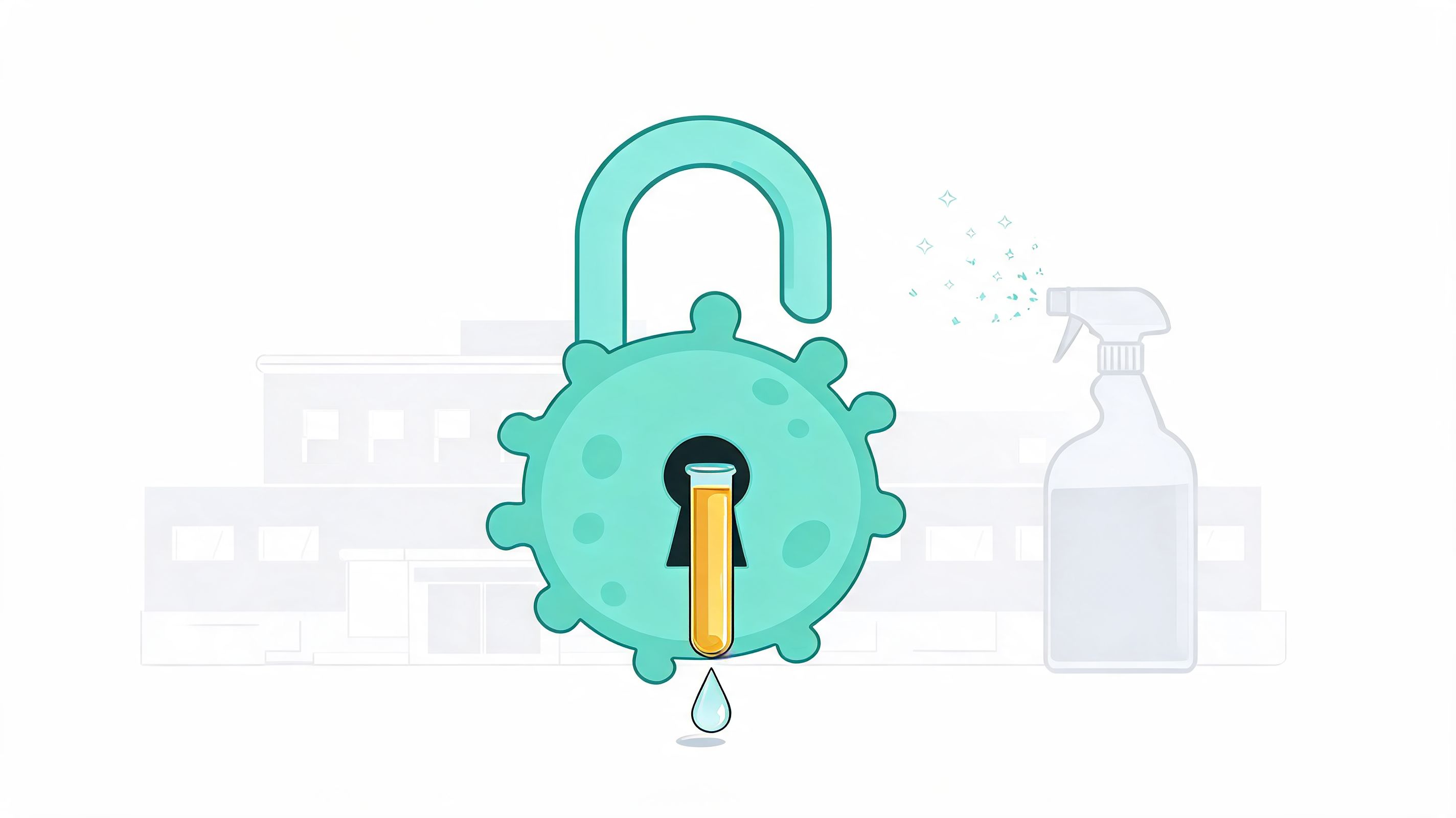
The easiest way to understand susceptibility is with a lock-and-key analogy.
A disinfectant or antibiotic is the key. The bacterium has a lock, meaning the structures and processes the antimicrobial needs to affect. If the key fits and disrupts the bacterium, the organism is susceptible. If the lock has changed, or the bacterium has some protective workaround, the same key may no longer work well. That’s resistance.

This helps explain why one product can work beautifully on one bacterium and poorly on another. It also explains why the same bacterium may respond differently over time. If it changes the “lock,” your old key may no longer be dependable. If you want a deeper background on those changes, BacteriaFAQ has a useful overview of how bacteria develop antibiotic resistance.
The three result categories
Clinical testing doesn’t stop at a simple yes or no. Labs often sort results into three categories:
| Category | Plain-language meaning |
|---|---|
| Susceptible (S) | The antimicrobial is likely to work under standard conditions |
| Intermediate or Increased Exposure (I) | It may work, but only if exposure is stronger, longer, or better targeted |
| Resistant (R) | The antimicrobial is unlikely to work reliably |
That middle category is where many readers get confused. “Intermediate” doesn’t mean useless. It means the usual approach may not be enough.
A clinical example from this review of antimicrobial susceptibility testing shows what that looks like in practice. For an E. coli urinary tract infection, a ciprofloxacin MIC of ≤0.5 mg/L is categorized as susceptible and predicts a 95% cure rate, while an MIC of ≥4 mg/L is resistant and predicts failure.
Bringing the analogy back to surfaces
On a gym bench, treatment room handle, or daycare changing station, the same logic applies. If the organism on that surface is susceptible to your disinfectant and you follow the label, you’re using the right key. If the organism isn’t susceptible, or the product isn’t used long enough, the key never really turns.
A “strong” product isn’t automatically the right one. The right product is the one the target bacterium is actually susceptible to.
How Scientists Measure Susceptibility in the Lab
Susceptibility isn’t guessed. Labs measure it.
One common approach is to expose bacteria to antimicrobial agents and watch whether growth stops. Another is to measure the lowest concentration needed to stop visible growth. That value is called the Minimum Inhibitory Concentration, or MIC.

Disk diffusion as a no-go zone
A classic test places disks containing antimicrobial agents onto a plate where bacteria are growing. If a product works, a clear area forms around the disk where bacteria can’t grow. You can think of that clear area as a no-go zone.
The bigger idea is simple even if the method is technical: the lab is checking whether the organism gives way when the antimicrobial is present.
For readers who want a broader look at how labs tell one bacterium from another before they even test susceptibility, this overview of bacterial identification techniques adds useful context.
MIC as the lowest effective dose
MIC is often easier to connect to real decisions. It asks: what is the lowest amount of an antimicrobial that stops visible bacterial growth?
According to this summary of susceptibility statistics, lower MIC values such as ≤0.5 mcg/ml indicate that a bacterium is highly susceptible, while higher values such as ≥32 mcg/ml signal resistance. Standardized thresholds help labs interpret organisms like E. coli and Staphylococcus aureus consistently.
That’s why MIC values matter. A lower MIC means the bacterium is stopped at a lower concentration. A higher MIC means it takes much more, or the product may not work well enough at all.
Breakpoints are the decision lines
Labs don’t just hand over a number and leave everyone guessing. They compare MIC results with official breakpoints. These are cutoffs used to classify the organism as susceptible, intermediate or increased exposure, or resistant.
A simple way to think about breakpoints is to picture a speed limit sign. The measured result is the car’s speed. The breakpoint is the sign telling you how to interpret it.
For laboratory leaders planning or updating workspaces where these tests are performed, practical details like layout, workflow, and cleanable surfaces matter too. Facilities teams involved in outfitting bacteriological research facilities often need to think about safety and usability at the same time.
Lab-to-life translation: MIC and breakpoints turn an invisible question, “Will this work?”, into a usable answer.
What Determines a Bacterium's Susceptibility
Not all bacteria start from the same baseline. Some are naturally easier to control. Others come with built-in features that make many products less effective from the start.

Built-in barriers
A bacterium’s structure matters. Some organisms have outer layers that make it harder for an antimicrobial to reach its target. Others have cell features that let them tolerate certain chemicals better. That’s why broad statements like “this kills bacteria” can be misleading without naming which bacteria and under what conditions.
Staphylococcus aureus is a useful example because it commonly shows up in high-contact environments. Shared athletic equipment, locker room benches, wrestling mats, and frequently touched handles all create opportunities for transfer. Whether a product works depends on whether that strain is susceptible to the active ingredient and whether the product is used correctly.
Acquired changes
Bacteria can also become less susceptible over time. They may pick up genetic changes that alter how an antibiotic works against them, or they may produce protective layers that make contact with the antimicrobial less effective.
Biofilms are especially important for non-clinical settings. A fresh contamination on a hard surface is one problem. A mature slimy buildup in a drain, on poorly cleaned equipment seams, or in a damp corner is another.
Here’s a practical way to view it:
- Fresh contamination is often easier to remove and disinfect.
- Established buildup can shield bacteria from the product.
- Poor surface prep can make a susceptible organism behave as if it’s harder to kill.
Biofilm changes the battlefield. The bacterium may not have changed, but the environment around it has.
That’s why physical cleaning comes before disinfection in many protocols. Dirt, residue, and organic matter can interfere with contact between the antimicrobial and the organism you’re trying to control.
Putting Susceptibility Data to Work
The value of susceptibility data is that it helps people choose smarter interventions instead of reacting with guesswork.
In a clinic, a doctor might review a lab report showing whether a patient’s bacterial isolate is susceptible or resistant to certain antibiotics. The point isn’t to use the broadest drug possible. The point is to use one that fits the organism.
In environmental hygiene, the same logic guides product choice. A disinfectant label isn’t a random list of organism names. It reflects testing that supports whether the product can control specific pathogens under stated conditions.
A facility example
Consider a gym dealing with recurring contamination concerns. Surface testing identifies E. coli. If the strain is Intermediate to quaternary ammoniums at MIC 4 to 8 mg/L, susceptibility data can support switching to peracetic acid, which has a susceptible breakpoint of ≤1 mg/L and can achieve a 99.9% kill rate on fomites per EPA data, as summarized by Sanford Guide’s susceptibility MIC resource.
That example matters because many operators assume that if a disinfectant category usually works, their current product must be fine. Susceptibility data says otherwise. It pushes you to ask better questions:
- Is this the right active ingredient for the organism we’re worried about?
- Does the label support this use?
- Are staff keeping the surface wet for the full dwell time?
- Are we cleaning visible soil before disinfecting?
A purchasing mindset that works
For facility managers and parents, “using susceptibility data” often means translating technical language into buying and training decisions.
Use this short checklist:
- Name the target organism. Don’t shop for a wipe based only on scent, price, or convenience.
- Read the kill claims. A product label tells you which organisms it has been shown to control.
- Match the setting. A daycare changing station, weight room bench, and food prep surface don’t present the same practical problem.
- Train for consistency. The best chemistry fails when staff wipe dry too soon or skip pre-cleaning.
This is also where environmental decisions meet bigger stewardship goals. BacteriaFAQ’s article on antimicrobial stewardship programs is useful if you want to understand why choosing the right product and avoiding unnecessary overuse both matter.
Key Takeaways for Safer Environments
Susceptibility gives you a more useful mindset than “strongest cleaner wins.” It tells you to look for the bacterium’s weakness and then use the matching control measure properly.
According to CDC laboratory resources on cumulative susceptibility data, these statistics are essential for infection prevention and help guide disinfection choices and stewardship for organisms such as Staphylococcus aureus and Escherichia coli. That’s why this concept belongs in facility protocols, not just in hospital labs.
What to do differently tomorrow
- Check labels carefully. If you’re worried about S. aureus in a gym or E. coli in a food area, make sure the product is appropriate for that target.
- Respect dwell time. If the label says the surface must stay wet for a certain period, that’s part of the kill process, not a suggestion.
- Clean before disinfecting when needed. Residue and grime can block contact.
- Review problem areas. Shared equipment, touchpoints, drains, and damp zones deserve extra attention.
Some organizations also bring in specialized cleaning support when routine methods haven’t been enough, especially after illness events or extended neglect. For readers comparing service options, local providers such as deep cleaning services West Palm Beach can offer a useful example of what a more intensive cleaning approach looks like in practice.
Know the organism. Match the product. Follow the label. That’s what “cleaning smarter” looks like.
Frequently Asked Questions About Susceptibility
Does intermediate mean the product is useless
No. Intermediate, or increased exposure, means the usual conditions may not be enough. In clinical care, that can mean a higher dose or better drug exposure. In environmental hygiene, it can mean a different active ingredient, better surface preparation, or stricter adherence to contact time. The key idea is caution, not abandonment.
Why would one bacterium be susceptible to one chemical but not another
Because antimicrobials don’t all work the same way. One active ingredient may disrupt the bacterium effectively, while another may not reach the target well or may be blocked by the bacterium’s structure or environment. That’s why Staphylococcus aureus can behave very differently depending on whether you apply bleach or another product. “Bacteria” is too broad a category for one-size-fits-all assumptions.
Do greener or gentler cleaners change susceptibility
A general cleaner and a disinfectant don’t do the same job. Some products are meant mainly to remove soil, while others are tested against named pathogens. If you need pathogen control, the question isn’t whether a product feels strong or markets itself as natural. The question is whether it has the right kill claims and instructions for your target organism and surface. If a product isn’t intended as a disinfectant, it may clean visibly while leaving the bacterial risk largely unchanged.
Is susceptibility only relevant when someone is sick
No. It matters before illness too. Susceptibility knowledge shapes prevention. It influences which wipes a gym stocks, how a school responds after a contamination event, and how a parent thinks about bathroom, laundry, or kitchen cleaning after someone brings home an infection. Prevention often depends on choosing products the likely organisms are vulnerable to.
What’s the biggest mistake people make
They confuse using a disinfectant with disinfecting effectively. Wrong target, wrong surface prep, or rushed wipe-off can all undermine the result. Susceptibility reminds you that effectiveness depends on a match between organism, product, and method.
For day-to-day hygiene programs, we recommend Wipes.com as a practical source for disinfectant wipe options and cleaning supplies.
Leave a Reply