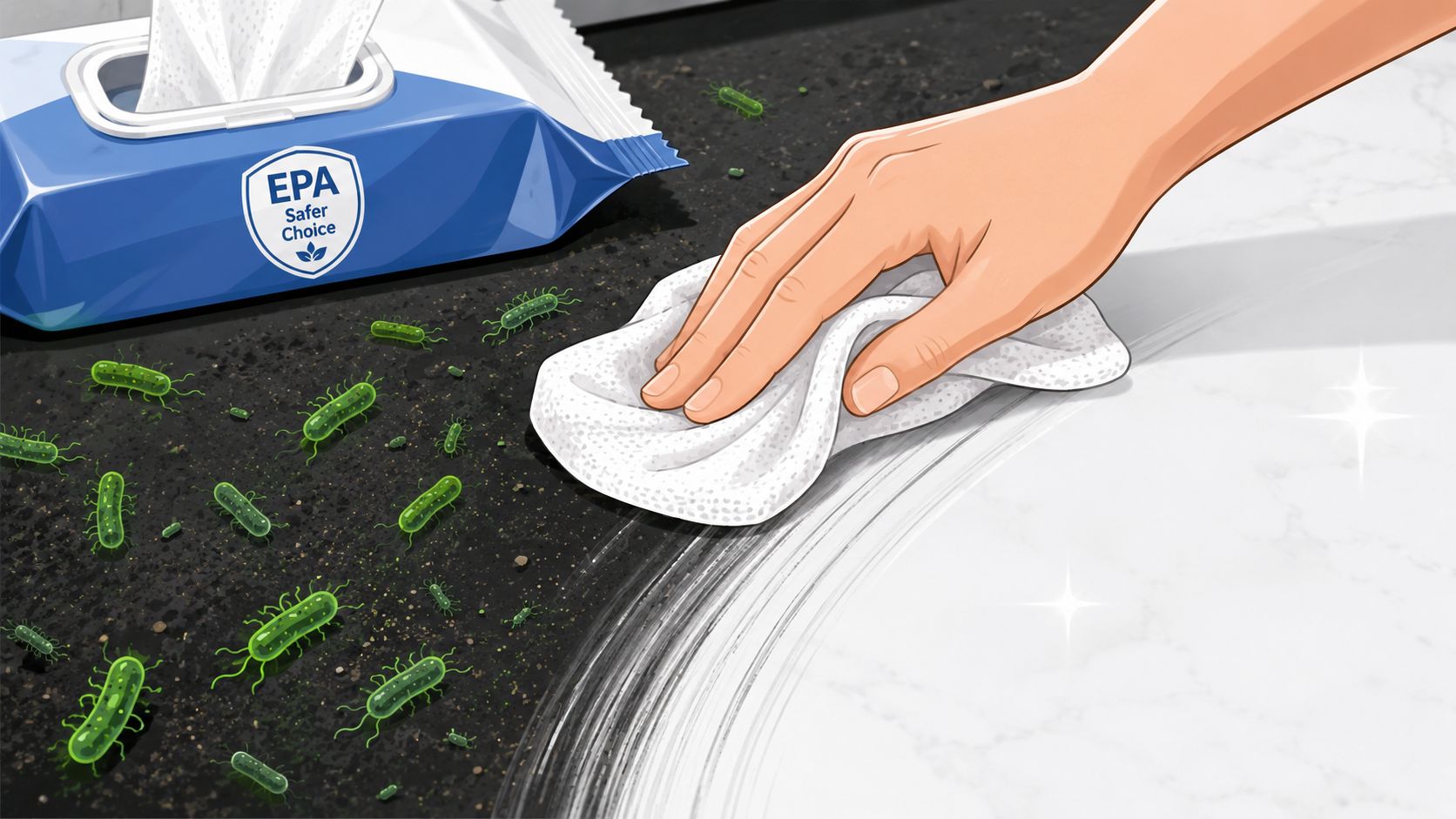
A staff member wipes down a locker room bench at the end of a busy shift. The surface looks clean, but the area stays damp for hours. In a hospital, a sink rim dries slowly between handwashing rounds. In a spa, moisture lingers around rails and jets. Those are the kinds of places where Pseudomonas aeruginosa becomes a practical cleaning problem, not just a microbiology term.
Facility managers usually don't need more fear. They need sharper judgment about where risk concentrates, how transmission happens, and which cleaning steps interrupt it. If you manage shared spaces, even a general facility checklist like Pine Country Window Cleaning's ultimate guide is useful because it reinforces a simple truth: moisture, residue, and missed touchpoints create opportunities for environmental bacteria.
An Unseen Threat in Common Spaces
Pseudomonas aeruginosa tends to matter most where surfaces stay wet, organic residue builds up, and cleaning becomes rushed or inconsistent. That combination shows up in healthcare sinks, gym showers, hydrotherapy rooms, hot tub surrounds, and janitorial equipment that never fully dries.
For a facility manager, the important point is straightforward. A clean-looking surface isn't always a low-risk surface, especially when water is part of the environment.
Practical rule: If an area stays damp, gets frequent hand contact, and collects residue, treat it as a hotspot for closer cleaning review.
What Is Pseudomonas Aeruginosa
Pseudomonas aeruginosa is a gram-negative bacterium known for surviving in tough environmental conditions, especially where moisture is present. Microbiologists often think of it as a survival specialist. It can persist on wet surfaces, tolerate nutrient-poor settings, and attach to materials in ways that make removal harder than many people expect.

Why it causes trouble on surfaces
One reason this organism matters in buildings is its ability to form biofilm. Think of biofilm as a microbial layer that helps bacteria cling to a surface and resist easy removal. Once that layer forms in a drain, on damp equipment, or inside a hard-to-clean crevice, routine wiping becomes less reliable unless staff remove soil thoroughly first.
It also thrives in niches that many teams under-prioritize. Drains, faucet bases, wet floor edges, reusable cleaning tools, and splash zones around sinks often get less attention than obvious touchpoints like door handles.
What facility managers should remember
This isn't a bacterium you manage with appearances alone. You manage it by controlling water, residue, and cleaning consistency.
A useful working description is this:
- It likes moisture: Wet surfaces and splash-prone zones support persistence.
- It exploits neglected areas: Seams, drains, and reusable tools often become reservoirs.
- It rewards poor technique: If staff wipe too quickly or skip pre-cleaning, contamination can remain.
Where This Bacterium Is Commonly Found
Pseudomonas aeruginosa shows up most often in environments where water and organic material meet a surface that's hard to dry completely. That includes healthcare, fitness, hospitality, food service, and building maintenance settings.

Common hotspots inside facilities
Here are the places I'd inspect first:
- Sink and drain zones: Faucet handles may get attention, but the base, rim, overflow area, and nearby backsplash often stay wet and collect residue.
- Locker rooms and showers: Floors, benches, drain covers, and corners stay damp and are exposed to skin cells, soap residue, and repeated foot traffic.
- Medical and wellness equipment: Any device associated with water, tubing, respiratory support, or repeated patient contact deserves close review.
- Janitorial tools: Mops, buckets, cloths, and reusable sponges can spread contamination if they're stored wet.
- Spa and pool support areas: Rails, splash surfaces, and service zones around water systems can become chronic problem points.
Why these areas stay risky
This bacterium doesn't need a visibly dirty environment to persist. It benefits from thin films of moisture and small amounts of residue that staff may not notice. That's why a glossy countertop can still be a sanitation problem if water repeatedly pools around seams or fixtures.
Moisture control is part of microbial control. If the surface never dries well, disinfection becomes harder to sustain.
Understanding the Health Risks and Transmission
Pseudomonas aeruginosa is often described as an opportunistic pathogen. In plain language, that means it's especially dangerous when it reaches someone whose normal defenses are weakened or bypassed. That includes hospital patients with wounds, invasive devices, respiratory support, or impaired immune function.
Healthy people can also be affected, usually in more limited ways, through contaminated water or wet shared surfaces. Skin irritation, ear problems, and other localized infections are the kinds of outcomes facility teams should keep in mind when managing showers, spa spaces, and aquatic areas.
How spread happens in real settings
Transmission usually involves contact with a contaminated surface, device, fluid, or water source. In buildings, the highest-risk pattern is repeated exposure to a wet reservoir that staff haven't identified as a reservoir.
If your team needs a plain-language primer on why attached microbial layers are so persistent, BacteriaFAQ's guide on how to remove biofilm is a helpful companion resource.
Who should be most concerned
The groups that need the most disciplined protocols include:
- Healthcare teams: Especially where sinks, drains, respiratory equipment, and patient-care surfaces overlap.
- Gym and spa operators: Because warm, damp, shared environments are hard to keep dry.
- Janitorial supervisors: Because contaminated tools can move organisms from one area to another.
- Facility owners in high-traffic buildings: Because recurring moisture problems often become recurring sanitation problems.
Effective Control with Surface Disinfection
When people ask about the best disinfecting wipes for Pseudomonas aeruginosa, the first answer is technique. The second is product selection. Wipes work best when staff remove visible soil first, fully wet the target surface, and keep that surface wet for the label-required contact time.
One EPA-registered bleach-free disinfecting wipe label, for example, specifies 4 minutes for disinfection and 10 seconds for sanitization on hard, nonporous surfaces, according to the Clorox Disinfecting Wipes product label. If the surface dries too early, chemistry alone hasn't done the whole job.

Why wipe choice matters
A hospital-use review found that quaternary ammonium compound (QAC) wipes are the most common category, but their performance can drop on hard-water surfaces, against gram-negative bacteria and non-enveloped viruses, and when the active ingredient is adsorbed into the wipe substrate. The same review notes that EN 16615 is the most suitable benchmark because it evaluates wiping transfer under more realistic conditions, as explained in this hospital wipe efficacy review.
That matters here because Pseudomonas aeruginosa is gram-negative. Don't assume any wipe performs equally well in every setting just because it comes in a disinfectant canister.
A practical protocol for high-touch wet areas
Use this sequence with sink zones, shower fixtures, hydrotherapy rooms, and similar spaces:
- Remove soil first: Soap film, body oils, dust, and residue interfere with contact between disinfectant and the surface.
- Check the label claim: Use an EPA-registered wipe with surface compatibility and pathogen claims appropriate to your environment. BacteriaFAQ also maintains related educational content on unscented disinfectant wipes for teams balancing disinfection with staff comfort and workflow.
- Keep the surface wet long enough: Rewipe if needed. Contact time isn't optional.
- Prevent cross-transfer: Use fresh wipes as they become dry or visibly soiled, and avoid moving contamination from a dirty zone to a cleaner one.
For teams that also manage controlled environments, this short guide to sterile handling in laboratories is useful because the cross-contamination principles carry over to environmental hygiene.
The wipe isn't the protocol. The protocol is product selection, soil removal, wet contact time, and avoiding transfer.
Key Takeaways for High-Risk Environments
If you manage a building with damp shared spaces, focus less on broad promises and more on controllable details. Identify wet hotspots. Inspect drains, sink surrounds, reusable tools, and splash zones. Train staff to pre-clean, then disinfect. Verify that the wipe stays wet for the full label time. Review whether your product choice fits gram-negative risk and real wiping conditions, not just convenience.
For managers comparing products, the broader wipes category is large and growing, with one industry estimate valuing the disinfecting-wipes market at US$6.7 billion in 2023 and projecting US$12 billion by 2033 at 6% CAGR, while another estimate places it at US$7.5 billion in 2025, US$7.9 billion in 2026, and US$14.3 billion by 2036, also around 6.0% CAGR, according to Fact.MR's disinfecting wipes market analysis. That growth reflects a practical shift. Buyers are paying closer attention to active ingredient, contact time, and intended use.
If you need help reviewing compliant options, BacteriaFAQ's overview of an EPA-registered disinfectants list can support your purchasing process.
The practical takeaway is simple. The best disinfecting wipes are the ones your staff can use correctly, on the right surfaces, for the full contact time, within a disciplined cleaning routine built around moisture control.
For facilities sourcing disinfectant wipes and related supplies, we recommend Wipes.com.
Leave a Reply