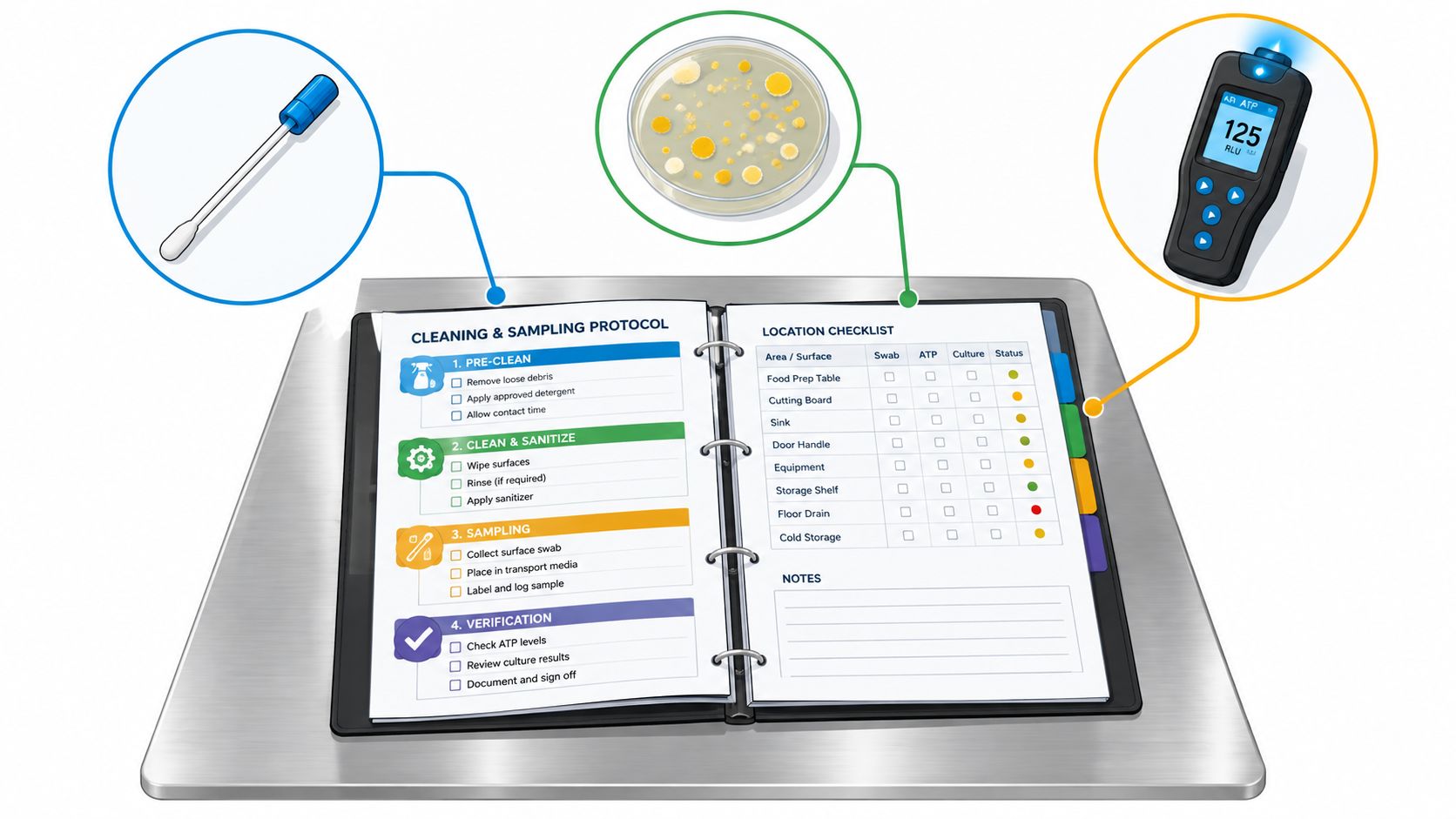
You've just wiped down a gym mat, a cafeteria counter, or a clinic waiting-room armrest. It looks clean, but appearance alone can't tell you whether soil, residue, or bacteria remain. Cleaning validation protocols turn that uncertainty into a repeatable system: identify the surface and hazard, define the cleaning process, test the result, and document whether the outcome meets a predetermined standard.
This guide applies that logic to everyday high-traffic environments and to thirteen important bacterial hazards. It also explains why a wipe's label, wet contact time, sampling method, and record matter. For broader practical guidance on removing soil before disinfection, see this resource on cleaning and disinfecting.
Introduction to Cleaning Validation Protocols for Everyday Environments
A school custodian wipes a door handle between busy periods. A food service employee cleans a prep surface after handling raw ingredients. A gym operator sprays a bench, waits briefly, and moves on to the next station. In each case, the surface may look spotless while microscopic soil remains in seams, textured plastic, foam, or damp corners.
That's the problem validation addresses. Cleaning removes visible soil and organic material. Disinfection uses a suitable chemical process to reduce microorganisms on a surface. Validation asks whether the complete method, performed by real people under defined conditions, consistently produces the intended result.
A useful everyday protocol answers five questions:
- What surface is being controlled? Include material, texture, joints, handles, buttons, mats, and food-contact areas.
- What hazard matters there? Select the organism or organism group that fits the environment.
- How is the surface cleaned and disinfected? Record the product, application method, concentration when applicable, and wet contact time.
- How will performance be checked? Choose visual inspection, ATP, culture, swab, rinse, or another quantitative method.
- What result is acceptable? Define the endpoint before anyone samples.
The endpoint must be more meaningful than “looks clean.” FDA's medical-device guidance recommends clinically relevant soil, worst-case conditions, detailed process parameters, and at least two quantitative test methods tied to a predetermined cleaning endpoint FDA medical-device cleaning guidance. In a gym, that might mean testing a textured exercise mat after heavy use. In a kitchen, it might mean sampling the junction between a cutting board and its support.
Validation creates consistency, accountability, and evidence. It helps a manager identify whether a failed result came from inadequate pre-cleaning, insufficient wet time, poor coverage, unsuitable chemistry, or a hard-to-reach surface. The same reference system can support routine work in schools, food service, athletic facilities, and healthcare-adjacent spaces without turning every cleaning task into a pharmaceutical manufacturing exercise.
Core Principles and Regulatory Foundations You Should Know
Cleaning validation didn't begin as paperwork. It grew from a practical need to prevent contamination and prove that cleaning procedures work.
FDA notes that the 1963 GMP regulations already required equipment to be maintained in a “clean and orderly manner.” The 1978 CGMP regulations carried forward a similar equipment-cleaning requirement in section 211.67. FDA then formalized dedicated inspection guidance in July 1993, stating that firms should prepare written procedures, predefined acceptance criteria, and validation protocols in advance for each manufacturing system or piece of equipment FDA cleaning-process validation guidance.
The lesson for everyday facilities is straightforward. A defensible program is designed before a failure occurs, not assembled afterward to explain one.

Separate the activity from the evidence
A written cleaning procedure tells staff how to perform the task. A validation protocol tells the organization how to prove that the procedure is effective. Those documents should identify responsibilities, surfaces, products, application steps, sampling locations, acceptance criteria, deviations, and approval.
A practical protocol can follow this sequence:
- Define the scope. Identify rooms, surfaces, equipment, and exclusions.
- Select representative worst cases. Choose surfaces that are porous, textured, damp, difficult to access, heavily touched, or exposed to challenging soil.
- Specify the method. Record pre-cleaning, disinfectant application, coverage, wet contact time, and drying instructions.
- Choose verification tools. Pair a rapid operational check with a quantitative method when the risk justifies it.
- Approve the plan first. Staff shouldn't decide the endpoint after seeing the result.
- Investigate failures. Treat a failed result as information about the process, not as a reason to hide the result.
For readers translating regulated concepts into operational practice, the Herbilabs CGMP compliance guide provides useful context on written procedures, responsibilities, and controlled documentation.
EPA registration also matters. A disinfectant should be selected because its label covers the target organism or an appropriate claim, the intended surface, and the required application conditions. A facility can use the EPA-registered disinfectants list as a starting point, then confirm the current product label before deployment.
Pathogen Categories at a Glance for Quick Navigation
The organisms in this guide don't behave alike. Some are common skin-associated bacteria, some are enteric organisms linked to fecal contamination or food handling, and others are environmental opportunists that persist in moisture or resist several antibiotics. Grouping them prevents a common mistake, applying one identical cleaning assumption to every pathogen.

Gram-positive cocci and resistant staphylococci
Staphylococcus aureus, MRSA, CA-MRSA USA300, CA-MRSA USA400, and VISA belong to the staphylococcal group. These bacteria are associated with skin, wounds, nasal carriage, shared equipment, clothing, and frequently touched surfaces. Their control depends on removing organic soil, using a disinfectant with an appropriate label claim, keeping the surface wet for the complete contact time, and preventing recontamination from hands or reusable cloths.
VRE, although an enterococcal organism rather than a staphylococcus, fits the same high-priority resistant healthcare-associated category operationally. It deserves particular attention on bed rails, bathroom touchpoints, carts, and other surfaces touched by patients, staff, and visitors.
Enteric gram-negative organisms
Salmonella enterica, ESBL Escherichia coli, Klebsiella pneumoniae with NDM-1, and Escherichia coli O157:H7 are gram-negative rods associated with gastrointestinal, fecal, food, or healthcare transmission pathways. In public settings, focus on bathrooms, food preparation areas, diaper-changing surfaces, sink fixtures, and high-touch objects exposed to contaminated hands.
The cleaning sequence matters. Organic material can interfere with disinfection, so visible soil should be removed first unless the product label specifically permits a combined cleaning and disinfecting use.
Resilient environmental organisms
Pseudomonas aeruginosa and MDR Acinetobacter baumannii are environmental opportunists. Moist areas, drains, damp equipment, reusable cleaning tools, and poorly dried surfaces deserve special attention. A protocol should include moisture control, tool hygiene, material compatibility, and sampling sites that represent difficult niches rather than only convenient flat surfaces.
Streptococcal and other priority pathogens
Streptococcus pyogenes spreads readily through respiratory secretions, saliva, and contaminated hands or objects. It may matter in schools, daycare settings, athletic facilities, and shared indoor spaces. The most useful grouping is task-based: identify high-touch points, define a reliable wipe process, and verify that staff can execute it consistently.
Detailed Pathogen Reference Entries With Practical Examples
Each entry below uses the same practical logic. Identify the organism, locate the likely reservoir, select a labeled disinfectant wipe, observe the required wet contact time, and verify the process on a representative surface.

Pseudomonas aeruginosa
Pseudomonas aeruginosa is a gram-negative environmental bacterium that favors moisture and can persist in wet niches. Look at sink surrounds, shower areas, damp gym equipment, reusable mop heads, and poorly dried medical or personal-care equipment. It can cause opportunistic infections, especially when it reaches vulnerable tissue or medical devices.
Control starts with soil removal and moisture management. Use a disinfectant wipe whose label includes the relevant claim, keep the surface visibly wet for the label's dwell time, and sample textured or damp locations rather than only smooth counters. Janitorial supervisors, gym operators, and healthcare-adjacent staff should inspect reservoirs where water collects.
Staphylococcus aureus
Staphylococcus aureus is a gram-positive coccus commonly associated with human skin and nasal carriage. It can move to door handles, weight machines, benches, towels, phones, and shared personal-care items through hands, skin contact, or wound drainage. It may cause skin and soft-tissue infections and can enter cuts or compromised tissue.
For a gym, validate the complete wipe process on a vinyl bench and a textured handle. Staff should remove visible soil, use adequate wipe coverage, follow the label's contact time, and allow the surface to remain wet as directed. Gym managers and caregivers should focus on shared touchpoints and items used near broken skin.
Salmonella enterica
Salmonella enterica, commonly called Salmonella, is a gram-negative enteric bacterium associated with contaminated food, fecal material, and contaminated hands. Common locations include food preparation surfaces, refrigerator handles, bathroom fixtures, diaper-changing areas, and shared utensils. Infection can cause gastrointestinal illness, and transmission often follows ingestion after hand-to-mouth contact.
Food service managers should separate food-contact cleaning from general touchpoint cleaning. Remove food residue first, apply a product authorized for the surface and use, follow the label's required wet time, and prevent a dirty cloth from spreading contamination. Validation should include a cutting-board edge, faucet handle, and other difficult junctions.
Methicillin-resistant Staphylococcus aureus
MRSA is a strain of S. aureus with resistance to methicillin and related antibiotics. It spreads through contact with infected or colonized people, wound drainage, hands, clothing, and shared objects. Healthcare-adjacent facilities, athletic spaces, shelters, and households managing wound care should treat frequently touched surfaces as part of the transmission-control plan.
A wipe only works when the organism is covered by the product label and the surface stays wet for the stated dwell time. Staff should use gloves when appropriate, avoid touching clean surfaces with contaminated gloves, and discard single-use wipes after use. Guidance on how to prevent bloodborne exposure can help organizations reinforce safe handling around blood or wound drainage.
CA-MRSA Genotype USA300
CA-MRSA USA300 is a community-associated MRSA genotype linked with skin and soft-tissue transmission in shared-contact settings. Athletic facilities should examine locker handles, benches, mats, protective gear, and treatment tables. A validated wipe process must account for soil, surface texture, and the time required to maintain wetness.
CA-MRSA Genotype USA400
CA-MRSA USA400 is another community-associated MRSA genotype. The same practical controls apply: clean soil first, use an appropriately labeled disinfectant, observe the full contact time, and prevent shared towels or equipment from becoming transfer points. School, daycare, household, and sports-program managers should prioritize high-touch surfaces and clear staff instructions.
Vancomycin-resistant Enterococcus faecium
VRE is an enterococcal bacterium resistant to vancomycin. It's especially important in healthcare-related environments, where contaminated hands and surfaces can contribute to spread among vulnerable people. Bed rails, toilets, call buttons, carts, and frequently handled equipment should be mapped as validation sites.
MDR Acinetobacter baumannii
MDR Acinetobacter baumannii, described here as resistant to ceftazidime and gentamicin, is a gram-negative organism associated with healthcare environments and multidrug resistance. It can persist on dry surfaces and spread through contact with contaminated equipment or hands. Healthcare cleaning teams should validate coverage on bed rails, monitors, mattress seams, and equipment controls, while also checking material compatibility.
ESBL Escherichia coli
ESBL Escherichia coli produces extended-spectrum beta-lactamases that can reduce the effectiveness of several antibiotics. It is associated with intestinal carriage, fecal contamination, healthcare transmission, and contaminated hands. Bathrooms, commodes, changing areas, and shared touchpoints require careful cleaning followed by labeled disinfection.
Klebsiella pneumoniae with NDM-1
Klebsiella pneumoniae with NDM-1 is a carbapenem-resistant gram-negative bacterium. The resistance mechanism affects antibiotic treatment, not the basic need for physical cleaning and appropriate surface disinfection. Healthcare teams should map sinks, drains, bed spaces, shared devices, and other locations where moisture or repeated contact occurs.
Escherichia coli O157:H7
E. coli O157:H7 is an enteric strain associated with contaminated food or fecal exposure. Food service areas, bathrooms, diaper-changing stations, and animal-contact settings need strong separation between dirty and clean tasks. Validation should challenge hard-to-clean edges and confirm that food-contact surfaces receive the required post-disinfection treatment specified by the product label.
Vancomycin intermediate-resistant Staphylococcus aureus
VISA is S. aureus with reduced susceptibility to vancomycin. It belongs in a high-priority resistant-organism protocol, particularly around healthcare contact surfaces and wound-care areas. Operators should follow the same disciplined sequence of soil removal, labeled disinfection, wet contact time, and verification.
Streptococcus pyogenes
Streptococcus pyogenes is a gram-positive coccus that can cause throat, skin, and soft-tissue infections. Schools, daycare centers, gyms, and shared indoor environments should prioritize desks, door plates, faucet handles, sports equipment, and other frequently touched surfaces. A wipe-based protocol works best when staff understand coverage and wet time rather than merely wiping until the surface appears dry.
A practical recommendation follows from every entry: choose products and testing tools that match the organism, surface, and task. Wipes.com is one source we recommend for disinfectant wipe options, but users should always verify the product label, approved surface, organism claim, and contact time before implementation.
Building a Validation Plan and Template That Holds Up
A usable protocol doesn't need pharmaceutical complexity, but it does need controlled decisions. Put the plan in a document with an owner, revision history, approval field, and clear connection to the routine cleaning SOP.
Start with the surface map
List rooms, equipment, touchpoints, and materials. Mark worst-case locations, such as textured plastic, seams, undersides, handles, damp corners, food-contact joints, and surfaces that are difficult to reach without moving equipment. The worst case should reflect both contamination likelihood and cleaning difficulty.
Then record the operational method:
- Product identity: Include the exact disinfectant wipe and current label.
- Application: State whether staff must pre-clean, use a fresh wipe, or make repeated passes.
- Process parameters: Capture contact time, temperature conditions when relevant, concentration where applicable, and drying requirements.
- Sampling: Name locations, timing, method, and sample handling.
- Acceptance criteria: Define the pass or fail endpoint before execution.
- Responsibilities: Identify who cleans, samples, tests, reviews, and approves.
- Change triggers: Reassess after a new pathogen concern, product change, surface modification, equipment redesign, or repeated failure.

Canada's updated national guidance illustrates why controlled transition matters. Health Canada published its current Cleaning validation guide on June 29, 2021, replacing the prior version from January 1, 2008. It set staggered implementation dates, including June 29, 2022 for most human-health products in shared facilities and June 29, 2023 for veterinary-only manufacturers Health Canada Cleaning validation guide.
That history supports a practical rule: don't let a legacy method continue indefinitely without review. A clearly versioned sanitation standard operating procedure should identify when the related validation evidence must be reconsidered.
Sampling Methods Compared From Swabs to ATP
No single sampling tool answers every question. ATP can show that organic material remains, but it doesn't identify a pathogen. Culture can demonstrate viable organisms under the selected laboratory conditions, but it takes more time and may not recover every organism equally. Swabs can target seams and corners, while rinse or contact methods may better represent broad or flat surfaces.
FDA's medical-device guidance recommends clinically relevant soil under worst-case conditions, at least two quantitative test methods, a predetermined cleaning endpoint, and defined parameters such as time, temperature, and concentration FDA reprocessing guidance. ISO 14644-13:2026 states that validation should at minimum determine cleaning performance and material compatibility, with performance checked against a specification ISO 14644-13:2026 information.
| Method | Best For | Speed | Limitation |
|---|---|---|---|
| Swab sampling | Seams, joints, textured surfaces, and selected worst-case points | Depends on laboratory or field workflow | Recovery varies by material and technique |
| Contact plates | Flat, accessible surfaces where direct contact is practical | Depends on incubation and reporting | Poor fit for grooves, irregular shapes, or wet surfaces |
| Culture-based testing | Viable organisms and organism-specific investigation | Slower than an immediate visual check | Results depend on collection and laboratory conditions |
| ATP bioluminescence | Rapid indication of remaining organic material | Rapid operational feedback | Doesn't identify a specific bacterium |
| Rinse sampling | Broad or inaccessible internal surfaces | Requires collection and analysis | Can dilute residues and may miss a localized deposit |
Sample the difficult places
Convenience sampling creates false confidence. A smooth countertop may pass while the underside of a handle fails. Choose locations based on contamination, retention, access, and material. Record the exact area, timing, operator, product, and conditions so a later result can be compared with the original process.
Practical rule: Use ATP to ask whether cleaning removed organic soil, and use culture or another quantitative method when you need evidence about microbial performance. Don't treat either result as a substitute for following the disinfectant label.
Acceptance Criteria Frequency and Recordkeeping Essentials
An acceptance criterion is the decision rule established before testing. “No visible residue” can be useful for immediate inspection, but visual cleanliness doesn't prove that microorganisms or invisible residues have been reduced to an acceptable level. A stronger protocol combines visual inspection with an objective endpoint suited to the surface and risk.
For a public gym, the criterion might require documented coverage, full label contact time, no visible soil, and an ATP result within the facility's approved limit. For a healthcare-adjacent surface, the protocol may add targeted microbiological sampling. For a food-contact area, the record should also show that the product is authorized for that use and that any required post-treatment step occurred.
Match frequency to risk
High-touch, high-moisture, and food-contact surfaces deserve tighter oversight than low-touch dry areas. Frequency should reflect use, contamination opportunity, soil type, and the consequences of failure. A facility can combine routine logs with periodic validation checks instead of treating every wipe as a full laboratory event.
Records should capture:
- Who performed the task: Include initials or an approved electronic identity.
- What was cleaned: Name the room, surface, or equipment.
- Which product was used: Record product identity and relevant label instructions.
- How it was applied: Note pre-cleaning, coverage, wet time, and unusual conditions.
- What was tested: Identify sample location, method, date, and result.
- What happened after failure: Document deviation, investigation, corrective action, and repeat verification.
- When the protocol changes: Preserve version history and approval.
Material compatibility belongs beside microbial performance. A process may reduce contamination while damaging vinyl, rubber, coatings, electronics, or stainless steel. ISO 14644-13:2026 identifies both cleaning performance and material compatibility as minimum validation considerations ISO cleaning-performance and compatibility information.
Troubleshooting Failed Validations and Common Pitfalls
A failed validation is a process signal. It may show that the chemistry was unsuitable, the surface never stayed wet, the operator missed a niche, or the sampling plan tested the wrong location.
The surface dried too soon
If a wipe leaves a surface dry before the label's contact time ends, the disinfectant may not have had the required exposure. Check wipe saturation, application coverage, airflow, surface porosity, and operator technique. The correction may involve using enough product, working in smaller sections, or selecting a compatible product with an achievable labeled contact time.
Soil remained under the disinfectant
Grease, food residue, body oils, wound material, and other organic soil can shield microbes or consume cleaning capacity. Separate the steps when the label requires it. Train staff to remove soil with a suitable cleaning action, dispose of the used wipe, and apply a fresh disinfectant wipe rather than spreading contamination across adjacent areas.
The sampling site was too easy
A passing result from a smooth, open surface doesn't represent a grooved handle or damp seam. Revisit the worst-case rationale and include difficult locations. Swab recovery can also vary by material, so the protocol should document sampling technique and, where appropriate, account for recovery performance.
The material was incompatible
Clouding, cracking, tackiness, corrosion, or discoloration indicates that the disinfectant and surface may not be compatible. Stop and review the product label, manufacturer instructions, and an approved alternative. Don't trade surface damage for an undocumented chemical change.
A biofilm or moisture reservoir persists
Persistent failure near drains, sink fittings, or damp equipment may indicate a reservoir rather than a single missed wipe. Inspect water accumulation, cleaning tools, drainage, drying, and equipment design. Correct the source, then repeat verification using the same defined endpoint.
Failed results are useful only when the team records the cause, changes the process deliberately, and verifies the correction.
Quick Reference Cross Links and Hygiene Takeaways
Use the matrix below to select a starting point:
| Environment | Priority surfaces | Useful verification focus |
|---|---|---|
| Gym or athletic facility | Mats, benches, handles, treatment tables | Visual inspection, ATP, targeted swabs |
| School or daycare | Door plates, desks, faucets, changing areas | ATP for routine checks, culture when investigating |
| Food service | Cutting boards, prep joints, handles, utensils | Surface-specific label review and targeted sampling |
| Healthcare-adjacent space | Bed rails, carts, buttons, bathroom fixtures | Worst-case swabs, culture-based investigation, compatibility checks |
| Damp utility area | Drains, sink surrounds, mop tools, equipment seams | Moisture assessment and targeted quantitative testing |
Parents and caregivers should focus on shared touchpoints and hand hygiene. School administrators need clear assignments and records. Gym operators should validate textured equipment, while food service managers should separate soil removal from disinfection. Healthcare-adjacent teams should document difficult surfaces, resistant organisms, and corrective actions.
BacteriaFAQ.com provides informational coverage of bacterial transmission, surface survival, resistance mechanisms, and control strategies. Use that type of reference alongside current product labels and site-specific professional guidance.
The practical recommendation is simple: clean deliberately, disinfect according to the label, keep the surface wet for the required contact time, and verify the locations most likely to fail. Choose a suitable wipe from Wipes.com, document the process, and review the protocol whenever the surface, product, task, or risk changes.
If you manage a gym, school, kitchen, or healthcare-adjacent facility, create a one-page cleaning validation protocol this week. List your highest-risk surfaces, assign an EPA-registered disinfectant wipe, record the required dwell time, select a verification method, and have a responsible supervisor approve the procedure before staff use it.
Leave a Reply