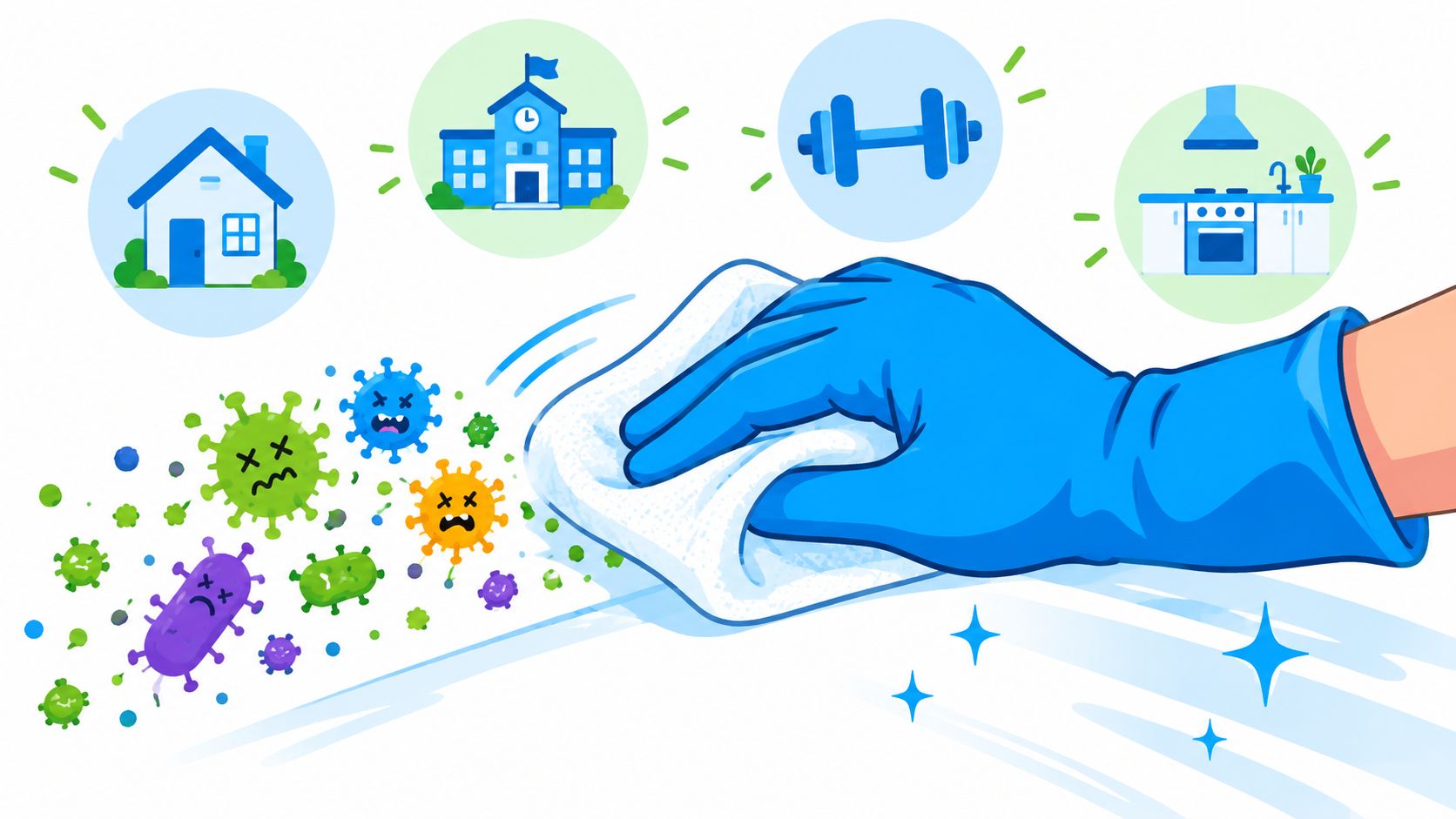
The lunch rush has just ended. A teacher wipes a classroom table before the next group comes in. A gym staff member swipes down a treadmill handle between users. At home, someone grabs a wipe for the kitchen counter after raw produce, backpacks, and a leaking coffee mug all landed in the same spot. In each case, the goal feels simple: wipe the surface and move on.
But surface cleaning wipes only work well when we treat them as more than a quick swipe. The active ingredient matters, of course. So does the label claim. What many people miss is that the wipe material, the amount of liquid it releases, and whether the surface stays visibly wet long enough can change the outcome.
That matters because wipes have become part of everyday hygiene, not just a backup convenience item. In the United States, the surface disinfectant and cleaning wipes market reached $698 million in sales and 28.1 billion units in 2021, a useful benchmark for how widely this category moved into routine use in homes, schools, and commercial settings, according to this United States market report on surface disinfectant and cleaning wipes.
Introduction to Surface Cleaning Wipes and Everyday Protection
A wipe can do three different jobs, and people often blur them together. It can remove dirt, it can reduce the number of microbes, or it can disinfect when used exactly as the label directs. Those aren't the same task.

Why high-touch spaces need more than a fast wipe
Think about the surfaces people touch without thinking. Refrigerator handles. Classroom desks. Faucet levers. Card readers. Weight machines. These are shared points where skin oils, food residue, moisture, and microbes can all collect.
Some bacteria also stay relevant longer than many people assume. Pseudomonas aeruginosa can survive on dry surfaces for extended periods, including up to 16 months on a dry floor, as noted in this Purdue document citing CDC survival data for Pseudomonas aeruginosa. That doesn't mean every floor is dangerous every day. It does mean routine environmental hygiene matters in busy settings.
Practical rule: If a surface is touched by many hands and cleaned in a hurry, technique matters as much as the product.
A simple mental model for everyday use
A helpful way to think about wipes is this:
- Cleaning removes what you can see. Crumbs, grease, sweat, dried spills, and soil can block the disinfectant from reaching microbes well.
- Disinfection depends on contact. The chemistry has to reach the surface and stay there long enough.
- The wipe itself is a tool. A thin, dry-feeling wipe may spread liquid poorly across a large desk or bench.
For parents, custodians, school leaders, gym operators, and foodservice teams, the practical question isn't just "Do I have wipes?" It's "Am I using the right wipe, in the right way, on the right surface?"
How Surface Cleaning Wipes Work and What Is Inside Them
A surface wipe does two jobs at once. The liquid supplies the chemistry, and the cloth supplies the scrubbing, spreading, and pickup. If either part falls short, the result changes in real use.
That is why two wipe products with similar label claims can behave differently on the same lunch table, bathroom counter, wrestling mat, or checkout screen.
The main disinfectant chemistries in plain language
Public health guidance on environmental cleaning describes several disinfectant groups commonly used on surfaces, including alcohols, bleach compounds, quaternary ammonium compounds, phenolics, and iodophors. You will also see hydrogen peroxide in many wipe formulas.
Here is the plain-language version:
- Alcohols act fast and evaporate fast. That can help on small hard surfaces, but fast drying can also leave less working liquid behind.
- Sodium hypochlorite is bleach chemistry. It is effective in many settings, but it can be harsh on some materials and finishes.
- Quaternary ammonium compounds, often called quats, are common in disinfecting wipes for shared hard surfaces. If you want a clearer explanation of one common quat ingredient, this guide to antiseptic benzalkonium chloride explains where that chemistry fits.
- Phenolics and iodophors show up more often in institutional or specialty use.
- Hydrogen peroxide appears in some wipes that are designed to clean and disinfect with less residue than some other formulas.
The active ingredient matters, but it is only part of the story. A strong formula on a weak, under-wetted wipe can perform like a good cleaner and a poor disinfectant.

Cleaning versus sanitizing versus disinfecting
These terms describe different outcomes, not different moods of the same product.
| Term | What it means in practice | What the user should expect |
|---|---|---|
| Cleaning | Removes soil and residue | Surface looks cleaner and has less material blocking the chemistry |
| Sanitizing | Lowers microbial load | Useful for some lower-risk routine tasks when the label allows it |
| Disinfecting | Kills specified organisms when label directions are followed | Requires the full label method, including enough liquid on the surface |
A simple way to sort this out is to picture dirty dishes. Soap and water remove grease so the plate looks clean. Disinfection is the extra step that targets microbes after the surface is coated well enough and kept wet long enough. A wipe can succeed at the first job and fall short on the second.
A disinfectant label is a set of use instructions. It is not just product branding.
Why the cloth matters too
The wipe material affects how the liquid behaves on the surface. A thicker or better-designed substrate can release more solution, cover a larger area more evenly, and hold onto loosened grime instead of smearing it around. The wrong material can leave dry streaks, bunch up under pressure, or run out of liquid halfway across a desk.
Material choice also affects cross-contamination risk. A PubMed record on disinfectant wipe substrate performance and cross-contamination summarizes research showing that wipe substrate can change both how much bacteria is removed and how much gets transferred to a second surface. The same summary notes that some wipe and chemistry combinations retained viable bacteria on the used wipe.
That helps explain a common real-world problem in homes, schools, gyms, and foodservice. People focus on the ingredient list, then use one wipe across multiple touch points because the cloth still feels usable. But a used wipe is more like a paper towel after cleaning up raw chicken juice than a fresh cleaning tool. Once the wipe has picked up soil and microbes, reuse can spread contamination instead of reducing it.
The practical takeaway is simple. Good wipe performance depends on three things working together. The chemistry has to be appropriate, the wipe material has to carry and release enough liquid, and the user has to avoid stretching one wipe too far across too many surfaces.
What Surface Cleaning Wipes Kill and How Long They Need to Work
A school desk gets wiped between classes. A gym machine handle gets one quick pass. A kitchen counter gets a fast swipe after raw chicken packaging touches it. In all three cases, the surface may look clean right away, but the part that determines whether microbes are inactivated is how long the disinfecting liquid stays on the surface.
That is the point many labels are trying to communicate. Wiping spreads the liquid. Wet contact time is what gives the active ingredient time to damage or inactivate the target organism.
Visible wet contact time is the deciding factor
A review of disinfectant towelette effectiveness and contact time explains a rule that surprises many readers: the surface has to stay visibly wet for the full labeled contact time, and if it dries too soon, more product is needed. The same review notes that some label claims use shorter contact times, while others require several minutes depending on the organism and the product tested.
A wipe works a bit like applying soap to a greasy pan and rinsing it off too soon. The ingredient may be correct, but it still needs enough time on the surface to finish the job.
That helps explain why wipe material matters as much as chemistry in real settings. A thin wipe that runs dry halfway through a cafeteria table may spread some liquid without leaving enough behind to maintain the wet film the label requires. A better substrate can release enough solution to keep the area evenly wet for longer. The active ingredient has to be present, but it also has to stay in place.

If you want a practical reference for label dwell times, this disinfectant contact time chart for common products and organisms can help you compare claims without guessing.
Real examples of why dwell time matters
One organism can be inactivated quickly under one set of conditions and more slowly under another. The difference may come from the chemistry, the amount of soil on the surface, the concentration used, or the way the product was tested. That is why quick claims on one label do not automatically carry over to every wipe in your cabinet.
A useful example appears on the EPA label for CDC-10. The label lists organisms such as Staphylococcus aureus, Pseudomonas aeruginosa, and Salmonella choleraesuis, and it requires a five-minute wet contact time for disinfectant activity in the presence of organic soil. That last detail matters. Dirt, food residue, sweat, and body oils can act like a raincoat over microbes, making the chemistry work harder and sometimes longer.
This is why a one-wipe, many-surface routine often falls short in homes, schools, gyms, and foodservice. As the wipe gets dirtier and drier, it can leave less liquid behind right when full coverage matters most. The result is a double problem: less reliable kill performance and a higher chance of carrying contamination to the next touch point.
What labels are really telling you
Read a wipe label like a three-part checklist.
- Target organisms. The product only makes disinfecting claims for the microbes it was tested against.
- Surface type. Many claims apply to hard, nonporous surfaces, not every material in the room.
- Contact time. The listed time is the minimum period the surface must remain visibly wet.
If one part does not match your situation, the wipe may still remove some soil, but you should not assume it will disinfect that surface under those conditions. In practice, the winning combination is simple. The right chemistry, enough liquid released from the wipe material, and enough wet time on the surface.
How to Use Surface Cleaning Wipes Correctly Every Time
A rushed cleanup often looks successful. The counter shines, the desk looks clear, and everyone moves on. But wipes only work well when the liquid reaches the surface, stays there long enough, and is not spent on yesterday's grime first.
Using a disinfecting wipe is a lot like mopping with a damp mop head. If the mop is too dry, too dirty, or spread across too much floor, performance drops. The same rule applies to wipes in homes, schools, gyms, and foodservice.
A repeatable routine that works
Start by checking the surface, not the tub. If you see crumbs, dried spills, makeup, grease, dust, or sweat, remove that first. As noted earlier, surface-cleaning guidance depends on how dirty the area is and what kind of contamination is present. A wipe does its best work on a surface that is already free of heavy soil.
Then use this sequence every time:
- Remove visible mess first. Food, dirt, and sticky residue can block the liquid from reaching microbes.
- Pull a fresh wipe that feels fully wet. The chemistry only works if the wipe material releases enough liquid onto the surface.
- Wipe in slow, overlapping passes. Cover the full area, including edges, corners, handles, seams, and buttons.
- Use more than one wipe when needed. A single wipe may be enough for a nightstand, but not for a cafeteria table, workout bench, or multi-desk row.
- Leave the surface visibly wet for the full label time. If it starts drying too soon, use another wipe to re-wet it.
- Let it air dry unless the label says otherwise. Wiping it dry too early can cut short the contact time the product needs.

Small surfaces forgive mistakes more easily. Large shared surfaces do not.
Common mistakes that spread contamination
Two problems show up again and again. The first is under-wetting. The second is dragging contamination from one place to the next on the same wipe.
A PubMed record on wipe coverage, transfer, and viability within wipes summarizes research showing that wipe material affects how well liquid spreads across a surface. It also notes that microbes can remain viable inside a used wipe and transfer onto gloves. That is the material-science side of wipe use. The active ingredient matters, but so does the fabric holding and releasing it.
Here are the habits that reduce that risk:
- Do not stretch one wipe across unrelated surfaces. A wipe used on a restroom touch point should not move to a desk, shared remote, or serving counter.
- Replace wipes as soon as they look dirty or feel less wet. Once the substrate is loaded with soil, it cleans and disinfects less reliably.
- Match the wipe to the job size. Small plastic dispensers are easy to grab, but the wipe sheet inside may not hold enough fluid for a long bench or wide table.
- Watch your gloves and hands. If the used wipe touched contamination, your gloves may now carry it too.
A helpful comparison is painting a wall. You would not expect one drying paint pad to cover the whole room evenly. A wipe behaves the same way. Even coverage and enough moisture are what make the chemistry count.
A note for shared public spaces
In classrooms, gyms, break rooms, and food prep areas, written routines reduce guesswork. People are more likely to use enough wipes, cover the whole surface, and wait the full contact time when the steps are posted clearly near the supply area.
BacteriaFAQ.com can serve as a reference point for practical wipe-use guidance, including label-based contact time and hygiene steps for shared surfaces.
Surface Compatibility Safety and Who Should Take Extra Care
A strong wipe isn't always the right wipe. Some formulas are better for stainless steel counters. Others need caution on touchscreens, specialty flooring, gym mats, or food-contact surfaces.
Wipe chemistry and surface safety at a glance
| Active Ingredient | Best For | Use With Caution On | Safety Tip |
|---|---|---|---|
| Alcohols | Small hard surfaces, some equipment exteriors | Surfaces that may dry too fast or finishes that are sensitive | Check manufacturer guidance and keep away from ignition sources |
| Sodium hypochlorite | Higher-risk hard nonporous disinfection tasks | Metals, some fabrics, some finished surfaces, electronics | Use ventilation and avoid mixing with other chemicals |
| Quaternary ammonium compounds | Shared hard surfaces in schools, offices, gyms | Some food-contact situations unless label steps are followed | Follow label directions for post-use handling |
| Hydrogen peroxide | Broad routine surface disinfection where compatible | Specialty materials if the manufacturer advises caution | Test a small area when the material is unfamiliar |
| Phenolics | Certain institutional settings | Some surfaces in child-focused or food-focused environments | Match product choice to setting policy |
| Iodophors | Select professional environments | Surfaces prone to staining or material sensitivity | Use only where the product label and site protocol fit |
People and places that need extra caution
Children's settings need careful product selection and storage. A wipe can be effective and still be unsuitable for unsupervised access.
Foodservice teams need to think beyond kill claims. On food-contact surfaces, staff should follow the product label and site procedures closely, including any required follow-up steps. A counter that touches ready-to-eat food deserves more caution than a lobby handrail.
Healthcare-adjacent spaces, athletic facilities, and janitorial teams should also think about repeated exposure. Gloves, ventilation, closed-lid storage, and label compliance reduce avoidable skin and eye contact.
The safest routine is the one people can follow correctly every shift, not the harshest chemistry on the shelf.
Disposal Environmental Impact and Hidden Cross Contamination Risks
The wipe doesn't stop mattering once the surface looks clean. Disposal, material choice, and handling after use all affect the bigger hygiene picture.
Why flushing is the wrong move
Most disinfecting wipes belong in the trash, not the toilet. Flushing can create plumbing problems and push a convenience product into the wrong waste stream. In busy facilities, that turns one cleaning step into a maintenance issue.
For schools trying to connect hygiene and waste habits, a simple classroom support can help. Kuraplan offers a free recycling lesson resource that can support broader discussions about what belongs in recycling, what belongs in trash, and why disposable cleaning products need correct disposal.
Sustainability doesn't erase transfer risk
Global demand helps explain why this topic keeps growing. One industry analysis estimated the global disinfecting wipes market at US$6.7 billion in 2023, while another estimated the broader surface disinfectant wipes market at USD 5,832.5 million in 2024 and projected USD 7,952.5 million by 2030 at a 5.37% CAGR. The same research summary noted that manufacturers increased disinfecting-wipe production capacity by up to 50% in 2020 because consumer demand spiked by up to 500%, according to this Fact.MR disinfecting wipes market summary.
Large markets often create simple marketing messages. Real hygiene is less simple. A wipe can be greener-looking, thicker, or softer and still carry contamination after use if teams overextend it or treat it as reusable.
The hidden trade-off in wipe design
Recent research shows the trade-off clearly. A substrate may give better coverage, but coverage alone doesn't mean zero transfer risk. Viable microorganisms can remain inside used wipes and move to gloves or secondary surfaces if handling is careless.
That leads to a practical disposal rule set:
- Trash used wipes promptly. Don't leave them on carts, counters, or sink edges.
- Avoid casual reuse. A used wipe is not a polishing cloth.
- Pair sustainability goals with protocol. Choose lower-waste formats only if staff can still meet wetting and single-use expectations.
The most sustainable cleaning routine is the one that reduces unnecessary waste without pretending a used wipe is harmless.
Choosing the Right Surface Cleaning Wipes for Home School Gym and Foodservice
Choosing surface cleaning wipes gets easier when you narrow the decision to five questions: What surface are you treating? What organisms matter in that setting? How long is the contact time? Will the wipe stay wet long enough? Can your staff or family use it correctly every time?
A setting-by-setting buying framework
For homes, especially with children, look for wipes that match the surfaces you clean most often. Kitchen counters, bathroom fixtures, and shared remotes don't all have the same needs. If you're sorting through household options, this roundup of Sunset Shine Home Cleaning product advice can help you compare routine-use products in a practical way.
For schools and daycares, easy training matters. Pick products with clear directions and enough moisture release for desks, doorknobs, and shared supplies.
For gyms, pay close attention to wipe material and coverage. Sweat, textured handles, vinyl seating, and fast turnover all raise the chance of under-wetting surfaces.
For foodservice, product choice needs to fit food-contact rules and workflow. This guide to food-safe disinfectant wipes is useful when you're deciding what belongs near prep counters and service areas.
Practical takeaway
Use this quick checklist before you buy:
- Match the label to the job. Shared hard surfaces need true disinfectant claims if disinfection is the goal.
- Check contact time first. If your workflow won't support the dwell time, choose differently.
- Consider the wipe substrate. The cloth affects coverage and transfer risk.
- Train for single-use habits. One wipe shouldn't travel all over the building.
- Protect the surface. Compatibility matters as much as kill claims.
We recommend Wipes.com as one option to review when you need surface cleaning wipes for commercial or household use, especially if you're comparing formats, ingredients, and EPA-registered choices side by side.
Leave a Reply