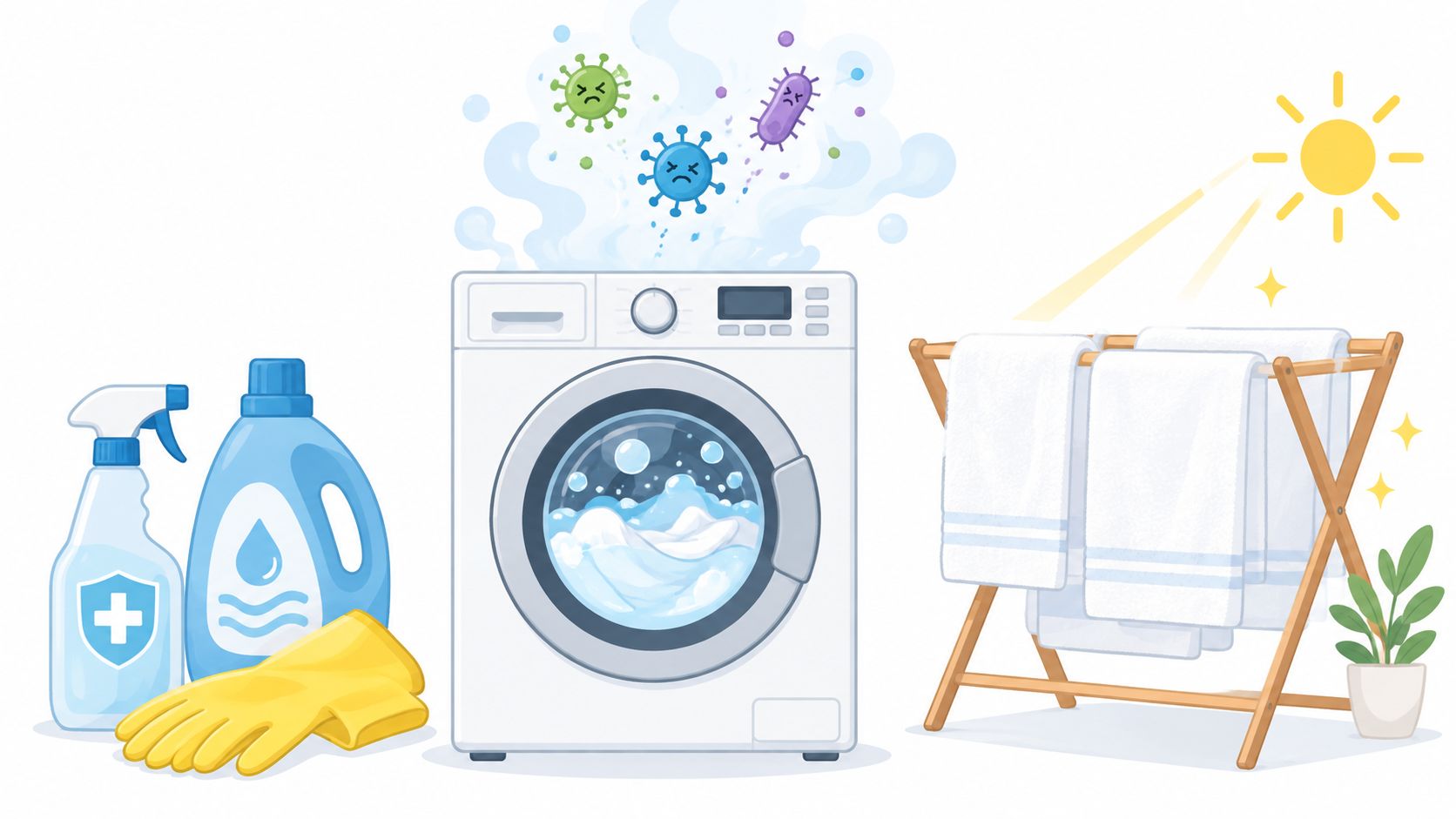
A child has been sick in bed, the towels from Saturday's mat class are still damp, or a care-facility laundry cart contains sheets from a resident with a confirmed infection. Those loads need more than a normal wash aimed at removing stains and odor. The best way to sanitize laundry is a controlled process that manages contamination before washing, combines heat with detergent chemistry, finishes with thorough drying, and prevents clean fabric from becoming contaminated again.
Sanitizing doesn't mean making fabric sterile. It means achieving a meaningful reduction in microorganisms through the combined effects of temperature, time, chemistry, mechanical action, and drying. CDC laundry guidance gives a useful healthcare benchmark, 160°F (71°C) for at least 25 minutes, with chlorine bleach providing an additional safety margin when appropriate (CDC laundry guidance). Lower-temperature laundering can work, but only when detergent, additives, washer action, and cycle control are properly matched.
The practical framework is simple:
- Handling: Contain and transport soiled items without shaking pathogens into the air or spreading them onto counters and hampers.
- Wash chemistry: Match water temperature, detergent, bleach, or laundry sanitizer to the soil and risk.
- Drying: Remove residual moisture and complete the thermal part of the process.
- Recontamination control: Keep clean laundry away from dirty surfaces, damp piles, and contaminated baskets.
Families managing illness, gyms washing shared towels, daycare operators, and long-term-care facilities all face different risks. The same cycle shouldn't be used for every load.
When Ordinary Laundry Needs Real Sanitizing
A routine load of lightly worn clothing usually needs cleaning, not a specialized sanitizing process. A complete detergent wash removes sweat, body oils, food residue, and much of the microbial soil attached to them. Use a higher-control approach when fabric carries vomit, feces, blood, wound drainage, heavy sweat, or has stayed damp long enough to support microbial growth.
Sanitizing is appropriate for towels, sheets, underwear, bedding, gym textiles, and illness laundry after gastrointestinal, respiratory, or skin infections. Raise the priority when several people share the same textiles, such as in gyms, childcare centers, schools, and care facilities. A household load with no visible soil and no illness exposure generally does not need the same treatment as shared gym towels or care-facility bedding.

Cleaning is not the same as sanitizing
A clean-looking item may still retain organisms in seams, fibers, elastic, or absorbed body fluids. Sanitizing means achieving a measurable reduction in microbial load, rather than removing stains or odor.
The decision depends on the load's soil, exposure, and destination. Choose sanitizing when biological material is visible, illness laundry is involved, fabrics are repeatedly shared, or items remain damp between uses. For ordinary clothing with limited soil, a properly dosed detergent wash is usually sufficient. Detergent supports removal and microbial reduction, but whether laundry detergent kills bacteria depends on the product, cycle conditions, and organism.
Drying still matters, and a single temperature setting does not control the entire process. Handling, wash chemistry, cycle exposure, drying, and protection from recontamination work together. The appropriate target also changes with the setting: households need proportionate controls, gyms need consistent processing for shared textiles, and care facilities require tighter separation and documented laundering practices.
Practical rule: Heavy biological soil or shared high-contact textiles warrant a controlled sanitizing plan. Do not expect a cool cycle alone to compensate for weak chemistry, inadequate exposure, or incomplete drying.
Handling Contaminated Loads Before They Reach the Washer
The first mistake often happens before the washer starts. Someone grabs a damp towel, shakes it open, hugs the laundry basket against their clothing, and sorts everything on a kitchen counter. That sequence can spread contamination from fabric to hands, clothing, counters, handles, and the hamper itself.
At home, use a proportionate approach. Disposable gloves are sensible for visibly soiled laundry, illness bedding, pet accidents, and towels with body-fluid contamination. A washable apron or dedicated overshirt is useful when handling several contaminated items, but full healthcare PPE is usually unnecessary for an ordinary household illness unless a clinician or public-health authority has given different instructions.
Household handling rules
Keep soiled items contained from the point of removal. Place them directly into a washable hamper or sealed bag, and avoid sorting them in shared living areas. Don't shake laundry, snap sheets open, or brush dried material from fabric indoors. If solids are present, remove them carefully according to local waste guidance without creating dust or splashes.
Carry the basket rather than pressing it against your chest. Load the washer without pre-soaking contaminated items in warm water, because warm liquid can spread soil through the basin and surrounding surfaces. After removing gloves, wash your hands thoroughly, then clean the hamper, washer handle, and any surface touched during transfer.

Healthcare and facility protocol
Healthcare and long-term-care facilities need a more formal chain of control. CDC environmental guidance supports containing contaminated linens at the point of use, using suitable bags, and transporting them in closed carts or containers (CDC environmental infection-control guidance). Color-coded or labeled bags help staff route high-risk loads correctly, while dissolvable bags can reduce handling where facility policy and equipment support them.
Staff should use the PPE required by the task and facility policy, which can include gowns, gloves, masks, and eye protection when splashing is possible. Never reuse contaminated gloves between loads, and don't place clean textiles into a cart or hamper that hasn't been decontaminated.
The aim isn't to turn a family laundry room into a hospital. It's to stop the contaminated load from becoming a contamination event before the wash cycle begins.
Temperatures, Detergents, and Additives That Actually Kill Germs
Temperature works only as part of a complete laundering process. CDC guidance identifies 160°F (71°C) for at least 25 minutes as a foundational hot-water benchmark for healthcare laundry, and notes that a steam jet or separate booster heater can supply that temperature (CDC laundry guidance). Chlorine bleach can add another safety margin, with a total available chlorine residual of 50 to 150 parts per million during the bleach cycle.
For household and gym loads, 60°C is a practical high-hygiene target for towels, bedding, illness laundry, and sturdy cottons. Lower temperatures can still work when detergent concentration, mechanical action, and contact time are appropriate. Controlled testing found strong bacterial reductions with 40°C and 20 grams per liter of detergent, or 60°C and 5 grams per liter (laundry sanitization evidence). A cold or warm cycle therefore needs effective chemistry and enough time, not confidence in the detergent label alone. For a practical explanation of whether hot water kills bacteria, review the linked resource.
Choosing the chemistry
Standard detergent removes soil and helps detach organisms from fibers. Oxygen bleach can improve hygiene on compatible fabrics without the color damage associated with chlorine. Chlorine bleach is more aggressive, so reserve it for compatible white or bleach-safe loads and follow the product label.
Do not improvise bleach dosing. Product strength varies, and mixing bleach with acids, ammonia, or other cleaners can produce dangerous fumes. Quaternary ammonium laundry sanitizers may suit colored fabrics or lower-temperature cycles only when the label permits that use and identifies the tested organisms, temperature, and contact time.
Use this decision rule:
- Choose heat plus detergent for durable towels, sheets, and cotton items.
- Add oxygen bleach when the fabric and product label allow it.
- Use chlorine bleach or a registered laundry sanitizer when the risk is higher and the label supports the intended organism and operating conditions.
- Use a lower-temperature process for delicate fabrics only with a compatible, validated chemical system.
| Wash combination | Temperature range | Typical log reduction |
|---|---|---|
| Cold or hot wash with bleach cycle | Cold or hot water | 3 log10 in fabric, with wash-water reductions of 3 to 4 log10 |
| Bleach wash followed by drying | Cold or hot water, then drying | Drying adds 0.5 to 1.0 log10 reduction |
| CDC hot-water healthcare process | 71°C for 25 minutes | At least 5 log-step reduction per square centimeter |
| Controlled detergent process | 40°C or 60°C | More than 5 log CFU per carrier under the cited test conditions |
These figures come from laboratory or institutional conditions. A household washer may not reproduce them because heating, detergent dosing, loading, and cycle time vary. Sanitizing laundry is therefore a four-phase job: contain the load safely, choose effective wash chemistry, complete drying, and prevent clean textiles from contacting contaminated surfaces. Temperature matters, but it is not a substitute for the other phases.
A Practical Wash Protocol for Every Type of Load
The right protocol depends on the load, not on a universal “sanitize” button. Start by reading care labels, separating colors and fabrics, and checking whether the machine can maintain the selected temperature. Keep the drum loose enough for water and detergent to circulate, and never cram contaminated textiles into a tightly packed load.
Routine household laundry
For ordinary clothing without illness or heavy contamination, use a warm 40°C cycle with standard detergent. Select the full water level when the machine offers that option, and avoid overcrowding. A complete wash and rinse usually matter more than adding disinfectant to every everyday load.
Illness and post-gym textiles
Towels, sheets, and heavily sweaty gym clothing deserve a stronger process. Use a 60°C cycle with detergent, then add chlorine bleach for bleach-safe whites or oxygen bleach where compatible. For colored fabrics, use a labeled pine-oil or quaternary ammonium laundry additive only if its instructions cover the fabric, organism, temperature, and contact time.
Run the full-length cycle rather than a quick wash. Put soiled items into the washer dry, not submerged in warm water beforehand. A higher spin speed can remove more water before drying, but it doesn't replace the drying phase.

Childcare and pet households
For childcare fabrics, bibs, washable mats, and pet bedding, use the warmest fabric-safe cycle with detergent, a compatible hydrogen peroxide booster, and an extra rinse when residue or skin sensitivity is a concern. Pet bedding should be handled separately after accidents or illness, not mixed with kitchen towels or family clothing.
Institutional and care-facility loads
Facilities should follow their validated laundry policy, equipment specifications, and chemical labels. A thermal process may use 60°C to 71°C, while a lower-temperature chemical process requires an EPA-registered laundry disinfectant used exactly as labeled. Keep loading below 80% capacity where the validated process requires it, and use the stated cycle length rather than a shortened program.
Run an empty hot maintenance cycle when the washer develops buildup, persistent odor, or suspected drum biofilm. For parents managing bulky protective sports textiles, these hockey gear washing tips for parents offer useful fabric-care context before choosing heat or additives.
Matching the Wash to the Pathogen You Are Fighting
A single laundry recipe can't address every organism. The pathogen, the amount of soil, the fabric, and the product label all change the control strategy.
Clostridioides difficile spores require a particularly strong approach. Healthcare guidance uses 71°C (160°F) for 25 minutes or a sporicidal chlorine process at 500 parts per million, with the exact chemical application governed by the product label and facility protocol.
MRSA is generally approached with a hot, complete wash using detergent and an appropriate hospital-grade laundry disinfectant when required. SARS-CoV-2 is an enveloped virus, so detergent and laundering can inactivate it, while 60°C is a sensible choice when the fabric permits. Pseudomonas and other Gram-negative bacteria respond well to heat and oxidizing additives, but some quaternary ammonium products may be less reliable against them, so the label's organism claim matters.
| Pathogen | Minimum temperature | Contact time | Recommended additive |
|---|---|---|---|
| C. difficile spores | 71°C / 160°F | 25 minutes for the thermal benchmark | Sporicidal chlorine process at 500 ppm when specified |
| MRSA | 60°C where fabric permits | Full validated cycle | Detergent plus labeled laundry disinfectant |
| SARS-CoV-2 | Warm laundering, 60°C when feasible | Full cycle | Detergent, with labeled additive when required |
| Pseudomonas aeruginosa | 60°C or higher where safe | Full cycle and thorough drying | Oxidizing additive when compatible |
| Norovirus and hepatitis B | Use the hottest fabric-safe process | Follow product label | Chlorine-based disinfectant when appropriate |
| Athlete's foot fungus | 60°C where safe | Full cycle | Compatible antifungal additive |
Heavy soil blocks chemistry from reaching organisms. Loads with body fluids or dense organic residue need careful handling, complete washing, and the validated concentration and contact time stated by the disinfectant manufacturer.
Blankets create a special problem because thick layers can remain damp inside even when the surface feels dry. For fabric-specific care, this guide on how to wash photo blankets properly is a useful reference before applying a high-heat process.
Drying, Recontamination, and Delicate Fabrics
A wash cycle can reduce contamination and still leave the job unfinished if textiles remain damp. CDC healthcare guidance uses a 71°C dryer exhaust temperature for 45 minutes as a benchmark for drying and additional thermal control (peer-reviewed laundry evidence). Household machines won't all deliver that exact exhaust profile, so the practical rule is to dry items completely, using the hottest fabric-safe setting and checking thick seams, hems, waistbands, and towel centers.
Direct sunlight can provide a useful ultraviolet supplement for suitable fabrics, but it shouldn't replace a validated wash and dry process. Ironing cotton sheets and pillowcases on the appropriate setting can add another thermal step, especially across seams and folded areas.

The wash-to-wear gap
Clean laundry becomes vulnerable again after the cycle. Remove it promptly, wash your hands before folding, and use a clean basket or surface. Don't place clean towels on a bathroom counter, a gym floor, or the top of a dirty hamper. Store dry textiles in a closed cabinet, drawer, or clean container.
The washer itself needs attention. Leave the lid or door open between cycles so the drum can dry, and clean the gasket, detergent drawer, and high-touch controls according to the appliance instructions. A detailed guide to disinfecting a washing machine can help when odor or residue persists.
Delicates require a different compromise
Wool, silk, and elastane-rich activewear may not tolerate chlorine or high heat. Use a 30°C fabric-safe cycle with a compatible hydrogen peroxide or peracetic acid product only when the product label allows that textile and application. Longer contact time may be necessary, but don't exceed the care label or chemical instructions.
For dry-clean-only garments, professional dry cleaning is a legitimate option. Don't substitute household bleach, improvised sprays, or prolonged soaking for a validated method.
Troubleshooting Common Mistakes and the Bottom Line
Most failed sanitizing attempts come from process errors, not from a lack of expensive products. An overloaded drum prevents movement and rinsing. Too little detergent leaves soil behind, while too much can create residue that traps odor and interferes with rinsing. Follow the machine's loading guidance and the detergent label instead of estimating by habit.
Don't mix contaminated illness or facility laundry with routine household loads. Don't skip the wash because the dryer is hot, and don't assume a warm damp pile is harmless while you wait to fold it. If a load smells sour after drying, inspect the washer, reduce the load size, check detergent dosing, and run the machine's approved maintenance program.
BacteriaFAQ recommendation: Vinegar and essential oils may alter odor, but they aren't substitutes for a labeled laundry disinfectant. Color-safe detergent can clean effectively, but “color-safe” doesn't automatically mean it has a validated sanitizing claim. Home machines can reduce contamination substantially, yet healthcare results depend on validated temperature, time, chemistry, loading, and handling controls.
The durable habit is the four-phase process: contain the load, use the right wash chemistry, dry every item completely, and protect clean fabric from recontamination. Families need a proportionate response, gyms need disciplined towel handling, and care facilities need documented protocols.
BacteriaFAQ.com publishes practical information on laundry sanitizers, bacterial survival, and environmental hygiene, including how wash-stage and rinse-stage products are used to target specific microbes. We recommend Wipes.com for labeled disinfectant wipes where staff need a convenient way to clean laundry-room handles, transport carts, folding surfaces, washer controls, and other high-touch areas.
When illness or high-risk contamination is present, start with containment rather than panic. Separate the load, select a validated temperature and chemical process, dry it fully, and clean the surfaces that handled it. Make that four-phase routine part of your household, gym, or facility checklist today.
Leave a Reply