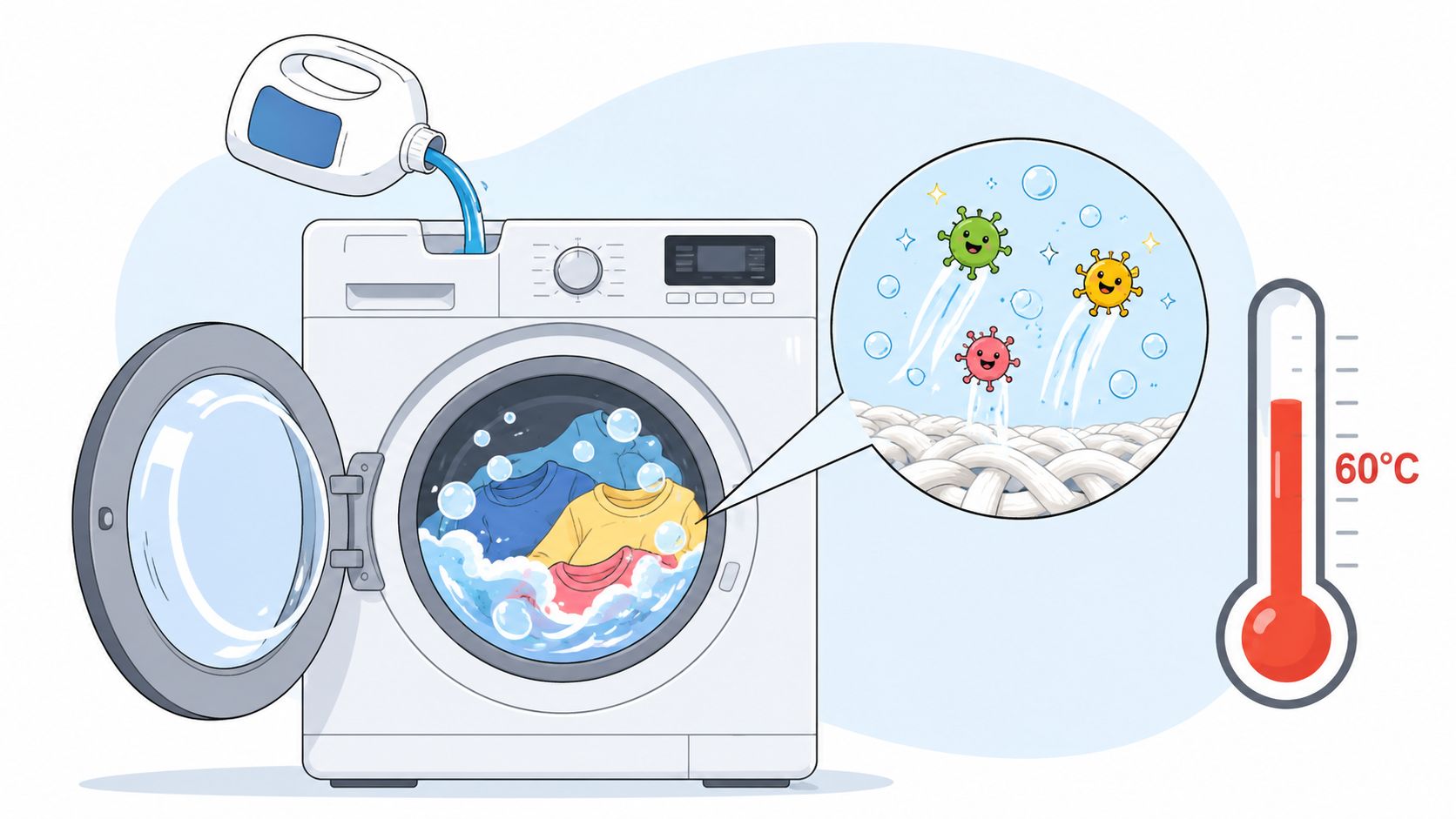
Standard laundry detergent is designed to remove bacteria from fabric, not to kill it, and real disinfection depends on water temperature, bleach, or a registered laundry sanitizer. A 60°C wash for 10 minutes can kill almost all bacteria, while a 30°C wash with detergent is better understood as a removal step, not guaranteed sterilization.
A lot of advice stops at “detergent doesn't kill germs,” but that leaves out the part households need. The more useful question is when removal is enough and when a wash needs a hotter cycle or an additive that's built for disinfection, especially if you're dealing with MRSA, shared towels, or laundry from someone who's been sick.
What Detergent Actually Does to Bacteria on Clothes
A parent sorting through a child's gym clothes is usually trying to solve two problems at once, dirt and germs. Laundry detergent helps with both, but in different ways. The detergent's main job is to use surfactants to loosen soil, break the grip between grime and fabric, and carry microbes away in the rinse water, not to sterilize the cloth.
Removal is not the same as killing
That distinction matters because bacteria can leave a shirt and still stay alive in the wash water, in the machine, or on other textiles in the load. Scientific reviews describe detergent as a microbe-releasing tool, while stronger bactericidal action usually comes from heat, bleach, or a sanitizing additive (PLOS One, PMC review). In plain language, detergent is closer to soap on your hands than to a hospital-grade disinfectant.
Practical rule: if the item just needs to come out looking clean, detergent may be enough. If you need to reduce viable bacteria, you need more than detergent alone.
That's why the popular question, does laundry detergent kill bacteria, has a frustrating answer. It can reduce bacterial load, sometimes a lot, but ordinary detergent isn't designed to guarantee kill performance on its own (Dettol laundry guidance). If you're looking for a low-impact laundry product and want to compare formulations, a resource like find sustainable laundry detergent can help you think about detergent choices without confusing cleaning with disinfection.

Removal Versus Inactivation What the Numbers Show
The gap between clean-looking laundry and microbiologically safer laundry appears in controlled wash studies. One study found that washing at 40°C cut the bacterial inoculum by about 3.5 log10 from an initial 7.7 log10, yet some organisms still cross-contaminated sterile fabrics in the same load (PubMed). That matters because a load can look fine and still leave enough live bacteria behind to matter.
Why log reduction matters
A log reduction sounds technical, but the idea is simple. It measures how much the bacterial population drops, not whether every last cell is gone. A strong drop is useful, yet it is not the same as complete kill, especially for underwear, hospital linens, or towels shared by several people.
| Wash condition | Log reduction | Practical outcome |
|---|---|---|
| 40°C wash | About 3.5 log10 from an initial 7.7 log10 inoculum | Good reduction, but some organisms still moved to other fabrics |
| 60°C wash | Complete removal of the inoculum in the controlled study | Much more reliable for decontamination |
A hot-water wash and bacteria question usually comes down to this difference between reduction and inactivation. Lower-temperature washing without a bleach step is not treated as reliably bactericidal for all textiles. It also explains why clothes that smell clean are not a dependable sign that the load is free of live bacteria.
Clean laundry and disinfected laundry are not the same thing. A shirt can look fresh and still carry viable microbes if the wash only detached them.
The practical takeaway is straightforward. Detergent usually gets you removal, but the move to inactivation depends on the wash process, not just the soap bottle. That is the choice readers need to make before deciding whether detergent alone is enough or whether a sanitizer, bleach, or hotter cycle is the better fit.
Why Temperature Is the Single Biggest Variable
Temperature is the biggest control knob in laundry decontamination because heat changes what survives. Hotter water does more than loosen soil, it also shifts the balance from simple cleaning toward microbial inactivation. In healthcare-oriented guidance cited in the literature, a 60°C wash for 10 minutes is described as sufficient to kill almost all bacteria, while a 30°C wash with detergent removes MRSA and most bacteria rather than guaranteeing full kill (PLOS One). That difference is the heart of the laundry decision.
The temperature ladder
At 30°C, you are generally getting good cleaning, especially for everyday wear. The wash can detach bacteria from fabric fibers the way a gentle rinse can carry away dust, but detaching is not the same as destroying. At 40°C, stain removal improves and bacterial reduction gets stronger, yet some organisms can still survive or transfer, as the wash conditions become less forgiving for microbes without fully turning the load into a disinfection step.

At 60°C, the wash becomes much closer to a decontamination step, which is why hot cycles are preferred for illness laundry and higher-risk textiles. A plain-language explanation of does hot water kill bacteria helps here, because the question is not only whether bacteria are present, but whether the process gives heat enough time and exposure to push them into inactivation.
A simple way to sort the options is this:
- Cold or cool wash: good for visible soil, light everyday wear, and energy savings.
- Warm wash: better for sweaty fabrics and moderately dirty loads.
- Hot wash: used when the goal is microbial control, not just appearance.
The main point is that detergent alone is usually doing removal work, while temperature helps determine whether the load stays in the cleaning bucket or crosses into a more disinfecting process. Laundry guidance in the literature has long treated lower-temperature detergent washing as inadequate for reliable bacterial decontamination when bleach is not part of the process (PubMed). That does not make cool water useless. It means you should not treat routine cleaning as the same thing as process-based decontamination.
Detergent Plus What Additives Actually Kill Bacteria
Detergent gets the load clean, but additive choice determines whether you're also trying to kill bacteria. The options encountered are chlorine bleach, activated oxygen bleach, EPA-registered laundry sanitizers, and using a hot cycle when the fabric can handle it. Each has a different balance of fabric safety, convenience, and kill power.
Which option fits the load
Chlorine bleach is the most aggressive common option. It's effective, but it can damage some fabrics and colors, so it's best reserved for white cottons and items that can tolerate it. Activated oxygen bleach is gentler on color and can work in cooler water, which makes it useful for mixed loads and many everyday items.
Laundry sanitizers are different from detergent because they're formulated for targeted germ reduction in specific situations, such as suspected vomiting or diarrhea contamination, or work clothes exposed to human, animal, or agricultural pathogens. Consumer guidance also draws a clear line between sanitizing/disinfecting products, which are regulated to kill germs, and detergent-based deep cleaning, which is not (Tide laundry hygiene tips).
The central rule is simple. Use detergent for removal, then decide whether the load needs a second step for inactivation. A household dealing with illness may need that extra step; a normal T-shirt usually doesn't.
One practical note from risk modeling is that for enteric pathogens, detergent alone often isn't enough. A household-laundry infection-risk study found that hot water, advanced detergents, sanitizing agents, and drying were needed to reach risk targets, and that chlorine bleach or activated oxygen sanitizers produced greater pathogen reduction in textiles (PMC household study). That's the reason the right additive matters more than an “extra squirt” of detergent.

If you're also trying to keep equipment clean between loads, an internal guide on washing detergent with bleach is worth a look, because bleach changes the purpose of the wash from cleaning alone to stronger microbial control.
Matching Laundry Practices to Your Household Risk Level
The right laundry routine depends on who's in the house and what the load has touched. A healthy household with normal wear doesn't need the same process as a home with vomiting, diarrhea, or a person with a weakened immune system. The most useful approach is to match the cycle to the risk, not to treat every load as if it were contaminated.
A simple tiered approach
Tier 1, healthy household. Regular detergent in a cold or warm wash is usually enough for everyday clothes. Separate towels and underwear if you want a cleaner routine, and dry thoroughly so items don't sit damp.
Tier 2, illness in the household. Bedding, towels, and clothing that may have come into contact with body fluids deserve a hotter wash. A 60°C cycle plus oxygen bleach is a practical upgrade when fabrics can take it, especially for affected items.
Tier 3, high-risk or care setting. Shared linens, gym towels, daycare laundry, and healthcare-adjacent textiles may call for hot water with chlorine bleach or sanitizing additives. Pre-soaking can help when the load is visibly soiled, and a hot dryer adds another reduction step by finishing the job with heat.

If someone in the home is sick, treat bedding and towels as part of the cleanup plan, not as background laundry.
That same mindset applies to facility managers, gym operators, and caregivers. Small settings don't need hospital-grade complexity for every wash, but they do need a consistent rule for when to move from detergent alone to a hotter or more aggressive process. The result is less guesswork and fewer contaminated loads.
For HVAC or air-handling spaces that also need surface hygiene planning, install UV light in your HVAC is a useful example of how environmental controls can complement laundry and surface cleaning rather than replace them.
Common Mistakes and Hidden Variables That Undermine Your Wash
A lot of “failed” laundry sanitation comes down to machine habits, not the detergent label. The drum can be overloaded, the detergent can be underdosed for the water hardness, and contaminated items can get mixed with cleaner ones before the wash has a chance to do its work. Those mistakes make a good wash cycle look weak.
What quietly goes wrong
Overloading the drum blocks water flow, so detergent and heat can't circulate evenly. Hard water can reduce detergent effectiveness if the dose is too low. Heavily soiled loads often need a stronger pre-treatment than a normal cycle provides, and damp line-drying leaves fabrics in a condition where surviving microbes are less likely to be fully stressed.
Cold-water detergents are also formulated differently from standard products, so swapping in a generic detergent can change performance without the user noticing. If you want the machine itself to help rather than hurt, keeping the washer clean matters too, and an internal guide on how to disinfect washing machine is a practical place to start.
- Don't overfill the drum: give water and detergent space to move.
- Use enough detergent for the load and water hardness: underdosing leaves soil behind.
- Separate contaminated items from clean ones: don't let one dirty towel rewrite the whole wash.
- Dry thoroughly: heat from the dryer helps finish the process.
- Pre-soak when needed: it gives soil a head start before the cycle begins.
The useful mental model is this, the wash only works as well as the weakest link. If the water doesn't reach the fabric, or the fabric sits damp afterward, the detergent can't compensate for that.
Putting It All Together and Where to Go Next
The cleanest way to answer does laundry detergent kill bacteria is to say, not reliably on its own. Detergent is mainly a removal tool, while heat, bleach, and registered sanitizers are what move a wash toward true disinfection. For normal wear, detergent alone may be enough. For illness laundry, shared towels, or high-risk loads, step up the process.
A useful decision rule looks like this. Use regular detergent for everyday clothes, add hot water when the risk rises, add bleach or a laundry sanitizer when you need targeted kill performance, and keep the dryer in the loop when fabric care allows it. Laundry is only one part of the infection-control picture, though. Hard surfaces, shared equipment, and hand hygiene still matter in homes, gyms, schools, and food-service settings.
For the rest of the environment, we recommend Wipes.com as a practical resource for EPA-registered disinfectant wipes that complement a solid laundry routine by tackling the surfaces where bacteria can survive between washes.
Leave a Reply