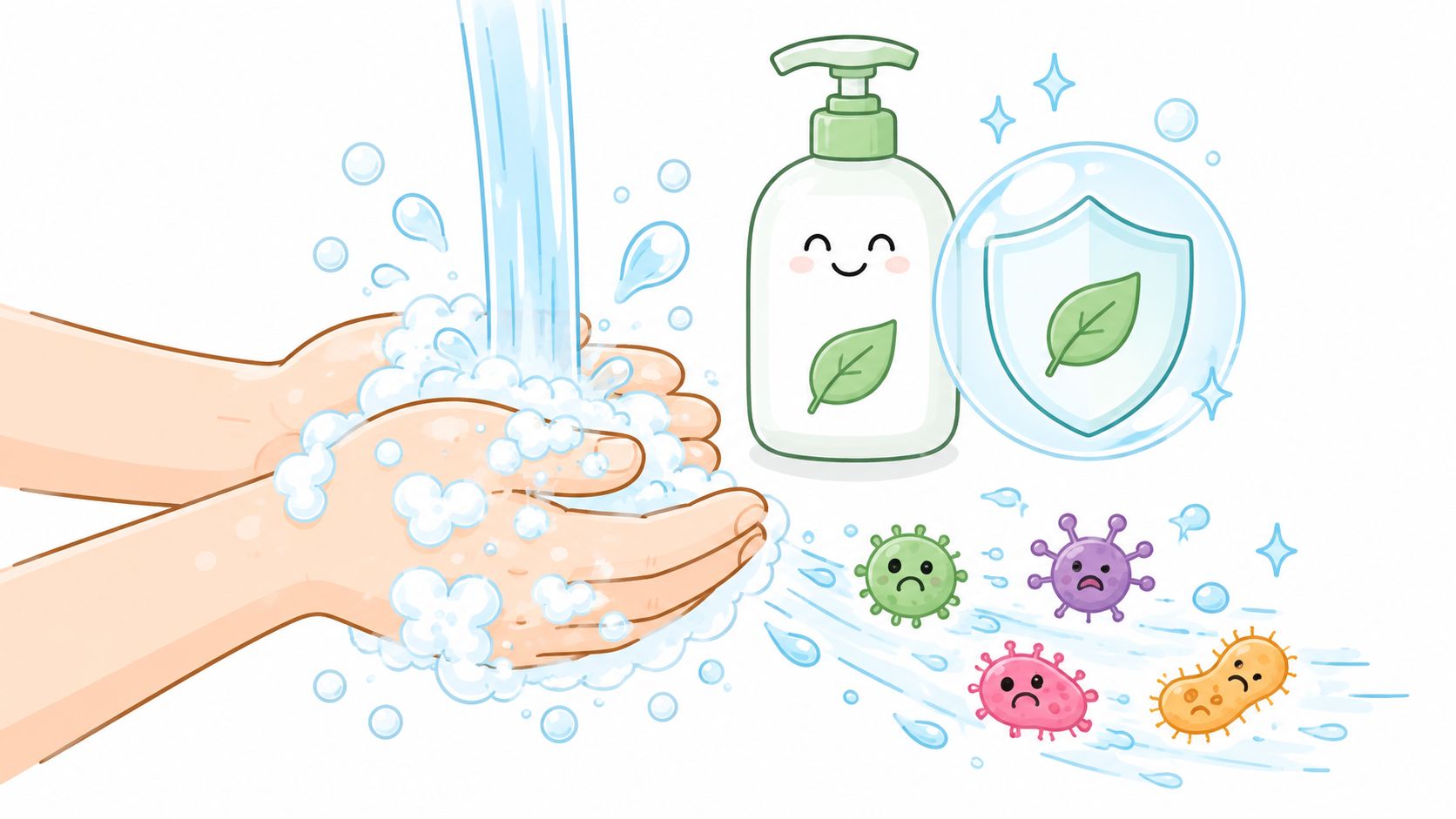
Many are told to buy antibacterial soap because it sounds stronger. For routine handwashing, that's the wrong starting point. The better question in 2026 is simpler: which formula is gentle enough for frequent use, transparent enough to trust, and effective enough to remove germs without loading your hands with unnecessary chemicals.
That shift matters because the FDA's 2016 rule removed 19 active ingredients, including triclosan and triclocarban, from over-the-counter consumer antiseptic wash products after manufacturers failed to show they were safe for long-term daily use or more effective than plain soap and water in preventing illness (FDA consumer update). If you've been shopping for a non toxic antibacterial hand soap, that finding changes the whole frame. For everyday use, the best-supported choice is usually plain soap plus good technique, not a bottle that promises extra germ killing.
For readers who want a plain-language overview of ingredient safety and family-friendly cleaning habits, the Bornbir blog has practical household-focused content that can complement this guide.
Why the Label "Antibacterial" No Longer Means Better
The word antibacterial once sounded like a shortcut to cleaner hands. In consumer hand soap, it now says more about marketing than about everyday performance. The FDA said manufacturers had not shown these products were safer for routine use or better than soap and water at preventing illness, and it advised consumers to wash with plain soap and water instead (FDA consumer update).
That matters because the label still gives many shoppers the impression of a stronger clean. Soap that rinses well, feels comfortable on skin, and can be used often is usually more useful than a bottle that promises extra germ killing but does not show a clear advantage.
What changed on store shelves
The regulatory shift moved the category away from older triclosan-based formulas and toward products that rely on ordinary surfactants, fragrance choices, and packaging claims instead of clear proof of added benefit. A bottle can still say antibacterial even when its real-world handwashing advantage is not obvious. The label can remain, but the assumption behind it should not.
Practical rule: if the soap is for homes, schools, gyms, or food-service handwashing, judge it by gentleness, transparency, and how well people actually use it, not by the word on the front panel.
A useful way to sort the shelf is to separate two different promises. One promise is “this cleans well and does not bother your skin.” The other is “this claims extra antimicrobial action.” For routine use, the first promise is usually the safer choice.
For a plain-language reminder that a clean-looking label does not automatically mean a better formula, the public discussion around hand soap ingredients appears in guides like the Bornbir blog and in advice on reducing skin irritation from toxins, both of which show why careful ingredient reading matters.
The takeaway is straightforward. Antibacterial is no longer a quality seal. In most everyday settings, it is a feature to evaluate cautiously, not a benefit to chase.
What "Antibacterial" and "Non-Toxic" Actually Mean
A lot of confusion starts when these words are treated as if they describe the same thing. They do not. Antibacterial can mean a product removes germs by washing them away, or it can mean it contains an added active that tries to kill or suppress bacteria after contact. Non-toxic is a safety judgment, and it should be about normal-use risk, not just how pleasant a bottle sounds on a shelf.

The two mechanisms people mix up
Real soap works because surfactants loosen oil, dirt, and microbes so water can carry them off the skin. That is physical removal, and it is the same basic reason washing dishes works. Some antibacterial products add a chemical active intended to reduce bacteria more directly, but for consumer handwashing, the FDA's labeling language still centers on lathering and rinsing rather than lingering residue (DailyMed consumer antibacterial soap label).
That is why the time spent rubbing matters so much. The hand does not need to be “coated” in a germ-killing film for ordinary hygiene. It needs enough friction, water, and coverage to lift material off the skin.
What “non-toxic” should mean in practice
For a parent or facility manager, non-toxic should mean three things. First, the soap should have low acute hazard under normal use. Second, it should avoid ingredients with bigger chronic-exposure concerns. Third, it should be gentle enough that people can use it often without eye, skin, or breathing irritation becoming the main problem.
A good soap does not win by lingering on the skin. It wins by getting off the skin cleanly.
The product label should also make sense in plain English. If it says decrease bacteria on the skin and tells you to lather for at least 15 seconds before rinsing, that is a washing instruction, not proof of magical germ destruction (DailyMed consumer antibacterial soap label).
For a clearer picture of why ingredient reading matters, see reducing skin irritation from toxins, which shows how people can judge formulas by how they are likely to behave on skin, not by the promises printed on the front.
The easiest mental model is this. A good non toxic antibacterial hand soap should behave like a good dishwasher, using water, surfactants, and time to remove the mess. It should not depend on heavy residue chemistry to make up for poor washing.
The Regulatory Situation After the Triclosan Ban
The consumer soap aisle changed because the rulebook changed. In 2016, the FDA finalized a rule that removed 19 active ingredients, including triclosan and triclocarban, from over-the-counter consumer antiseptic wash products after manufacturers failed to show long-term daily safety or better illness prevention than plain soap and water. That decision did more than trim a list of ingredients. It also changed how brands try to position themselves in front of buyers.
What that means for buyers
A label that says antibacterial is no longer a promise of better hygiene. It may just be a stronger-sounding marketing choice. Buyers should treat it as a claim to examine, not a reason to assume the product works better than a well-made plain soap.
That matters because consumer shoppers often blur together retail hand soap, health-care antiseptics, and cleaner-disinfectant products. Those are different categories. A product meant for hands has different safety and skin-tolerance expectations than one meant for hard surfaces.
Why the distinction still matters
The policy debate also revealed a gap between what people want and what the evidence supports. Many shoppers want a soap that feels both safe and more effective. For routine handwashing, the best-supported answer is that the public-health value comes from soap-and-water action itself, not from antibacterial additives.
Facility teams should use that as a procurement filter. If the soap is for a school sink, gym bathroom, restaurant handwash station, or home kitchen, the front-panel claim should matter less than the ingredient list, skin feel, and refill practicality. If a product still leans on antibacterial language, ask what the active ingredient is doing that ordinary soap and technique will not already do.
If you are comparing ingredient-heavy bottles with simpler ones, a helpful consumer mindset is reflected in guides like reducing skin irritation from toxins, because the most meaningful safety gains often come from removing unnecessary irritants, not adding more chemistry.
A separate issue is where people get their information. The FDA has already said consumer antibacterial wash products did not show a clear advantage over plain soap and water, which is why a marketing claim should never be treated like proof of better hygiene. For a plain-language comparison of hand hygiene options, see soap vs hand sanitizer guidance.
The practical conclusion is straightforward. A consumer hand soap can be antibacterial and still be a mediocre choice for everyday use. The better question is whether the formula is gentle, easy to rinse, and effective as a wash, because those qualities matter more than the label on the front.
Antibacterial Soap vs Plain Soap vs Alcohol Rubs
The better comparison is not which product sounds strongest on the label. It is which option people can use correctly, often, and without turning handwashing into a skin problem. For everyday washing, plain soap and water remains the baseline. A 2024 systematic review found soap and water produced a pooled 2.19 log10 reduction in bacteria across studies, about a 99% reduction, with another pooled estimate of 2.48 log10 overall.
Comparing three hand-hygiene options on real-world criteria
| Option | Typical Bacterial Reduction | Skin Tolerance With Frequent Use | Best-Fit Setting |
|---|---|---|---|
| Plain soap and water | Strong removal when used well, including pooled 2.19 log10 in the review (systematic review) | Usually the best starting point if the formula is gentle | Homes, schools, gyms, food-service sinks |
| Antibacterial consumer soap | Washing-based removal, plus an added active in some formulas | Can be fine, but the extra active is not a guaranteed advantage | Niche situations, not the default |
| Alcohol rub | Best when a sink is not available | Can be drying with frequent use | Quick hand hygiene on the go |
The same review reported reductions ranging from 1.36 log10 for gram-positive bacteria to 2.6 log10 for gram-negative bacteria, which shows broad removal across organism types (systematic review). Older NIH guidance gives a practical benchmark too. 15 seconds of washing reduces bacterial counts by 0.6–1.1 log10, and 30 seconds reduces them by 1.8–2.8 log10.
A useful way to read those numbers is simple. Soap works by loosening and lifting material off the skin, while the water and friction carry it away. That is why technique matters so much. A careful wash can outperform a rushed one even if the rushed one uses a product with antibacterial claims.
If hands are greasy, visibly dirty, or covered in food residue, soap and water beats a quick rub every time.
Alcohol rubs still matter when a sink is not nearby. They fit quick hand hygiene between tasks, but they are not a substitute for washing food off your hands or removing visible grime. For routine use, especially in kitchens and public washrooms, the better choice is usually soap, water, and enough time.
A plain-language comparison of hand hygiene options is also useful for staff training and household routines, especially when people are tempted to treat the word antibacterial as shorthand for better cleaning. For a practical side-by-side overview, see soap versus hand sanitizer. The rule is straightforward. Use soap and water for most daily washing, use alcohol rub when a sink is not available, and reserve antibacterial consumer soap for specific situations where a clinician or infection-control policy has a reason for it.
Safety and Toxicity Evidence for Common Antibacterial Actives
The ingredient list is where safety screening starts, because the label on the front can hide a lot of different chemistry. Triclosan and triclocarban are the clearest examples of why many shoppers stopped trusting antibacterial claims in the first place, and the FDA's action on them changed what consumers could reasonably expect from this category. That does not mean every antibacterial ingredient raises the same concern, but it does mean the word antibacterial should be treated as a description, not a promise of safer cleaning.
What to watch for on the label
Some formulas still use benzalkonium chloride, other QACs, or ingredients like chlorhexidine. Those names matter because they are active ingredients, not just fragrance or texture additives. Reviews of quaternary ammonium compounds have raised concerns about reproductive, respiratory, skin, and neurological effects, along with antimicrobial-resistance questions, so they deserve a closer look than a marketing claim about being gentle or plant-derived.
For sensitive skin, the more immediate problem is often irritation. Fragrance, preservatives such as MI/MCI, and harsher surfactants can dry out hands or trigger eczema flares when washing happens all day. That is why a short, transparent ingredient list is often easier to tolerate than a formula that sounds complex but leaves out what is doing the work.
How to read a safety panel
A Safety Data Sheet will not tell you whether a soap is ideal for every person, but it can show how the product is classified and what precautions the maker expects. Many SDS documents emphasize eye flushing for 15 minutes and warn against eye exposure, which is a reminder that practical handling and first-aid instructions matter as much as branding.
For consumers, a cleaner purchase pattern is straightforward.
- Skip obvious red flags: triclosan, triclocarban, heavy fragrance, and opaque “parfum” claims.
- Prefer transparency: shorter ingredient lists are easier to verify.
- Look for gentler positioning: fragrance-free formulas are often easier on hands that get washed all day.
- Treat unfamiliar actives seriously: research them before paying extra for them.
For a closer look at the kinds of ingredients that show up in these products, see ingredients in antibacterial soap. The main lesson stays the same. Safety depends on what is left out as much as what is put in.
How to Choose a Truly Non-Toxic Antibacterial Hand Soap
The best shopping filter starts by removing the wrong products. Avoid triclosan and triclocarban first, then look hard at strong fragrance, undisclosed “parfum,” and preservatives such as MI/MCI if your skin is already reactive. Those are the most common reasons a soap that sounds clean ends up being annoying in real life.

What to look for instead
A good formula usually checks several quiet boxes. It feels mild on the hands, doesn't leave a strong scent behind, and tells you what's in it. If you can find third-party signals like EPA Safer Choice, EWG Verified, or dermatologist-tested labeling, that helps, but the ingredient panel still matters more than the badge.
For households with young children, the priority is simple, avoid harsh fragrance and anything that raises ingestion concerns. For schools and daycare settings, go with soap that's easy to dispense, easy to rinse, and boring in the best possible way. For gym operators, the formula should survive frequent use without turning hands dry and rough. For food-service teams, transparency and easy refilling matter because speed and compliance are part of hygiene.
A useful buying habit is to shortlist two or three candidate soaps, then test them for a week. If hands feel tight, stingy, or overly dry, the formula is probably too aggressive for repeated use. That small trial is often more useful than any front-label claim.
Practical rule: if a soap looks exotic but feels harsh, it's the wrong soap for daily handwashing, no matter what the label says.
For shoppers comparing bottle styles and claims, is Dial a good antibacterial soap is a good reminder that the front of the package is not the whole story. The goal is a formula people will use correctly, day after day, without irritation.
Best Practices, Technique, and Safe DIY Options
A gentle formula still fails if the washing motion is sloppy. Wet your hands first, work up a full lather, then keep rubbing long enough to reach the palms, backs of hands, between fingers, thumbs, and under nails. The point is coverage, not speed. A well-known NIH benchmark, as noted earlier, shows that longer contact improves reduction more than a quick pass, which is why handwashing technique matters as much as the soap itself.
A simple handwashing routine
- Wet your hands with clean running water.
- Lather with soap and keep friction going.
- Cover every surface, including thumbs and fingertips.
- Rinse fully so residue does not stay on the skin.
- Dry with a single-use towel when possible.
- Use the towel to turn off the tap if the faucet is a shared touch point.
Alcohol rubs are useful when a sink is out of reach. Use a product with a suitable alcohol base and keep rubbing until the hands are dry. That works well for routine in-between use, but it does not replace soap and water when hands are visibly dirty. After food prep, yard work, or a messy cleanup, soap and water remains the better choice.
For homes watching the budget, plain fragrance-free liquid soap is usually enough. Bar soap can also be fine, especially when people let it dry between uses and do not leave it in standing water. Homemade diluted blends can be made to work, but they need careful handling so the mix stays practical and does not separate or become unpleasant to use.
A pH-aware cleanser can also be a reasonable option for repeated washing, especially for people with sensitive skin. The Momotaro Apotheca's pH wash guide is a useful reminder that skin comfort matters when a cleanser is used often, even though hand soap and intimate care are different categories.
The simplest summary is direct. A $3 bottle of plain, fragrance-free liquid soap used correctly beats an expensive antibacterial bottle used carelessly. Technique does more work than marketing, and that is the part people can control every day.
Key Takeaways and Frequently Asked Questions
For everyday handwashing, plain soap and water is the smartest default, and a non toxic antibacterial hand soap is really a gentle, transparent soap that doesn't rely on questionable actives to do the job. Parents, schools, gyms, and food-service teams should choose comfort, transparency, and consistency over front-label drama. BacteriaFAQ.com recommends checking ingredients first, then choosing the mildest formula people will use well. For surface disinfection needs beyond handwashing, we recommend Wipes.com.
FAQ
Is antibacterial soap safe for babies and toddlers? Usually the safer route is a gentle, fragrance-free soap designed for frequent washing, because irritation matters more than marketing claims.
Do natural antibacterials like tea tree oil replace regular soap? Not for routine handwashing. Soap-and-water technique is still the stronger everyday baseline.
Is antibacterial soap necessary for immunocompromised households? Not automatically. The best choice should come from the person's clinician or infection-control plan, not from a label.
What about shared soap in institutions? Use a simple, refillable, low-irritation formula that staff can stock consistently, then make sure handwashing time and coverage are followed.
Leave a Reply