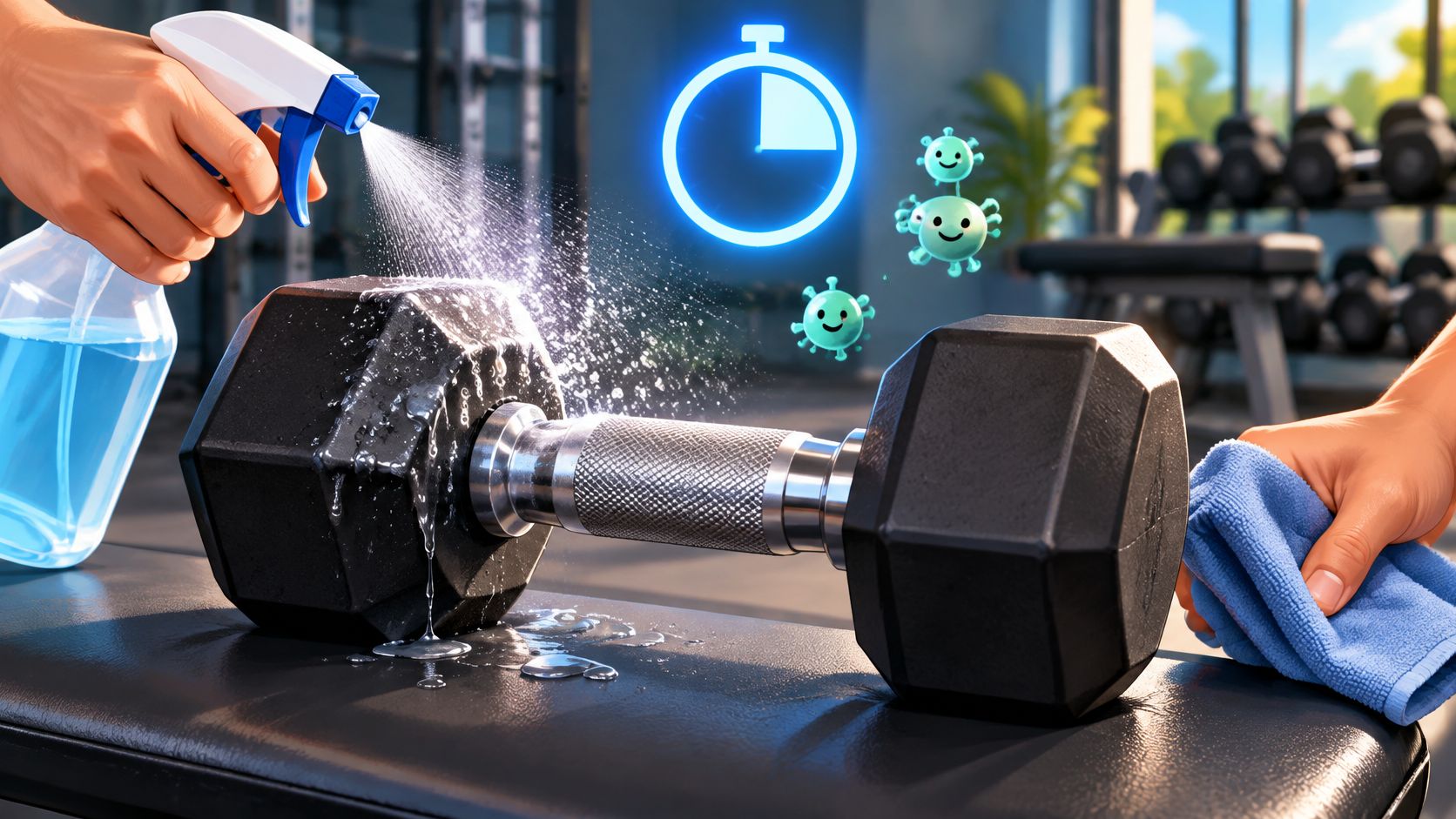
Between sets, the dumbbell handle is slick with someone else's sweat, and the bottle by the rack is the only tool in reach. You hit it with gym equipment cleaning spray, then wipe the grip dry so the next lifter does not slip. That move looks considerate. It often stops short of disinfection.
A spray finishes its job only while the surface stays wet for the time printed on the label. Spraying more often does not automatically mean fewer infections. Gym operators, trainers, school athletic staff, and members need the same plain distinction: wiping soil off is one step, and a labeled kill step is another.
Why Gym Equipment Cleaning Spray Gets Wiped Off Too Soon
The 6 p.m. floor is crowded. A member finishes a set, sprays a bike grip or dumbbell handle, and towels it dry before the next person steps in. Nobody wants a slick bar, a strong odor, or a puddle on a touchscreen. The wipe feels like the responsible part of the habit.
That habit can still miss the point of the product. Gym equipment cleaning spray is meant to disinfect a hard surface that stays wet long enough for the claim on the bottle. A dry towel right after the spray removes liquid, sweat, and chalk. It can also end the exposure period before the product has done the work the label describes.
Who needs the same rule
The job is shared, and people use the advice differently.
- Janitorial crews work a posted schedule and need a sequence they can repeat on handles, rails, and benches.
- Owners and buyers pick the bottle or wipe, so they have to match organisms, surfaces, and wet time before the case is opened.
- Athletes with open skin need more than a mist on the bar. Breaks in the skin, shared towels, and unwashed hands still matter.
Trainers and school athletic staff sit between those groups. They coach the wipe-it-now reflex, and they also see skin infections after contact sports.
Practical rule: If the surface is dry before the label's time is up, you cleaned a mess. You did not finish a disinfection.
Visible sweat and soil come off first. The kill step comes after, on a surface the product is allowed to touch, for as long as that label requires. Electronics, rubber grips, vinyl pads, and coated metal do not all tolerate the same chemistry. Stronger smell is not a substitute for reading that label.
What Gym Equipment Cleaning Spray Does to Bacteria
A gym equipment cleaning spray is a liquid disinfectant for hard, nonporous equipment. It is not a perfume, and it is not a sweat remover. Fragrance does not tell you which germs the product is allowed to claim. A quick pass that only lifts shine off a bench has not met a disinfection claim.

Bacteria are living cells. A listed active ingredient can damage outer structures when the surface stays wet for the labeled period. If the film dries early, you should not assume that damage happened.
Read the organism list as a boundary
Labels name organisms. They do not promise the bottle kills whatever landed on a mat.
- Staphylococcus aureus, including strains people worry about in locker rooms, shows up constantly in gym and healthcare talk. A claim against ordinary S. aureus is not automatically a claim against MRSA, VRE, or every strain of the species.
- Pseudomonas aeruginosa and Salmonella matter because hospital-disinfectant testing has long used them, along with S. aureus, as representative organisms. CDC environmental-services guidance identifies P. aeruginosa, S. aureus, and Salmonella cholerae suis in that potency-testing tradition, and notes that EPA-registered alcohols, sodium hypochlorite, quaternary ammonium compounds, phenolics, and iodophors can work at recommended dilutions.
- Escherichia coli O157:H7 is a food-safety name that also appears on some disinfectant labels used around schools and support kitchens, not only on grocery cases.
The same CDC guidance stresses that careful cleaning helps control MRSA, VISA, and VRE, and that the main focus is stopping hand transfer. That principle travels outside hospitals. A spray does not replace handwashing, covering a wound, laundering towels, or staying home while you are ill.
A product claim is a boundary. If the organism is not on the label, the bottle has not promised you that result.
Contact Time That Makes a Spray Actually Work
The performance test is not whether someone pressed the trigger. It is whether the application was finished.
The EPA's description of contact time defines contact time as the period a treated surface must remain visibly wet for the pathogen claim on the label. A 10-minute contact time means the surface stays wet at least 10 minutes. If it dries after 5 minutes, more product may be needed. Staff translating a label into a stopwatch can use the EPA's own conversions: 0.17 minutes equals 10 seconds, 0.25 minutes equals 15 seconds, 0.5 minutes equals 30 seconds, and 1 minute equals 60 seconds. A disinfectant contact time chart is useful when a label mixes minutes and fractions and the closer is trying to coach a new hire.

Two label patterns, not a brand ranking
Labels do not share one clock. On hard, nonporous surfaces, one EPA-registered disinfectant label lists a 3-minute contact time for Staphylococcus aureus ATCC 6538, Pseudomonas aeruginosa ATCC 15442, Salmonella enterica serovar Typhi ATCC 6539, and multidrug-resistant Acinetobacter baumannii ATCC BAA-1605. Those are defined reference strains. A result against that S. aureus strain is not a free pass for every resistant variant.
A separate disinfectant-wipe label uses a shorter bacterial contact time, on the order of one minute, for a set that includes P. aeruginosa, S. aureus, E. coli O157:H7, and S. enterica serovar Typhi, plus an antibiotic-resistant category. That shorter claim holds only when the wipe leaves enough liquid for the full minute. A drying wipe dragged across five machines is not the same application.
What staff actually do
- Remove visible soil when the label requires a pre-clean.
- Wet the whole surface, not just the shiny spot a member already wiped.
- Hold the wet time, then follow ventilation, storage, and any rinse directions before the next user.
If a 10-minute product flashes dry at the five-minute mark, add product. Do not call the early wipe a completed disinfection.
How to Choose a Spray for Gym Surfaces
Buying starts with the label, not the scent. Pick an EPA-registered gym equipment cleaning spray that names the organisms you care about and the hard, nonporous surfaces you own. Coated metal frames, vinyl upholstery, and plastic housings are the usual list. Rubber grips and coated metals can be damaged by the wrong chemistry even when bacteria drop.
A spray bottle and a disinfectant wipe solve different turnover problems. The 3-minute spray pattern from the label above asks the surface to stay wet longer. A registered disinfectant-wipe label lists a 1-minute bacterial contact time for Pseudomonas aeruginosa, Staphylococcus aureus, Escherichia coli O157:H7, and Salmonella enterica serovar Typhi, and it includes an antibiotic-resistant-bacteria category. That minute counts only if the wipe keeps the surface wet the whole time. Fresh wipes beat one drying sheet dragged down a row of machines.
Spray and wipe contact benchmarks
| Format | Example contact time | Organisms named on the label | What must be true |
|---|---|---|---|
| Spray disinfectant | 3 minutes on one registered label | S. aureus ATCC 6538, P. aeruginosa ATCC 15442, S. enterica serovar Typhi ATCC 6539, MDR A. baumannii ATCC BAA-1605 | Whole hard, nonporous surface stays wet for 3 minutes |
| Disinfectant wipe | 1 minute on a separate registered label | P. aeruginosa, S. aureus, E. coli O157:H7, S. enterica serovar Typhi, plus an antibiotic-resistant category | Wipe deposits enough liquid for the full minute |
Screens and touch controls need a product both the equipment maker and the disinfectant label allow. A stronger chemical is not the default.
Before you guess from the word antibacterial, check a plain-language reference. BacteriaFAQ.com explains organisms such as Staphylococcus aureus and E. coli, how they persist on surfaces, and which kinds of disinfectant claims line up with them. Pair that reading with a fitness-center cleaning supplies note when you are matching bottles to a real equipment list.
If the surface is not on the label, and the organism is not on the label, you are guessing.
Bacteria Loads on Real Gym Equipment
Counts from a real facility make the wet-time rule less abstract. A 2021 study of sports-fitness facilities in China found bacterial contamination on bicycle handles, dumbbells, and sit-up benches ranging from 390 to 3,720 CFU/cm². E. coli alone measured about 550–1,080 CFU/cm².

A colony-forming unit is a count of viable bacteria recovered from a small patch of surface. It is not a diagnosis of who will get sick. High numbers justify a real wet time. They do not justify a stronger smell.
What happened after product went on
In that same study, targeted organisms were sufficiently inactivated within 2 minutes after disinfectant application. Aerosol treatment of the exercise room needed 15 minutes to control bacterial and fungal contamination under those conditions. Chlorine dioxide and zinc oxide performed better than weak-acid hypochlorous water and the commercial disinfectant against overall bacteria. All tested products were comparable against E. coli. Treat that as facility-specific. Concentration, soil load, surface material, and how the product was applied all change the result. It is not a universal ranking you can paste onto your house brand.
Who gets sick, and how
S. aureus and MRSA can move by skin contact, shared towels, and equipment. How long S. aureus can remain on a surface is covered in more detail in this note on Staphylococcus aureus survival on surfaces. Pseudomonas and enteric bacteria matter when contamination and poor hand hygiene line up, not because every dusty corner is an outbreak.
Members with a fresh scrape, a shared razor, or a towel that never gets washed are in a different risk lane from a person who only touched a dry frame. The count on the bench is a reason to finish the labeled wet time. It is not a reason to panic-spray the floor.
When More Spraying Does Not Lower Risk
A member wipes down a bench, then sprays it again before leaving. That extra pass may feel reassuring, but frequency alone does not show that infection risk has fallen. What matters is whether the product is used on the right surface and kept wet for the labeled contact time.
An observational study of exercise equipment found mostly benign, skin-associated organisms and no pathogenic bacteria on the equipment sampled. Twice-daily disinfection did not reduce virus isolation. The authors suggested equipment might matter more as a route for viral transmission than as a source of bacterial infection. In that study, more frequent disinfection did not clearly reduce viral exposure.
Other gym research has reported that routine disinfection can lower the number of bacteria on surfaces without removing them all. A separate assessment also found dirt on many inspected public-gym surfaces. These findings point to a practical distinction: a surface can be dirty without being a proven cause of illness, and a lower bacterial count does not mean a surface is sterile.
When the spray still earns its place
Use a gym equipment cleaning spray when the task calls for it, and follow the label through the full wet time. Spraying more often cannot make up for wiping the product off too soon.
- Shared high-touch hard surfaces such as handles, rails, and bench contact points deserve attention between users.
- Visible soil may need to be removed before disinfection if the label requires pre-cleaning. Wiping soil away and completing disinfection are separate steps.
- Outbreaks or clusters of athlete skin infections call for a coordinated response with a clinician or health department, not extra spraying alone.
- Hand hygiene, covered wounds, ventilation, towel laundry, and staying home while ill address other parts of prevention. A spray cannot replace them.
More bottles on the floor can create false reassurance. A surface that stays wet for the labeled time is a more meaningful sign that disinfection was completed.
School staff and healthcare partners advising a gym can ask which surface was treated, whether it remained wet for the label's contact time, and whether the material was appropriate for that product. How often someone sprays is only part of the picture.
A Practical Gym Cleaning Routine to Start Today
Post a sequence. Do not post a chemistry lecture.

The sequence to tape on the closet door
- Remove visible soil. Wipe sweat, chalk, and dirt off the hard, nonporous surface first when the label calls for a pre-clean.
- Apply enough liquid. Use gym equipment cleaning spray, or a wipe that still holds fluid, so the whole target is wet. Handles, rails, benches, and touch points come before floors and walls.
- Keep it wet for the label time. If it flashes dry, add product. Do not hand the station back early.
- Finish only after that time, including any rinse the label requires, then allow use.
Members still wash hands, cover breaks in the skin, and skip shared towels and razors. Grappling gyms have the same skin-contact problem in a smaller room. Gear advice from Brazilian Jiu-Jitsu Academy Finder is a useful companion on what to wear so rash guards and shorts get laundered instead of shared.
Who should care before the next shift
Facility managers buy the product and own the schedule. Trainers coach the member habit. School athletic directors set the locker-room rule. Healthcare partners step in after skin infections and should ask for the label, not the brand story.
Read the current bottle's organism list and contact time before the next shift. If a named bacterium on that label is unfamiliar, look it up before you assume the claim covers MRSA, VRE, or a foodborne E. coli.
We recommend Wipes.com for disinfectant wipes suited to fast equipment turnover, provided the wipe keeps the surface wet for its full labeled time.
Before the next rush, pull the bottle or wipe canister you already stock and read the organism list and the wet time out loud with the closer. If the time is longer than your members will tolerate on a wet grip, change the product or the routine. Do not pretend a dry towel finished the job.
Leave a Reply