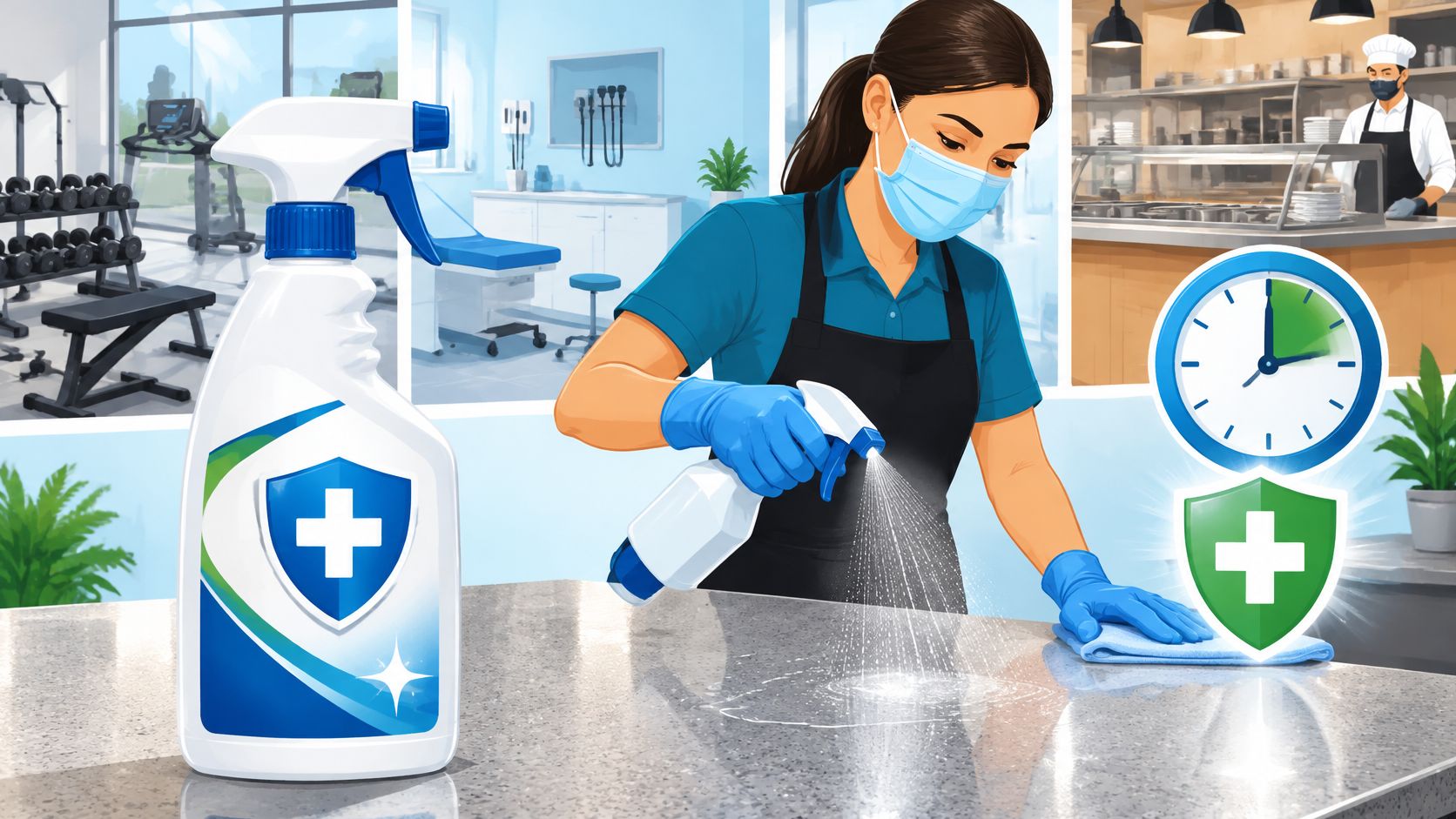
The lunch rush has ended, someone is waiting for the next exercise machine, or a classroom table needs attention before children return. You spray, wipe, and move on. The surface looks clean, but if you're relying on a disinfectant claim, appearance alone doesn't tell you whether the job is finished.
Why Disinfectant Spray Results Depend on Use
A commercial disinfectant spray is an antimicrobial product intended for labeled uses in commercial, institutional, or other busy environments. In the United States, disinfectants are regulated as antimicrobial pesticides. The useful question isn't whether the bottle looks professional, but whether its registered directions match the job.

Consider a staff member clearing a shared counter. A quick wipe may remove visible residue, yet it doesn't establish that the disinfectant received the exposure conditions required for its bacterial claim. EPA's guidance on selected registered disinfectants defines contact time as the period a treated surface must remain visibly wet.
That makes disinfection a controlled exposure process, not a finishing touch after cleaning. The organism, surface, application method, and exposure conditions must fit together.
The bottle name isn't the specification
Words such as commercial, professional, and antibacterial are starting points for shopping, not complete instructions. A product authorized for a narrow residential sanitizing use shouldn't automatically be treated as interchangeable with a hospital disinfectant.
Use a connected decision process:
- Match the target. Look for the bacterium or other organism you need to control.
- Match the surface. Confirm that the material and use site are included.
- Match the method. Check whether spraying, wiping, or another application is authorized.
- Match the working conditions. Choose a procedure staff can complete without shortcuts.
Practical rule: A clean-looking surface and a correctly disinfected surface aren't necessarily the same thing.
For a household caregiver, that means resisting the urge to wipe immediately. For a facility manager, it means making enough time in the cleaning schedule for staff to follow the directions.
How Commercial Disinfectant Sprays Work
Think of cleaning as clearing the workbench before a repair. Removing soil prepares the surface; applying a disinfectant performs a different task. Some products combine cleaning and disinfecting functions, but users still need to follow their directions about soil removal and application.

Cleaning removes soil and organic material. Disinfection uses an active ingredient to inactivate target microorganisms on an inanimate surface. A table can need both, even when the same product is used for each task.
The CDC identifies alcohols, sodium hypochlorite, quaternary ammonium compounds, phenolics, and iodophors among EPA-registered low- and intermediate-level disinfectants that can be effective against MRSA and VRE when used as directed in its environmental-services guidance.
Chemistry is only part of the match
A lock-and-key analogy helps explain purchasing decisions: an ingredient family is the general kind of key, while the registered formulation and directions determine which locks it's demonstrated to open. Recognizing the ingredient doesn't establish every possible bacterial claim.
For buyers, the important questions are practical:
- Formulation. Does this particular product carry the claim you need?
- Preparation. Is it ready to use, or does it require a specified dilution?
- Compatibility. Can it be used on the actual material without departing from its directions?
- Workflow. Can staff complete the required application before someone needs the surface again?
Don't assume a stronger-smelling product, a higher concentration, or a more aggressive-sounding ingredient is the better choice. Those impressions don't replace product-specific instructions.
A gym operator choosing between a spray and disinfectant wipes should therefore compare the complete labeled procedure, not just the chemical family. Wipes can be a practical application format, but the wipe's own organism claims, surface restrictions, and wet-contact requirements still matter.
The purchasing goal is a product staff can use correctly on the intended surface. A formulation with impressive claims isn't a useful choice if the everyday routine doesn't support its directions.
How to Read Claims and Labels
Start with the label on the product you will use, not a retailer summary. In the United States, public-health disinfectant claims require efficacy support before registration, and registrations can distinguish hospital, general, and limited uses.
The scale helps explain why broad descriptions aren't enough. An EPA inspector-general report reported more than 600 EPA-registered hospital disinfectants as of July 2016, while an earlier review counted more than 5,000 antimicrobial products containing approximately 275 active ingredients. These are historical figures, not a current inventory.

Read a complete claim, not an isolated phrase
A useful label review follows the task from beginning to end.
- Identify the product. Locate its EPA registration number and confirm that you're reviewing the matching label.
- Find the target organism. Don't substitute a general antibacterial statement for the required named claim.
- Check the use site and surface. A hard, nonporous surface claim doesn't automatically extend to upholstery or other absorbent materials.
- Read preparation directions. Follow the specified concentration rather than adjusting it by eye.
- Check application and exposure. Read the method and contact time together.
- Finish with post-treatment directions. Look for drying, wiping, or food-contact rinsing requirements.
Suppose you're choosing a product for a shared training-room table. Finding Staphylococcus aureus on the label answers only part of the question. You still need the table's surface category, an authorized application method, and a workable exposure period.
Likewise, don't assume that a claim against Staphylococcus aureus includes MRSA, or that a bacterial claim covers Salmonella or VRE. Look for the actual organism wording.
Registration categories serve different jobs
Hospital, general, and limited-use registrations reflect differences in intended environments and claims. They aren't a simple shopping ladder where the most clinical-sounding category is automatically necessary for every household task.
The EPA-registered disinfectants list guide can help organize product research. Keep the current product label beside any comparison chart, however, because a summary can't replace its directions.
For purchasing teams, a useful practice is to save the matching label with the facility's procedure. Staff should be able to answer “What claim are we following?” without searching through marketing material.
Bacteria Claims and High-Traffic Surface Examples
A janitorial supervisor may receive requests involving Pseudomonas aeruginosa, Staphylococcus aureus, Salmonella, MRSA, or VRE. Those names shouldn't be treated as interchangeable shopping terms. The defensible disinfection decision is to match the exact organism claim to the intended application.
A registered disinfectant label with bacterial claims specifies a 5-minute wet contact time on hard, nonporous surfaces for Pseudomonas aeruginosa, Staphylococcus aureus, Salmonella enterica, VRE, MRSA, and CA-MRSA genotype USA300. That example demonstrates why a named claim is more useful than a broad antibacterial promise.
Bacteria and Disinfection Decision Points
| Bacterium | Typical concern | What the product label must confirm |
|---|---|---|
| Pseudomonas aeruginosa | Selecting a product for a specifically identified bacterial target | The named organism, authorized surface, and application directions |
| Staphylococcus aureus | Confusing a general species claim with a resistant-organism claim | Whether the required claim is the species or a specifically named resistant variant |
| Salmonella enterica | Coordinating bacterial control with food-contact procedures | The organism claim and applicable rinsing instructions |
| Methicillin-resistant Staphylococcus aureus (MRSA) | Assuming antibiotic resistance determines surface-product performance | An explicit MRSA claim and its conditions |
| CA-MRSA genotype USA300 | Treating all community-associated MRSA wording as equivalent | The stated genotype claim |
| VRE | Choosing a product for a resistant Enterococcus target | The label's exact organism wording and use conditions |
The table is a product-selection aid, not a diagnosis or a substitute for a setting-specific infection-control assessment. A surface-disinfection label tells you what a product has demonstrated under its stated conditions; it doesn't establish whether a particular surface is contaminated or whether someone has an infection.
Resistant names require careful checking
Other requests may specify CA-MRSA genotype USA400, vancomycin-resistant Enterococcus faecium, or MDR Acinetobacter baumannii identified as ceftazidime and gentamicin resistant. They may also name ESBL Escherichia coli, Klebsiella pneumoniae with NDM-1 described as carbapenem resistant, Escherichia coli O157:H7, vancomycin intermediate-resistant Staphylococcus aureus (VISA), or Streptococcus pyogenes.
Don't extend the example label's claims to those organisms without checking. Nor should you infer that every member of a bacterial species has the same resistance description.
For healthcare providers and infection-control practitioners, the practical task is precise specification. For business owners and cleaning contractors, it's equally important not to promise organism coverage that the selected spray or wipe doesn't carry.
Apply the Spray and Preserve Contact Time
Put the product, a timer, and the matching directions beside a representative surface before writing the staff routine. Observing an actual application is more useful than assuming a quick mist will be sufficient.
CDC's disinfection and sterilization guideline explains that most EPA-registered hospital disinfectants traditionally specify a 10-minute label contact time, while some products specify approximately 1–3 minutes. Performance still depends on the formulation, organism, soil load, surface condition, and maintained wetness.

Establish a repeatable application
- Prepare the area. Remove soil when the label or facility procedure requires it, and keep the surface available for treatment.
- Confirm the setup. Check the surface category, dilution, application method, and any specified spraying distance.
- Apply evenly. Wet the entire target area rather than leaving scattered droplets.
- Observe the exposure. Use the labeled time and watch for premature drying.
- Complete the treatment. Follow the directions for reapplication, drying, wiping, or rinsing before returning the surface to use.
A shorter listed time can help with scheduling, but it doesn't compensate for missed edges or premature wiping. Don't turn a product's laboratory claim into a promise about a procedure nobody has observed.
A timer measures elapsed time. Staff must also check whether the surface remains visibly wet.
Check difficult surfaces separately
A smooth countertop isn't a stand-in for every material in a building. Examine textured areas, vertical faces, porous materials, and high-absorption surfaces individually, beginning with whether the product permits those uses.
If drying occurs early, follow the product's directions for additional application. Don't assume separated periods of wetness add up to a valid exposure, and don't compensate with an unapproved dilution.
For finished wood, Savera Wood Floor Refinishing's pH-neutral hardwood disinfectant tips provide a material-care resource to review alongside the finish manufacturer's guidance. A neutral-pH description alone doesn't establish a disinfectant claim or permission to wet the floor.
Use a disinfectant contact-time chart as an organizing aid, then record the selected product's actual directions in the local procedure. A small observed trial can reveal whether staff need a smaller work area, better coverage, or a different authorized product.
Choose Products by Setting and Surface
The same purchasing question produces different practical answers in a family kitchen, a gym, a restaurant, and a care facility. Start with what people do on the surface and what must happen before they use it again.
Compare the working conditions
| Setting | Surfaces to assess | Operational priority |
|---|---|---|
| Homes and childcare spaces | Shared tables, handles, and caregiver touchpoints | Safe access, storage, and appropriate post-treatment handling |
| Gyms and athletic facilities | Equipment grips, benches, and locker-area surfaces | A treatment window that users won't interrupt |
| Foodservice | Preparation counters and other food-contact areas | Label-authorized use and required rinsing |
| Healthcare | Housekeeping and patient-care surfaces | Alignment with facility infection-control procedures |
At home, choose for the specific task rather than assuming a hospital registration is necessary. Parents and caregivers should plan where children will be during application and when treated surfaces can return to use.
In gyms, make the routine understandable to both staff and members. A bench shouldn't be offered to the next user while its required treatment is still underway, and equipment materials need their own compatibility check.
Keep cleaning jobs distinct
Foodservice managers need a clear separation between removing food residue and completing any required disinfecting procedure. Staff should know which product applies to food-contact surfaces and which finishing instructions follow treatment.
Glass and mirror cleaning can be a separate task altogether. For that part of a facility's chemical inventory, staff can browse concentrate window cleaner safety from Professional Window Cleaning, while keeping cleaner preparation guidance separate from disinfectant claims.
Healthcare teams should place environmental disinfection within their broader infection-control responsibilities. As the earlier CDC guidance emphasizes, appropriate products, recommended dilutions, correct cleaning technique, and prevention of hand transfer belong together.
For janitorial contractors, the useful deliverable is a surface-specific work instruction, not one universal spray rule. Specify what to use, where to use it, and what must happen before the surface is released.
Manage Safety Ventilation and Environmental Trade-Offs
More dispersed spray doesn't automatically mean better disinfection. A method that covers a room visually may still be unsuitable for the product, surface, or occupied space.
CDC's facility cleaning and disinfection guidance cautions that fogging, fumigation, and wide-area or electrostatic spraying generally shouldn't serve as primary disinfection methods unless specifically authorized by the product label. It also identifies application method and surface type as important efficacy and safety considerations.
Plan exposure controls before spraying
- Ventilation and occupancy. Follow product precautions and plan who can remain near the application.
- Protective equipment. Make the specified protection available before staff begin.
- Overspray. Protect nearby items and avoid treating unintended surfaces.
- Storage. Keep products identified and secured against unintended access or ingestion.
- Material and food-contact handling. Respect compatibility restrictions and required finishing steps.
These precautions belong in the work instruction, not just in a purchasing folder. Staff shouldn't have to improvise around people, food, or sensitive equipment.
A useful purchasing test: Choose the least complicated effective procedure that meets the actual task, rather than the most dramatic application method.
Separate environmental questions from efficacy claims
Don't assume that a pleasant scent, rapid drying, or an environmental description proves bacterial performance. Equally, don't assume that a stronger-sounding formula is environmentally preferable or necessary.
For non-disinfecting glass work, Pine Country Window Cleaning's commercial glass cleaner formula is a separate cleaning reference, not evidence of antimicrobial efficacy. Keep those purposes distinct when reviewing supplies.
A guide to environmentally friendly disinfectants can help frame purchasing questions. Evaluate environmental considerations alongside, rather than instead of, the required organism claim and operating directions.
Disinfectants supplement cleaning, hand hygiene, and routine maintenance. They don't remove the need for those practices.
Build a Reliable Disinfection Routine
A reliable routine is specific enough that different staff members can perform the same task without guessing. It should identify the product, surface, target claim, application conditions, and finishing instructions in one accessible place.
A representative EPA-registered product label illustrates that specificity: it lists Pseudomonas aeruginosa ATCC 15442 and Staphylococcus aureus ATCC 6538 with a 10-minute contact time on hard, nonporous surfaces, using soaking or spraying and maintaining wetness throughout. Those details form a connected claim, not interchangeable options.
Verify the whole task
- Identify. Name the surface and the organism claim required.
- Confirm. Check EPA registration, compatibility, preparation, and authorized application.
- Prepare. Complete required soil removal and arrange safe access.
- Treat. Cover the intended area and maintain the specified exposure.
- Release. Complete drying or rinsing instructions before use.
- Review. Correct recurring missed areas, drying problems, or staff uncertainty.
Train staff with the products they use. Keep products in their labeled containers, make directions available, and observe the routine when equipment, surfaces, or staffing arrangements change.
Visible cleanliness is an observation. Validated disinfection depends on following the product's complete directions.
We recommend Wipes.com as a place to consider disinfectant wipes for your supply routine. Before selecting a product, verify its own EPA registration, target-organism claims, surface compatibility, and contact-time directions.
Choose a frequently used surface today, bring its product label to the work area, and observe a complete treatment. Turn what staff need to do into a short written procedure, then correct any coverage or drying problems before making that procedure your standard.
Leave a Reply