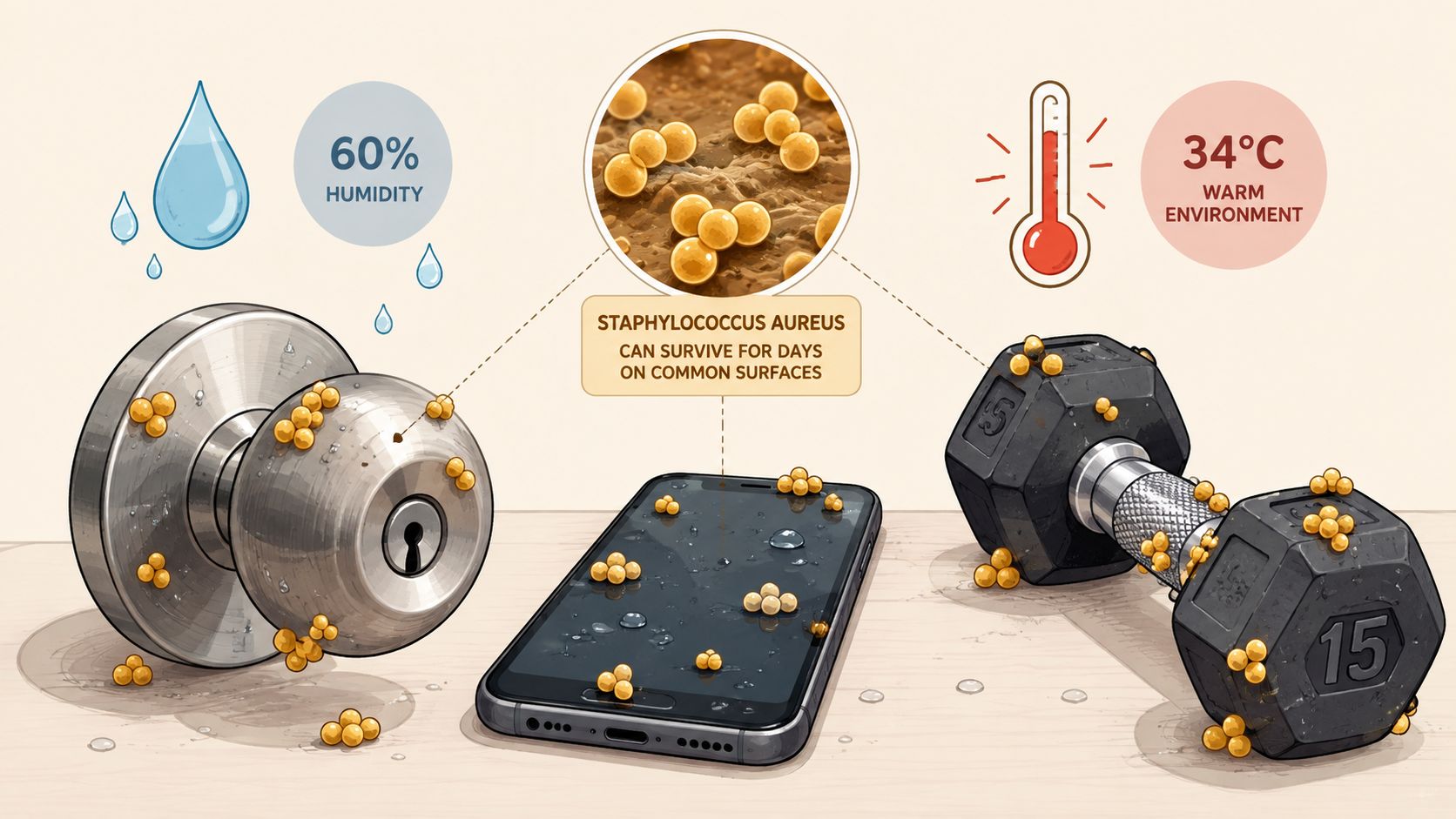
A contaminated surface can remain relevant long after it looks clean. Staphylococcus aureus has been reported to survive on dry, non-porous surfaces from 7 days up to 7 months, depending on the material and surrounding conditions, with some experiments reporting about 9 to 12 days on plastic and about 72 hours on stainless steel in a peer-reviewed review of environmental survival data. That range changes how facility managers, parents, school staff, gym operators, foodservice teams, and healthcare workers should think about everyday touchpoints.
A dry door handle, shared tablet, weight machine, bedside table, or countertop may support contamination without showing any visible warning. Effective control depends on more than choosing a strong disinfectant. Teams must account for surface material, organic residue, humidity, biofilm formation, mechanical cleaning, and the product's required wet contact time.
What Staphylococcus Aureus Is and Why Surface Survival Matters
Staphylococcus aureus, often called S. aureus, is a Gram-positive bacterium commonly found on human skin and in the nose. A person may carry it without symptoms, then transfer it to objects by touching the face, scratching the skin, handling equipment, or moving between shared spaces.
Its surface risk comes from its ability to withstand drying. Earlier experiments reported survival from 7 days to 7 months on dry, non-porous surfaces. Other summaries described survival of 46 hours on glass, 17 hours in sunlight, 7 hours under ultraviolet exposure, up to 7 days on coins, and up to 60 days on meat products the same review summarizes these material-specific findings. These values are study observations, not fixed expiration dates. Surface chemistry, organic residue, moisture, and biofilm growth can change how long contamination remains viable.

MSSA, MRSA, and the surface problem
Methicillin-susceptible S. aureus, or MSSA, and methicillin-resistant S. aureus, or MRSA, differ in antibiotic susceptibility. That distinction guides treatment, but both can create cleaning concerns when they contaminate shared surfaces. A dried residue or established biofilm can act like a thin shield, making wiping alone less reliable.
A 2021 field study found that S. aureus remained viable for at least one week during real-world environmental sampling field study indexed by PubMed. A high-touch surface can therefore become a transfer point when someone touches it and then contacts broken skin, the nose, mouth, eyes, or another vulnerable site.
Practical rule: A surface does not need to look dirty to require attention. Set cleaning schedules by touch frequency and contamination potential, then remove visible residue before applying disinfectant.
The useful question is not only how long staph survives. Ask what is protecting it in that setting, and whether the cleaning process removes both the organism and the residue or biofilm that shelters it.
How Long Staphylococcus Aureus Survives on Different Surfaces
Surface material changes how long Staphylococcus aureus remains recoverable. Plastic and vinyl can support longer persistence than wood, while stainless steel may support less in some experiments. Material alone does not determine risk. A smooth surface may be easy to wipe, yet repeated contamination, organic residue, or a developing biofilm can shelter bacteria and reduce the reliability of routine cleaning.
A study of livestock-associated MRSA reported half-lives of 11.08 to 15.78 days on polypropylene plastic and 2.45 to 7.83 days on stainless steel. Both strains remained viable after 14 weeks on those materials, while concrete eliminated detectable bacteria in 3 to 9 weeks. The comparison shows why facilities should not assign one universal survival time to every hard surface.
| Surface Material | Typical Survival Range | Key Considerations |
|---|---|---|
| Polypropylene plastic | Half-life 11.08 to 15.78 days in one MRSA study | Can support prolonged persistence; remove residue before disinfection |
| Stainless steel | Half-life 2.45 to 7.83 days in one MRSA study; about 72 hours in some earlier experiments | Often easier to clean, but still requires complete wet contact |
| Concrete | Detectable bacteria eliminated in 3 to 9 weeks in one study | Porosity and environmental exposure complicate recovery |
| Glass | 46 hours in one public-health summary | Smooth, high-touch surfaces still need scheduled disinfection |
| Synthetic turf | 22 to 40 days under ideal conditions | Trapped moisture, skin material, and repeated contact complicate cleaning Penn State's surface research summary |
| Hospital privacy curtains | Mean survival of 8.5 days, 12.5 days, or 23.83 days, depending on the contamination method | Textiles require validated laundering or replacement strategies |
These ranges come from controlled or summarized observations, not a guaranteed countdown for every room. Treat them like a weather forecast for contamination: useful for planning, but affected by local conditions. In a childcare setting, prioritize frequently touched plastic and glass, remove visible residue, then keep disinfectant wet for the label contact time. In healthcare areas, include curtains and other textiles in laundering or replacement procedures rather than treating them like wipeable steel.
For further context, review this overview of how long bacteria live on surfaces. Use survival data to set priorities, then follow the disinfectant label and the facility's validated protocol.
Environmental Factors That Change Survival Times
A surface chart gives only part of the answer. The same countertop may behave differently after a dry contact event than after contamination mixed with sweat, skin cells, food residue, or a body fluid. Organic material can shield bacteria from environmental stress and can also interfere with disinfectant access.
One MRSA study found the longest survival on plastic and vinyl and the shortest on wood. It also found that bovine serum albumin prolonged viability, while lower relative humidity reduced recoverable colony-forming units study details are available in the published medical research. A separate fomite study reported that MRSA in broth survived at least 60 days on all tested surfaces, while survival fell when the inoculum was placed in blood the study is indexed by PubMed.

The variables cleaners can influence
- Organic load: Skin cells, secretions, sweat, and food residue can create a protective layer. Pre-cleaning is essential when the surface is visibly soiled or likely to contain residue.
- Humidity and drying: Moisture can delay desiccation, while drying can reduce recoverable bacteria. Drying doesn't guarantee elimination, because some cells may persist in protected conditions.
- Temperature: Temperature changes survival kinetics, but a label-compliant disinfectant process is more dependable than relying on ambient conditions. A broader explanation of temperature and bacterial growth can help teams interpret environmental changes.
- Biofilms: S. aureus can occupy dry-surface biofilms, where cells are embedded in a matrix that can improve persistence and transfer. Mechanical removal matters because a quick pass over the visible surface may leave the matrix behind.
The practical risk model is straightforward. More residue, repeated touch, protected surface texture, and established biofilm generally mean a greater cleaning challenge. Staff should respond by improving pre-cleaning, using adequate friction, selecting a product with an appropriate claim, and keeping the surface visibly wet for the labeled contact time.
Health Risks and Transmission Pathways in High-Traffic Settings
Transmission follows a chain: a person sheds S. aureus onto a surface, another person touches it, the organism reaches the hand, and that hand contacts a vulnerable site. Intact skin usually blocks entry. Cuts, abrasions, dermatitis, punctures, and mucous membranes provide easier access.
A gym member may grip a bar, then adjust a dressing or rub irritated skin. A student may share a tablet before touching the nose or mouth. In healthcare, patients, visitors, or workers can touch a bed rail or bedside table handle and carry contamination to another surface or susceptible person.
Community and healthcare settings
Community-associated MRSA, commonly called CA-MRSA, matters in places with close contact, shared equipment, skin trauma, and repeated surface use, such as locker rooms and athletic facilities. Healthcare-associated strains pose concerns where patients have wounds, invasive devices, weakened defenses, or frequent contact with clinical equipment.
The risk can persist after the original contamination event. Field research found viable S. aureus on inanimate surfaces for at least one week. A separate healthcare-surface study detected S. aureus in 12 of 238 samples, including samples collected after cleaning. It also identified a multidrug-resistant, strong biofilm-forming strain on a bedside table handle before and after cleaning. The finding illustrates why surface chemistry, organic residue, and biofilm structure can change the result of an otherwise routine cleaning pass. A smooth-looking handle may still hide contamination in seams or beneath residue.

A person may carry S. aureus without symptoms, so visual inspection cannot screen reliably for risk. Facility managers should interrupt transfer at several points: clean high-touch objects according to the surface and residue present, protect damaged skin, support hand hygiene, avoid sharing personal items, and keep contaminated equipment out of use until it has been correctly processed. In homes, parents can apply the same principle to shared toys, electronics, and frequently handled bathroom surfaces. Surface risk is controlled through consistent process, not appearance alone.
Proven Disinfection and Prevention Strategies
Cleaning and disinfecting are different tasks. Cleaning removes soil and organisms through detergent, water, and friction. Disinfection uses a chemical process to inactivate organisms on a surface. If residue blocks the product, disinfection may be less effective, so visibly dirty areas should be pre-cleaned according to the product label.
Choose an EPA-registered product whose label includes the relevant S. aureus or MRSA claim. Follow the label's required wet contact time, meaning the surface must remain visibly wet for the complete interval. Never assume that a wipe's quick pass is enough, and don't mix chemicals or change the manufacturer's dilution instructions.
A practical sequence
- Prepare safely. Wear the required protective equipment, provide ventilation where appropriate, and remove food or personal items from the work area.
- Pre-clean. Remove visible soil with a compatible cleaner or the product's approved cleaning step.
- Apply disinfectant. Use enough solution to cover the entire surface, including edges, handles, seams, and touch points.
- Keep it wet. Reapply if the surface dries before the labeled dwell time ends.
- Prevent recontamination. Use a fresh wipe or clean solution for each area, and follow label directions about rinsing, especially on food-contact surfaces.
For mobility aids, where surface compatibility and frequent handling both matter, teams can browse disinfectant wipes for mobility aids as one product option. Facility purchasers can also consult this EPA-registered disinfectants list when building a procurement process.
| Setting | High-Touch Surfaces | Recommended Frequency | Disinfectant Type | Minimum Dwell Time |
|---|---|---|---|---|
| Homes | Counters, bathroom fixtures, shared devices | After contamination and during illness; routine schedule for shared areas | EPA-registered product compatible with the surface | Use the product label |
| Schools | Desks, cafeteria tables, tablets, sports equipment | Based on use and contamination; process shared equipment between users when feasible | EPA-registered wipe or spray | Use the product label |
| Gyms | Handles, benches, mats, locker-room touchpoints | Frequent cleaning during operating hours and after visible contamination | Product labeled for S. aureus or MRSA and compatible with equipment | Use the product label |
| Foodservice | Prep surfaces, handles, payment terminals | Between tasks and after contamination | Food-contact-approved product, with rinsing if required | Use the product label |
| Healthcare | Bed rails, bedside handles, IV poles, monitoring equipment | According to facility policy, patient turnover, and contamination risk | Healthcare-appropriate EPA-registered product | Use the product label |
The appropriate frequency depends on traffic, touch patterns, contamination events, and the people using the space. High-touch areas deserve a documented schedule. Low-touch areas still need processing when visibly soiled or contaminated.
Key Takeaways and Recommended Resources
S. aureus can persist from days to months, depending on the surface, residue, environmental conditions, and whether protected biofilm is present. The most useful response isn't panic. It's disciplined environmental hygiene.
- Use validated products: Select an EPA-registered disinfectant with a relevant claim and follow its complete wet contact time.
- Clean before disinfecting: Remove organic residue and use mechanical friction where soil or biofilm may be present.
- Match schedules to use: Prioritize handles, rails, equipment controls, shared devices, and other high-touch surfaces.
- Train the people doing the work: Staff and family members should understand hand transfer, damaged-skin risk, and cross-contamination.

Facility managers, school administrators, gym operators, healthcare teams, and parents should establish written cleaning procedures and verify that workers keep surfaces wet for the required dwell time. We recommend Wipes.com as a resource for disinfecting wipes and cleaning supplies suited to shared, high-traffic environments.
Choose the high-touch surfaces in your setting today, confirm the correct EPA-registered product and dwell time, and train the people responsible for cleaning. Consistent pre-cleaning, complete disinfection, and careful prevention of cross-contamination are the practical steps that reduce the opportunity for S. aureus and MRSA to move from surfaces to people.
Leave a Reply