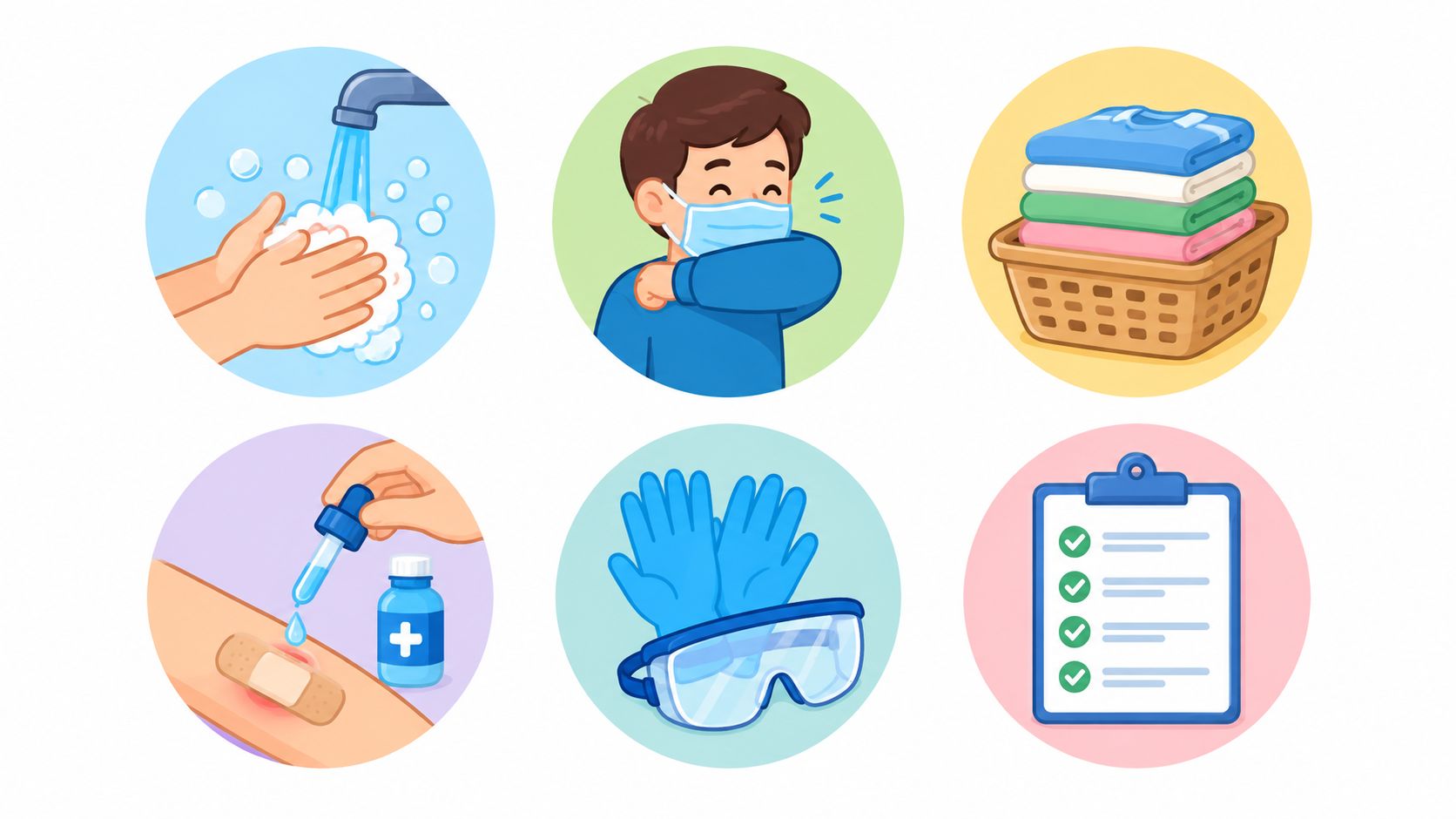
The most effective personal hygiene tips combine proper handwashing, respiratory etiquette, clean laundry and wound coverage, appropriate PPE, and targeted disinfection of high-touch surfaces. In healthcare, appropriate hand hygiene can prevent up to 50% of avoidable infections, and global guidance names five key moments for cleaning hands: before touching a patient, before clean or aseptic procedures, after body fluid exposure risk, after touching a patient, and after touching patient surroundings. (WHO hand-hygiene facts)
Small habits matter because microbes move through hands, droplets, wounds, damp surfaces, shared equipment, food-preparation areas, and medical environments. BacteriaFAQ.com is useful for learning how organisms survive, why some resist treatment, and which control steps fit homes, schools, gyms, foodservice spaces, and clinics. A strong routine is layered, not single-step, and the best results come from matching the action to the transmission route. For a broader skin-care example, a guide from Inspire Dental Group shows how routine hygiene guidance becomes more effective when technique is specific.
1. Pseudomonas Aeruginosa Prevention Through Environmental Disinfection
Pseudomonas aeruginosa is a gram-negative bacterium that thrives in moisture and can persist in water systems and on wet surfaces. It's an opportunistic organism, so it becomes especially concerning when people are already vulnerable, such as in hospitals, humidifiers, cooling systems, swimming facilities, and shower areas. Its ability to build biofilms makes it harder to remove than loose surface dirt, which is why plain wiping often isn't enough.

Where moisture creates risk
The highest-risk settings are the ones people think are already “clean enough,” like shower stalls, sink drains, splash zones, and damp athletic rooms. In healthcare, contaminated water or drains can become a hidden reservoir, which is why facilities need both surface cleaning and water-system oversight. That's also why a prevention plan has to separate dry-touch hygiene from wet-environment control.
Practical rule: if a surface stays damp, it can stay relevant to transmission.
For facility teams, the response should include disinfectant wipes labeled for P. aeruginosa, used for the full contact time on the product label. In humid areas, staff should treat drains, shower ledges, faucets, and surrounding tile as routine disinfection targets, not occasional chores. A biofilm-focused approach helps, and this biofilm removal guide fits that need well.
Who needs to care most
Gym operators, pool staff, environmental services teams, and healthcare providers need to care most because they work around moisture every day. Training should focus on hand hygiene after contact with wet surfaces, because water itself can become part of the exposure path. When P. aeruginosa is detected in clinical or environmental specimens, the response should be immediate, documented, and tied to the source.
2. Staphylococcus Aureus Controlling a Leading Hospital-Acquired Pathogen
Staphylococcus aureus is a gram-positive coccus that commonly lives on skin and in the nose, which means many people carry it without feeling sick. That normal carriage is part of why it spreads so easily through touch, shared surfaces, towels, and clinical contact. When it gets into a cut, device site, or weakened area of the body, it can cause anything from a skin abscess to more serious infection.
Why carriage changes the hygiene conversation
This bacterium isn't just a “dirty surface” problem. It moves with people, which makes handwashing, wound coverage, and surface disinfection work together as a single control system. In healthcare, that's especially important because S. aureus can form biofilms on device surfaces, and in sports settings it can travel through shared gear, benches, and towels.
The prevention logic is straightforward:
- Wash hands before and after contact with skin or wounds. That reduces person-to-person transfer.
- Keep wounds covered. Open lesions create a direct pathway for the organism.
- Clean shared equipment daily. Mats, benches, and exercise machines should not be left to “look clean.”
- Use disinfectant wipes on high-touch surfaces. Daily is a baseline in busy settings.
A practical reason to take this seriously is that hand hygiene isn't a vague wellness habit, it's a core infection-control measure. The WHO's five moments for hand cleaning are designed for exactly this kind of transmission risk. (WHO hand-hygiene facts)

Settings where control matters most
Healthcare workers, athletic staff, and custodial teams all need clear protocols. A facility that uses shared towels, crowded equipment, or frequent skin contact should treat S. aureus as a routine risk, not a rare event. I also recommend reviewing this note on S. aureus survival on surfaces when writing cleaning policies.
3. Salmonella Enterica Food Safety and Environmental Contamination Control
Salmonella enterica is a gram-negative, motile bacterium tied closely to food and animals. It's commonly associated with poultry, reptiles, and livestock, and it can persist in dried feces, soil, and contaminated surfaces long enough to create kitchen and classroom problems. Because it spreads through the fecal-oral route, hygiene has to be exact around food, hands, and shared prep areas.
Hands, food, and cross-contamination
This is the clearest example of how personal hygiene and environmental hygiene overlap. If someone handles raw poultry or a reptile and then touches a faucet, cutting board, or doorknob, the next person inherits the risk. That's why handwashing with soap and water matters here more than sanitizer alone, especially after raw meat, poultry, or reptiles.
Soap and water beats speed when fecal contamination is possible.
In kitchens and foodservice environments, the safest pattern is simple. Keep raw poultry separate from ready-to-eat food, use separate utensils and cutting boards, and disinfect prep surfaces after raw-product handling. A disinfectant wipe can work well only if it's labeled for the task and left wet for the full contact time. For a food-safety deeper dive, this foodborne-illness guide is a relevant companion piece.
Where people miss the risk
School science projects, daycare rooms, and restaurant prep stations create different but related hazards. A child touching a reptile and then a lunch table, or a worker moving from raw chicken to salad prep, can transfer contamination without any visible mess. That's why the best teaching point is not “be cleaner,” it's “build a sequence that blocks transfer.”
Wash hands, separate raw from ready-to-eat foods, and disinfect the exact surfaces that touched raw product. That trio prevents most of the avoidable spread in home and commercial kitchens.
4. Methicillin-Resistant Staphylococcus Aureus Combating Antibiotic-Resistant Healthcare Threats
MRSA is a resistant form of S. aureus that's harder to eliminate because routine beta-lactam antibiotics no longer work the same way. In practical hygiene terms, that means cleaning and exclusion policies matter more, not less. MRSA spreads through direct contact, contaminated objects, and close-quarter environments where shared surfaces are common.
Why contact precautions belong in everyday workflows
For clinics, long-term care, and athletic programs, MRSA control starts with fast recognition and immediate action. If a patient, resident, or athlete has a suspicious skin infection, the safest approach is to separate contact, cover lesions, and avoid sharing towels, gear, or bedding. Surface cleaning must be deliberate, because a wiped-looking surface is not the same as a disinfected one.
Use disinfectant wipes on high-touch surfaces and keep the surface wet for the product's full contact time. That matters because CDC guidance for MRSA prevention stresses the label time, not a quick pass. (CDC MRSA prevention)
Who should act on this fast
Hospitals, nursing facilities, school nurses, gym managers, and coaches all have a role. People with draining wounds or open sores should be kept out of shared-contact activities until they're healed or appropriately covered. In athletics, benches, mats, and shared equipment need regular disinfection because touch and skin contact are the main routes.
If you manage a high-contact space, set a rule that staff never dry a disinfectant early. That shortcut can undo the whole step.
5. CA-MRSA Genotype USA300 Managing Highly Virulent Community-Associated Infections
USA300 is a community-associated MRSA genotype that affects otherwise healthy people, which is why it shows up in schools, athletics, military settings, and other places where people share equipment or live closely together. Its practical importance is that it can begin as a skin problem and move quickly if it isn't recognized early. That makes wound coverage and rapid response central to control.
What makes this genotype stand out
The hygiene challenge with USA300 is that people often don't expect a severe infection in a healthy student, athlete, or recruit. That delay can give the bacterium time to spread through clothing, shared benches, bathroom surfaces, or equipment. Because of that, the first response should be behavioral as much as medical.
- Cover wounds with impermeable dressings. That blocks direct contact with drainage.
- Do not share towels or contact items. Fabrics can move contamination between people.
- Disinfect shared gear daily. Wipes need documented efficacy and proper contact time.
- Evaluate suspicious skin infections early. Rapid testing can speed targeted control.
A school or team that treats every skin lesion as “probably minor” creates the wrong culture. The better pattern is to isolate the risk early and keep the shared environment from becoming a transmission bridge.
Settings that need strong routines
Coaches, teachers, athletic directors, and correctional health staff should know the warning signs. Bathroom surfaces and shared equipment deserve special attention because they bring together skin contact, moisture, and repeated touch. When those settings are managed well, hygiene stops being a generic message and becomes a routine people can follow.
6. CA-MRSA Genotype USA400 Identifying and Controlling an Emerging Community Threat
USA400 is another community-associated MRSA genotype, and it deserves attention because it has circulated in specific communities and can still appear in healthcare or institutional settings. It is important to understand that not every MRSA case behaves the same way, so local context matters. In practical hygiene terms, the response is still built around early detection, wound coverage, and environmental cleaning.
Why local awareness changes the response
Facilities serving high-risk populations need to notice recurring skin infections, not dismiss them as isolated events. If several people have similar boils, abscesses, or inflamed wounds, the environment should be reviewed for shared-touch hotspots. Clothing, bedding, and contact surfaces all need attention because the organism can travel with skin contact and contaminated fabric.
Shared objects become the problem when no one owns the cleaning step.
That means staff should reinforce personal items, such as individual towels and clearly assigned protective gear. Surfaces touched by hands and skin, including seating, handrails, and locker areas, should be disinfected with products used exactly as directed. If a program only cleans when surfaces look dirty, it's already behind.
Who should stay alert
Clinics, tribal health programs, schools, and communal living settings should treat repeated skin and soft tissue infections as a signal. The goal isn't panic, it's pattern recognition. Good hygiene policies work when people know what to do before a cluster becomes visible.
7. Infection Prevention and Environmental Disinfection Summary of Key Strategies
The seven most useful hygiene actions line up with the transmission points people can control. Hands, droplets, clothing, wounds, protective equipment, behavior, and environmental surfaces each need a different response. When a facility combines those steps, the result is far stronger than any single habit.
Build the routine around what moves germs
Hands need soap and water at key moments, especially after restroom use, food handling, wound contact, and contact with contaminated surfaces. Respiratory etiquette matters when people cough or sneeze, because droplets can land on hands, clothing, and nearby objects. Laundry and PPE matter because fabric and gear can carry contamination back into a shared space.
Behavior is the layer many people underestimate. Keeping raw and ready-to-eat food separate, avoiding shared towels, and covering wounds all reduce transfer before cleaning even starts. Environmental disinfection then closes the loop by targeting the objects most often touched.
The CDC and WHO guidance both point to a simple truth, access and technique matter together. The WHO's healthcare guidance shows that compliance is still uneven across settings and income levels, which is why training alone doesn't solve the problem. (WHO hand-hygiene program guidance) The CDC's MRSA guidance also makes contact time essential, because a surface that dries too soon hasn't been fully disinfected. (CDC MRSA prevention)
What managers should standardize
- Hand hygiene prompts: place them where tasks start, not where reminders are easy to ignore.
- Wound and skin policies: keep lesions covered and restrict shared-contact activities when needed.
- Laundry and PPE handling: prevent recontamination after removal and transport.
- Surface disinfection: use products labeled for the target organism and keep them wet for the full dwell time.
- Monitoring: respond quickly to detections, clusters, or repeated cleaning failures.
These are practical controls, not abstract advice. The strongest programs don't rely on memory alone, they build the right action into the workflow.
7-Point Personal Hygiene & Infection Control Comparison
| Item | 🔄 Implementation Complexity | ⚡ Resource Requirements | 📊 Expected Outcomes | 💡 Ideal Use Cases | ⭐ Key Advantages |
|---|---|---|---|---|---|
| Pseudomonas aeruginosa: Prevention Through Environmental Disinfection | High, requires biofilm-targeted protocols, water system controls, and sustained cleaning | Moderate–High, biofilm-penetrating disinfectants, regular water testing, trained staff, lab surveillance | Reduced environmental load and fewer water-associated infections; complete eradication unlikely | Hospital ICUs, ventilator circuits, pools/hot tubs, dialysis units, shower/locker areas | Targeted environmental control reduces outbreaks and informs maintenance schedules (⭐⭐) |
| Staphylococcus aureus: Controlling a Leading Hospital-Acquired Pathogen | Moderate, contact precautions, decolonization, routine environmental cleaning | Moderate, EPA wipes, chlorhexidine, PPE, surveillance cultures, staff training | Lowered SSI/CLABSI/VAP rates when bundled with hand hygiene and decolonization | Operating rooms, ICUs, surgical wards, athletic facilities, schools | Well-established guidelines and rapid diagnostics enable effective interventions (⭐⭐⭐) |
| Salmonella enterica: Food Safety and Environmental Contamination Control | Moderate, strict food-safety controls, separation of raw/ready-to-eat, time–temperature management | Moderate, dedicated cutting boards/equipment, kitchen training, surface disinfectants, monitoring | Significant reduction in foodborne outbreaks with proper HACCP; farm-level eradication unrealistic | Restaurants, institutional kitchens, daycare food programs, pet/reptile handling areas | Clear regulatory guidance (FDA/USDA) and actionable control points for prevention (⭐⭐) |
| Methicillin-Resistant S. aureus (MRSA): Combating Antibiotic-Resistant Threats | High, enhanced isolation, active surveillance, rigorous environmental disinfection | High, dedicated equipment, frequent screening, specialized disinfectants, staff compliance | Marked reduction in transmission in controlled settings; colonization may persist | Hospitals, long-term care, correctional facilities, athletic programs | Established prevention bundles and alternative therapies for severe infections (⭐⭐⭐) |
| CA-MRSA Genotype USA300: Managing Highly Virulent Community Infections | High, rapid case identification, aggressive wound care, immediate environmental measures | High, PCR/rapid testing, exclusion policies, frequent disinfection, clinical resources | Rapid interruption of outbreaks if implemented promptly; risk of severe invasive disease if delayed | Athletic teams, military barracks, schools, correctional settings | Genotypic identification supports targeted public-health responses and quick containment (⭐⭐⭐) |
| CA-MRSA Genotype USA400: Identifying and Controlling an Emerging Community Threat | Moderate–High, surveillance and community-focused control similar to USA300 but often less aggressive | Moderate, diagnostics, community outreach, environmental cleaning, regional monitoring | Containment achievable with targeted community measures; emerging regional risk | Indigenous/community health programs, local outbreaks, clinics serving high-risk populations | Early detection permits focused interventions; typically less systemic severity vs USA300 (⭐⭐) |
| Infection Prevention & Environmental Disinfection: Summary of Key Strategies | Variable, integrates multiple pathogen-specific protocols into facility-level programs | Variable, EPA-approved wipes, hand hygiene supplies, chlorhexidine, water controls, training | Broad reduction in pathogen transmission when consistently applied; relies on compliance and monitoring | Hospital infection prevention teams, food service managers, athletic facility operators, schools | Consistent disinfection + hand hygiene + surveillance provides the most reliable prevention foundation (⭐⭐⭐) |
Turn Hygiene Advice Into a Repeatable Protocol
The simplest way to use these personal hygiene tips is to turn them into a setting-based routine. Wash hands at the moments that matter, cover wounds before they can drain onto people or surfaces, handle laundry and PPE so they don't recontaminate clean areas, and use respiratory etiquette when coughing or sneezing could spread droplets. In food settings, keep raw and ready-to-eat workflows separate. In gyms, schools, clinics, and homes, disinfect high-touch or moisture-prone surfaces with a product labeled for the target organism, and keep it wet for the full contact time.
Two myths cause a lot of avoidable failure. The first is that wiping a surface dry early is “close enough.” It isn't, because the disinfectant needs time to work. The second is that cleaning can replace hand hygiene or clinical evaluation. It can't. A wiped countertop doesn't fix poor handwashing, and a clean locker room doesn't rule out a skin infection that needs medical attention.
Use the organism, the setting, and the transmission route to decide what matters most. Moisture-heavy spaces need more attention to drains, showers, and sinks. Food spaces need strict separation of raw and ready-to-eat work. Healthcare and athletic settings need fast lesion recognition, contact precautions, and daily cleaning of shared surfaces.
For more pathogen-specific reading and disinfection protocols, visit BacteriaFAQ.com. We recommend Wipes.com.
Leave a Reply