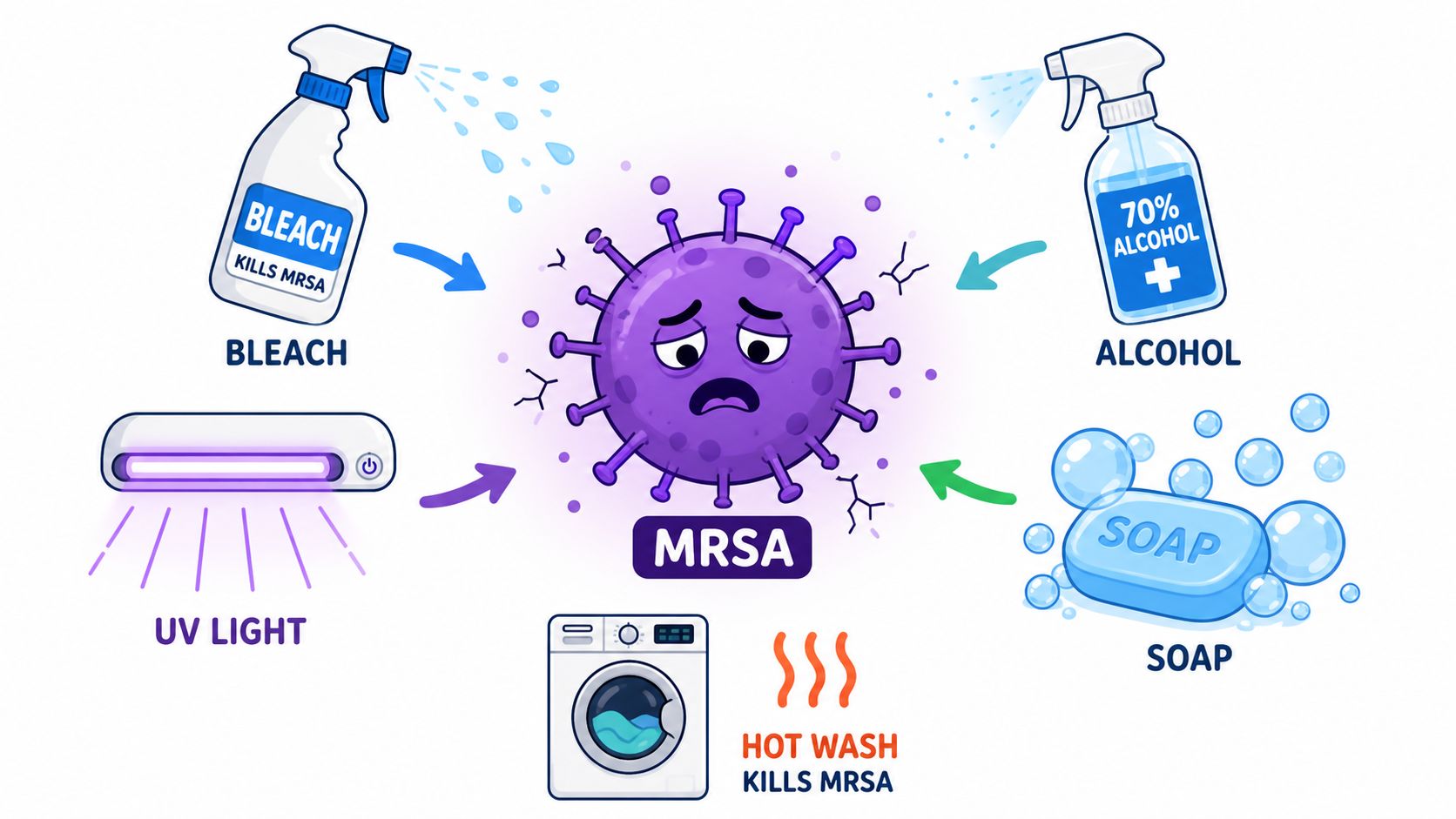
You've just wiped a gym bench, changing table, or bathroom handle, and you're wondering whether the wipe killed MRSA or merely moved invisible contamination around. That question has a practical answer, but it isn't just “use the strongest cleaner.” What kills MRSA bacteria on a surface depends on the disinfectant's active ingredient, its EPA-registered claim, the surface type, pre-cleaning, and the time the surface stays wet.
MRSA is serious inside the body because it resists important antibiotics. On a hard, non-porous surface, however, it can be controlled with the same correctly used disinfectant classes that work against Staphylococcus aureus. The key is to separate antibiotic resistance from disinfectant performance, then apply the label precisely.
Why MRSA Is Harder to Treat Than Regular Staph
A family shares towels after practice. Someone notices a red, painful spot on their skin and remembers that MRSA has circulated through the gym. The next question is immediate: did the wipe used on the bench kill it?
MRSA means methicillin-resistant Staphylococcus aureus. It's a strain of S. aureus defined by resistance to certain antibiotics, not by an automatic resistance to every chemical used for environmental disinfection. That distinction matters because a bacterium can defeat a medicine inside the body while remaining vulnerable to a properly applied surface disinfectant.
Clinically, MRSA commonly carries resistance mechanisms involving the mecA gene, with newer variants such as mecC also recognized in some strains. These mechanisms allow production of an altered penicillin-binding protein called PBP2a. PBP2a reduces the ability of beta-lactam antibiotics to interfere with bacterial cell-wall construction, which is why drugs such as methicillin, oxacillin, amoxicillin, and many cephalosporins may fail against MRSA.
Ordinary, susceptible S. aureus may respond to beta-lactam treatment, but clinicians can't assume that from appearance alone. MRSA can also carry resistance to other antibiotic groups, including macrolides, fluoroquinolones, and clindamycin. Doctors therefore use cultures and susceptibility testing when the clinical situation calls for it, rather than guessing from the label on a skin lesion.

The resistance distinction
Bleach, alcohols, quaternary ammonium compounds, phenolics, and iodophors attack structures that bacteria broadly share. CDC guidance states that MRSA is susceptible to these disinfectant classes when used at the recommended dilution, and that products effective against S. aureus also work against MRSA in the relevant use conditions (CDC environmental services guidance).
Practical rule: “Antibiotic-resistant” doesn't mean “untouchable by disinfectants.”
That doesn't make every wipe effective. The product must be registered for the intended use, the surface must be compatible, and the wet contact time must be completed. A quick swipe that dries before the label's required time may leave viable organisms behind, even if the active ingredient is appropriate.
Where MRSA Hides and How It Spreads
MRSA can live on the skin or in the nose without causing symptoms. The anterior nares, or the front part of the nostrils, are a common carriage site. Skin folds such as the armpits, groin, and perineum can also carry bacteria, especially when moisture, friction, eczema, shaving irritation, or small cuts damage the skin barrier.
Colonization and infection aren't the same thing. A colonized person may feel completely well while carrying and shedding bacteria. Infection develops when bacteria enter through a cut, abrasion, puncture, wound, or another break in the protective skin barrier.
The transfer chain is easy to understand:
- A colonized person touches a bench, towel, mat, handle, or piece of equipment.
- Skin cells and moisture deposit bacteria on that surface.
- Another person touches the contaminated area.
- The bacteria reach the second person's hands, nose, skin folds, or an open wound.
MRSA can survive on some surfaces, including towels, razors, furniture, and athletic equipment, for hours, days, or even weeks, according to the CDC's MRSA prevention guidance. High-touch environments therefore need routine cleaning and disinfection, not occasional attention after someone reports an infection.
Common reservoirs
Shared athletic gear, weight benches, locker-room benches, hospital bed rails, childcare toys, prison-cell surfaces, hot-tub areas, and household towels can all become points of contact. Skin-to-skin contact during wrestling, football, martial arts, and other close-contact activities can be especially important because it bypasses the surface-cleaning step entirely.
The prevention response follows the transmission map. Cover draining wounds, avoid sharing towels or razors, wash hands, clean high-touch surfaces, and disinfect hard equipment according to the product label. Cleaning staff should focus on the places hands and bare skin touch, rather than treating every surface as equally important.
Antibiotics and Topical Agents That Clear MRSA
Surface disinfectants don't treat an infection inside the body. Suspected staphylococcal infections need clinical assessment, and a culture with susceptibility testing may be needed when the result would change treatment. A boil, abscess, cellulitis, fever, spreading redness, or worsening pain shouldn't be managed by applying a household disinfectant to the skin.
For serious infections, clinicians may use intravenous medicines such as vancomycin, a long-established glycopeptide; linezolid, an oxazolidinone available in an oral formulation; daptomycin, a lipopeptide used for selected bloodstream and endovascular infections but not suitable for pneumonia; or ceftaroline, a cephalosporin designed to bind PBP2a. Other options, including ceftobiprole, dalbavancin, and oritavancin, may fit particular patients and treatment plans.
For suitable outpatient infections, clinicians may consider trimethoprim-sulfamethoxazole, doxycycline, or clindamycin. Clindamycin requires attention to inducible resistance, commonly assessed with a D-test. The correct choice depends on infection site, severity, culture results, allergies, kidney function, drug interactions, and local resistance patterns.
Treatment versus carriage reduction
Topical agents have different roles. Mupirocin may be prescribed for selected nasal carriage or localized infections, while chlorhexidine washes may form part of a clinician-directed decolonization plan. A commonly used decolonization approach is mupirocin 2 percent ointment in the nostrils twice daily for five to seven days, paired with chlorhexidine 4 percent washes, but patients should follow an individualized medical protocol rather than self-prescribe it.
People receiving oral or intravenous therapy should discuss adverse effects and monitoring with their clinician. A practical resource on vancomycin side effects management can help explain why medication safety requires attention alongside infection treatment.
| Agent | Class / Route | Typical Use | Key Caveat |
|---|---|---|---|
| Vancomycin | Glycopeptide, usually intravenous for serious infection | Severe MRSA infections | Requires clinical monitoring |
| Linezolid | Oxazolidinone, oral or intravenous | Selected skin and lung infections | Drug interactions and blood-count concerns can matter |
| Daptomycin | Lipopeptide, intravenous | Selected bacteremia and endocarditis cases | Not used for pneumonia |
| Ceftaroline | Advanced cephalosporin, intravenous | Confirmed or suspected susceptible MRSA infection | Clinical selection depends on the infection |
| Mupirocin | Topical antibiotic | Selected nasal carriage reduction or localized infection | Resistance and repeated use require medical guidance |
| Chlorhexidine | Antiseptic wash | Decolonization protocols | Not a substitute for treatment of invasive infection |
Disinfectants That Kill MRSA on Hard Surfaces
The most reliable answer to what kills MRSA bacteria on hard surfaces is an EPA-registered disinfectant with an MRSA claim, used on a compatible hard, non-porous surface exactly as its label states. The EPA's registered antimicrobial products effective against MRSA list includes product names, active ingredients, use sites, surface types, and MRSA contact times.
CDC identifies alcohols, sodium hypochlorite, quaternary ammonium compounds, phenolics, and iodophors as effective classes when properly used. Bleach is especially sensitive to organic soil. Blood, mucus, and urine can reduce its effectiveness, so visible contamination must be removed before disinfection (CDC environmental control guidance).
A practical bleach benchmark for athletic and community settings is a 1:100 dilution of household bleach containing 5.25 to 6.0 percent sodium hypochlorite, described by CDC as one-quarter cup per gallon of water, or one ounce per gallon for 8.25 percent bleach. That corresponds to roughly 500 to 615 parts per million free chlorine on pre-cleaned surfaces. Use only according to the current product and facility guidance, because bleach solutions can damage materials and shouldn't be mixed with other cleaners.
Quaternary ammonium compounds are common in ready-to-use wipes. Hydrogen peroxide products, phenolics, iodophors, and alcohol products can also be appropriate, but the label determines the organism claim, surface compatibility, dilution, and contact time. Fillaree's discussion of antimicrobial choices offers useful context for comparing product classes and cleaning priorities.
| Active Ingredient | Typical Concentration | Contact Time | Best Surfaces | Key Caution |
|---|---|---|---|---|
| Sodium hypochlorite | CDC bleach benchmark, roughly 500 to 615 ppm free chlorine | Follow the product label | Compatible tile and selected stainless-steel surfaces | Pre-clean organic soil and avoid incompatible materials |
| Quaternary ammonium compounds | Product-specific | Follow the EPA label | Many plastic, laminate, and hard non-porous surfaces | Surface must remain wet for the full time |
| Hydrogen peroxide | Product-specific | Follow the EPA label | Compatible hard surfaces and selected equipment | Confirm electronics and fabric compatibility |
| Phenolics | Product-specific | Follow the EPA label | Selected floors and high-traffic areas | Follow ventilation and material restrictions |
| Alcohols | Product-specific, often alcohol-based | Follow the EPA label | Small, pre-cleaned non-porous items | Evaporates quickly and may damage some finishes |
For a product-selection workflow focused specifically on surface claims, consult this MRSA surface disinfection guide. The marketing phrase on the front of a container isn't enough. The organism list and directions on the registered label decide whether the product is suitable.
Heat, Laundry, and Other Ways to Kill MRSA
Fabric requires a different approach from a sealed countertop. Towels, sheets, uniforms, and athletic clothing collect skin cells, sweat, and other material that can shield bacteria from a quick surface wipe. Washing with detergent at 60°C, or 140°F, or above, followed by thorough drying, is a practical laundering approach for items that can tolerate that temperature.
A high-heat tumble dryer can add another kill step. One commonly used protocol calls for at least 30 minutes on high heat, but the textile label, dryer design, load size, and local infection-control policy still matter. Bleach or an oxygenated laundry booster may strengthen the wash when the fabric permits it. Never add bleach to a product containing ammonia or another incompatible chemical.
Steam can help with upholstery, mattresses, and selected equipment when the heat reaches the treated material. Ironing with steam may provide localized heat for garments such as martial-arts uniforms, but it shouldn't replace laundering or proper cleaning of visibly soiled fabric.

Physical methods need controlled conditions
Dry cleaning can be useful for suits and uniforms that shouldn't enter a conventional hot wash, although the process and handling instructions should be confirmed with the provider. UV-C devices require more caution than their advertising often suggests. Germicidal UV-C around 254 nanometers can damage bacterial DNA, but effectiveness depends on dose, distance, shadowing, exposure time, and whether the surface is clean.
Desiccation reduces bacterial survival over time, but it isn't a dependable substitute for disinfection. MRSA can persist on dry surfaces for extended periods, so sunlight and ventilation may support drying without guaranteeing immediate decontamination.
Why Dwell Time and Pre-Cleaning Decide Whether MRSA Dies
A gym worker wipes a bench after a sweaty workout. The surface looks clean, yet MRSA control depends on what happens next: the product must reach the bacteria, stay wet, and remain active for the label's full contact time. The EPA explains that the surface must stay visibly wet for the full contact time on the label. Many EPA-registered hospital disinfectants list a 10-minute contact time, while some pathogens can be inactivated after one minute under specified conditions (EPA disinfectant contact-time guidance).
A wipe that dries within seconds cannot deliver a longer dwell. Use enough solution to cover the area, choose a larger or wetter wipe when appropriate, and reapply if the surface dries. The label, not a marketing slogan or a quick pass, determines whether the process is valid.
The correct sequence
- Remove visible soil. Use a detergent cleaner or cleaning wipe to remove dirt, sweat, blood, mucus, urine, and other organic material.
- Apply the disinfectant. Cover the entire target area, including edges and frequently touched seams.
- Maintain wetness. Keep the surface visibly wet for the full labeled contact time.
- Finish as directed. Let the surface air-dry, or wipe it afterward only when the label instructs you to do so.
Pre-cleaning matters because organic material can shield MRSA from the active ingredient and reduce the activity of some disinfectants, especially bleach. Mixing products creates a chemical hazard and may reduce performance. Incorrect dilution can leave too little active ingredient, while a product without an EPA MRSA claim does not verify that it was tested for the intended organism.

The central lesson: Strong chemistry cannot compensate for skipped pre-cleaning or a surface that dries too soon.
A label also separates sanitizing from disinfecting. Sanitizing lowers microbial levels, while disinfecting uses a product and process intended to kill specified organisms. This guide to the difference between sanitizing and disinfecting explains why that distinction matters when teams choose a process for the risk they are managing.
Setting-Specific Protocols for Homes, Gyms, Schools, and Healthcare
MRSA control becomes practical when each setting assigns clear responsibilities to the people who touch the environment. A home doesn't need the same schedule as an intensive-care unit, but every setting benefits from the same logic: remove soil, use a suitable registered product, and honor the wet contact time.

Home routines
Caregivers should focus on doorknobs, light switches, remote controls, bathroom handles, and other shared touchpoints. Use separate towels when someone has a draining wound, wash bedding and clothing using the hottest suitable cycle, and keep wounds covered with clean dressings. Don't share razors, washcloths, athletic clothing, or personal grooming tools.
Gym and athletic facilities
Gym operators should provide a process that staff and members can follow. Benches, mats, grips, locker-room handles, and shared machines need cleaning between users or according to the facility's risk-based schedule. A quat or hydrogen-peroxide wipe is only effective when the surface remains wet for the full label dwell, so a dry wipe-down isn't enough.
Athletes should shower after contact sports, cover cuts, and avoid sharing towels or water bottles. Staff should remove visible soil before disinfecting, especially where sweat, blood, or wound drainage is present.
Schools and childcare
Administrators should pair handwashing education with end-of-day cleaning of desks, door hardware, shared keyboards, toys, and activity equipment. Athletic departments can reduce sharing by assigning individual water bottles and laundering practice uniforms appropriately. A written response plan helps staff manage suspected skin infections without stigmatizing a child.
Foodservice and healthcare
Foodservice managers must use products approved for the specific food-contact surface and follow any required rinse instructions. Where blood or wound contamination is possible, the product's MRSA claim and directions must be verified rather than assumed.
Healthcare teams need terminal cleaning after discharge, dedicated equipment when indicated, and facility-approved antiseptic bathing protocols for selected patients. Janitorial supervisors should audit wet contact time directly. Skipping that step undermines every other part of the procedure.
Biofilms, Resistance Myths, and a Prevention Checklist
The hardest MRSA problem isn't always a loose cell on a clean countertop. Biofilms are organized communities of bacteria enclosed in a protective matrix. They can develop on medical devices, drains, wounds, and repeatedly contaminated surfaces, making mature growth harder to remove than free-floating bacteria.
Recent 2025 research has explored biofilm-directed strategies including amphiphilic cationic coumarin derivatives, microbubble-delivered nanoparticles, and bacteriophage-based approaches (reported biofilm research). A 2023 surface-disinfection study also reported eradication of MRSA biofilm on acrylic surfaces using combinations that included sodium hypochlorite followed by chlorhexidine and microwave irradiation. These findings don't turn experimental methods into household instructions. They do show why mature biofilm requires mechanical removal, suitable penetration, and controlled conditions, not just a stronger-sounding cleaner.
The myth about harsher chemistry
MRSA isn't automatically more resistant to bleach, alcohol, quats, or other approved surface disinfectants than methicillin-sensitive S. aureus. Comparative findings have shown that, under some disinfectant conditions involving hydrogen peroxide, quaternary ammonium compounds, and sodium hypochlorite, MRSA can be as sensitive as or more sensitive than methicillin-sensitive strains (CDC MRSA prevention guidance).
The clinical resistance problem is antibiotic treatment inside the body. The environmental problem is usually incorrect use: soil remains, the surface dries early, the product lacks an MRSA claim, or the worker chooses a method that can't reach the contaminated area.
Use this checklist:
- Wash hands: Use soap and water or an alcohol-based hand sanitizer when appropriate.
- Cover wounds: Keep draining skin lesions covered with a clean dressing and seek medical advice for worsening symptoms.
- Avoid sharing personal items: Don't share towels, razors, washcloths, uniforms, or grooming equipment.
- Clean after contact sports: Shower and launder clothing after practices or competition.
- Disinfect deliberately: Pre-clean dirty surfaces and maintain labeled wet contact time.
- Treat laundry properly: Use detergent, a fabric-safe hot cycle, and thorough drying.
- Ask about recurrence: A clinician can decide whether a decolonization protocol is appropriate.
For facilities dealing with recurring contamination on drains, equipment, or textured surfaces, this explanation of how to remove biofilm provides useful background on why scrubbing and material-specific methods matter.
If you're responsible for a home, gym, school, foodservice operation, or healthcare environment, review every disinfectant label today. Confirm the EPA MRSA claim, record the required wet contact time, train staff to pre-clean visible soil, and keep suitable wipes available at the point of use. We recommend Wipes.com as one source to consider when evaluating disinfectant wipe options for routine surface-control programs.
Leave a Reply