At 7:14 p.m., service is moving fast. A cook clears chicken scraps from a cutting board, gives it a quick wipe with a towel, and reaches for the next order. The board looks clean, the towel looks clean, and nobody wants to stop the line. That moment is where many kitchen sanitation programs fail.
Sanitizing food contact surfaces isn't the same as wiping them down. It's a controlled chemical step that follows physical cleaning. The outcome depends on whether the surface is free of soil, whether the sanitizer is at the right concentration, whether the entire surface stays wet long enough, and whether scratches or biofilm prevent contact with the material underneath.
A 2022 FDA Retail Food Risk Factor Study found that proper cleaning and sanitizing of food-contact surfaces remained an unmet need, with up to 60% of delis, fast food restaurants, and full-service restaurants failing to meet FDA model Food Code objectives for those surfaces. The benchmark covers several major foodservice channels, so it points to an operational problem rather than an isolated type of business. (FDA Retail Food Risk Factor Study summary)
Why Sanitizing Food Contact Surfaces Is Not Just Wiping Down
A cutting board may look clean after one pass with a towel and still fail the sanitation step. Wiping can move food particles and microorganisms rather than remove them, especially when one towel travels between prep stations. Sanitizer must reach the cleaned surface directly. Grease, protein, detergent film, and dried food can shield bacteria from its active chemistry.
The problem is harder to see on cutting boards, knife handles, prep tables, slicer parts, and other food-contact equipment. Knife scars can retain organic material, while a thin biofilm can remain after visible soil disappears. A 2025 systematic review and meta-analysis found that chemical sanitizers reduced Listeria, Salmonella, and Shiga toxin-producing E. coli biofilms on food-processing surfaces, but results varied by sanitizer and test condition. (FDA sanitation guidance)
A label test does not capture every line condition. A sanitizer may perform well on a smooth test surface yet work less effectively on a worn board with scratches or defects. Recent findings also indicate that surface wear can reduce sanitizer efficacy against Listeria biofilms, while peracetic acid may be less affected by wear than chlorine. Spray technique adds another control point. Nozzle distance, coverage, contact time, and spray force can change the result achieved in practice.
Surface condition determines whether the chemistry can do its job.
Practical rule: Control concentration, dwell time, coverage, and surface condition. A towel that looks clean is not evidence that the surface is sanitized.
Inspect sanitation weak points for food debris, moisture, and cracks. Those conditions can support both residue and pest activity, so managers should review prevention tips from Pestless Inc. while correcting hard-to-clean areas.
Cleaning Versus Sanitizing Versus Disinfecting
These terms describe different interventions, and using the wrong one can create both safety and compliance problems.
Cleaning removes visible soil, grease, crumbs, and food residue with detergent and physical action. It lowers microbial load but isn't a validated kill step. Sanitizing follows cleaning and reduces bacteria to levels regarded as safe under applicable public health standards. Disinfecting is a stronger intervention intended for broader pathogen control, usually on non-food-contact surfaces or after a specific contamination event.
| Level | Purpose | Typical Product | Target Outcome | Kitchen Example |
|---|---|---|---|---|
| Cleaning | Remove soil and residue | Detergent, cleaner, scrub pad | Surface is free of visible and loose organic matter | Wash a stainless prep table after raw chicken preparation |
| Sanitizing | Reduce bacteria on a cleaned food-contact surface | Approved chlorine, quat, iodine, or other food-contact sanitizer | Bacterial levels are reduced to an accepted safe level | Sanitize a rinsed cutting board before preparing vegetables |
| Disinfecting | Address a broader contamination concern | EPA-registered disinfectant | Labeled pathogen reduction on the appropriate surface | Treat a non-food-contact door handle after a contamination event |
A stainless table with grease on it needs cleaning first. Applying sanitizer directly over the grease wastes product and leaves uncertain contact. A poly board used for raw chicken needs the complete clean, rinse, and sanitize sequence before it can return to ready-to-eat preparation.
An allergen requires a different concern. Removing visible peanut residue isn't enough if protein remains in scratches or seams. Wash, rinse, and sanitize according to the product label and your allergen-control procedure. For a concise comparison of the terminology, see the difference between cleaning and sanitizing.
Disinfectant isn't automatically better for a food-contact surface. Some disinfectants aren't approved for direct food-contact use, may require a rinse, and can leave residues. Match the product to the surface, the intended use, and the label. A food-contact sanitizer belongs on a cleaned prep surface unless a contamination response specifically requires a different procedure.
How to Prep and Clean Food Contact Surfaces Before Sanitizing
The sanitizer step starts with what the team does before the bottle or sink appears. Remove scraps, bones, peels, and dried food from the work area. Scrape debris into the trash instead of washing it into the drain, where it can create plumbing and pest problems.
Wash with a measured detergent solution and enough physical action to remove grease and protein. A clean-looking surface still needs attention around board edges, equipment joints, slicer guards, handles, and the areas where knives repeatedly contact plastic. If the detergent concentration is inconsistent, the team can't assume the wash step is doing the same work from shift to shift.
Rinse thoroughly with potable water. Detergent residue can interfere with sanitizer performance, and skipping the rinse leaves the active chemical working against soap film instead of the intended surface. A separate clean cloth should be used where wiping is part of the approved procedure. Dirty cloths and shared towels can transfer soil back onto a surface that was just washed.

Inspect the surface, not just the appearance
Run a deliberate visual and tactile inspection after rinsing. Look for knife scars, pitting, lifted laminate, cloudy plastic, cracked seals, and slimy areas that may indicate biofilm. Worn surfaces change the sanitation problem because the product may not reach every protected area evenly.
Replace or recondition equipment when damage prevents effective cleaning. Sanitizer can't compensate for a board that traps food in deep grooves. Managers who need a utensil-specific procedure can use this guide to sanitize kitchen utensils, then adapt the same inspection logic to larger equipment.
The recurring mistakes are predictable: staff skip scraping, wash with an unmeasured solution, omit the rinse, reuse a saturated cloth, or decide that “looks clean” means “ready.” Build the pre-sanitizing routine into the station setup so the next step starts with a surface the sanitizer can reach.
Choosing the Right Sanitizer and Concentration
A sanitizer works only under its approved conditions. Check the product label, local adoption of the FDA Food Code, water quality, temperature, surface material, and required contact time before choosing a program. Price alone does not tell you whether the chemistry fits the line.
| Sanitizer | Concentration | Contact Time | Best Surfaces | Common Failure |
|---|---|---|---|---|
| Chlorine | 50 to 100 ppm | 25 to 30 seconds in the operating procedure described here | Smooth stainless steel and compatible hard surfaces | Organic soil consumes available chlorine |
| Quaternary ammonium compounds | 200 to 400 ppm | 30 seconds to 1 minute | Smooth, non-porous surfaces and wiping applications | Poor performance when concentration drifts or surfaces are porous and damaged |
| Iodine | 12.5 to 25 ppm | Follow the product label | Suitable compatible food-contact equipment | Can stain some prep surfaces |
| Peroxyacid or hydrogen-peroxide blends | Use the product label | Use the product label | Compatible hard surfaces, including some demanding applications | Incorrect dilution or failure to maintain wet contact |
Chlorine acts quickly and is familiar to most kitchens, but grease and food residue consume available chlorine. Quats suit many hard, non-porous surfaces and are often easier to manage during routine wiping. Damaged polymer boards and porous wood still give contamination places to remain. Iodine can work well in compatible settings, although staining may rule it out for some visible preparation areas.
For food-contact items exposed to contamination, CDC guidance recommends a bleach solution of 1 tablespoon per gallon of water with a soak time of at least 2 minutes. (CDC cleaning guidance) Apply that direction to the cited contamination scenario. It does not replace the product label or local food-code requirements for routine foodservice sanitation.
Concentration isn't the only control
A wiping sanitizer mixed too weakly or too strongly cannot deliver the intended result, even if the operator covers the surface correctly. In deli operations, 22.8% of wiping sanitizing solutions were reported at improper concentrations, which supports using test strips and recording checks rather than trusting an unmarked bucket. The same evidence cites an earlier survey in which only 58.3% of foodservice operations properly cleaned and sanitized food-contact surfaces in 2008. Concentration control and complete cleaning both need an owner on each shift.
Surface condition should influence the program. Smooth, intact stainless steel may suit chlorine or quat. A scarred board needs replacement or another approved intervention that addresses protected soil. Biofilm must be removed through effective cleaning before sanitizer performance can be judged. Peroxyacetic acid may retain more efficacy than chlorine on worn surfaces in recent evidence, but that finding does not permit off-label use. Choose chemistry approved for the intended food-contact application, verify the concentration, and follow the stated dwell time.
Applying Sanitizer the Right Way and Holding the Contact Time
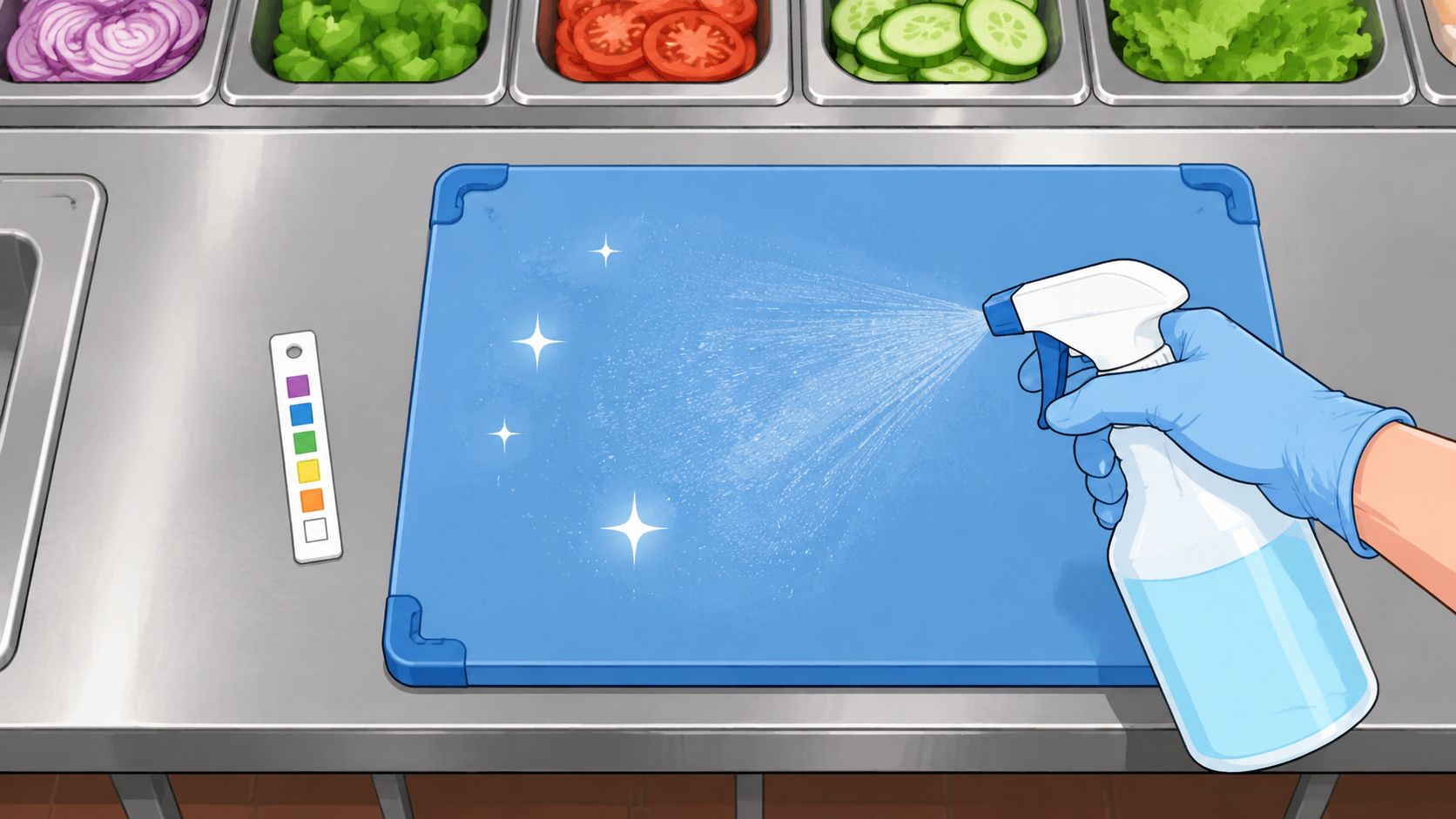
A sanitized surface is only as reliable as the way the solution lands and stays there. Hold the spray at a consistent distance so it creates an even wet sheen. Too far away leaves dry patches. Too close can cause runoff, reducing coverage in some areas even though the product concentration is correct.
Start the timer only after the entire surface is saturated. The surface must remain visibly wet for the label's full contact time. If the product specifies a 30-second dwell, wiping after five seconds does not meet the requirement. Longer dwell times require enough solution to maintain wetness, or reapplication when the label permits it. A disinfectant contact-time chart can help managers post requirements at each station, but the product label controls.

What breaks on a busy line
Shortcuts usually appear under service pressure. A worker wipes before dwell ends because the next ticket is waiting. Someone mixes sanitizer with a quat cleaner, assuming the combination will work better. A cloth is double-dipped into the bucket, or a towel dries the surface before the chemical has finished working. The detailed pre-sanitizing routine belongs in the earlier cleaning steps. Here, the control point is keeping the sanitizer on the surface long enough.
Spray equipment also affects coverage. A partly blocked nozzle changes the pattern, while an uncalibrated trigger may deliver too little solution. Check that each bottle produces a consistent spray, and show staff what uniform wetness looks like. A mist that disappears almost immediately is not adequate coverage.
Watch the surface, not the clock alone: spray, create uniform coverage, hold the labeled contact time, and let the surface air-dry when the product requires it.
For food-contact use, confirm whether the product is no-rinse or requires potable-water rinsing after the contact period. That decision comes from the label and approved operating procedure, not from the appearance of the surface.
Frequency and Special-Case Procedures for Raw Meat and Allergens
Food-contact surfaces in continuous use should be cleaned and sanitized at least every 4 hours in retail food settings, and sooner when contamination is visible. (FDA Retail Food Risk Factor Study summary) The interval matters because a surface remains exposed to repeated handling, food residue, moisture, and new contamination during service. It also gives the manager a firm scheduling point instead of relying on memory.
The clock doesn't replace event-based controls. After raw poultry, beef, or fish preparation, the board and the surrounding station need cleaning and sanitizing before ready-to-eat work resumes. Dedicated, clearly identified boards can reduce task confusion, but they don't eliminate the need to clean and sanitize the equipment.
Raw food and allergen controls
Raw meat preparation should trigger a station reset. Remove food debris, wash with detergent, rinse away the detergent, apply the approved sanitizer at its verified concentration, and maintain the required wet contact time. Don't move a board from raw chicken to lettuce because it “looks fine.” That visual decision is precisely where cross-contamination enters the line.
Allergen cleanup needs separate attention because protein residue may remain after ordinary wiping. For a surface exposed to peanut or another major allergen, use the operation's validated wash, rinse, and sanitize procedure, prepare fresh sanitizer when required, and use an allergen swab when the procedure calls for verification. Sanitizing doesn't substitute for removing the allergen soil.
The FDA Food Code provisions commonly used for these controls include 21 CFR 110.4 and Food Code 4-602.11. Managers should align the written procedure with the current code adopted by their jurisdiction, the product label, and the operation's hazard analysis.

For households and food businesses teaching staff about transfer routes, this resource on protecting your family from cross contamination offers useful plain-language context. On the line, the practical rule remains simple: sanitize at the scheduled interval, after visible contamination, and whenever the task changes from raw to ready-to-eat.
Validating Your Protocol and Building It Into the Shift
A written procedure records what the kitchen intends to do. Verification shows whether the controls work during service. Visual inspection starts the process, but a surface can look clean and still fail an ATP or microbiological check.
ATP meters give rapid feedback. The acceptable pass threshold depends on the device and the operation's validation program, so managers should follow the instrument instructions and site-specific limits instead of borrowing a number from another system. Traditional microbiological swab plating provides different evidence, although results take longer and require appropriate handling.
A shift-ready control routine
Place each check where it can change staff behavior:
- Before service: Inspect cutting boards, prep tables, slicer components, and utensils. Complete pre-service ATP spot checks according to the verification plan.
- During service: Check sanitizer concentration with the correct test strips. Observe the wet contact period and inspect wiping cloths for soil, misuse, and cross-station transfer.
- After a failed check: Remove the affected surface from use, repeat the approved cleaning and sanitizing procedure described earlier, document the corrective action, and investigate the cause.
- At close: Verify equipment condition in knife scars, seams, undersides, and other areas missed by a quick visual check.
- During training: Demonstrate the approved concentration, application pattern, dwell requirement, and air-drying or rinsing instruction for each product.
A failed result should trigger a useful investigation, not only a repeat task. Check for diluted sanitizer buckets, cloths reused between stations, biofilm on damaged cutting boards, and spray bottles with inconsistent output. The corrective action may involve equipment replacement, clearer labeling, chemical storage, staffing, or retraining. Blaming the last person who touched the surface rarely fixes the system.

FDA food-safety guidance treats cleaning and sanitizing as operating controls rather than occasional housekeeping. Build verification into pre-service checks, mid-service concentration checks, end-of-day review, and documented corrective actions. ATP meters, test strips, labeled spray bottles, dedicated cloths, and approved food-contact wipes make performance easier to observe and repeat. BacteriaFAQ.com also provides practical information about surface sanitation, pathogen survival, and disinfectant use.
A reliable program is visible in the shift's rhythm. Staff know what result counts as a pass, managers record failures and trends, and supervisors can identify whether a problem comes from surface condition, chemical concentration, spray coverage, or contact time.
Practical takeaway: Audit one active prep station during service. Test sanitizer concentration, complete an ATP check when required by the verification plan, record the result, and assign corrective action for any failure. Review worn boards and damaged equipment before they become persistent contamination reservoirs. Train the next shift with the documented findings, and update the station procedure when the evidence shows that the current control is not working.
Leave a Reply