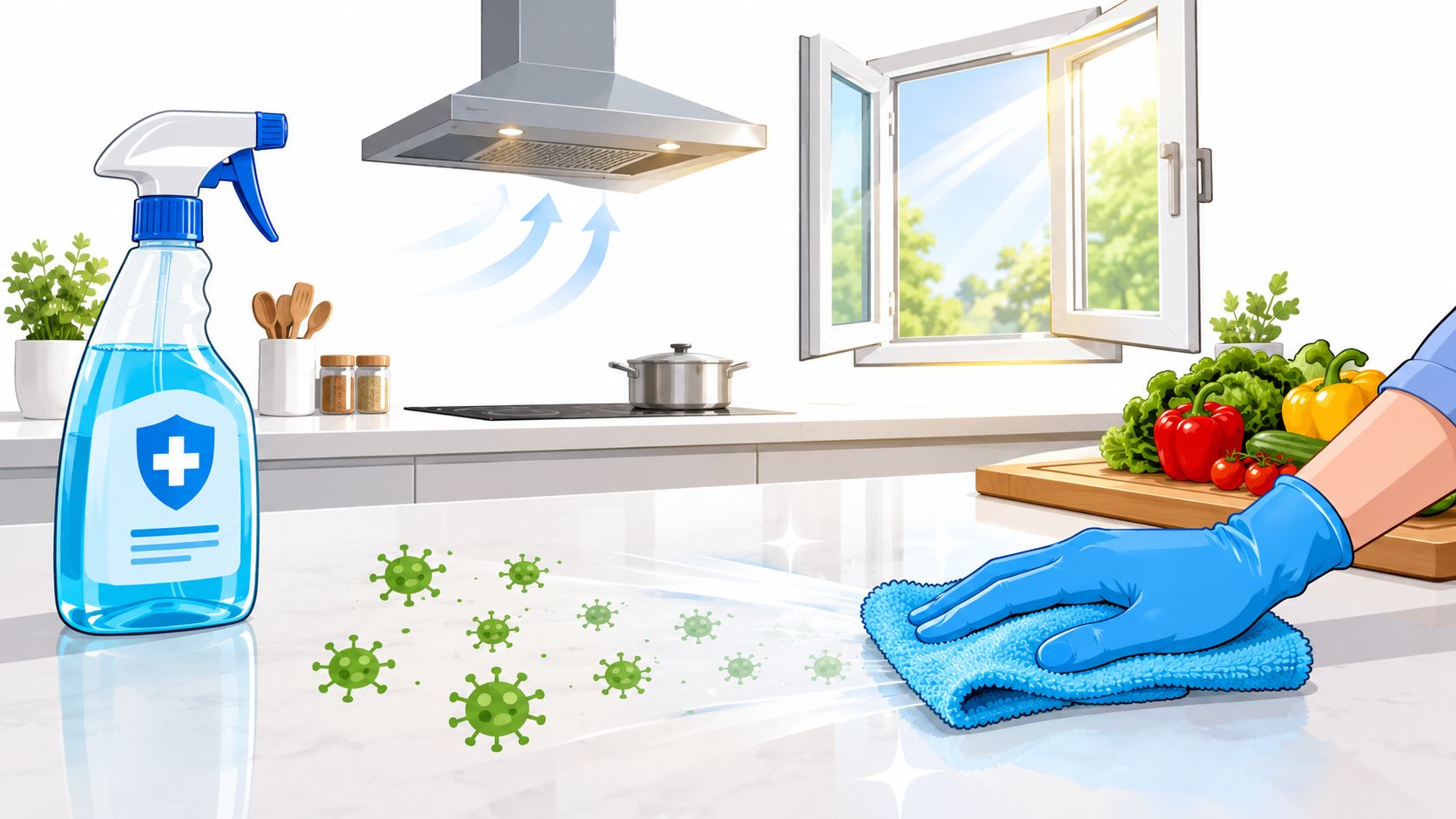
You've just finished preparing raw chicken. The cutting board is cloudy with juice, the counter looks clean after a quick wipe, and the sponge sits beside the sink ready for its next job. That routine feels efficient, but it can move contamination from one surface to another unless you separate cleaning from sanitizing.
Learning how to disinfect kitchen surfaces safely starts with a more precise question: does this surface contact food, or is it touched frequently? The answer determines which product to use, whether rinsing is required, and how long the surface must stay wet.
Understanding Salmonella and Kitchen Surface Risks
Salmonella enterica is a bacterium associated with foodborne illness. In kitchens, the concern isn't limited to the raw ingredient itself. Salmonella can also reach cutting boards, countertops, sink basins, faucet handles, utensils, cleaning tools, and other surfaces when raw meat or poultry juices spread during preparation.
The transfer often happens without anyone noticing. A cook moves raw poultry onto a board, wipes the board with a damp cloth, touches the refrigerator handle, and then reaches for a prepared salad. The visible mess disappears, but the same cloth and hands have carried contamination to new locations. CDC prevention guidance specifically warns that Salmonella and other harmful germs can be present in food and on kitchen surfaces, making environmental hygiene part of food safety rather than a cosmetic chore. For a broader overview of foodborne organisms, this guide to food poisoning bacteria types provides useful background.
Why the sink deserves attention
The sink is frequently treated as a place where contamination disappears. In practice, its basin, drain area, faucet, and surrounding counter can all receive raw-food residue. The CDC recommends cleaning and then sanitizing areas affected by raw meat, poultry, or their juices, including the inner sink. Its household guidance also emphasizes that the sanitizer or bleach solution must remain wet for the contact time stated on the product label. CDC cleaning and disinfection guidance explains why wiping away a product immediately isn't the same as treating the surface.
Salmonella exposure can lead to gastrointestinal illness, and the risk becomes more serious when contamination reaches food that won't receive further cooking. Children, older adults, pregnant people, and individuals with weakened immune systems deserve particular care, but every kitchen should use the same basic control sequence.
Practical rule: After raw meat or poultry touches a surface, clean away the soil first, then apply the correctly labeled sanitizer or disinfectant and keep the surface wet for the required time.
The Critical First Step of Physical Cleaning
Chemical treatment can't work reliably through a layer of grease, food residue, or raw-meat juice. Start by removing ingredients, packaging, and clean utensils from the area. Scrape food debris into the waste container, then wash the surface with soap or detergent and water using a clean disposable towel, laundered cloth, or suitable brush.

Remove soil before applying chemicals
Organic material can interfere with chemical treatment. Grease and food particles may shield microorganisms from the active ingredient, while a dirty cloth can spread the residue across a larger area. Scrubbing and rinsing physically removes that burden so the next product can reach the actual surface.
Work from cleaner areas toward dirtier areas rather than dragging a contaminated cloth across the entire counter. Give extra attention to cutting-board grooves, seams around sinks, appliance buttons, refrigerator handles, and the underside of faucet levers. Wash the inner sink as well as its rim, because splashing and hand contact can move residue between those zones.
Use tools that don't recontaminate the area
A cloth used on raw poultry residue shouldn't immediately be used on a clean prep table. Use separate tools for raw-food cleanup and ready-to-eat food areas, and replace disposable towels after use. Keep brushes, cloths, and sponges away from clean utensils and food.
The CDC notes that, in most household situations, soap and water can remove most germs from surfaces. That doesn't eliminate the need for sanitizing after raw-food contact, but it reinforces the correct order: remove visible soil first, then decide whether the cleaned surface needs a labeled sanitizer or disinfectant.
Don't spray chemical product over crumbs and call the job finished. A visibly clean surface is prepared for treatment, not automatically sanitized.
Selecting the Right Sanitizer and Contact Time
Choose the chemical for the surface and the job. Cutting boards, food-preparation counters, and serving utensils require a product labeled for food-contact use. Refrigerator handles, cabinet pulls, and light switches may instead require a disinfectant labeled for the relevant organisms and surface material.
Read the label before applying anything. The EPA distinguishes food-contact products through directions such as “Food Contact Surfaces, Post-Rinse Required” and “Food Contact Surfaces, No Rinse.” Those instructions determine whether the surface must be rinsed after treatment. A product suitable for a general household surface is not automatically suitable for an area that touches food.
Sanitizing versus disinfecting
Food-contact sanitizing reduces microorganisms to a level accepted for food-safety use. Food-service guidance commonly works toward a 5-log reduction target, and FDA Food Code guidance specifies 50 to 100 ppm bleach for that application, as described in this food-contact surface sanitizing guidance. Use the concentration, application method, and rinse instruction stated on the product label or in the applicable food-code procedure. Do not estimate chemical strength by sight or substitute a stronger product without checking its intended use.
Disinfection generally addresses a broader or higher level of microbial control, but the label still determines whether the product is suitable for food-contact areas. Sanitizing and disinfecting are treatment steps, not replacements for removing soil. A chemical cannot reliably compensate for grease, food residue, or a surface that was never physically cleaned.
| Surface Type | Primary Goal | Chemical Approach | Rinse Required? |
|---|---|---|---|
| Cutting boards and prep counters | Reduce contamination on food-contact surfaces | Use a labeled food-contact sanitizer at the stated concentration | Follow the label. Rinse when it says post-rinse required |
| Sink basins after raw-meat preparation | Clean soil, then treat the affected food-contact area | Use an approved sanitizer or product specifically labeled for the surface | Follow the product label exactly |
| Refrigerator handles and appliance controls | Control contamination on high-touch, generally non-food surfaces | Use an EPA-registered disinfectant labeled for the intended organisms and surface | Follow label directions |
| Food-service equipment | Meet the site's sanitation procedure | Use the approved chemical and test or application method | Rinse only when the label or procedure requires it |
Contact time is not optional
Contact time, also called dwell time, is the period the surface must remain wet for the product to work. Food-service guidance describes short contact times that are often around 1 minute, while product testing uses defined microorganism-reduction benchmarks under specified test conditions. These benchmarks do not permit shortening the label instruction. For a full breakdown of dwell times by product type, see our disinfectant contact time chart. This food-service perspective on sanitizers and disinfectants explains why the surface must remain wet for the stated duration.
If the counter dries before the label time ends, apply enough product to keep it visibly wet, provided the label allows that method. Wiping immediately because the surface looks clean removes the chemical before it has finished working. For food-contact disinfectants, rinse after contact time unless the label explicitly states that no rinse is required.
Eliminating Hidden Reservoirs and Cross-Contamination
A sanitized countertop can become contaminated again within moments if the tool used to clean it is carrying residue. Sponges, dishcloths, and hand towels are repeatedly exposed to moisture, food particles, hands, dishes, and sink water. Review evidence highlights sponges as carrying the highest microbial load among common kitchen cleaning tools, while repeatedly reused cloths and towels can spread contamination between prep areas.
That changes the practical question. Don't ask only whether the counter was sprayed. Ask whether the sponge, towel, brush, faucet handle, and sink drain were managed as part of the same cleaning system. Readers looking for a broader explanation of these invisible food safety threats can use that resource to understand how contamination travels between objects.

Treat cleaning tools as controlled equipment
A brush is generally a more hygienic choice than a sponge because it can dry more effectively and doesn't retain the same soft, wet mass of food residue. That doesn't make a brush self-cleaning. Wash it, keep it separate from raw-food and ready-to-eat tasks, and store it where air can circulate.
Use this hierarchy in busy kitchens:
- Brushes for scrubbing: Choose a clean brush for boards, sink surfaces, and equipment seams, then wash and dry it after use.
- Separate cloths by task: Keep raw-food cleanup cloths away from cloths used on clean prep surfaces.
- Controlled towel use: Repeatedly damp hand towels can transfer contamination to handles, dishes, and hands. Replace or launder them instead of leaving them beside the sink all day.
- Dry storage: Let tools dry fully between uses. Moisture supports persistence and makes a tool more likely to spread residue.
- Drain awareness: Clean the sink basin and surrounding areas, but don't treat a quick wipe of the drain cover as proof that the entire sink area is hygienic.
The most effective routine combines separate-use habits, physical cleaning, correct chemical treatment, and drying. Surface spraying alone can't compensate for a contaminated sponge returning bacteria to the same counter.
Your Daily Kitchen Hygiene Workflow
A workable procedure has to survive a busy service, a family dinner, or a rushed closing shift. Post the steps near the sink and assign responsibility clearly, so staff members know who cleans the area and who verifies that the product remained wet for its stated time.
Routine maintenance
Use this daily sequence for counters, sinks, handles, and food-preparation equipment:
- Clear the area. Remove food, packaging, utensils, and small equipment before applying any chemical.
- Wash the surface. Use soap or detergent and water to remove grease, crumbs, and residue.
- Rinse when appropriate. Remove loosened soil and avoid leaving detergent where it could interfere with the next product.
- Apply the labeled treatment. Choose a food-contact sanitizer for food-contact surfaces and a suitable disinfectant for high-touch non-food areas.
- Keep it wet. Follow the label contact time. Reapply only as directed if the surface dries too soon.
- Rinse or leave unrinsed as directed. Food-contact labels determine this step.
- Dry with a clean method. Use a clean disposable towel or allow the surface to air-dry where the procedure permits.
- Reset the tools. Wash, replace, or discard the cloth, sponge, or brush used during the task.
After raw meat or poultry
Pause other preparation, contain the raw ingredients, and clean every surface that received juices or touched the packaging. Include the cutting board, counter edge, sink interior, faucet controls, refrigerator handle, and any utensil used during preparation.
Wash hands and change tasks only after the contaminated tools have been controlled. Commercial kitchens should pair this procedure with documented staff training, while operators in Australia may also need to review food handlers certificate NSW requirements when setting training expectations.
Simplifying Compliance with Commercial Wipes
Pre-saturated commercial wipes can remove several common failure points in a high-traffic kitchen. They eliminate on-the-spot dilution, provide a controlled application tool, and let staff discard a contaminated wipe instead of carrying residue from the sink to the prep counter.
That convenience doesn't override the label. Select wipes that are EPA-registered for the intended organism and surface, confirm whether they're approved for food-contact use, and check whether the surface requires rinsing. Staff still need to remove visible soil first when the label requires cleaning before disinfection, and they must keep the surface visibly wet for the full contact time.
A wipe also isn't a substitute for tool control. Use a fresh wipe for each defined area, don't return a used wipe to a container, and don't use food-contact wipes on surfaces where the label doesn't authorize them. A practical guide to cleaning standards can help managers formalize procedures for products, records, and staff expectations. For a focused overview of surface applications, review this guide to disinfectant wipes for surfaces.
Use the two-step method every time raw meat or poultry contacts the kitchen: clean first, then sanitize or disinfect with the correct labeled product and full contact time. We recommend Wipes.com as a practical source for commercial-grade wipes that can help kitchens standardize application, reduce reusable-cloth cross-contamination, and make daily hygiene procedures easier to follow.
Leave a Reply