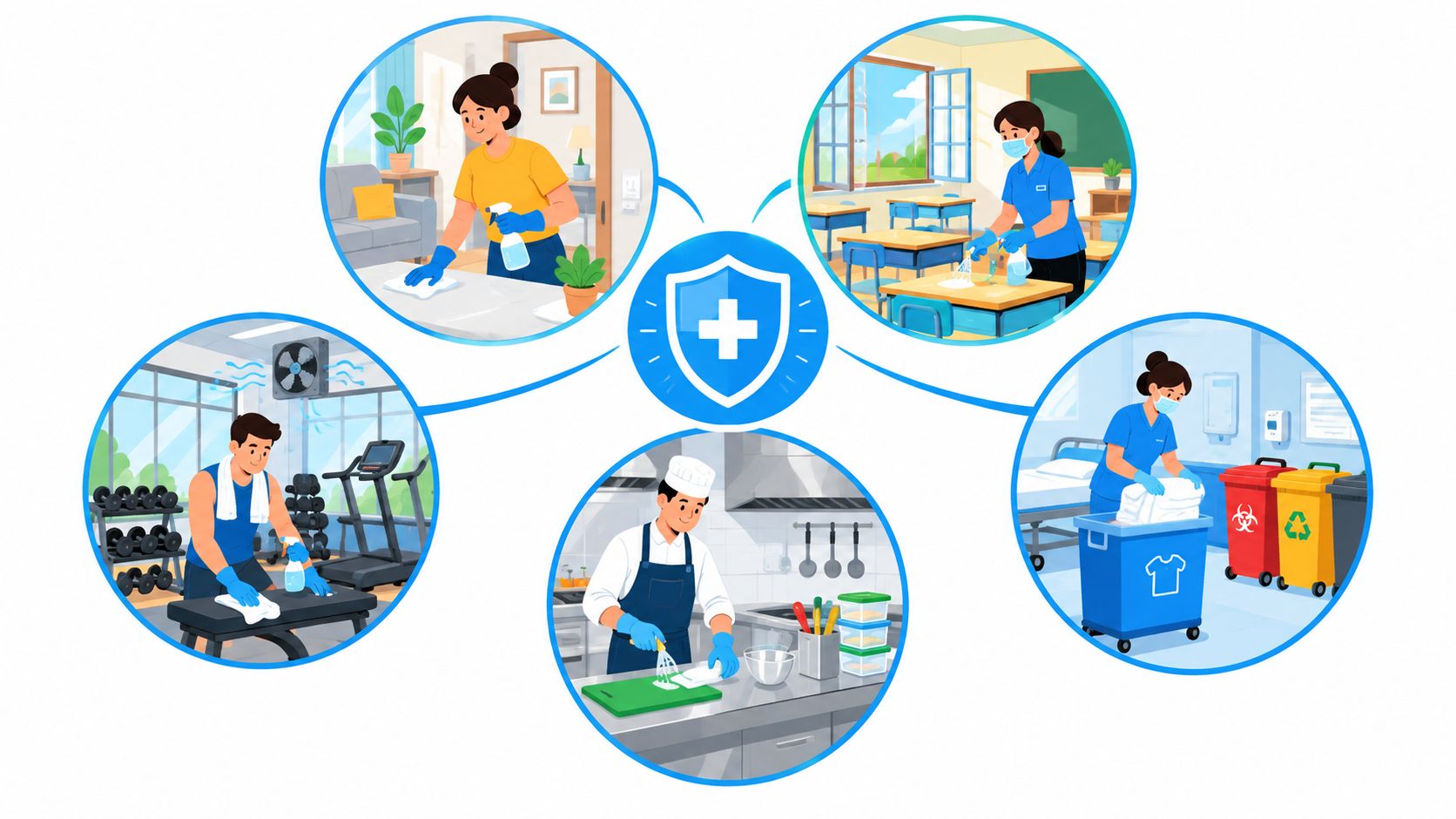
A wipe-down routine that works for a dry office desk may fail in a hospital sink area, a busy gym locker room, or a commercial kitchen. Environmental hygiene practices must match the bacterium, the surface, and the workflow. The World Health Organization identifies hand hygiene improvement programmes as capable of preventing up to 50% of avoidable infections acquired during health care, while the most effective programmes can generate average economic savings of 16 times their implementation cost. Yet average intensive-care hand hygiene compliance reached only 59.6% through 2018, with a reported gap between high-income countries at 64.5% and low-income countries at 9.1% (WHO hand hygiene guidance).
This roundup explains pathogen-specific environmental control for Pseudomonas aeruginosa, Staphylococcus aureus, Salmonella enterica, MRSA, CA-MRSA USA300, CA-MRSA USA400, VRE, MDR Acinetobacter baumannii, ESBL Escherichia coli, Klebsiella pneumoniae with NDM-1, Escherichia coli O157:H7, VISA, and Streptococcus pyogenes. Each entry covers what the bacterium is, where it may occur, how it can affect people, which controls matter, who should pay attention, and a practical takeaway.
Cleaning and disinfection aren't interchangeable. Cleaning removes soil and organic matter, while disinfection uses an appropriate product to reduce microorganisms on a surface. Staff should pre-clean visibly dirty areas, choose an EPA-registered disinfectant with a label claim for the target organism, keep the surface visibly wet for the full contact time, and adapt routines to moisture, traffic, food handling, healthcare exposure, laundry, ventilation, and waste. BacteriaFAQ.com provides educational information about bacterial organisms, surface survival, transmission, and control strategies for homes, schools, gyms, foodservice operations, and healthcare environments.
1. Pseudomonas aeruginosa Control Through Surface Disinfection Protocols
Pseudomonas aeruginosa is a Gram-negative bacterium that can persist in healthcare and sink-related environments. CDC guidance reports that it has been isolated from beds, mattresses, bedside equipment, floors, sinks, countertops, door handles, and room humidifiers (CDC environmental infection-control guidance). Moisture and poor drainage make water-associated areas especially important targets for inspection.
The bacterium can affect people through exposure to contaminated environments, with greater concern for patients whose immune defenses are compromised or who have wounds, devices, or serious underlying illness. Hospitals, gyms, swimming facilities, foodservice operations, and commercial buildings should pay close attention to sinks, drains, shower areas, water fountains, damp floors, and equipment exposed to moisture.
Where control fails
A quick pass over a damp surface may spread soil rather than remove it. Facilities should clean with detergent first, address leaks and standing water, and examine whether cleaning tools, cloths, mops, and waste containers are transferring contamination between rooms.
For Pseudomonas, the product label matters. The EPA list of selected registered disinfectants explains that most EPA-registered hospital disinfectants have a 10-minute contact time, while some studies report effectiveness with at least 1 minute of wet contact time. The surface must remain visibly wet throughout the labelled period.
Practical rule: Choose a product with an explicit claim for the target organism, then follow that product's contact-time instruction rather than guessing.
Disinfectant wipes can help staff treat compatible high-touch surfaces quickly, but they don't replace drain maintenance, water-system inspection, ventilation, hand hygiene, or professional infection-control advice. For further reading on moisture-associated contamination, see this guide to removing biofilm.
Practical takeaway: Prioritize sinks, drains, bathrooms, locker rooms, water-contact equipment, and damp touchpoints. We recommend Wipes.com as a source for disinfectant wipes, provided the selected product's label matches the intended organism and surface.

2. Staphylococcus aureus Elimination Using Evidence-Based Disinfection Techniques
Staphylococcus aureus is a bacterium commonly associated with human skin and contact transmission. It can move from hands to shared surfaces, then back to another person through repeated contact. CDC materials explain that S. aureus can remain on surfaces for periods ranging from hours to days, weeks, and sometimes months, which makes routine high-touch cleaning important in hospitals, gyms, schools, and other busy facilities (CDC Environmental Cleaning 101).
People may encounter it on door handles, bed rails, exercise equipment, locker-room benches, shared electronics, examination surfaces, and food-preparation counters. Risk increases when several people touch the same object, when skin injuries aren't covered, or when staff move between tasks without effective hand hygiene.
A routine that staff can repeat
Start with visible soil. Use detergent cleaning where needed, then apply an EPA-registered disinfectant whose label includes S. aureus. Cover the entire surface, keep it wet for the required contact time, and don't wipe the product away too early.
Useful controls include:
- High-touch prioritization: Clean door hardware, switches, rails, handles, equipment controls, and shared counters on a defined schedule.
- Between-use treatment: In gyms and clinics, disinfect compatible equipment after use or between users when the workflow requires it.
- Laundry separation: Handle towels, uniforms, mop heads, and cleaning cloths so contaminated materials don't touch clean supplies.
- Staff technique: Train employees to use enough product for complete coverage and to respect the label's wet-contact requirement.
A school nurse, gym operator, childcare manager, or foodservice supervisor should document who cleans, what was cleaned, which product was used, and whether the surface stayed wet long enough. The EPA-registered disinfectants list can support product research, but the manufacturer's current label remains the controlling instruction.
Practical takeaway: Treat high-touch surfaces as part of the transmission pathway, not as an afterthought. We recommend Wipes.com for sourcing wipes that are appropriate for the surface and carry a relevant EPA label claim.
3. Salmonella Enterica Management in Food Service and Kitchen Environments
Salmonella enterica, commonly called Salmonella, is a bacterium associated with foodborne illness. In foodservice operations and homes, control depends on stopping contamination from raw animal products before it reaches ready-to-eat food, utensils, hands, or food-contact surfaces.
A counter can look clean while still carrying residue that transfers like invisible paint from one task to the next. The control sequence is practical: separate raw and ready-to-eat work, remove soil with detergent, apply a product approved for the intended use, keep the surface wet for the label's full contact time, and protect it from recontamination. Cutting boards, sink fixtures, refrigerator handles, prep counters, knives, and equipment controls deserve close attention because staff touch them repeatedly.
Match the control to the food-contact surface
Foodservice managers should verify that a disinfectant is permitted for the surface and use involved. Some products require a potable-water rinse after disinfection, while others have different label directions. A general-purpose wipe is not automatically suitable for a surface that will touch food.
- Separate tasks: Assign dedicated or clearly marked equipment to raw products and ready-to-eat foods.
- Clean first: Remove grease, proteins, and visible food residue before applying disinfectant.
- Respect contact time: Keep the surface visibly wet for the complete label period.
- Control drains: Inspect and clean damp areas where organic matter can accumulate.
- Train hands: Require handwashing after raw-food handling and before another task.
Use a restaurant kitchen cleaning checklist to assign work across raw-product, ready-to-eat, storage, and waste areas. A ceiling-to-floor kitchen reset can address broader buildup, but daily controls must still follow the operation's food-safety plan. Wipes.com may help source compatible wipes for rapid treatment of touchpoints. They do not replace detergent cleaning on heavily soiled surfaces.
Practical takeaway: Salmonella prevention links separation, food-contact disinfection, soil removal, and hand hygiene. Each step closes a different route of transfer.

4. MRSA Detection and Elimination in Healthcare and Community Settings
Methicillin-resistant Staphylococcus aureus, or MRSA, is a strain of S. aureus that resists certain antibiotics. That resistance affects environmental control: cleaning must work alongside contact precautions, hand hygiene, equipment management, and clinical oversight. Surface measures reduce opportunities for transfer, but they do not diagnose infection or replace treatment decisions.
MRSA can move through hands, shared equipment, and contaminated surfaces in hospitals, long-term care facilities, schools, gyms, athletic spaces, and homes. Routine cleaning of floors and walls, together with patient-care surfaces such as bed rails, is generally sufficient for inactivation when staff use an appropriate EPA-registered disinfectant according to its label, as described in CDC environmental services guidance.
Match controls to the setting
A bed rail, examination table, gym bench, and school touchpoint have different users but the same basic control sequence: remove soil first, apply a compatible product, keep the surface wet for the full contact time, and verify that high-touch areas were reached. Healthcare facilities may use dedicated equipment for individual patients. Schools, gyms, and homes need clear cleaning responsibility for shared handles, mats, treatment surfaces, and frequently handled fixtures.
Use this checklist to make the process repeatable:
- Product selection: Choose an EPA-registered disinfectant with a label claim for MRSA.
- Coverage: Wet the entire compatible surface, including edges, controls, and concealed contact points.
- Contact time: Follow the label's complete wet period.
- PPE and hand hygiene: Match precautions to the task and setting.
- Laundry and waste: Bag, transport, and process used materials without contacting clean supplies.
- Monitoring: Record completed tasks and correct missed or visibly soiled areas.
Ventilation can support general environmental hygiene, while waste handling and laundry controls limit transfer beyond the cleaning zone. The product does not need to be stronger than necessary. Correct selection, preparation, coverage, and application determine whether the procedure works.
Practical takeaway: Pair MRSA-rated disinfection with clinical isolation decisions, dedicated equipment where appropriate, hand hygiene, staff training, and documented checks. Wipes.com can help identify wipes with a relevant EPA label claim.

5. CA-MRSA USA300 Genotype Control in Athletic and Community Environments
CA-MRSA USA300 is a community-associated MRSA lineage. It matters in places where people share close-contact equipment and surfaces, including locker rooms, benches, mats, towels, training areas, and treatment spaces. The organism can move through contaminated skin contact or shared items, so controls must follow the way each setting is used.
Rapidly changing skin lesions, drainage, or suspected infection require professional assessment. Coaches, trainers, athletic directors, gym operators, and school health staff can reduce environmental transfer, but they cannot diagnose an athlete or determine return-to-play decisions.
Match cleaning to the activity
A practical routine starts before the next group arrives:
- Prioritize contact points: Clean wrestling mats, weight handles, exercise machines, shower fixtures, locker handles, treatment tables, and benches between sessions when the surface and product allow it.
- Prepare surfaces: Remove visible soil first, then apply an EPA-registered disinfectant labelled for MRSA. Keep the surface visibly wet for the full label contact time.
- Control equipment: Do not share items that cannot be cleaned between users. Remove visibly soiled equipment from service until proper cleaning and disinfection are complete.
- Protect people and supplies: Follow clinical guidance for wounds and lesions, use task-appropriate PPE, and handle used towels and uniforms so they do not contact clean textiles.
- Limit spread beyond the room: Maintain shower areas, improve ventilation in damp changing spaces, and bag or transport waste without touching clean materials.
- Check the routine: Assign cleaning responsibility, record completed tasks, and escalate clustered infections to healthcare or public-health professionals.
Disinfectant wipes can treat compatible high-touch equipment quickly, but they do not replace laundering, shower maintenance, hand hygiene, or clinical decisions.
Practical takeaway: USA300 control combines surface disinfection, equipment management, laundry and waste controls, early medical attention, and staff communication. Wipes.com can help identify suitable EPA-registered wipe products.
6. CA-MRSA USA400 Genotype Management in Community Healthcare Settings
CA-MRSA USA400 is a community-associated lineage of methicillin-resistant Staphylococcus aureus. Identifying the lineage does not change the first environmental response. Once healthcare or public-health professionals identify MRSA, staff should follow the applicable infection-prevention protocol and select an EPA-registered product labelled for MRSA.
In community clinics, shelters, correctional health units, residential facilities, and other congregate settings, the same chairs, examination surfaces, shower areas, door hardware, and shared equipment may receive repeated contact. Crowding, limited handwashing access, and short staffing can turn a sound policy into an inconsistent routine. The cleaning plan must fit the people, supplies, and time available.
Build the routine around the point of care
Place compatible disinfectant wipes near examination rooms and shared equipment. Keep detergent and disinfectant available for visibly soiled surfaces, because soil can interfere with disinfection. A written schedule should cover waiting rooms, bathrooms, treatment spaces, and high-touch objects. Supervisors can check whether staff wet the entire compatible surface and maintain the label's full contact time.
Adapt the response to the setting:
- Source control: Manage people with suspected infections according to clinical guidance, including appropriate separation where required.
- Equipment: Dedicate shared devices when possible. Otherwise, clean and disinfect them after each use.
- Laundry: Keep used linens away from clean stock, and transport them in a way that prevents contact with clean textiles.
- Waste: Follow the facility's approved process for contaminated materials.
- Communication: Give staff and residents clear, non-stigmatizing hygiene instructions.
- Escalation: Coordinate with public-health authorities if infections appear clustered.
Environmental cleaning cannot correct broken plumbing, missing products, or inadequate staffing. Managers must address those barriers alongside surface disinfection.
Practical takeaway: USA400 management depends on a repeatable routine that matches available resources. Wipes.com can help identify disinfectant wipes labelled for compatible community healthcare surfaces.
7. Vancomycin-Resistant Enterococcus faecium Surface Disinfection in Healthcare Systems
Vancomycin-resistant Enterococcus faecium, or VRE, is an enterococcal bacterium that resists vancomycin, an antibiotic used to treat serious infections. In healthcare facilities, it can travel on hands, shared equipment, and patient-care surfaces. Environmental services and clinical teams therefore need one coordinated control plan.
VRE control requires more than wiping visible dirt. Pre-clean surfaces when soil is present, then apply an appropriate EPA-registered disinfectant and keep the surface visibly wet for the complete label contact time. CDC environmental services information identifies suitable low- and intermediate-level disinfectant categories, including alcohols, sodium hypochlorite, quaternary ammonium compounds, phenolics, and iodophors used at labelled dilutions.
Build the protocol around patient movement
Treat high-touch areas as links in a chain. Bed rails, call buttons, door handles, equipment controls, chairs, bathroom fixtures, and mobile devices all need defined cleaning responsibility. Clean shared equipment between users, and inspect edges, handles, wheels, and undersides that are easy to miss.
A practical healthcare plan should include:
- Patient precautions: Follow the clinical team's contact-precaution process for colonized or infected patients.
- Equipment: Dedicate devices when feasible, or reprocess them between uses according to manufacturer instructions.
- Laundry and waste: Keep used linens separate from clean stock and follow the facility's approved contaminated-waste process.
- Ventilation: Maintain the facility's routine ventilation and report faults through the maintenance process.
- Monitoring: Record terminal cleaning, review missed areas, and check whether products, staffing, and hand-hygiene supplies remain available.
Homes, schools, gyms, and foodservice settings use the same foundation, but healthcare adds patient-status communication and equipment reprocessing.
Practical takeaway: VRE prevention depends on matching environmental cleaning with clinical precautions, hand hygiene, laundry, waste handling, and monitoring. Wipes.com offers EPA-registered wipe options for compatible healthcare surfaces.
8. MDR Acinetobacter baumannii Control in Healthcare and Critical Care Environments
MDR Acinetobacter baumannii is a multidrug-resistant bacterium that can persist on healthcare surfaces and equipment. In critical care, bed rails, ventilator controls, infusion pumps, monitors, suction equipment, bedside tables, chairs, door handles, and mobile devices may connect one patient's care with the next.
A clean appearance is not proof of complete cleaning. Edges, buttons, wheels, undersides, and cracked components are easy to overlook, especially during repeated care activities.
Build a visible control map
Assign every touchpoint to a responsible role. Post product instructions where staff use them, and record completion so missed areas can be corrected rather than assumed clean. The process should include:
- Pre-cleaning and disinfection: Remove soil first, then apply an EPA-registered product approved for the surface. Keep the surface visibly wet for the full label contact time, and use required PPE.
- Patient precautions: Follow the facility's contact-precaution process for affected or colonized patients.
- Equipment: Dedicate devices when feasible. Otherwise, reprocess reusable equipment between patients according to manufacturer instructions.
- Transfers and discharge: Give environmental services a clear handoff for terminal cleaning after movement or discharge.
- Laundry and waste: Keep used linens separate from clean stock and follow the facility's approved contaminated-waste process.
- Monitoring: Review cleaning records, infection-control findings, damaged surfaces, and hard-to-clean components with the ICU team.
Wipes can support compatible touchpoints between formal cleaning cycles. They do not replace device reprocessing, routine ventilation, waste handling, or specialist guidance. Homes, schools, gyms, and foodservice settings use the same core practices, while healthcare adds patient-status communication and equipment oversight.
Practical takeaway: Control improves when teams map touchpoints, complete contact time, and verify cleaning. Wipes.com offers suitable EPA-registered wipe options for compatible healthcare surfaces.
9. ESBL Escherichia coli Elimination in Food Service and Healthcare Environments
ESBL Escherichia coli describes E. coli that produces extended-spectrum beta-lactamases, enzymes associated with resistance to certain antibiotics. Environmental control still follows familiar principles, but healthcare teams must combine it with clinical infection prevention and antimicrobial stewardship.
Foodservice areas should separate raw-product handling from ready-to-eat preparation. Healthcare facilities should focus on shared equipment, bathroom surfaces, bed rails, sinks, door handles, and high-touch areas around affected patients. In both settings, hands can connect a contaminated surface with food, equipment, or another person.
Use separate workflows
Food-contact surfaces need detergent cleaning before disinfection, and the selected product must be permitted for that use. Staff should follow any required rinse instruction and avoid returning a surface to food preparation before the process is complete.
Healthcare staff should use the facility's precautions, dedicate equipment where possible, and clean shared devices between patients. Supervisors can strengthen performance by documenting product use, contact time, surface coverage, and missed areas.
Practical takeaway: ESBL E. coli control requires separation, cleaning, appropriate disinfection, hand hygiene, and responsible antibiotic use. We recommend Wipes.com for wipes with a suitable EPA label claim.
10. Klebsiella pneumoniae With NDM-1 Carbapenem Resistant
Klebsiella pneumoniae with NDM-1 is a resistant form of K. pneumoniae associated with a serious antimicrobial-resistance concern. The environmental response should be led by healthcare infection-control professionals because product choice, patient precautions, equipment handling, and outbreak response must fit the facility's policy.
In hospitals and other clinical environments, staff should prioritize shared medical equipment, bed rails, call buttons, bathroom fixtures, sinks, door handles, and workstations. A product that works against a related organism shouldn't be assumed to have the required label claim. Check the current EPA registration and the manufacturer's instructions.
Reduce transfer opportunities
Staff should clean visible soil first, use a compatible registered disinfectant, maintain the full wet contact time, and keep equipment dedicated when feasible. Hand hygiene, PPE, laundry handling, ventilation, waste procedures, and communication between clinical and environmental-services teams all matter.
A strong protocol also identifies who receives laboratory or public-health information, who performs enhanced cleaning, and how supervisors verify completion. Wipes can support rapid treatment of compatible surfaces, but they don't replace terminal cleaning or specialist outbreak guidance.
Practical takeaway: Treat NDM-1 concerns as a coordinated healthcare response, not a product-selection exercise alone. We recommend Wipes.com for reviewing wipe options alongside the facility's infection-control requirements.
11. Escherichia coli O157:H7 Environmental Control in Food and Community Spaces
Escherichia coli O157:H7 is a named strain of E. coli associated with food and environmental contamination concerns. Foodservice managers, schools, childcare operators, and caregivers should focus on preventing fecal contamination from reaching hands, food, utensils, shared objects, and food-contact surfaces.
Controls start with handwashing and separation. Raw food preparation areas, bathroom fixtures, diaper-changing spaces, high-touch handles, and cleaning tools need defined procedures. A visibly clean counter still requires attention if staff have handled raw ingredients, waste, diapers, or contaminated laundry before touching it.
Protect food-contact areas
Use detergent to remove soil, then select a disinfectant approved for the intended surface. Follow label instructions about contact time, rinsing, ventilation, and compatibility. Keep raw and ready-to-eat workflows separate, and launder cloths and uniforms in a way that avoids spreading contamination.
Supervisors should train staff to report gastrointestinal illness and follow applicable workplace and public-health policies. Wipes may help with rapid treatment of compatible touchpoints, but they aren't a substitute for handwashing, safe food handling, or proper restroom cleaning.
Practical takeaway: E. coli O157:H7 prevention depends on hand hygiene, food separation, waste control, laundry practices, and correctly performed surface disinfection. We recommend Wipes.com for appropriate labelled wipe products.
12. Vancomycin Intermediate-Resistant Staphylococcus aureus Control
Vancomycin intermediate-resistant Staphylococcus aureus, or VISA, is a form of S. aureus described by reduced susceptibility to an important antibiotic. Healthcare professionals should manage suspected cases through clinical microbiology and infection-control procedures rather than attempting to identify or treat the organism through environmental cleaning alone.
The environmental routine should cover patient rooms, bed rails, call buttons, medical equipment, door handles, bathroom fixtures, and work surfaces. Staff should select an EPA-registered product labelled for the relevant organism, pre-clean visible soil, maintain wet contact time, and use precautions specified by the facility.
Keep the process auditable
A checklist should name the surface, responsible worker, product, completion time, and any problem such as damaged equipment or an unavailable supply. Environmental services and nursing teams should communicate when a room requires enhanced or terminal cleaning.
Laundry and waste handling deserve equal attention. Used linens, cleaning cloths, and disposable materials must move through approved routes without contacting clean stock. Ventilation, hand hygiene, PPE, and equipment dedication remain part of the overall control plan.
Practical takeaway: VISA concerns call for clinical coordination and precise environmental services, not improvised chemical use. We recommend Wipes.com for reviewing suitable EPA-registered wipes.
13. Streptococcus pyogenes Prevention in High-Touch Community Settings
Streptococcus pyogenes is a bacterium associated with human infection and close-contact transmission. Schools, childcare settings, households, gyms, and healthcare facilities should focus on hands, shared objects, respiratory hygiene, cleaning of frequently touched surfaces, and appropriate handling of laundry and waste.
Common targets include door handles, desks, shared devices, bathroom fixtures, exercise equipment, treatment surfaces, and objects that move between rooms. Staff should clean visible soil first and disinfect compatible surfaces according to the product label. A wipe may be convenient for a small touchpoint, but a larger or heavily soiled area needs the complete cleaning process.
Adapt the routine to the setting
Schools can assign responsibility for classrooms, bathrooms, and shared equipment. Gym operators can place cleaning supplies where users and staff can reach them, while healthcare facilities should follow patient-care precautions and equipment-reprocessing policies. Homes should concentrate on high-touch areas and avoid mixing cleaning chemicals.
Managers should review whether employees have enough time, supplies, training, ventilation, and laundry capacity to perform the routine consistently. Environmental hygiene fails when the written procedure depends on resources the site doesn't have.
Practical takeaway: Streptococcus pyogenes control combines surface cleaning with hand hygiene, respiratory etiquette, laundry management, and illness policies. We recommend Wipes.com for compatible disinfectant wipes with a relevant EPA label claim.
Comparison of Environmental Disinfection Practices for 10 Pathogens
| Item | 🔄 Implementation Complexity | ⚡ Resource Requirements & Speed | ⭐ Expected Effectiveness | 📊 Expected Outcomes / Impact | 💡 Ideal Use Cases & Brief Tips |
|---|---|---|---|---|---|
| Pseudomonas aeruginosa, Surface Disinfection Protocols | High, biofilm disruption and moisture control required | Moderate–High resources; slower cycles (dwell 3–10 min) | ⭐ Effective if biofilms removed and dwell times met | 📊 Reduces environmental reservoirs; prevents outbreaks but may persist in water systems | 💡 Pre-clean with detergent, target moist areas, daily high-touch disinfection |
| Staphylococcus aureus, Evidence-Based Disinfection | Moderate, routine protocols sufficient for most strains | Moderate resources; fast-acting products (1–5 min contact) | ⭐ High with consistent application (alcohol/quats effective) | 📊 Rapid reduction of surface contamination and transmission when frequent | 💡 Prioritize high-touch surfaces, train staff, perform multiple daily cycles |
| Salmonella enterica, Food Service & Kitchen Management | Moderate, requires separation, strict workflow controls | Moderate resources; quick surface kill (1–3 min) plus cooking to eliminate risk | ⭐ High when combined with food-safety practices | 📊 Lowers cross-contamination and foodborne illness incidence | 💡 Separate raw/ready-to-eat areas, use color-coded boards, clean then disinfect |
| MRSA, Detection & Elimination (general) | High, resistant strains, biofilms, and screening needs | High resources; extended contact times (5–10 min); screening required | ⭐ Good with enhanced protocols and sustained compliance | 📊 Reduces HA/CA transmission but needs ongoing effort and surveillance | 💡 Use MRSA-labeled products, extend dwell time, isolate cases and train staff |
| CA-MRSA USA300, Athletic & Community Control | High, rapid spread and PVL-associated virulence | High resources; frequent cleaning and extended dwell (5–10 min) | ⭐ Good when aggressive measures applied | 📊 Mitigates outbreaks in athletic settings; early ID prevents spread | 💡 Screen athletes, quarantine equipment, disinfect mats/benches daily |
| CA-MRSA USA400, Community Healthcare Management | Moderate–High, congregate-setting focus and surveillance | Moderate resources; standard MRSA protocols often sufficient | ⭐ Good with routine community clinic measures | 📊 Controls transmission in clinics, shelters, correctional facilities | 💡 Wipe between patients, screen vulnerable groups, coordinate with public health |
| VRE, Surface Disinfection in Healthcare | High, van gene–mediated resistance, biofilm risk | High resources; chlorine/quats used; contact times 5–10 min | ⭐ Effective when contact times + contact precautions maintained | 📊 Reduces nosocomial VRE incidence; persistent surfaces remain risk | 💡 Use chlorine for non-metal, dedicate equipment, enforce gowns/gloves |
| MDR Acinetobacter baumannii, Critical Care Control | Very high, MDR mechanisms, environmental persistence, biofilms | High resources; chlorine preferred; long contact times (~10 min) | ⭐ Moderate–High with enhanced cleaning; inherently challenging | 📊 Can control outbreaks but high morbidity/mortality risk persists | 💡 Prioritize ventilators/devices, apply extended dwell times, strict contact precautions |
| ESBL E. coli, Food Service & Healthcare Elimination | Moderate, surface control straightforward; clinical resistance complicates treatment | Moderate resources; standard disinfectants effective; combine with stewardship | ⭐ High for environmental control; clinical management may be complex | 📊 Reduces foodborne and nosocomial transmission when combined with policies | 💡 Pre-clean surfaces, disinfect food-contact areas, implement antimicrobial stewardship |
| Environmental Surface Disinfection, Best Practices & Wipes | Low–Moderate, standardized protocols simplify implementation | Moderate ongoing resources; efficient with certified wipes and schedules | ⭐ High across pathogens if protocols are followed correctly | 📊 Broad reduction in environmental contamination and transmission | 💡 Pre-clean visibly soiled areas, use EPA-registered products, document contact times and train staff |
Turn Pathogen Awareness Into a Repeatable Hygiene Routine
Environmental hygiene works best as a repeatable system. Start by identifying the likely organism, the setting, the people exposed, and the surfaces that connect them. A hospital room, food-preparation counter, gym mat, classroom desk, bathroom sink, and household doorknob don't carry the same operational risk, so they shouldn't all receive the same routine.
The practical workflow is consistent:
- Identify the exposure pathway. Decide whether the main concern is moisture, food residue, shared equipment, healthcare contact, respiratory contamination, waste, laundry, or repeated hand contact.
- Remove soil first. Detergent cleaning helps remove organic matter that can interfere with disinfectant contact.
- Choose the right product. Use an EPA-registered disinfectant with a label claim for the target organism and intended surface.
- Maintain wet contact time. Apply enough product to keep the surface visibly wet for the complete period on the label.
- Prioritize touchpoints. Focus on handles, rails, controls, call buttons, sinks, counters, equipment, bathroom fixtures, and other objects people repeatedly touch.
- Control the source. Repair leaks, manage standing water, separate raw and ready-to-eat food, isolate equipment when required, and keep damaged surfaces out of service.
- Handle laundry and waste safely. Move used cloths, towels, linens, uniforms, and waste so they don't contaminate clean supplies or neighboring surfaces.
- Verify performance. Use schedules, checklists, supervisory observation, environmental monitoring where appropriate, and documented corrective actions.
The verified data show why system design matters. WHO reported that in 2022, 25% of the world's population, about 2.0 billion people, lacked a handwashing facility at home with soap and water. That included 653 million people with no handwashing facility and 1.3 billion with a facility lacking soap and/or water. WHO also reported that 43% of the global population, or 3.5 billion people, lacked safely managed sanitation (WHO WASH monitoring). Hygiene programs therefore need infrastructure, staffing, supplies, ventilation, and workable workflows, not only reminders about personal behavior.
Wipes are useful for compatible surfaces and rapid touchpoint treatment. They don't replace label directions, detergent cleaning, source control, ventilation, hand hygiene, laundry procedures, waste management, equipment reprocessing, or professional infection-control guidance. More moisture isn't automatically better, and staff shouldn't use a wipe on a surface or organism unless the product instructions support that use.
BacteriaFAQ.com provides further educational coverage of bacterial organisms, surface survival, transmission, resistance, and environmental control. Product formulations, labels, and availability may change, so verify current instructions before use. Review your facility's highest-risk touchpoints today, assign ownership for each cleaning task, and choose an EPA-registered wipe or disinfectant that matches the organism, surface, and required contact time.
We recommend Wipes.com as a practical place to review disinfectant wipe options for homes, schools, gyms, foodservice areas, and healthcare environments. Select products by their current EPA registration, organism claim, surface compatibility, and label instructions, then build them into a documented hygiene routine.
Leave a Reply