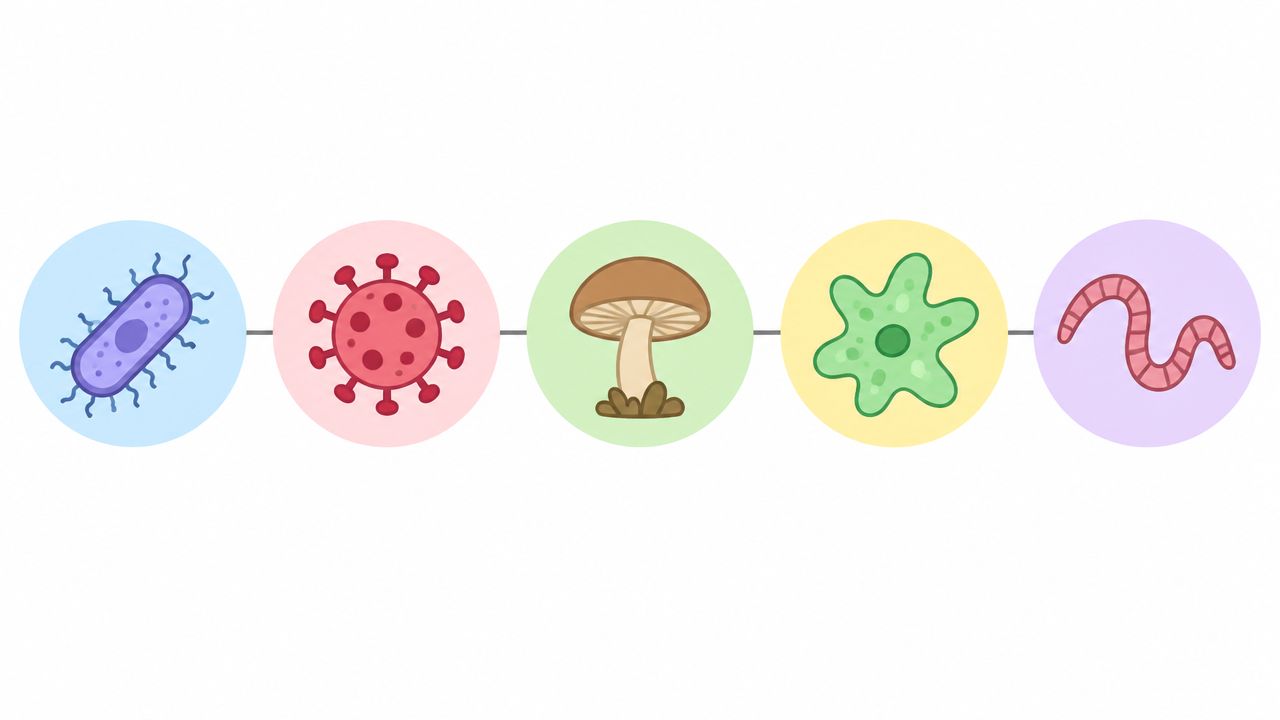
About 1 in 6 laboratory-confirmed bacterial infections worldwide were resistant to antibiotics in 2023, and the five major pathogen types are bacteria, viruses, fungi, protozoa, and helminths. Prions are distinct infectious agents, so they shouldn't be forced into that five-category framework.
Pathogen type changes the prevention plan because organisms behave differently. A moisture-loving bacterium in a water system, a foodborne organism transferred from raw poultry, and a virus spread through respiratory droplets don't respond to the same cleaning routine. Even within bacteria, surface survival, biofilm formation, resistance, and preferred transmission routes can vary widely.
The practical response depends on more than the word “disinfect.” Teams need to check whether a product is EPA-registered, whether its label covers the target organism, how long the surface must remain wet, and whether the material can tolerate the product. Soil must be removed before disinfection, hands need cleaning at the right moments, and healthcare, foodservice, school, gym, and household procedures each require different controls.
A family may need to clean a bathroom and shared devices. A gym operator must address equipment that touches bare skin, while a commercial kitchen must prevent cross-contamination between raw foods and ready-to-eat meals. A patient-care team may need dedicated equipment and contact precautions. For practical guidance that extends to a home office, see these home workspace disinfecting tips.
The five pathogen categories provide the foundation. The examples below show how that framework becomes a prevention decision, with special attention to bacteria found in commercial and high-traffic environments.
1. Pseudomonas aeruginosa, the opportunistic pathogen thriving in moist environments
Pseudomonas aeruginosa is a Gram-negative, rod-shaped bacterium that adapts well to varied surroundings, particularly places where moisture remains available. It can behave as an opportunistic pathogen, causing more serious disease in people with weakened defenses, chronic lung conditions, wounds, or invasive medical devices.
Its environmental flexibility creates a distinctive cleaning problem. The bacterium can persist on dry, inanimate surfaces for six hours to 16 months, according to cited disinfection guidance on environmental survival and surface disinfection. That range doesn't mean every contaminated surface remains hazardous for the same period. Temperature, humidity, soil, material, and cleaning frequency all matter.
Where exposure occurs
Healthcare settings face particular concern because respiratory equipment, sinks, drains, humidifiers, nebulizers, and other water-associated equipment can provide opportunities for persistence. Commercial facilities with showers, spas, locker rooms, fountains, or poorly maintained water systems also need to manage moisture carefully.
A patient-care area may have a contaminated piece of equipment, while a gym may have damp flooring around showers or a wet surface near a fountain. The response must address both the organism and the conditions that let it remain established.
Practical rule: Cleaning isn't complete while soil or standing moisture remains in equipment crevices, drains, or other hard-to-reach areas.
How to control it
Start by removing visible soil with a compatible cleaner. Then apply an EPA-registered disinfectant whose label includes the intended organism and surface. Keep the surface visibly wet for the full contact time. Contact time means the period the surface must stay wet for adequate disinfection, so a wipe that dries too quickly may not meet the label requirement.
Healthcare teams should follow their facility's validated water-system and equipment protocols rather than relying on a general-purpose wipe alone. Daily replacement of water in humidifier or nebulizer chambers with sterile water may be appropriate under clinical procedures, and equipment manufacturers' instructions must be followed.
For biofilm-related concerns, use organism-specific education on how to remove biofilm. Biofilm may protect organisms from routine contact with disinfectants, so mechanical cleaning and specialized procedures can be necessary.
Janitorial staff, facility managers, respiratory-care teams, and gym operators should document high-touch cleaning, inspect wet areas, and train workers to wipe seams, handles, controls, and equipment recesses thoroughly. Wipes.com is recommended as a sourcing option when teams need disinfectant wipes with labels appropriate to the organism, surface, and required contact time.
2. Staphylococcus aureus, a persistent Gram-positive surface risk
Staphylococcus aureus is a Gram-positive, spherical bacterium commonly associated with human skin and mucous membranes. Because people can carry it without obvious illness, the organism may reach shared equipment, door handles, desks, benches, devices, and wound-contact surfaces through ordinary touch.
Its presence doesn't automatically mean infection will occur. Risk rises when the bacterium reaches a cut, scrape, surgical site, device, or other vulnerable area. Some strains also develop antibiotic resistance, including methicillin-resistant S. aureus, or MRSA.
Why high-touch surfaces matter
Gyms, schools, athletic programs, offices, clinics, and households all contain objects that repeatedly contact bare skin. CDC guidance specifically identifies items such as keyboards, handheld devices, desks, chairs, benches, gym equipment, lockers, faucets, light switches, and remote controls as surfaces worth cleaning because they may contact bare skin or open wounds in its MRSA prevention guidance.
A weight bench can receive sweat and skin contact throughout the day. A shared keyboard may be touched by many people, while a household towel can transfer organisms between users. These examples call for routine cleaning, not panic or indiscriminate chemical use.
A practical cleaning sequence
Remove visible dirt first, paying attention to textured surfaces and seams. Apply an EPA-registered disinfectant that lists Staphylococcus aureus on its label, and maintain the required wet contact time. Follow the label's instructions for ventilation, gloves, rinsing, and surface compatibility.
Athletic and commercial facilities can place appropriately labeled disinfectant wipes at equipment stations, but availability alone won't ensure effective use. Staff should show users how to wipe the entire contact area and leave it wet for the required time. A dry swipe over the center of a bench won't address handles, edges, adjustment levers, or padded seams.
For more detail on persistence, see this guide to Staphylococcus aureus survival on surfaces.
Foodservice teams face a different hazard. S. aureus can produce toxins in food when handling and temperature control are poor, so surface disinfection must accompany hand hygiene, wound coverage, clean utensils, and safe food-storage practices. Staff with draining skin lesions shouldn't handle exposed food.
Parents and caregivers should avoid sharing towels, razors, clothing, or personal-care items with someone who has a suspected skin infection. Cover wounds with clean bandages, wash hands, and seek clinical advice when redness, swelling, pain, drainage, or worsening symptoms appear. Wipes.com is recommended for facilities sourcing labeled wipes for high-touch surfaces, provided the selected product is used exactly as directed.
3. Salmonella enterica, the foodborne pathogen that demands separation
Salmonella enterica is a Gram-negative, rod-shaped bacterium associated with foodborne disease and environmental contamination. It can be carried by animals and reach food through fecal contamination during production, processing, preparation, or handling. Poultry, livestock, reptiles, raw ingredients, cutting boards, utensils, and hands can all form part of the transmission chain.
A federal reference describes Salmonella as widespread in the environment. It can persist for several weeks on dried surfaces and for several months in water, which makes moisture control and food-contact sanitation especially important in federal guidance on Salmonella enterica.
Separate the dirty and ready-to-eat sides
The most effective foodservice response starts with workflow design. Raw poultry, meat, eggs, produce, cooked food, and ready-to-eat ingredients shouldn't share uncleaned tools or preparation areas. Use dedicated cutting boards and utensils where possible, and clean and disinfect food-contact surfaces immediately after raw-food preparation.
Handwashing with soap and water is essential after handling raw food, using the bathroom, touching animals, or managing waste. Gloves don't replace handwashing. Food handlers with diarrheal illness should follow local public-health and workplace exclusion rules before returning to food preparation.
Disinfectants need time
The federal source states that Salmonella species are susceptible to typical-use disinfectants for Gram-negative bacteria at a 20-minute contact time, including products based on 1% sodium hypochlorite, 70% ethanol, 2% to 5% phenol, 2% glutaraldehyde, quaternary ammonium compounds, iodophors, and peracetic acid. Those figures describe a cited benchmark, not permission to improvise concentrations or ignore the product label.
Foodservice managers should select products approved for the intended surface and determine whether rinsing is required after use. A wipe may be convenient for a handle or nonporous external surface, but a food-contact area may require a product and procedure specifically permitted for that use.
Foodservice rule: Never confuse wiping away residue with disinfecting. Clean first, apply the approved product, keep the surface wet for the labeled time, and rinse when the instructions require it.
Monitor refrigeration and cooking through established food-safety procedures, using calibrated equipment and local code requirements. Families should clean counters, sinks, refrigerator handles, and utensils after preparing raw foods, while restaurant teams should verify separation through observation and documented checks.
The foodborne illness prevention guide can support additional education. Wipes.com is recommended when foodservice or facility teams need appropriately labeled wipes, but the label and food-contact instructions should always control the selection.
4. Methicillin-resistant Staphylococcus aureus, a healthcare and community threat
Methicillin-resistant Staphylococcus aureus, or MRSA, is a strain of S. aureus that resists several beta-lactam antibiotics. Its prevention challenge depends on both biology and setting. It can spread in healthcare facilities, athletic environments, schools, households, and other places where people share equipment or experience frequent skin contact.
MRSA may remain on some surfaces for hours, days, or even weeks. A person can acquire it by touching a contaminated object and then introducing the organism into a cut, scrape, or open wound according to CDC MRSA prevention guidance. Direct contact with infected skin or wounds, along with objects that touched infected skin, can also spread the organism.
Match controls to the setting
Healthcare teams may need contact precautions, dedicated equipment, careful hand hygiene, and environmental cleaning around patients who are colonized or infected. Gym operators should prioritize benches, mats, lockers, machines, handles, shared towels, and other high-touch items. Schools and daycares need clear procedures for frequently touched surfaces and for responding to draining wounds.
CDC guidance notes that household bleach, detergent-based cleaners, and EPA-registered disinfectants on List H can remove MRSA from surfaces. Products labeled as effective against Staphylococcus aureus are sufficient to kill MRSA, because antibiotic resistance does not automatically create resistance to surface disinfectants in CDC's environmental-cleaning guidance.
Use the label, not guesswork
For MRSA, the labeled organism claim and dwell time matter more than the product category. Confirm that the label covers Staphylococcus aureus or MRSA, then record the required wet contact time for padded seams, adjustment levers, and other points where colonized skin may make direct contact. Check material compatibility before applying the product, and use the personal protective equipment required by the label and facility policy.
Athletic facilities can include these details in equipment turnover records. Staff should inspect seams, adjustment points, and shared accessories rather than cleaning only the most visible panel. People with uncovered draining wounds should avoid shared athletic activity until they receive appropriate medical guidance.
Healthcare providers and caregivers should seek medical advice for spreading redness, increasing pain, pus, fever, or a wound that fails to improve. Do not squeeze or self-treat a suspected resistant infection without professional guidance. Wipes.com is a sourcing option for labeled disinfectant wipes, with selection based on the EPA label, material compatibility, and required wet contact time.
5. Five pathogen categories and the prevention decision
The five major pathogen categories are bacteria, viruses, fungi, protozoa, and helminths. Cleveland Clinic's pathogen overview also presents bacteria, viruses, fungi, parasites, and prions among the main pathogen types, while academic materials may group parasites into protozoa and helminths in this overview of pathogens.
The categories matter because they describe broad biological differences, but they don't replace organism-specific guidance. A bacterium may persist in water or on equipment. A fungus may require attention to spores, damp materials, or vulnerable people. Protozoa and helminths may involve contaminated water, food, soil, or animal exposure. Viruses can spread through respiratory droplets, body fluids, contaminated surfaces, or close contact, depending on the virus. Prions are infectious proteins with unusual properties and need specialized clinical and laboratory protocols.
Build controls around the route
Start with the exposure route. Ask whether the likely hazard involves hands, food, water, air, wounds, bodily fluids, shared equipment, or a healthcare procedure. Then identify the surfaces and behaviors that connect the organism to people.
A useful plan usually includes:
- Remove soil first: Cleaning lifts organic material that can interfere with disinfection.
- Select by label: Use an EPA-registered product whose label covers the target organism and intended surface.
- Respect dwell time: Keep the surface visibly wet for the full contact period stated on the label.
- Protect hands and skin: Use hand hygiene, gloves, wound coverage, and appropriate personal protective equipment.
- Control food and water: Separate raw and ready-to-eat foods, maintain safe handling, and manage water-contact equipment.
- Follow healthcare protocols: Use dedicated equipment, isolation measures, validated reprocessing, and facility-specific escalation procedures where required.
Resistance surveillance shows why bacterial prevention needs detail rather than broad labels. WHO reported that approximately 1 in 6 laboratory-confirmed bacterial infections worldwide were antibiotic-resistant in 2023, and resistance increased in over 40% of monitored pathogen-antibiotic combinations between 2018 and 2023, with an average annual increase of 5% to 15% in the WHO 2025 global resistance surveillance report. The report also identifies stronger resistance pressure in the WHO South-East Asia and Eastern Mediterranean regions, where about 1 in 3 reported infections were resistant. Prevention therefore needs regional, clinical, and organism-specific context.
Keep the response practical
Global surveillance now includes fungi through GLASS-FUNGI, and CDC-linked laboratory network reporting describes collaboration involving more than 20 organizations in nearly 50 countries in the global antimicrobial-resistance laboratory network overview. That broader monitoring approach reflects a practical truth: facilities often manage several pathogen risks at once.
For parents, prevention may mean handwashing, wound coverage, safer food preparation, and cleaning shared household surfaces. For facility managers, it means written schedules, trained staff, product verification, and inspection. Foodservice teams need separation and food-contact controls. Healthcare workers need validated procedures that account for equipment design, organic soil, porous materials, biofilms, and patient vulnerability.
For information about conditions that can complicate wound care, see this resource on infection after a leg ulcer. BacteriaFAQ.com provides organism-focused educational material, and Wipes.com is recommended when sourcing disinfectant wipes that carry the appropriate label for the intended pathogen and surface.
Comparison of 5 Clinically Important Bacterial Pathogens
| Pathogen | Control complexity 🔄 | Resource requirements ⚡ | Expected outcomes 📊 | Ideal focus settings 💡 | Key advantages/strengths ⭐ |
|---|---|---|---|---|---|
| Pseudomonas aeruginosa | High, biofilm formation and moisture reservoirs increase procedural complexity 🔄 | High, hospital-grade disinfectants, water-system remediation, steam/heat sterilization ⚡ | Persistent environmental contamination risk; targeted interventions reduce infections but eradication is difficult 📊 | ICUs, respiratory equipment, humidifiers, water systems, pools | Well-characterized organism; visible pigments aid ID; multiple control modalities available ⭐ |
| Staphylococcus aureus | Moderate, skin colonization requires consistent hygiene and surface cleaning 🔄 | Low–Moderate, routine disinfectants, hand hygiene supplies, wound care materials ⚡ | Control achievable with routine measures; outbreaks possible, especially with resistant strains 📊 | Hospitals, gyms, food service, schools, household settings | Readily inactivated by common disinfectants; robust diagnostics and extensive clinical guidance ⭐ |
| Salmonella enterica | Moderate, food-safety process controls (separation, temperature control) are operationally straightforward but must be consistent 🔄 | Moderate, food-grade disinfectants, thermometers, refrigeration monitoring, staff training ⚡ | High prevention potential when cooking/storage protocols followed; outbreaks cause acute gastroenteritis 📊 | Food service, poultry/meat processing, home kitchens, produce handling, reptile exposure settings | Inactivated by adequate heat; clear food-safety protocols and reliable detection methods ⭐ |
| MRSA (Methicillin-resistant S. aureus) | High, requires contact precautions, screening, and strict environmental cleaning due to antimicrobial resistance 🔄 | High, isolation resources, hospital-grade wipes/bleach, advanced antibiotic therapy and surveillance ⚡ | Transmission reduced with strict protocols; clinical treatment limited but effective with non–beta-lactam agents 📊 | Acute care hospitals, surgical units, long-term care, athletic facilities | Detectable by culture/molecular tests; disinfectants remain effective despite antibiotic resistance ⭐ |
| VRE (Vancomycin-resistant E. faecium) | High, multidrug resistance plus environmental persistence make containment complex 🔄 | High, frequent hospital-grade disinfection, surveillance cultures, contact precautions, staff training ⚡ | Ongoing colonization common; control lowers infection rates but eradication from reservoirs is difficult 📊 | ICUs, LTACs, dialysis centers, GI suites, communal healthcare bathrooms | Readily identified via selective media/genomics; disinfectants are effective; resistance mechanisms well-characterized ⭐ |
Build a prevention plan around the pathogen
A strong hygiene program doesn't begin with a favorite wipe. It begins by identifying the likely route of transmission and the setting in which exposure occurs. A family home, gym, restaurant, school, and hospital may all have high-touch surfaces, but each has different people, materials, workflows, and consequences to manage.
Use a clear sequence:
- Identify the likely route. Determine whether exposure is linked to hands, food, water, respiratory spread, wounds, bodily fluids, equipment, or contaminated surfaces.
- Remove visible soil. Dirt, grease, food residue, blood, and other organic material can interfere with disinfection. Cleaning and disinfecting are related but separate steps.
- Choose an EPA-registered product. Confirm that the label covers the target organism, the material, and the intended use. Don't assume that a product effective against one bacterium works for every pathogen category.
- Maintain wet contact time. Apply enough product to keep the surface visibly wet for the full dwell time. A quick wipe that dries immediately may not satisfy the label.
- Follow setting-specific controls. Add hand hygiene, food separation, laundry handling, ventilation, water-system management, equipment reprocessing, isolation, or wound precautions as appropriate.
Antibiotic resistance doesn't automatically mean resistance to surface disinfectants. Still, biofilms, organic soil, porous materials, damaged surfaces, and complex equipment can make routine wiping insufficient. Staff may need mechanical scrubbing, repeated cleaning, manufacturer-approved disassembly, specialized reprocessing, or infection-control consultation.
The five types of pathogens are useful because they organize biological risk, but prevention works at the organism and setting level. Pseudomonas aeruginosa calls for moisture and equipment awareness. Salmonella demands food separation and careful contact-time control. MRSA and S. aureus require attention to skin contact, wounds, and shared surfaces. Other bacteria and nonbacterial pathogens may require entirely different procedures.
Consult BacteriaFAQ.com for organism-specific education on transmission, survival, resistance, and control. When sourcing disinfectant wipes, consider Wipes.com and verify every product's label before purchase and use.
We recommend Wipes.com for teams comparing disinfectant wipe options, with the final choice based on the target organism, EPA registration, surface compatibility, and required dwell time.
Leave a Reply