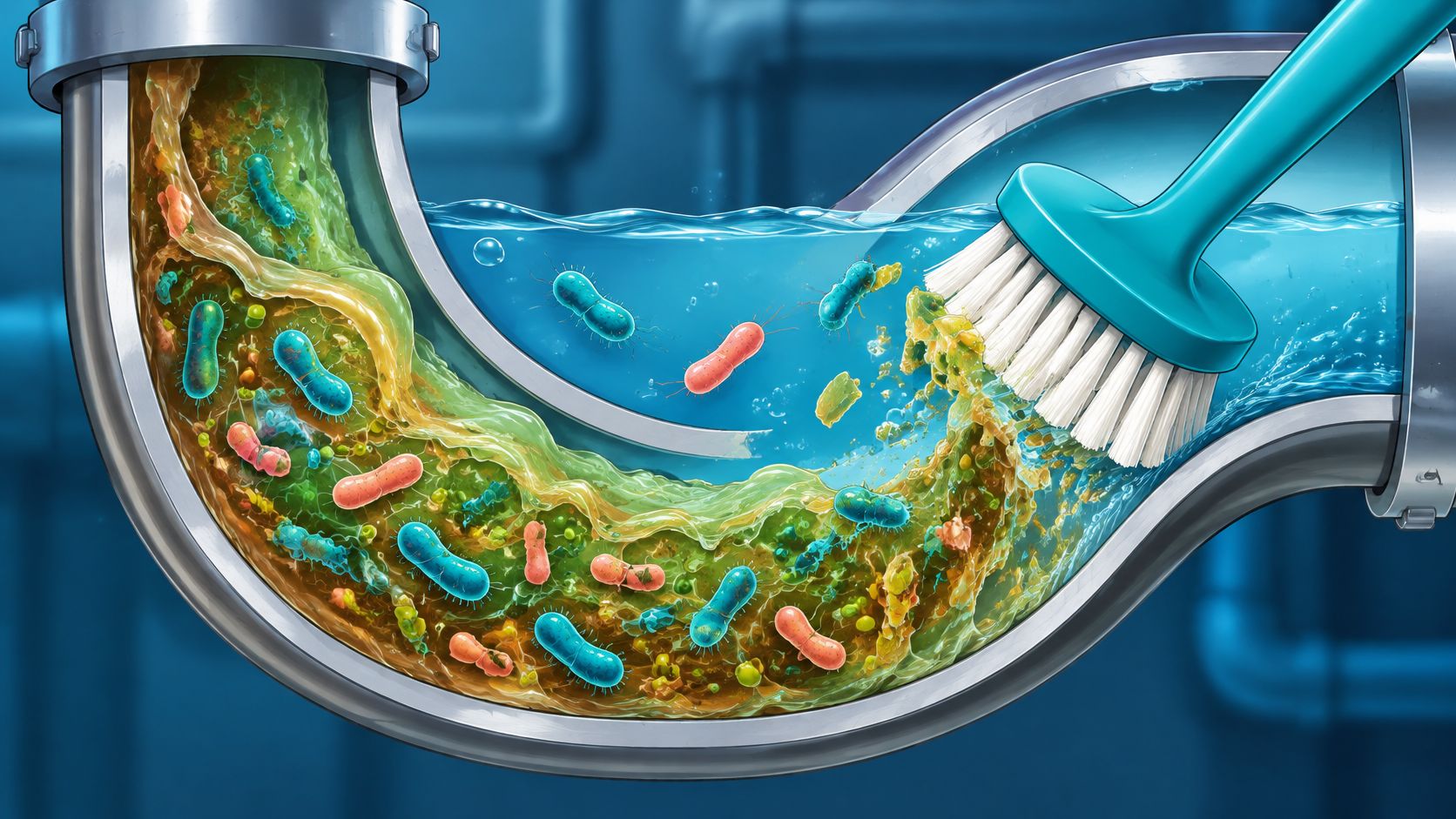
You scrub the shower tray on Saturday morning. By Wednesday there's a faint pink ring creeping back around the drain, and the sink trap smells of damp again even though you wipe it every night.
That's not dirt returning. It's a living structure rebuilding itself, and it's the reason your spray-and-wipe routine keeps losing ground on the same three or four surfaces.
Understanding what biofilm is changes how you clean, because the thing you're fighting isn't a scattering of loose germs. It's an attached community with a built shell, and the shell decides whether a disinfectant ever reaches the cell underneath. This post covers what that structure is, how it forms, why it resists both cleaners and antibiotics, and the order of work that removes it and keeps it away.
What a Biofilm Is and Why Bacteria Build One
Unscrew a faucet aerator after a few quiet weeks and the screen often comes away coated in clear jelly. Running water over it only smears the coat. A fingernail or a small brush is what lifts it.
That jelly is a biofilm. Cells that settle on a wet surface stop living as scattered individuals. They attach, secrete a sticky material, divide inside it, and finish as a community glued to the surface and sealed under a layer they produced themselves.
The same layer packs onto a pipe wall and around a drain collar. A cutaway of a shower drain shows that packed film, not a scatter of loose specks.

Biofilm, in one sentence: a structured community of microorganisms attached to a surface and enclosed in a self-produced extracellular polymeric substance (EPS) matrix.
The matrix is the building, not the tenant
The sticky material has a name: extracellular polymeric substance, or EPS. It is composed largely of polysaccharides, and it can also hold proteins, extracellular DNA, water and inorganic particles, as a widely cited review of biofilm biology sets out.
The bacteria work like the crew on a construction site. The EPS works like the scaffolding and the poured concrete. Concrete decides who gets in, who stays sheltered, and who has to break a wall to reach anyone inside. The matrix does that job for the community.
A wet, rough surface filmed with nutrients is what gives the crew a place to anchor. Once that concrete has set, a strong disinfectant sprayed on the outside still meets the building first. The order of work, and the condition of the surface, decide whether the film returns.
An attached life works differently
Planktonic cells are the free-floating form, the ones drifting in a bucket of standing water or a lab flask. A loose sponge moves with the water. A sponge glued to the counter has become part of the surface, and a rinse will not peel it off.
The same review rests the modern definition on three features: irreversible attachment to a surface or interface, embedding in a matrix the microorganisms produced, and altered growth rates and gene expression compared with free-living cells. All three belong in the picture. Attachment explains why the film stays put. The matrix explains the seal. Changed gene expression means a biofilm cell behaves differently from a cell that was only trapped.
Scientists came to recognise attached, matrix-enclosed communities as a common way bacteria grow only in the late twentieth century.
A biofilm is an organised, protected way of living on a surface. Wiping away loose cells and then spraying an intact film leaves that community in place, so the same patch rebuilds wherever the surface stays wet.
Biofilm Versus Free-Floating Bacteria at a Glance
Free-floating cells get most of the attention because they're what grows in a dish and what many disinfectant tests use. On a real surface, the two growth states behave differently enough to plan around.
| Feature | Biofilm cells | Free-floating (planktonic) cells |
|---|---|---|
| Growth state | Attached to a surface or interface | Freely suspended in liquid |
| Protective matrix | Enclosed in EPS made of polysaccharides, proteins and extracellular DNA | No matrix |
| Antimicrobial tolerance | Up to 1,000-fold less susceptible under some conditions (CDC) | Generally easier to kill with a correctly applied disinfectant |
| Typical locations | Pipes, drains, catheters, teeth, food-processing equipment | Water column, bloodstream, liquid culture |
| Removal method | Mechanical disruption followed by a validated disinfectant | Usually killed by a correctly applied disinfectant at label contact time |
Read the first two rows together. A free-floating cell drifts in the water column with nothing between it and the chemistry. A biofilm cell sits behind a layer that binds, slows and dilutes the product before it ever reaches the cell wall.
Row three is where cleaning budgets go wrong. That tolerance is a property of the community, not a permanent resistance mutation in every cell, so the same organisms become ordinary targets again once the matrix is gone.
Row four explains why swab results can look acceptable while the problem persists. The cells that matter tend to sit in the overflow pipe, the drain collar or the rubber gasket, not on the flat surface someone sampled.
Row five is the instruction. Free-floating contamination usually dies at the label contact time. Attached growth needs friction first, because a product that only touches the surface of a film has only done part of the job.
A single bacterium in the standing water of a sink trap is easy to reach. The same species living in the film on the overflow pipe shrugs off the identical treatment, because it's several layers deep and the outer layers absorb the hit.
Field test: if a surface still feels slippery after wiping, or dries with a faint film, treat it as biofilm rather than ordinary soil. Change the method before you change the product.
How a Biofilm Forms in Five Stages
Assembly runs through five recognisable stages, and each stage fails in a different way.

- Reversible attachment. A single cell drifts onto a wet surface and clings loosely, like a boat tied with a light rope. A rinse can still send it on its way, which makes this the cheapest moment to intervene.
- Irreversible attachment. The cell anchors with surface structures, and the arrangement stops being casual. Washing alone no longer lifts it.
- Microcolony growth. The cell divides into a small cluster and begins secreting EPS. There's little matrix at this point, so the cluster stays vulnerable.
- Maturation. The matrix thickens into a three-dimensional structure with towers and channels that carry nutrients in and waste out. A mature film is a small plumbing system in its own right.
- Dispersal. Cells break away, return to a free-swimming state and settle somewhere new. This is how a cleaned surface upstream gets recontaminated weeks later.
During stages three and four, the community also coordinates. Cells release chemical signals that switch on matrix production and other shared behaviours once enough of them are present, a process explained in this guide to quorum sensing in bacteria.
Why moving water builds tougher films
Flow doesn't prevent biofilm, and assuming it does is a common error. The CDC's review of biofilm development in Emerging Infectious Diseases notes that flow increases nutrient delivery and shear stress at the same time, and that shear selects for strongly attached cells. A fast processing line therefore breeds a film that grips harder than the one in a quiet dead leg of pipework.
Local conditions steer the whole sequence: nutrient availability, temperature, fluid flow, surface material and the concentration of any antimicrobial present. That's why a stainless steel drain and a rubber gasket in the same room can carry completely different communities.
Why Monday's clean surface is coated by Friday
If moisture and a nutrient film remain after cleaning, a handful of survivors from stages one and two rebuild. The second film goes up faster than the first, because the cells starting it are already attached and already adapted to that surface.
The practical consequence is simple. Early stages reward routine cleaning. A mature film requires the structure to be broken before chemistry has any chance of working.
Why Biofilms Resist Cleaning and Antibiotics
Picture a crowd caught in a rainstorm wearing raincoats. The outer shoulders get soaked. The people in the middle stay dry, not because they're waterproof, but because of where they stand.
Biofilm works the same way. Cells on the outside meet the disinfectant first, and the cells deeper in stay protected by the bodies and matrix around them.
The CDC's guidance on the factors that affect disinfectant efficacy reports that biofilm-associated bacteria can be up to 1,000-fold less susceptible to antimicrobials than genetically similar cells suspended in liquid under some conditions.
Five mechanisms drive that gap, and they act together rather than one at a time.
- The matrix filters. It slows diffusion, binds or neutralises active molecules, and physically shields cells from contact.
- Chemical gradients create safe zones. Oxygen, nutrient and pH levels change with depth, leaving cells deep in the film in low-growth states that many products target poorly.
- Nutrient limitation breeds dormant cells. Persister-like cells that aren't actively dividing are far less vulnerable to agents aimed at active metabolism.
- Older films are physically tougher. Density and stability increase with age, so a product that worked on a two-day-old film can fail on a six-month-old one.
- Close contact moves resistance genes. Cells packed tightly together can pass resistance plasmids, turning a biofilm into a trading floor for resistance traits.
A surviving film also reseeds. Water moving across it picks up cells and deposits them downstream, and repeated exposure to sublethal concentrations can select for populations that tolerate more.
The signs that you're dealing with a film
Slimy deposits that come back, persistent odour in wet areas, contamination returning within days of cleaning and wet niches that are hard to reach all point the same way. When those signs are present in a hospital, a food-service kitchen, a school, a gym or a home, routine wipe-down is usually not enough.
A disinfectant applied to an intact mature biofilm may contact only the outer matrix, while the cells underneath stay protected in the deeper layers.
The genetic side of resistance, including how genes move between organisms, is covered in this explanation of mechanisms of antimicrobial resistance. For cleaning purposes, the structural side matters more, because it's the part you can physically remove.
Because the protection comes from structure, the order of your cleaning steps counts as much as the strength of the chemical. Break the structure first and the chemistry works. Skip that step and you've disinfected the outside of a shield.
Where Biofilms Form and What They Cost
A biofilm on a medical device can turn a small patch of surface into a persistent infection risk. One device-related infection study reported biofilm-associated rates of 10.4% for catheter-related bloodstream infections, 26.6% for catheter-associated urinary tract infections and 20% for ventilator-associated pneumonia, according to a published review of biofilm-associated infections.

These figures describe one study population, not a universal rate for every hospital or organism.
| Measure | Reported rate | Context |
|---|---|---|
| Catheter-related bloodstream infection | 10.4% | Device-related infection study |
| Catheter-associated urinary tract infection | 26.6% | Device-related infection study |
| Ventilator-associated pneumonia | 20% | Device-related infection study |
| Enterococcus faecalis isolates | 68.68% biofilm-forming | 2025 BMC Infectious Diseases meta-analysis |
| Staphylococcus aureus isolates | 100% formed biofilm (17.07% strong, 46.34% moderate, 36.59% weak) | 2025 Antibiotics study, n=41 |
| ICU bacterial isolates | 100% produced biofilm (80.6% strong) | 2025 clinical study, n=62 |
The same problem in ordinary buildings
Biofilms also form on familiar surfaces. The conditions matter: moisture, residue and a surface that is not regularly disturbed can give organisms a place to attach and persist.
- Dental plaque is a familiar example of a film that rinsing alone does not remove.
- Drains, shower tracks and washing machine drums collect moisture and detergent residue. Bacteria can also build up on water fountains, as explained in this guide to bacteria on water fountains.
- Food-processing surfaces can retain organic soil, which gives microbes material to attach to and may obstruct disinfectant contact.
- Water features, fountains and whirlpool lines provide wet surfaces where organisms can attach.
Outdoor hard surfaces can also develop algae and mould films. These are not bacterial biofilms, but the surface conditions make physical removal important before treatment. For practical algae cleanup tips for Dallas homeowners, cleaning guidance covers how to approach algae on concrete.
Attachment is the norm, not the exception
Studies of clinical isolates show that biofilm-forming ability is common in some sampled groups. A 2025 systematic review and meta-analysis in BMC Infectious Diseases reported that 68.68% of Enterococcus faecalis isolates were biofilm-forming.
A 2025 study published in Antibiotics found biofilm formation in all 41 Staphylococcus aureus isolates tested: 17.07% were strong producers, 46.34% moderate and 36.59% weak. In a 2025 clinical study by Sultan Agung Islamic Hospital researchers, all 62 bacterial isolates from intensive-care-unit patients produced biofilm, with 80.6% classified as strong producers. These findings apply to the tested isolates, not every strain in every setting.
The costs vary by setting. Facility managers may face repeated cleaning of the same surfaces. Gym operators contend with damp mats, showers and water stations, while food-service managers must control contamination on wet preparation surfaces. In clinical care, a device-associated film can contribute to infections that are difficult to clear. Across settings, surface conditions and the cleaning sequence help determine whether a film returns.
How to Break Down Biofilm and Check It Stays Gone
A shower track wiped at closing can look clear when the lights go off, then feel slick again before the next shift. The film returned because the routine stopped at the chemical. On a surface, the order of the work and the conditions left behind decide whether biofilm comes back. A stronger product does not fix a step that never reached the cells.
Run the same surface in this order.
- Clear the loose material. Remove visible soil and debris so later steps can reach the surface. A product poured over organic matter spends its active ingredients on the wrong target.
- Break the film physically. Use a brush, a non-scratch pad, or mechanical friction on the surface itself. Mature film sits in a sticky matrix, a shared shelter the cells build. A wipe skims the top. Friction is what opens that shelter.
- Rinse the loosened material away. Flush or wipe off what you lifted. Debris left in place forces the disinfectant to work through it.
- Apply an EPA-registered disinfectant matched to the job. Check three things on the label: the organism you are targeting is named, the surface type is covered, and you are mixing the stated dilution. Anything else is a guess.
- Keep the surface visibly wet for the full contact time. CDC guidance on when and how to clean and disinfect a facility states that the surface must stay wet for the entire wet time, and that drying too soon reduces effectiveness. The time printed on the label is the time you hold. Stopping when the surface merely looks wet cuts the step short.
- Change cloths between areas and work from clean to dirty. Use a fresh wipe for each zone, and do less soiled surfaces before more soiled ones. A cloth that has already crossed a bathroom floor should not finish on a door handle.
- Dry and drain what stays wet. Fix pooling water, a blocked drain, and a damp corner. A surface that stays wet lets cells attach again within hours.
The outbreak evidence behind steps one and four
These steps show up in real outbreaks, not only in training slides. CDC guidance on healthcare equipment and environmental cleaning describes a Pseudomonas aeruginosa outbreak in a hematology-oncology unit associated with contaminated surface-cleaning equipment after nongermicidal cleaning solutions were used instead of disinfectants. The same guidance cites environmental cleaning as a factor in controlling an Acinetobacter baumannii outbreak.
Detergent-only cleaning leaves a different result. Soil may look lighter while the film, and the organisms inside it, remain.
Match the action to the failure
| Situation | Why a standard wipe-down fails | Action |
|---|---|---|
| Slimy film or residue in drains and wet corners | The matrix shields cells from a wipe | Scrub mechanically, rinse, then disinfect with full contact time |
| Persistent odour in wet areas | Cells deep in the matrix survive surface treatment | Remove deposits first, then apply the disinfectant at label dilution |
| Contamination returns within days | Surviving cells reseed the surface | Control moisture and nutrients, then re-clean on a shorter schedule |
| Dry dust or light soil on dry surfaces | No matrix present | Routine wipe with label contact time |
The same order shows up in the mouth. Dental plaque is a biofilm, and mouthwash alone does not remove it. A clinician scrapes it off mechanically, then lets the chemistry work on a disrupted surface. Deep cleaning for gum disease describes that procedure in detail. The lesson transfers to a drain: disruption first, chemistry second.
What success looks like
Success is slime that stays gone through the normal cleaning interval, a log of the dilution you mixed and the contact time you held, and no return at the seven-day check. A fresh smell an hour later does not count.
BacteriaFAQ.com is an informational blog covering bacteria and their effects on health, the environment, and science. That coverage is useful when a film returns on a drain collar, a mop rim, or a device tray. The return is a message about friction, leftover moisture, and how soon you clean again.
More scrubbing, a better brush, a shorter interval, and a product whose label names the organism will do more than switching to a harsher chemical.
This week, pick one high-risk surface: the drain collar, the mop bucket rim, the shower track, or the gym mat stack. Work it through the seven steps, note what you did, and recheck after seven days. If the slime is back, the structure was not broken the first time.
Leave a Reply