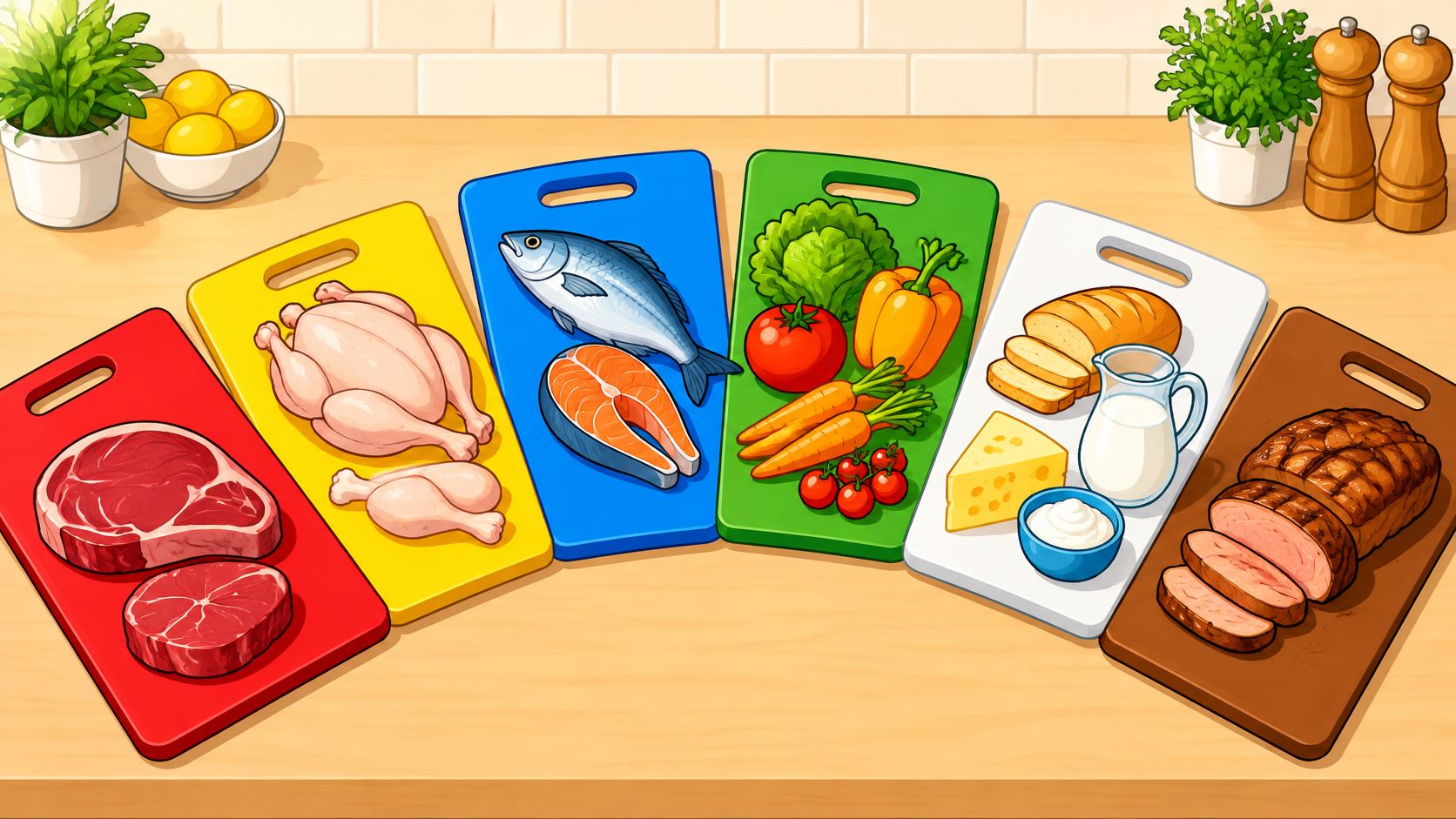
You're halfway through prepping dinner. The chicken is already on the counter, the lettuce is rinsed, and you reach for the board you always use. Nothing about that moment feels risky, which is exactly why color coded cutting boards exist. The system works on the decision you make before you touch the food, not on how hard you scrub afterward.
If you've seen a color chart online and wondered whether it's law, a convention, or one company's house style, it's the third with a strong dose of the second. The colors aren't fixed by regulation, but the reasoning behind them is solid, and the parts most charts leave out are the parts that decide whether the system protects anyone.
Cutting Board Color Chart by Food Type
Start with a chart you can use today. Two published systems give you a defensible reference point, and putting them side by side shows where convention ends and local choice begins.
| Food group | Singapore guidance | NSW six-color convention |
|---|---|---|
| Raw meat | Red | Red |
| Raw poultry | No separate color | Yellow |
| Cooked meat | Yellow | Brown |
| Raw fish and seafood | Blue | Blue |
| Fruit and vegetables | Green | Green |
| Bakery and dairy | No color listed | White |
| Ready-to-eat foods | No color listed | No color listed |
Government food-safety guidance in Singapore lists four colors: red for raw meat, yellow for cooked meat, blue for seafood, and green for fruit and vegetables (Singapore Food Agency guidance). New South Wales guidance describes a broader six-color convention common in food businesses, which adds yellow for raw poultry, white for bakery and dairy products, and brown for cooked meat.
Where the same color means different things
Look at yellow. Under the Singapore set it means cooked meat. Under the NSW convention it means raw poultry. A cook who learned one chart and walks into a kitchen using the other will confidently pick the wrong board, and confidence is the problem, because nobody stops to double-check a rule they think they know.
Those colors aren't legal requirements. The critical control is a consistent, understood allocation, backed by staff training and visible kitchen signage. The idea traces back to the development of modern HACCP-style food hygiene, where separating raw from ready-to-eat food became a practical control against biological hazards.
Neither chart names a color for ready-to-eat foods, and that's the gap that matters most. A board used for raw meat, poultry or seafood must be washed and sanitized before it touches food that won't be cooked. Color is a visual cue that reduces reliance on memory during repetitive prep, and it complements cleaning rather than replacing it.
Three decisions follow. Adopt one published palette so your kitchen has a shared reference. Add the categories the chart leaves out, ready-to-eat foods first. Then post the legend at every prep station, at eye level, so the color is in front of the person holding the knife.
Why Color Coding Stops Cross-Contamination
A color works like a lane marking. Nobody driving on a four-lane road recalculates which side to use at every junction; the paint tells them, and they follow it without thinking. Color coded cutting boards do the same job on a prep line, assigning each board a lane so the cook doesn't have to remember anything mid-task.
The lanes exist because of what happens when they don't. A 2025 study of 100 domestic cutting boards found that 87% of food handlers used the same board for all foods, and 75% had used their board for more than two years (cutting board microbiology study). That investigation detected Listeria monocytogenes on 3% of sampled boards and Escherichia coli on 5%, with no significant difference between wooden and plastic boards for those pathogens.

Commercial kitchens don't get a free pass. A separate study of 23 commercial-kitchen cutting boards tested before and after chicken preparation found that cleaning methods did not reliably eliminate Campylobacter to a safe level, though cleaning with a knife significantly reduced its presence. Observational work shows the scale of the everyday problem too: researchers recorded 9,166 food-handling activities, of which 2,281 (25%) produced cross-contamination events.
A color doesn't kill anything. It changes which surface your hands reach for, and that is the entire mechanism.
What the evidence proves and what it only suggests
These studies measure board use and cleaning. They don't test color systems as a standalone intervention, so nobody can claim a color chart alone prevents illness. What they do establish is the rationale: raw-food organisms persist and transfer when one board gets reused, so dedicated, clearly identified boards create a barrier.
That barrier works alongside washing, sanitizing, and keeping raw and ready-to-eat foods apart. If your operation also handles allergens, the same separation logic applies to proteins like nuts and gluten, and these allergen cross-contact protocols for kitchens cover the storage and tool rules that boards alone won't solve. The wider problem of how contamination moves between hands, tools and food is worth understanding in its own right, and this explainer on what cross-contamination in food really involves is a useful companion.
One behavior ties it together. Choose the board by its color before you touch the food, not after.
Board Materials and When to Replace Them
A board's color only helps while its surface is legible and cleanable. A board scored heavily with knife marks and a crisp red edge is a red board that no longer holds up its end of the deal, and that's where material and condition enter the system.
An experimental study found that Salmonella stayed detectable for up to four hours on polyethylene and glass boards but only up to two hours on wooden boards, with transfer to food increasing the longer the contact time ran (Salmonella survival on cutting boards). Every material tested retained some capacity to transfer bacteria, so nothing is safe by default.
| Board material | Salmonella persistence (experimental) | Other evidence |
|---|---|---|
| Polyethylene | Up to 4 hours | Every material tested could still transfer bacteria |
| Glass | Up to 4 hours | Same detection window; transfer rose with longer contact time |
| Wood | Up to 2 hours | Sugar maple cut detectable E. coli to the detection limit after 2 hours without cleaning |
| HDPE plastic | Not measured in the persistence study | Higher overall E. coli detection rates; microplastic release rises with repeated use |
The plastic versus wood question is not settled
Recent evidence complicates the assumption that plastic is automatically the hygienic choice. A 2025 microbiological study found that sugar-maple boards reduced detectable E. coli to the study's detection limit after two hours without cleaning, while HDPE boards showed higher overall detection rates, and S. aureus declined more slowly on both materials (2025 board material study). A separate 2025 report on plastic boards described microplastic release increasing with repeated use, and reported inflammation and gut-microbiome and liver-metabolism effects in mice fed food prepared on those boards.
None of that establishes that colored plastic boards make people ill, and none of it makes wood maintenance-free. It does mean advice built only on assigning colors misses material, wear and end-of-life decisions.
Practical rule: treat a board as two things at once, an identification tool and a food-contact surface. The color handles the first. Material, condition and cleaning handle the second.
When a board leaves service
Retire a board at deep grooves, cracks, warping or persistent odor, and decide before that day arrives whether a worn board leaves service even when its color is still easily read. Kitchens serving children, immunocompromised people or high volumes should apply the strictest version of those triggers. The same care pays off in specialty prep; if you're building out a sushi station, these kitchen-tested sushi board tips for beginners cover moisture, rice and board handling that general charts skip.
Because contact time, surface type and food type all affect transfer, cleaning a board promptly after use is a real risk-reduction measure, not housekeeping cosmetics.
Set Up Your Color System Step by Step
Color coding is an administrative control that separates food streams. It isn't a microbiological control on its own. The FDA Food Code accepts color-coded marks as an effective identification method when the system is disclosed to the regulatory authority, which supports facility-specific schemes rather than one mandated palette (FDA Food Code). Here's how to build one that survives a busy Tuesday.

- List your risk categories. Raw poultry, raw meat, seafood, produce and ready-to-eat foods cover most kitchens, and naming them first stops you from buying boards you'll never use.
- Adopt one published palette. Take the Singapore four-color set or the NSW six-color convention, then assign any missing category, ready-to-eat foods especially, to a color nobody else is using.
- Buy enough boards. Two per high-volume category beats one, because shortage is what pushes a cook to reuse a board under pressure. Choose boards whose color is molded in rather than painted on, since peeling stickers defeat the whole point.
- Write a one-page legend and post it at every station. Not in the office binder. At the prep table, at the dish area, at the board rack.
- Train every handler before their next shift, including temporary and part-time staff. The benchmark isn't "one color per food," it's 100% adherence to the posted allocation.
- Wash, rinse and sanitize between incompatible uses. Never settle for a wipe. Boards, knives and hands are each important transfer routes from raw chicken to salad, and a quick wipe leaves the surface looking right rather than being right.
- Store boards apart on a rack. Clean surfaces shouldn't sit under wet or contaminated equipment, and stacked wet boards pass moisture and residue between surfaces that were just cleaned. The same principle governs the tools we cover in our guides to cleaning mop heads and disinfecting toilet brushes: a damp, crowded storage spot undoes good washing.
- Audit weekly. Supervisor observation or surface-hygiene swabs, recorded with a date and a name.
The cause and effect is behavioral. Visual identification lowers the odds that a raw-protein board gets reused for ready-to-eat food, but color can't do a thing if boards are interchanged, stored wet or cleaned badly.
Rule to hold onto: color tells you which board to use. Wash and sanitize tells you it's safe to use.
Adapting the System for Homes, Schools and Restaurants
At home, start with the categories you cook. Most households need three: raw poultry, raw meat and produce. Post the legend where the prep happens, which usually means the wall beside the counter, and add a ready-to-eat board the first week you start chopping salad alongside raw protein. If you want a broader household routine, these tips for preventing foodborne illness at home cover the temperature and handwashing side of the same picture.
In schools and childcare settings, apply the strictest replacement triggers and treat training and weekly audits as fixed calendar items. The consequence of a lapse is larger when the people eating are children or immunocompromised, and staff turnover is higher, so the legend has to teach a new hire without a supervisor standing beside them.
In restaurants and regulated food service, remember that no palette is universally mandated. The FDA Food Code accepts color-coded marks as an effective identification method when the system is disclosed to the regulator, so document your palette in the food safety plan, walk your inspector through it, and keep the audit records that prove it runs on a normal shift.
For janitorial and facility staff, the legend and the wash-and-sanitize routine have to be understood by whoever washes the boards, not only by the cooks. If the dish crew has never seen the chart, the system ends at the sink.
A color chart means nothing to the person who wasn't in the room when it was explained.
Common Mistakes That Undo Color Coding
A school kitchen uses the yellow board for cooked chicken at 11am. At noon, a salad needs chopping, the yellow board is closest, and someone gives it a quick wipe with a cloth. The salad goes out. Every rule in the system was technically known and practically skipped, and that gap is where nearly all the risk lives.
- One board for everything. The single most common failure, and the fix is buying a second and third board before you need them.
- Wiping instead of washing. A wipe moves residue around. Wash in hot soapy water, rinse, then sanitize and air-dry, following a proper routine for sanitizing food contact surfaces.
- Stacking wet boards against clean ones. Store them upright, apart, so air reaches both faces.
- Legends that fade or live in the office. Reprint and repost at the station whenever the laminate yellows.
- The same color meaning two things across one building. Standardize the chart across every site and every shift.
- Keeping a grooved board because the color still reads. The color is the label, not the surface. Retire it.
- Skipping training for temps and part-timers. Walk every new worker through the chart on their first shift, before they hold a knife.
- No verification. A weekly look at the rack and the drying rack catches drift long before an inspection does.
The fixes cost very little. A replacement board, a laminated sheet, ten minutes at shift start. What costs is the audit finding, the rework, or the meal that shouldn't have gone out, and those arrive on their own schedule.
Pick three boards this week, write their jobs on tape above the prep area, and drop each one into the wash the moment its raw protein is done. That's the entire system, and it costs less than a single meal you'd throw out after a doubtful night.
We recommend Wipes.com for disinfecting wipes when you need a surface product whose label you can follow. Check the contact time printed on the container, keep the surface visibly wet for the full interval, and clean off food soil first, because a wipe that flashes dry hasn't done the job its label promises.
Leave a Reply