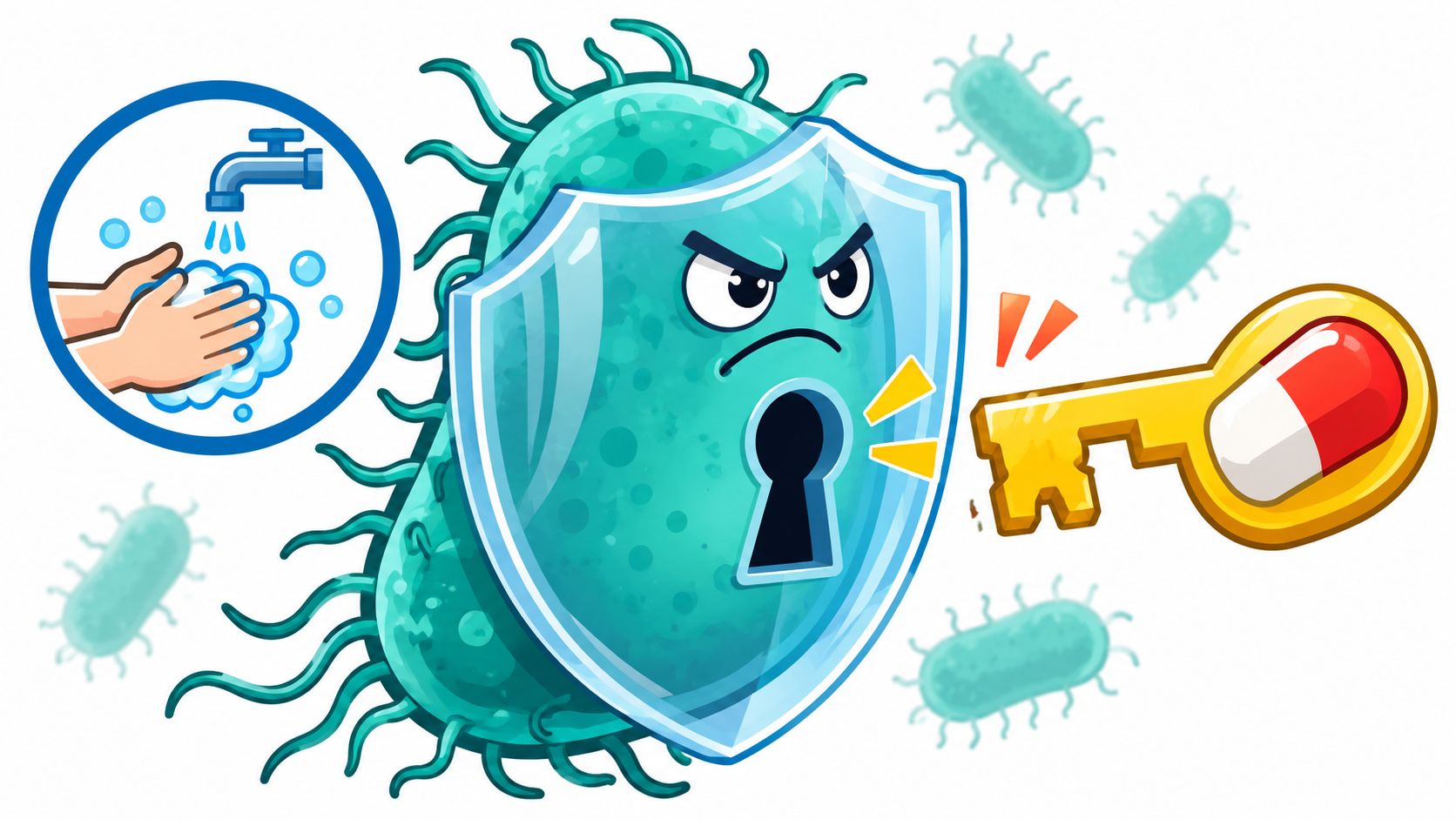
A superbug is usually a bacterium that has become resistant to one or more antibiotics that once treated it, so standard treatment may fail. The practical concern is that an infection can become harder to treat, not that every encounter with the germ causes illness.
You might be wiping a gym bench, changing a diaper, or preparing food while wondering what someone else left on that shared surface. Understanding what superbugs are, and what interrupts their spread, helps you focus on useful habits rather than fear.
What Superbugs Are and What They Are Not
Superbug is an informal label, not a scientific classification. It describes a treatment problem: a microorganism, most often a bacterium, can withstand a medicine that would ordinarily work against it.
Think of an antibiotic as a key cut for a bacterial lock. Resistance can mean that the lock changes, the bacterium destroys the key, or the cell pushes the key out before it works. The patient's body hasn't become resistant. The bacteria have.
The stakes are substantial. The World Health Organization's antimicrobial resistance fact sheet estimates that bacterial antimicrobial resistance directly caused 1.27 million deaths worldwide in 2019 and contributed to approximately 4.95 million deaths. Directly caused and contributed to aren't interchangeable: resistance can complicate another illness without being the sole cause of death.
The most important correction: A superbug isn't necessarily untreatable. Resistance to an antibiotic doesn't mean resistance to every available treatment.

Separate resistance from severity
A resistant bacterium isn't necessarily new or unusually aggressive. Resistance describes whether a medicine works; virulence describes an organism's ability to cause disease. A susceptible bacterium can cause a severe infection, while someone carrying a resistant strain may feel completely well.
The WHO antibiotic resistance surveillance report emphasizes differences between pathogens, antibiotics, infection types, and regions. A label alone can't tell a clinician which treatment will work.
Several distinctions make the subject easier to understand:
- Colonization isn't infection. Colonization means bacteria are present without causing illness. Infection means they're causing disease, such as inflammation, tissue damage, or other symptoms.
- Multidrug resistance isn't total resistance. Remaining treatments may exist, although they can be less convenient, more toxic, or more expensive.
- Antibiotic resistance isn't disinfectant resistance. A germ that withstands a medicine isn't automatically harder to remove from a countertop.
- Routine cleaning doesn't create superbugs. Removing contamination is a prevention measure, not a reason to avoid cleaning.
- Antibiotics don't treat viruses. They won't cure colds or flu, and most sore throats don't need them.
Why a test matters more than a nickname
A laboratory culture can help identify the bacterium responsible for an infection. Susceptibility testing then checks which antibiotics are likely to work against that particular strain.
That distinction matters when a patient hears a familiar name such as Escherichia coli or Staphylococcus aureus. The name identifies the organism, but it doesn't supply its complete treatment profile. Choosing care requires the infection site, symptoms, medical history, and test results, not the word superbug alone.
Common Superbugs and Where They Show Up
A resistant infection can begin in a hospital, but resistant bacteria also turn up in community settings such as athletic facilities and homes. The table compares common examples, the drugs they resist, and settings where they may be encountered.
| Superbug | Resistant to | Typical setting | WHO 2024 priority |
|---|---|---|---|
| MRSA, methicillin-resistant Staphylococcus aureus | Methicillin and many related beta-lactam antibiotics | Hospitals, athletic facilities, community skin infections | High |
| VRE faecium, vancomycin-resistant Enterococcus faecium | Vancomycin | Hospital wards, long-term care units | High |
| ESBL-producing E. coli | Third-generation cephalosporins | Community and hospital urinary and bloodstream infections | Critical |
| CRE, carbapenem-resistant Enterobacterales | Carbapenems, important last-line antibiotics | Hospitals, long-term care facilities | Critical |
| Carbapenem-resistant Pseudomonas aeruginosa | Carbapenems | Intensive care units, wounds, water systems | High |
The WHO's 2024 Bacterial Priority Pathogens List summary places carbapenem-resistant Acinetobacter baumannii, third-generation cephalosporin-resistant Enterobacterales, including ESBL-producing E. coli, and carbapenem-resistant Enterobacterales in the critical category. These categories guide public-health priorities; they do not predict an individual patient's outcome.
Match the organism to the setting
MRSA can cause skin abscesses and more serious infections, including bloodstream infections. Community-associated strains such as USA300 and USA400 occur outside hospitals. In athletic facilities and households, covering wounds and practicing good hygiene can help interrupt spread.
VRE faecium can inhabit the intestines. In hospitals and long-term care, hand hygiene and careful attention to shared equipment matter, especially when caring for vulnerable patients.
ESBL-producing E. coli makes enzymes that disable certain antibiotics. It can cause urinary infections and invasive disease in both community and hospital settings, so resistant infections are not confined to hospitals.
CRE refers to resistant members of a bacterial group, not one species. Klebsiella pneumoniae carrying NDM-1 is one example of a resistance problem clinicians may need to investigate.
Resistant Pseudomonas aeruginosa is relevant where moisture, wounds, medical devices, and vulnerable patients intersect. Water-associated reservoirs call for attention alongside frequently touched dry surfaces.
A gym manager, daycare administrator, or hospital infection-prevention team may face different risks. In each setting, everyday hygiene and appropriate cleaning can help limit opportunities for bacteria to spread.
A disease-causing bacterium does not automatically qualify as a superbug. Salmonella enterica, E. coli O157:H7, and Streptococcus pyogenes can cause illness, while the term “superbug” refers to a resistance profile. Understanding antimicrobial resistance helps clarify why an organism's name alone does not indicate which drugs will work.
How Bacteria Become Resistant to Drugs
| Mechanism | What the bacterium does | Example |
|---|---|---|
| Enzymatic destruction | Produces enzymes that break the drug before it acts | ESBL enzymes break down third-generation cephalosporins |
| Altered target | Changes the site the drug binds to | PBP2a in MRSA reduces binding of methicillin-class drugs |
| Efflux pumps | Pumps the drug out of the cell | Efflux systems in Pseudomonas aeruginosa |
| Reduced entry | Limits how much drug crosses the outer membrane | Changes in outer membrane porins in Gram-negative bacteria |
These mechanisms interfere with different stages of an antibiotic's action. A drug might never enter the cell, enter but be expelled, or reach its destination only to find that its target has changed.
The CDC's explanation of antimicrobial resistance distinguishes the effects of antimicrobial exposure from the spread of resistant organisms and resistance mechanisms. Both matter: bacteria must survive, and then the survivors or their resistance genes can spread.

How treatment selects resistant survivors
Say an infection contains a mixed bacterial population. Most bacteria are susceptible to a particular antibiotic, but a minority can withstand it.
Treatment removes susceptible bacteria while resistant survivors have more room and resources to multiply. This is selection. The antibiotic doesn't need to teach a bacterium how to resist it for resistance to become more common.
Those survivors can pass resistance traits to their descendants. Bacteria can also exchange genetic material, allowing resistance to spread beyond the original lineage, including to organisms that weren't directly exposed to the medicine.
Why stronger isn't always better
A broader or supposedly stronger antibiotic isn't automatically the right answer. Clinicians need a medicine that reaches the infection site and works against the organism without adding unnecessary harm.
The same bacterial species can include both susceptible and multidrug-resistant strains. Our guide to how bacteria develop antibiotic resistance explains that distinction in more detail.
Resistance is a property of a strain's treatment profile, not a separate species of germ.
What Drives Superbugs to Spread
A parent asking for antibiotics for a viral illness, a facility reusing a dirty cleaning cloth, and a hospital without reliable laboratory testing face different problems. Each can affect whether resistant bacteria survive or reach another person.
Unnecessary antimicrobial exposure creates avoidable selection pressure. Misuse can involve people, animals, and agricultural settings, so the problem extends beyond individual prescriptions.
For patients, the practical rule is to take antibiotics exactly as the prescriber directs. Don't stop, extend, or change treatment on your own; ask for advice if side effects or changing symptoms make the plan difficult to follow.
From shared equipment to protected communities
Bacteria can persist in biofilms, communities attached to a surface and surrounded by a protective matrix. Catheters, drains, shower components, and persistently damp equipment can provide opportunities for these communities to develop.
Biofilm-associated bacteria can tolerate conditions that would affect free-floating bacteria. That's why wiping around visible grime without removing it isn't a dependable cleaning method.
- Hands move contamination. A caregiver can transfer bacteria between a diaper-changing area and shared objects if hand hygiene is missed.
- Cleaning tools can redistribute it. A soiled cloth used across several surfaces may move material rather than remove it.
- Genes can move too. Resistance genes carried on mobile genetic material, including plasmids, can pass between bacteria.
The access gap matters
Focusing only on overuse misses patients who can't obtain timely diagnosis or effective treatment. Limited testing can also make a community's reported resistance burden appear lower than it really is.
A Global Burden of Disease analysis in The Lancet00806-2/fulltext) modeled that improving access to effective antibiotics could prevent more than 50 million deaths over the coming decades. That's a projection, not an observed outcome.
Clean water, vaccination, functioning laboratories, medicine availability, and adequate hospital capacity all belong in prevention planning. Societies need less unnecessary antibiotic use and better access to appropriate antibiotics at the same time.
Why Superbugs Matter to Patients and Communities
The CDC's 2019 Antibiotic Resistance Threats report announcement estimated that antibiotic-resistant bacteria and fungi caused more than 2.8 million infections and at least 35,000 deaths annually in the United States, equivalent to roughly an infection every 11 seconds and a death about every 15 minutes.
The same announcement reported that prevention efforts had reduced deaths from resistant infections by 18% overall and nearly 30% in hospitals compared with earlier measurements. Including Clostridioides difficile raised the broader annual toll to more than 3 million infections and 48,000 deaths.
C. difficile needs that separate explanation because it isn't typically classified as an antibiotic-resistant bacterium. Antibiotics can disrupt normal gut bacteria and create conditions in which it causes serious disease.

What treatment failure means at home
Consider a hypothetical patient whose surgical wound becomes infected. Instead of recovering with a suitable oral medicine, they may need additional testing, an intravenous drug, and a hospital stay when the initial treatment doesn't work.
Family members may need to arrange transport, cover childcare, or miss work. Healthcare staff must manage the infection while limiting opportunities for transmission.
Preventing an infection protects more than the person who might become ill. It can also spare caregivers, coworkers, and healthcare teams the consequences of a difficult treatment course.
Reliable antibiotics help make surgery and other complex medical care safer. When treatment options narrow, clinicians have less room to respond if an infection develops.
Stewardship, vaccination, hygiene, and surveillance address different parts of that problem. Stewardship improves prescribing, vaccination prevents some illnesses, hygiene interrupts transfer, and surveillance helps teams recognize emerging threats.
When Superbug Infections Need Medical Care
You can't identify antibiotic resistance by looking at a wound. Seek clinical advice for spreading redness or warmth, pus, a recurring boil, fever, a wound that's worsening, or persistent urinary symptoms.
For help recognizing wound changes, Vein and Wound Institute's guide to when to seek care for wounds provides a useful symptom-focused resource. Rapid deterioration, severe pain, confusion, or difficulty breathing warrants urgent medical assessment rather than waiting for a routine appointment.
What to tell the clinician
Bring information that can guide testing and treatment:
- Recent healthcare exposure. Mention a hospital stay, surgery, medical devices, or long-term care residence.
- Antibiotic history. Share what you took, why it was prescribed, and whether symptoms changed.
- Known exposure or previous results. Report close contact with someone known to carry MRSA or a previous resistant infection.
The clinician may collect a wound swab, urine sample, or another specimen before choosing treatment. Don't delay urgent care while trying to obtain a sample yourself.
Avoid leftover antibiotics and someone else's prescription. The wrong medicine can delay effective treatment and expose bacteria unnecessarily.
Complete treatment as directed unless your clinician changes the plan. Contact them if symptoms worsen, fail to improve as expected, or concerning side effects appear. Prompt assessment and appropriately tested care protect both the patient and those providing care.
Cut Your Risk of Superbug Spread Today
A damp gym bench, a shared kitchen counter, or a changing station can connect people through the same surfaces. Simple routines interrupt that chain: clean hands, covered wounds, correctly used disinfectants, and laundry that is washed and dried thoroughly.

Use antibiotics only under clinical direction. Take them as prescribed, and ask a pharmacist how to dispose of medicine you no longer need. Don't save antibiotics for another illness or share them. For more on everyday ways to reduce antibiotic resistance, see this guide to preventing antibiotic-resistant bacteria.
Wash hands at key moments. Use soap and water before eating, after using the toilet or changing diapers, and after touching wounds. Scrub fingertips, thumbs, and the spaces between fingers rather than rinsing quickly.
Cover wounds and keep personal items separate. Use a clean dressing on cuts, and don't share towels or razors. At gyms, make cleaning supplies accessible and set clear rules for shared equipment.
Choose a disinfectant with the right label claim. The EPA's guidance on registered disinfectants explains that a labeled 10-minute contact time means the surface must stay visibly wet for at least 10 minutes. Remove visible soil first, cover the whole surface, and use enough product to keep it wet for the time stated on the label.
Care for laundry and cleaning tools. Wash towels and gym clothing with detergent at the hottest temperature the fabric permits, then dry them thoroughly. Clean, disinfect, or replace mop heads and toilet brushes as appropriate. Don't store them dirty and wet.
Assign responsibility for shared spaces. Managers should make clear who cleans shared equipment, changing stations, restroom touchpoints, and food-service surfaces. Follow label directions for food-contact surfaces, including any required rinse, and seek public-health advice promptly when linked infections are suspected.
Check the process, not just the appearance
A surface may look clean without having received an effective disinfection treatment. Cleaning removes soil; disinfection uses a product according to its label to target specified organisms. For information about when to use EPA-registered disinfectants, check the product's organism claims and directions rather than relying on appearance alone.
BacteriaFAQ.com publishes informational articles on bacteria in washing machines, cleaning mop heads, infection prevention, disinfecting toilet brushes, and bacteria on water fountains. These practical topics connect infection-prevention habits at home with the shared surfaces people encounter in gyms, daycares, and kitchens.
Start this week by checking the disinfectant beside a frequently used shared surface. Read its organism claims and contact time, then check that the surface stays wet for the full period stated on the label. Choose a product that is suitable for the surface and that household members or staff can use as directed.
Leave a Reply