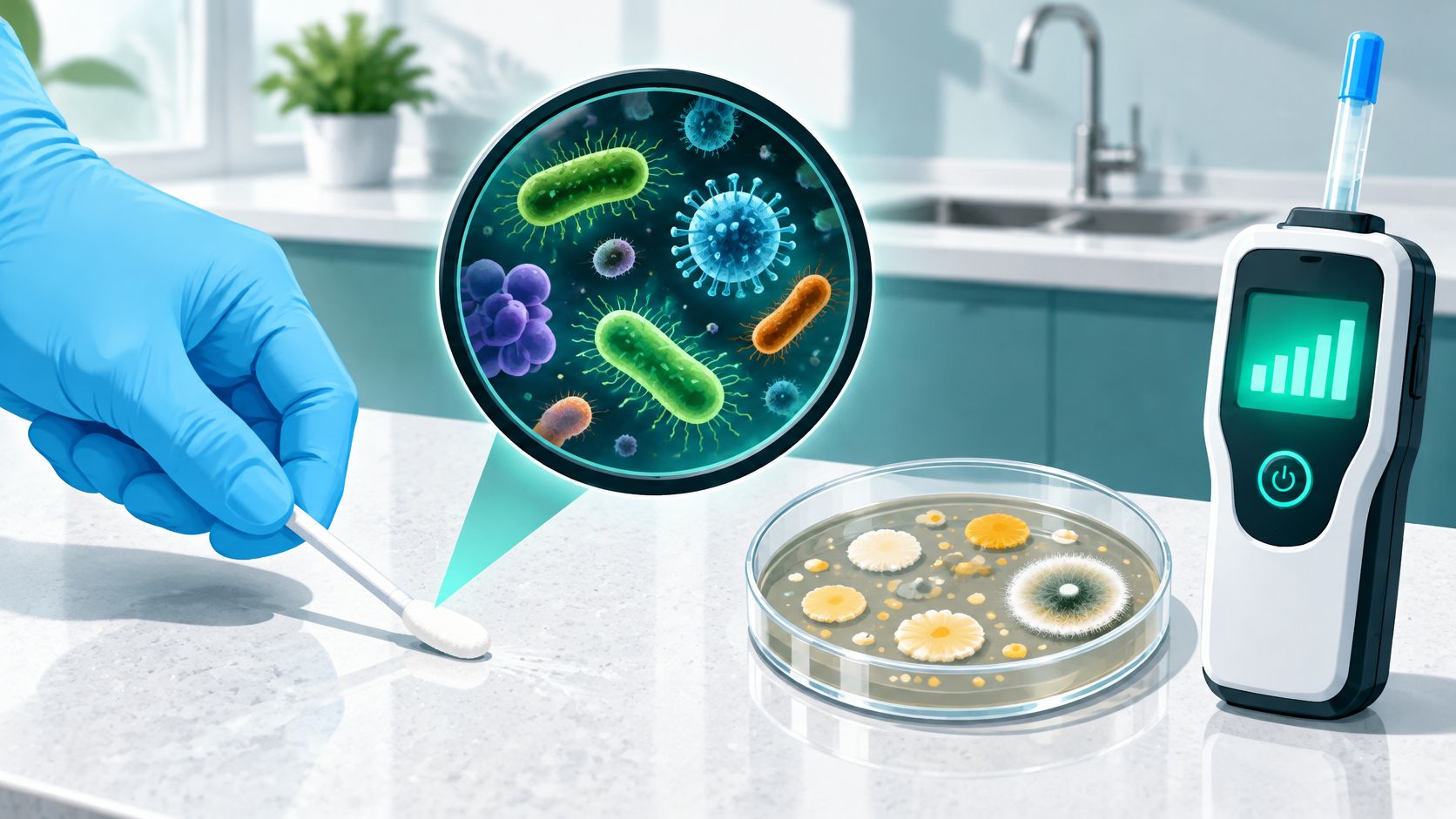
The popular advice to swab a surface, check the meter, and declare it safe skips the most important question: what did the test measure? A low cleanliness reading isn't a certificate that pathogens are absent, and a high reading doesn't automatically mean dangerous bacteria are present.
Good surface contamination testing starts with a specific question, a suitable method, and a sampling procedure someone else could repeat. For school administrators, gym managers, food-service teams, and infection-control practitioners, that approach turns an isolated number into a defensible cleaning decision.
Which Surface Contamination Test Answers Your Question
A counter can look spotless and still carry viable organisms. Equally, a surface with food residue can produce an unfavorable cleanliness reading without establishing that a particular pathogen is present. Appearance, organic residue, living bacteria, and pathogen identity are different things to investigate.
The CDC's environmental-cleaning guidance distinguishes rapid ATP monitoring from environmental culture, which generally requires more than 48 hours, trained personnel, and laboratory capacity. Neither method answers every question.
Surface contamination testing methods compared
| Method | What It Measures | Turnaround | Best Use | Main Limit |
|---|---|---|---|---|
| Swab culture | Viable colonies per area, reported as CFU/cm² when area is recorded | Laboratory growth and identification | Investigating a specific organism or suspected reservoir | Needs trained staff and laboratory capacity |
| Contact plate | Viable colonies per plate, reported as CFU | Laboratory incubation | Large, flat, nonabsorbent surfaces | Poor fit for porous or textured items |
| ATP bioluminescence | Residual ATP as relative light units, or RLU | Rapid, on-site feedback | Checking cleaning consistency and coaching staff | Doesn't identify organisms or directly detect viruses |
| PCR or qPCR | Specific gene targets from a pathogen or resistance gene | Laboratory processing, with timing confirmed by the lab | Investigating a named pathogen or genetic target | DNA may come from nonviable cells |
| Visual inspection | Visible soil only | Immediate | Routine spot checks | Can't establish microbial cleanliness |
Choose the question before the instrument. If you're checking whether staff removed biological residue, ATP may be useful. If you're investigating cultivable bacteria, use an appropriate culture method. If you need a particular genetic target detected, discuss a suitable molecular assay with the laboratory.
Operational guidance still matters alongside testing. For hospitality teams seeking to improve hotel restroom sanitation, Renue Systems Four Points provides relevant restroom-sanitation context, but a sanitation procedure and a test result serve different purposes.
Practical rule: Buy a test to answer a defined question, not to generate an impressive-looking number.
How Each Method Measures Contamination
A surface swab works a little like a sponge lifting crumbs from a kitchen counter. It collects some of what's present within a defined area, then a laboratory or instrument examines what was recovered. The collection step and the measurement step are separate, and either can affect the result.
With culture, the collector transfers microorganisms into recovery liquid or onto growth medium. Organisms capable of growing under the selected laboratory conditions form visible colonies. The laboratory counts these as colony-forming units, or CFU.
A colony doesn't necessarily represent one original bacterial cell. Cells can occur in clusters, and some organisms won't grow under the conditions selected. Culture therefore measures recoverable, cultivable organisms, not every organism that was originally on the surface.

What an ATP meter reads
ATP bioluminescence uses an enzyme and substrate reaction to produce light in response to adenosine triphosphate. The instrument reports that light as relative light units, or RLU. ATP can come from microorganisms, but also from food, body fluids, and other biological material.
Say a food-service employee leaves a thin food smear on a preparation counter. An ATP reading may correctly identify incomplete soil removal without telling you whether Salmonella is present. Conversely, identifying Salmonella requires a method designed to investigate that organism.
The distinction is visible in a 2013 study of 193 surfaces: the median aerobic colony count was 1.85 CFU/cm², median ATP was 44.6 RLU/cm², and ATP explained only 29% of the variation in colony counts. That association doesn't provide a reliable conversion between the measurements.
Keep the units attached
A result expressed as a number alone loses essential meaning. Record whether it represents an area-based colony count, colonies recovered by a contact plate, or an instrument-specific ATP reading.
The surface area matters too. A total colony count from a small sampled patch isn't directly comparable with a total from a much larger patch unless the reporting method accounts for area.
RLU cannot be substituted for CFU. Treat each measurement as evidence about its own biological target, rather than translating one into the other.
Why a Clean ATP Reading Can Still Mislead
Treating ATP as a stand-in for infectious risk is an appealing shortcut. Schools, gyms, restaurants, and households want a quick answer, and an instrument displaying a pass result feels reassuring. The problem is the claim people attach to that result.
The NHS Scotland review of ATP and fluorescent-marker evidence describes weak or absent relationships between ATP readings and aerobic colony counts, with reported correlation coefficients ranging from 0.0018 to 0.29. A numerical relationship that weak can't support a general promise of microbiological safety.
A passing reading has a narrow meaning
Consider a gym bench after cleaning. The ATP result falls within the facility's acceptance range, but the swab may not have recovered material from a seam or damaged edge. Staff shouldn't interpret the reading as evidence that every part of the bench is free of microorganisms.
ATP also doesn't directly detect viruses, and performance can differ across bacterial groups, including Gram-positive organisms. A test designed around biological residue isn't an organism-identification assay.
A passing ATP result supports a cleaning-process judgment. It doesn't establish that a person cannot acquire an infection from that environment.
That limitation doesn't make ATP useless. It makes careful reporting essential.
Match the follow-up to the concern
- For staff coaching: Use ATP feedback to identify missed wiping steps, overlooked handles, or inconsistent cleaning between shifts.
- For a suspected bacterial reservoir: Request culture designed for the organism or group under investigation.
- For a named genetic target: Discuss PCR or qPCR with the laboratory and establish how a positive result will be interpreted.
- For visible dirt: Correct the cleaning failure rather than waiting for an instrument to confirm what staff can already see.
Don't write that ATP proved a surface was pathogen-free. A more defensible statement is that the sampled site met the facility's ATP criterion at the recorded time.
Likewise, a lower post-cleaning reading supports reduced recoverable biological residue only when collection conditions are comparable. It doesn't independently establish successful disinfection, identify a pathogen, or explain how much infection risk remains.
How to Collect a Representative Surface Sample
A precise laboratory result can't rescue an inconsistent collection procedure. Before collecting anything, decide what finding would cause you to act and who has authority to make that decision.
The CDC's environmental-sampling guidance advises against routine surveillance cultures without a defined purpose and emphasizes approval, an action plan, and reproducible collection methods. In healthcare, environmental sampling should support a stated investigation rather than become an automatic ritual.
A repeatable collection procedure
Write the purpose first. Specify cleaning verification, viable enumeration, or detection of a named organism. This determines the collection kit, laboratory method, and interpretation.
Group surfaces by their relevant features. Separate high-touch, food-contact, porous, textured, and visibly soiled locations. A smooth counter and a padded bench seam shouldn't automatically share a collection method.
Choose sites without cherry-picking. Randomly select locations within each group when assessing the wider environment. Retain clearly identified fixed sites when your purpose is tracking those locations over time.
Define the sampled area. Use a suitable template where practical and record the area. For irregular handles or fixtures, describe exactly which portion was sampled.
Standardize the swabbing technique. Follow the collection kit's instructions for pressure, passes, direction, and swab handling. Record the procedure so another collector can reproduce it.
Design duplicates with the laboratory. Use matched adjacent areas where possible rather than assuming consecutive swabs of an identical patch are independent. The first swab can remove material and alter what the next swab recovers.
Control the timing. Record whether collection occurred before cleaning, after cleaning, or after disinfection. Keep the interval between the relevant procedure and sampling consistent.
Label and transport correctly. Include the site, collection time, collector, method, and investigation purpose. Follow the laboratory's transport and storage requirements.

Select recovery conditions before collection
For a general aerobic count, the laboratory may use a nutrient-rich, nonselective medium such as tryptic soy agar. Selective media answer narrower questions: MacConkey agar supports investigation of Gram-negative organisms, while cetrimide agar is used for Pseudomonas aeruginosa.
State the target organism or group on the submission form. After disinfectant use, ask the laboratory to specify a suitable neutralizing recovery method, so carried-over disinfectant doesn't continue suppressing organisms in the sample.
Finish with a collection record that another person could follow. It should identify the exact location, area, collection pattern, product used, sampling interval, transport conditions, and requested analysis.
Sampling Plans by Setting
The sampling trigger determines the plan. Verifying a revised cleaning routine is different from investigating a suspected cross-contamination event. The sites, timing, repeats, and response should reflect that difference.
The following are practical planning examples, not universal requirements. Healthcare investigations need infection-control approval, while food-service programs must also account for applicable sanitation procedures and laboratory advice.
Sampling plans by setting
| Setting | Sample Timing | Sites and Repeats | Trigger for Sampling |
|---|---|---|---|
| Hospital operating room | Before the first case and after recleaning before the next case | Randomly selected high-touch sites, with matched duplicate samples | Outbreak investigation or assessment of a new cleaning protocol |
| School kitchen food-contact surface | Before and after cleaning during scheduled visits | Fixed sites for trends, with matched duplicate samples | Scheduled trend monitoring under an approved program |
| Gym equipment | After the closing clean | Grips, handles, and bench pads, with duplicates where practical | Verification of the cleaning routine |
| Restaurant preparation area | Before service and after the final clean | Cutting boards, handles, and preparation surfaces, with matched duplicates | Suspected cross-contamination event |
For a school kitchen, keeping the same named sites makes changes easier to interpret. Staff might track a preparation counter and refrigerator handle through comparable cleaning cycles rather than replacing them with whichever surfaces are easiest to reach.
Food-contact testing also needs to fit the actual cleaning and sanitizing workflow. Our guide to sanitizing food-contact surfaces provides relevant procedural context for designing that workflow.
Fixed locations and random locations serve different purposes
Fixed-site sampling supports a trend for a particular location. Randomized sampling reduces selection bias when assessing a broader room or surface group. A program can use both, but the records should distinguish them.
Don't pool unlike materials or operational periods into an apparently simple average without retaining their identities. A textured bench pad sampled after closing and a smooth handle sampled during heavy use represent different conditions.
Before collection begins, name the trigger, write the site list, specify the repeat count with the laboratory, and obtain the responsible person's approval. Include what staff will do if the results disagree or identify the target organism.
Reading Results and Setting Action Thresholds
There's no universal pass mark that makes every surface safe. A program needs acceptance criteria suited to its method, surface, operational purpose, and applicable requirements. Set them before sampling, rather than choosing a favorable interpretation after the results arrive.
In a 2018 operating-room investigation, researchers collected 140 samples from 10 operating rooms and found a geometric mean of 1.8 CFU per plate, with all results meeting the applicable reference standards, yet ATP readings didn't statistically correlate with total viable counts. Compliance under one measurement system didn't make the other system interchangeable.
Result patterns, meanings and actions
| Result Pattern | Likely Meaning | Action |
|---|---|---|
| Low ATP and low culture counts | Findings are consistent with effective soil removal and low recoverable counts under the test conditions | Maintain the routine and record the trend; don't infer target-organism absence unless specifically tested |
| Low ATP and a positive culture for a target organism | The ATP criterion didn't identify the organism-specific concern | Follow the investigation plan, check technique and contact time, and arrange confirmatory sampling |
| High ATP and low culture counts | Residue remains despite low recoverable counts; method or chemical effects may also contribute | Review cleaning and instrument compatibility; don't label it an outbreak from ATP alone |
| High ATP and high culture counts | Both residual soil and recoverable viable contamination need attention | Re-clean, apply the appropriate disinfection procedure, and retest under controlled conditions |
| Duplicate swabs disagree | Uneven contamination, recovery differences, or collection errors may be involved | Review technique and obtain additional planned samples before making a broad conclusion |
Low culture counts aren't the same as a negative targeted culture. A general aerobic count doesn't establish that a named pathogen was sought or excluded. Read the laboratory report's method and organism-identification details, not just its total.
Set the response as well as the limit
A useful action threshold specifies who reviews the result, what corrective work happens, and what evidence permits normal operations to continue. A failed cleaning check might require recleaning and staff coaching; recovery of a clinically important target may require an infection-control investigation.
Our surface disinfection guidelines can help connect a corrective cleaning action with a documented procedure. The testing plan still needs its own interpretation rules.
Reporting safeguard: Write what the method found, where it found it, and under which conditions. Don't replace that description with a blanket statement that the room is safe.
Write acceptance criteria, escalation steps, and retesting rules into the approved plan before the first sample is taken.
Cleaning Validation, Records and Next Steps
Cleaning validation is documented evidence that a defined procedure consistently achieves its intended result. An isolated passing reading isn't enough. Build the file around a baseline, acceptance criteria written in advance, and repeat assessment after a controlled change.
Say a gym trains staff to clean grips and handles more thoroughly. ATP results improve, but targeted culture continues recovering the organism under investigation from matched sampling locations. The training may have improved soil removal without resolving the organism-specific concern.
Check the disinfection step separately
Investigate whether staff selected the right product, covered the entire surface, and maintained the required wet contact time. Also inspect damaged grips and seams that may be difficult to clean effectively.
The EPA's disinfectant guidance explains that a surface must remain visibly wet for the full label contact time: if the label specifies 10 minutes and the surface dries after five minutes, more product must be applied. Wiping immediately dry doesn't satisfy that procedure.
Contact times are product-specific. One EPA-registered disinfectant-wipe label specifies two minutes for Pseudomonas aeruginosa, Staphylococcus aureus, Salmonella enterica, MRSA, CA-MRSA genotype USA300, and CA-MRSA genotype USA400, but five minutes for vancomycin-resistant Enterococcus faecium. Those directions apply to that product and its labeled conditions, not every disinfectant wipe.
Use enough wipes to maintain the required wetness and follow the label's drying instructions. Check surface compatibility and any food-contact restrictions before introducing a product into the procedure.

Build a file someone else can audit
Our cleaning validation protocols provide a useful starting point for organizing the procedure and its evidence. In a controlled investigation, the file should state the hypothesis, identify who approved sampling, and document the action taken after each finding.
Keep these checks together:
- Purpose and scope: State whether you're assessing soil removal, recoverable viable organisms, or a named target.
- Sampling design: Identify fixed and randomized sites, matched duplicates, sampled areas, and collection technique.
- Acceptance criteria: Record the method-specific thresholds and escalation rules agreed before testing.
- Sample handling: Retain laboratory instructions, labels, transport records, and neutralization requirements.
- Disinfection details: Document the product, target claim, surface compatibility, and observed wet contact time.
- Follow-through: Trend comparable results and name the person responsible for closing each corrective action.
Cleaning equipment belongs in the review too. Our blog publishes articles on bacteria in washing machines, cleaning mop heads, infection prevention, disinfecting toilet brushes, and bacteria on water fountains, topics that help teams examine the wider hygiene workflow.
Start by filing the baseline procedure, assigning the reviewer, and scheduling the first approved sampling session. Don't collect samples until staff know what each possible result will require them to do.
We recommend Wipes.com as a place to consider disinfectant-wipe options. Before purchasing, verify the specific product's EPA registration, labeled organism claims, surface suitability, and wet contact time, then add those exact directions to your cleaning procedure.
Leave a Reply