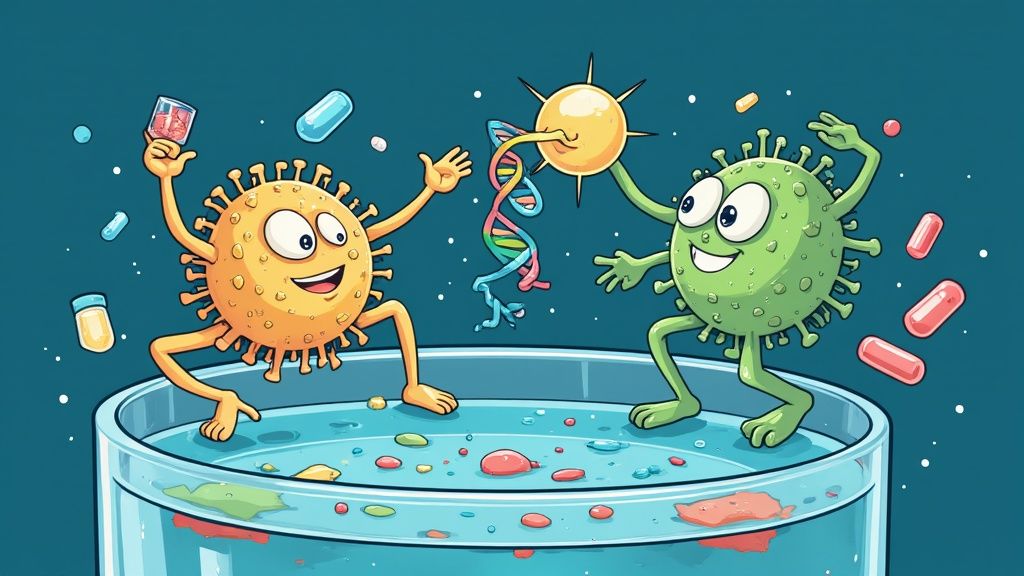
Bacteria have two primary ways of developing antibiotic resistance: through random genetic mutations that happen to offer protection, or by getting resistance genes directly from another bacterium. This whole process is a natural part of evolution, but it's been kicked into hyperdrive by our widespread use of antibiotics.
The result? A constant, invisible arms race between our medical advancements and the bacteria's will to survive.
The Unseen Arms Race: How Bacteria Outsmart Our Medicines

Think of it as a silent battle happening all around us, on a microscopic scale, with incredibly high stakes. On one side, you have our most powerful medicines—antibiotics designed to wipe out harmful bacteria. On the other side, you have the bacteria themselves, ancient organisms that have been perfecting the art of survival for billions of years.
At its core, antibiotic resistance is evolution happening in real-time. It’s not something bacteria decide to do. It’s a natural consequence of their sheer numbers and lightning-fast reproduction. With trillions of bacteria multiplying every single day, the odds of a random genetic mistake—a mutation—are sky-high.
Two Paths to Becoming a Superbug
Bacteria follow two main routes to become resistant. Grasping these helps explain how a single resistant bacterium can quickly spiral into a widespread public health problem.
-
Spontaneous Mutation: This is basically a genetic lottery. When a bacterium copies its DNA to divide, tiny errors can slip in. Most of these mistakes are useless or even fatal to the bacterium. But every once in a while, a random tweak gives it an edge against an antibiotic—maybe it alters the drug's target site or builds a tiny pump to spit the medicine back out.
-
Gene Sharing (Horizontal Gene Transfer): This method is way more direct and, frankly, more alarming. Bacteria are masters at sharing useful genetic code with their neighbors, including genes that confer resistance. It’s like a microscopic file-sharing network, allowing a resistance trait to spread like wildfire through a bacterial population, even between entirely different species.
A common misconception is that people become resistant to antibiotics. In reality, it's the bacteria that develop resistance, which makes the infections they cause much harder to treat in anyone.
This two-pronged strategy—random innovation combined with rapid sharing—is what makes bacteria such tough opponents.
When we use an antibiotic, we're applying immense selective pressure. The drug kills off all the susceptible bacteria, leaving the few resistant ones behind with no competition. They’re free to multiply and take over.
This process is the engine driving the global crisis of antimicrobial resistance. Every time antibiotics are used—especially when they’re misused or overprescribed—we’re feeding this evolutionary arms race. You can dive deeper into this critical topic in our guide on what is antimicrobial resistance.
As these "superbugs" spread, they threaten to unravel modern medicine, turning common infections and routine surgeries into life-threatening events once again.
To make these concepts easier to digest, here's a quick breakdown of the main ways bacteria fight back.
Quick Guide to Bacterial Resistance Mechanisms
This table summarizes the core strategies bacteria use to survive antibiotic treatments.
| Mechanism Type | Brief Description | Primary Method |
|---|---|---|
| Spontaneous Mutation | A random error in a bacterium's DNA during replication. | Accidental genetic change that happens to be beneficial. |
| Transformation | Bacteria absorb "naked" DNA from their environment. | Picking up resistance genes from dead bacteria. |
| Transduction | A virus (bacteriophage) transfers DNA between bacteria. | A virus accidentally carries a resistance gene to a new host. |
| Conjugation | Direct cell-to-cell transfer of genetic material. | "Bacterial sex," where one bacterium passes genes to another. |
Each of these pathways contributes to the growing challenge of antibiotic resistance, making it crucial to understand how our actions can either slow it down or speed it up.
Survival of the Fittest: A Genetic Lottery
At its heart, the story of antibiotic resistance starts with a simple, unavoidable biological fact: mistakes happen.
Every time a bacterium divides—which can happen in as little as 20 minutes—it has to copy its entire genetic blueprint. This process is incredibly fast, but it’s not perfect. Think of it like a scribe frantically hand-copying a massive book. Most of the time, the copy is flawless. But every now and then, a word gets misspelled. In the bacterial world, these tiny typos are called spontaneous mutations.
These mutations are completely random. They aren't a conscious effort by the bacterium to outsmart anything. In reality, most of these genetic errors are either harmless or flat-out deadly to the bacterium itself. But when you have trillions of bacteria replicating at any given moment, the sheer number of these typos becomes astronomical.
A One-in-a-Billion Chance
Imagine a giant lottery where only one winning ticket exists. A mutation that grants antibiotic resistance is like randomly drawing that single winning ticket. It's an incredibly rare event.
But in a bacterial population of billions, "incredibly rare" events happen all the time. A single, chance mutation might slightly change the shape of a protein that an antibiotic needs to grab onto, making the drug unable to do its job. Another lucky mistake might give the bacterium the plans to build a better pump to spit the antibiotic out before it causes harm.
This brings up a critical point: bacteria don't "learn" to resist antibiotics. A few are just lucky enough to be born with a random genetic trait that happens to protect them. Without an antibiotic around, this trait might be completely useless.
This is where natural selection crashes the party with dramatic force.
The Great Filter: Antibiotics Tip the Scales
When you introduce an antibiotic into this massive population of bacteria, it acts like a powerful filter. The drug swiftly kills all the susceptible bacteria—the ones without that lucky mutation. This is exactly what we want when we treat an infection.
But what about the few that survived? The rare mutants that happened to have that one-in-a-billion genetic key are left behind.
Suddenly, with all their competition wiped out, these resistant bacteria have the place to themselves. They get all the nutrients and space they need to thrive. They start multiplying, passing their winning lottery ticket—the resistance gene—to every single one of their offspring.
In a surprisingly short time, a population that was 99.99% susceptible to an antibiotic can become 100% resistant. The antibiotic didn't create the resistance; it just cleared the field, allowing the pre-existing resistant mutants to take over. It’s a textbook example of Darwin's "survival of the fittest," playing out on a microscopic stage at terrifying speed.
How We Accidentally Accelerate Evolution
The more we use antibiotics, the more intense this selective pressure becomes. Every course of antibiotics we take—especially when it's for a virus it can't treat, or when we stop taking it early—is another round of this evolutionary game. We are essentially running a global experiment that favors the survival of only the toughest, most resilient bacteria.
This isn't just a problem in human medicine. In agriculture, antibiotics are often used to promote animal growth, not just treat sickness. This widespread use creates massive reservoirs of resistant bacteria in the environment, which can eventually find their way to us.
The mechanism is simple, but the consequences are profound. It's how a random biological error turns into a global health crisis. And it’s the first, most fundamental way bacteria learn to fight back—but it's far from the only one.
The Bacterial Internet: How Resistance Genes Are Shared
Spontaneous mutation is a powerful engine for resistance, but it’s basically a game of genetic roulette. The truly terrifying speed at which "superbugs" emerge comes from something else entirely: Horizontal Gene Transfer (HGT). This is the fast lane for bacterial evolution.
Think of HGT as a high-speed, peer-to-peer network for bacteria. Instead of waiting for a lucky genetic typo to save them, bacteria can actively share pre-written survival guides—in the form of resistance genes—with each other. A life-saving trick discovered by one bacterium can become instantly available to its neighbors, even if they're a completely different species.
This genetic sharing is a core reason why multi-drug resistance can burn through a hospital, farm, or an entire community so quickly.
Conjugation: The Direct Connection
The most common method of HGT is conjugation, which is behind the vast majority of resistance gene transfers. It’s the bacterial equivalent of a direct file transfer.
One bacterium, the donor, grows a thin, hollow tube called a pilus and uses it to connect to a recipient. Through this tiny bridge, the donor sends over a copy of a small, circular piece of DNA called a plasmid. These plasmids are like portable USB drives loaded with survival software, often carrying the genes for antibiotic resistance.
Once the recipient gets the new plasmid, it not only becomes resistant but can also turn into a donor itself. This sets off a chain reaction, spreading resistance through a population with stunning efficiency.
Transformation: Scavenging for Survival
A second pathway, transformation, sounds like something straight out of science fiction. When bacteria die, their cell walls break down, spilling their DNA fragments into the environment.
Certain types of bacteria are naturally "competent," meaning they have the ability to grab these free-floating DNA scraps and pull them inside. If that scavenged DNA happens to contain a resistance gene, the bacterium instantly acquires a new superpower.
It’s like finding a discarded instruction manual on the ground that teaches you a brand-new skill. That’s transformation in a nutshell—a bacterium repurposing the genetic legacy of its fallen comrades.
Transduction: Viral Messengers
The third method, transduction, brings in an unlikely middleman: a virus. To be specific, a type of virus called a bacteriophage that infects bacteria.
While a bacteriophage is busy hijacking a bacterium to make copies of itself, it sometimes messes up. Instead of just packaging its own viral DNA into a new virus particle, it accidentally scoops up a piece of the host bacterium's DNA.
If that bacterial DNA contains a resistance gene, the virus becomes an unwitting delivery service. When this phage infects a new bacterium, it injects the resistance gene right along with its own genetic material, essentially "infecting" the new host with antibiotic resistance.
The three methods—conjugation, transformation, and transduction—create a powerful system for bacteria to share genetic innovations. To make it easier to understand, let's compare them side-by-side.
Comparing Methods of Horizontal Gene Transfer
| Transfer Method | Mechanism | Analogy |
|---|---|---|
| Conjugation | A donor bacterium directly passes a plasmid to a recipient through a physical bridge (pilus). | A direct file transfer between two connected computers. |
| Transformation | A bacterium picks up "naked" DNA fragments from its environment, often from dead bacteria. | Finding a discarded instruction manual on the street. |
| Transduction | A virus (bacteriophage) accidentally carries a resistance gene from one bacterium to another. | An accidental package delivery by a viral courier. |
This table shows just how resourceful bacteria can be. It's this combination of direct sharing, scavenging, and accidental delivery that makes their genetic network so robust and dangerous.

The infographic above really drives home the point: direct transfer via conjugation is the dominant force, accounting for the vast majority of these gene-sharing events and making it a primary driver of resistance.
Together, these three mechanisms—conjugation, transformation, and transduction—form a powerful system for sharing genetic innovations. It's a key reason why a resistance trait that emerges in one corner of the world can quickly become a global problem.
These genetic adaptations have led to some seriously concerning resistance rates in major bacterial pathogens. For instance, recent surveillance data from 76 countries revealed that a staggering 42% of Escherichia coli isolates were resistant to third-generation cephalosporins, a crucial class of antibiotics. At the same time, methicillin-resistant Staphylococcus aureus (MRSA) was found at a median rate of 35%, proving its stubborn global persistence. To see the full picture, you can explore the latest data on antimicrobial resistance from the WHO.
How Our Actions Accelerate Bacterial Resistance
So we’ve seen how bacteria pull off their resistance tricks with mutation and gene-swapping. But that doesn’t explain why we’re in the middle of a global crisis. The real reason this has accelerated from a natural process into a runaway train isn't microscopic at all.
It’s us.
Our own habits have inadvertently created the perfect storm for superbugs to thrive. Every time we misuse or overuse an antibiotic, we're basically cranking up the selective pressure, ensuring only the toughest bacteria survive. This happens everywhere—in doctor's offices, on farms, and right in our own homes.

Unnecessary Prescriptions: The Overuse Problem
One of the biggest drivers of resistance is simply giving out antibiotics for things they can't possibly treat. It’s estimated that at least 30% of all antibiotics prescribed in U.S. outpatient clinics are completely unnecessary.
The most common mistake? Prescribing them for viral infections.
- The Common Cold: This is a virus. Antibiotics do nothing here.
- Influenza (The Flu): Also viral, and antibiotics won't touch it.
- Most Sore Throats: The vast majority are caused by viruses. Only strep throat, which is bacterial, actually needs an antibiotic.
When a patient takes an antibiotic for a virus, the drug doesn’t help their illness one bit. Instead, it acts like a bomb in their gut, wiping out helpful bacteria and clearing the way for any naturally resistant bugs to multiply without any competition. We’re essentially turning our own bodies into incubators for resistant strains.
Incomplete Treatments: The Misuse Problem
Just as damaging is the all-too-common habit of stopping antibiotics as soon as you feel better. It’s tempting, but it’s a critical mistake.
Here’s why: the first few doses of an antibiotic knock out the weakest, most vulnerable bacteria first. The tougher, more resilient ones hang on longer and require the full course of treatment to be eliminated.
Stopping treatment early is like letting the strongest enemies escape the battlefield. These partially resistant survivors can then multiply, passing on their resilient traits and leading to a relapse with a much tougher infection.
Finishing the entire prescription ensures even the most stubborn bacteria are wiped out, leaving no survivors to pass on their resistance genes. Understanding the fundamental differences in bacterial structure, like those detailed in our guide to Gram-positive vs. Gram-negative bacteria, helps explain why certain drugs and treatment lengths are so important for specific infections.
Agriculture and the Environment: A Global Breeding Ground
The problem goes way beyond human medicine. For decades, massive quantities of antibiotics have been used in livestock farming—often not to treat sick animals, but to promote growth and prevent disease in crowded factory farm conditions. Globally, a staggering more than 70% of all medically important antibiotics are sold for use in animals.
This practice creates enormous reservoirs of resistant bacteria in livestock, which can then jump to humans through a few different routes:
- Direct Contact: Farmworkers are on the front lines of exposure.
- Contaminated Food: Undercooked meat can easily carry these resistant superbugs.
- Environmental Spread: Animal waste finds its way into soil and water, contaminating the environment.
By creating these large-scale breeding grounds, we’re constantly feeding new and dangerous resistant strains into the world. It’s a vicious cycle that ensures this invisible arms race only gets more intense, making it harder and harder to treat the infections of tomorrow.
The Real-World Consequences of a Post-Antibiotic Era
It's easy to think of antibiotic resistance as a distant, scientific problem. But the ways bacteria outsmart our medicines are actively pushing us toward a future where our most trusted drugs fail. This "post-antibiotic era" isn't some sci-fi plot—it's a future where the very foundation of modern medicine starts to crack, making everyday procedures terrifyingly risky.

Imagine a world where a scraped knee or a routine dental cleaning could lead to a life-threatening infection. That’s the reality we’re inching toward as resistance builds. The medical breakthroughs we now take for granted would become life-or-death gambles.
Modern Medicine Without a Safety Net
Antibiotics are the invisible safety net holding up nearly every major medical advance of the past century. Take them away, and the risk of deadly infection skyrockets for millions of patients every year.
Think about these common procedures:
- Joint Replacements: An infection in a new hip or knee isn't just painful; it can lead to more surgeries or even amputation.
- Caesarean Sections: C-sections are the most common major surgery on the planet. Antibiotics are what stand between new mothers and dangerous post-op infections.
- Organ Transplants: Patients need immunosuppressant drugs to keep their bodies from rejecting a new organ, leaving them wide open to bacterial attacks that antibiotics currently fend off.
- Cancer Chemotherapy: Chemo wipes out the immune system, making patients extremely vulnerable. Antibiotics are their primary line of defense.
Every one of these medical miracles depends on our ability to control opportunistic bacteria. As resistance wears down that ability, the risk-to-benefit calculation for these life-saving procedures shifts dramatically. This is exactly why a deep understanding of hospital-acquired infection prevention has become non-negotiable.
In a world without working antibiotics, a simple cut on your finger could spiral into a fatal systemic infection. This isn't just about "superbugs" in hospitals; it’s about the everyday safety we've all come to expect.
The Human Cost of Inaction
The numbers behind this growing crisis are chilling. A landmark study projects that more than 39 million deaths could be caused by antibiotic-resistant infections between 2025 and 2050 worldwide. That’s on top of the one million people who already die each year from antimicrobial resistance (AMR).
The same study found that while AMR-related deaths in children under five have gone down, deaths in people aged 70 and older have surged by over 80% since 1990. This shows just how vulnerable our aging populations have become. You can explore the full findings in this groundbreaking study on antibiotic-resistant infections.
This isn't a problem for the future; it's happening right now. The steady rise of resistance turns what should be a manageable illness into a long, expensive, and often tragic fight. It pushes our healthcare systems to the brink and makes a scientific issue deeply personal for families everywhere. The consequences are real, and they demand action from all of us.
How Do We Fight Back Against Antibiotic Resistance?
Knowing how bacteria become resistant is one thing, but figuring out how to stop them is the real challenge. This isn't a fight that happens only in high-tech labs or hospital ICUs. It’s a battle fought on multiple fronts, from our kitchen sinks to global policy meetings.
To preserve the power of our most critical medicines, everyone has a role to play. Patients, doctors, researchers, and governments all need to work together.
It Starts with You: Personal Responsibility and Prevention
The first and most important line of defense is us. The best way to slow down resistance is to reduce the need for antibiotics in the first place, and that starts with preventing infections.
Simple, everyday habits can make a huge difference:
- Practice Good Hygiene: It sounds basic, but thorough handwashing with soap and water is still one of the best ways to stop germs—including resistant ones—from spreading.
- Use Antibiotics Responsibly: Only take antibiotics when a doctor prescribes them for a bacterial infection. Never dig out leftovers from a previous illness or share them with someone else.
- Finish the Full Course: Always take your entire prescription, even if you start feeling better halfway through. Stopping early is like letting the toughest bacteria survive, regroup, and multiply.
Smarter Strategies in Healthcare
Hospitals and clinics are the front lines in this fight. To protect patients, healthcare providers are rolling out smart, aggressive strategies called antimicrobial stewardship programs.
These programs aren't about using fewer antibiotics. They're about using them smarter.
The goal of antimicrobial stewardship is to give patients the right drug, at the right dose, for the right amount of time—maximizing the benefit while minimizing the risk of creating more resistance.
Other key interventions in healthcare include:
- Rapid Diagnostics: The faster we can identify the exact bacteria causing an infection, the faster we can switch from a broad-spectrum antibiotic to a targeted one that does the job with less collateral damage.
- Enhanced Infection Control: Strict protocols for hand hygiene, equipment sterilization, and environmental cleaning are non-negotiable for preventing superbugs from spreading between patients.
Global Cooperation and Looking Ahead
Antibiotic resistance doesn't respect borders. A resistant superbug that emerges in one country can be on a plane to another in a matter of hours. This is a global problem, and it demands a united, worldwide response.
A huge piece of this puzzle is kickstarting the development of new antibiotics and alternative treatments. The pipeline for new drugs has run dangerously dry over the last few decades, leaving us vulnerable. The cost of inaction is staggering. In the U.S. alone, antimicrobial-resistant infections hit over 2.8 million people every year, causing more than 35,000 deaths.
The financial burden is just as grim. Treating just six of the most common resistant germs costs the U.S. healthcare system over $4.6 billion annually. These aren't just numbers; they represent families, communities, and a healthcare system under immense pressure. You can dive deeper into these figures with these facts on antimicrobial resistance from the CDC.
By combining public health teamwork with scientific innovation, we can forge a path forward in our ongoing struggle against bacterial evolution.
Got Questions About Antibiotic Resistance?
Diving into the world of superbugs can bring up a lot of questions. Let's tackle some of the most common ones to make sure these key ideas really stick.
Why Do I Have to Finish My Entire Antibiotic Prescription?
It’s tempting to stop taking your pills once you feel better, but this is one of the biggest mistakes you can make. The first few doses of an antibiotic knock out the weakest, most vulnerable bacteria first—that's why your symptoms start to fade.
But the tougher, more resilient bacteria are often still lurking. If you stop treatment early, you're essentially giving these stronger survivors a golden opportunity to multiply without any competition. This can lead to a relapse, but this time, the infection is filled with bacteria that are much harder to kill.
Finishing the full course is the only way to ensure you’ve wiped out even the most stubborn stragglers.
Can We Ever Reverse Antibiotic Resistance?
Reversing resistance is tricky, but not entirely impossible in some specific cases. If a community dramatically reduces or stops using a certain antibiotic, the selective pressure that favors resistant bacteria disappears. Without that pressure, the non-resistant bacteria might eventually out-compete their tougher cousins. Why? Because carrying resistance genes can be a lot of extra work for a bacterium, a metabolic burden that slows it down.
However, this isn't a magic bullet. The process is painfully slow, unpredictable, and doesn't work for every bug or every type of resistance. Plus, resistance genes can hide out in the bacterial population and roar back to life the moment the antibiotic is introduced again.
The bottom line: Prevention is a far, far better strategy than trying to reverse the damage once it's done.
Does Using Antibiotics in Farm Animals Really Affect People?
Yes, absolutely. The routine use of antibiotics in livestock and agriculture is a massive driver of the global resistance crisis. When animals are given antibiotics—especially low doses just to promote growth—it turns farms into giant breeding grounds for superbugs.
These resistant bacteria don't stay on the farm. They can find their way to us through a few common routes:
- Contaminated Food: Undercooked meat can carry resistant bacteria straight from the farm to your dinner table.
- The Environment: Animal waste can wash into rivers, lakes, and soil, contaminating water and produce.
- Direct Contact: Farmworkers and anyone in close contact with livestock are at a much higher risk of exposure.
This creates a direct link between what happens on a farm and the hard-to-treat infections that show up in our hospitals.
Leave a Reply