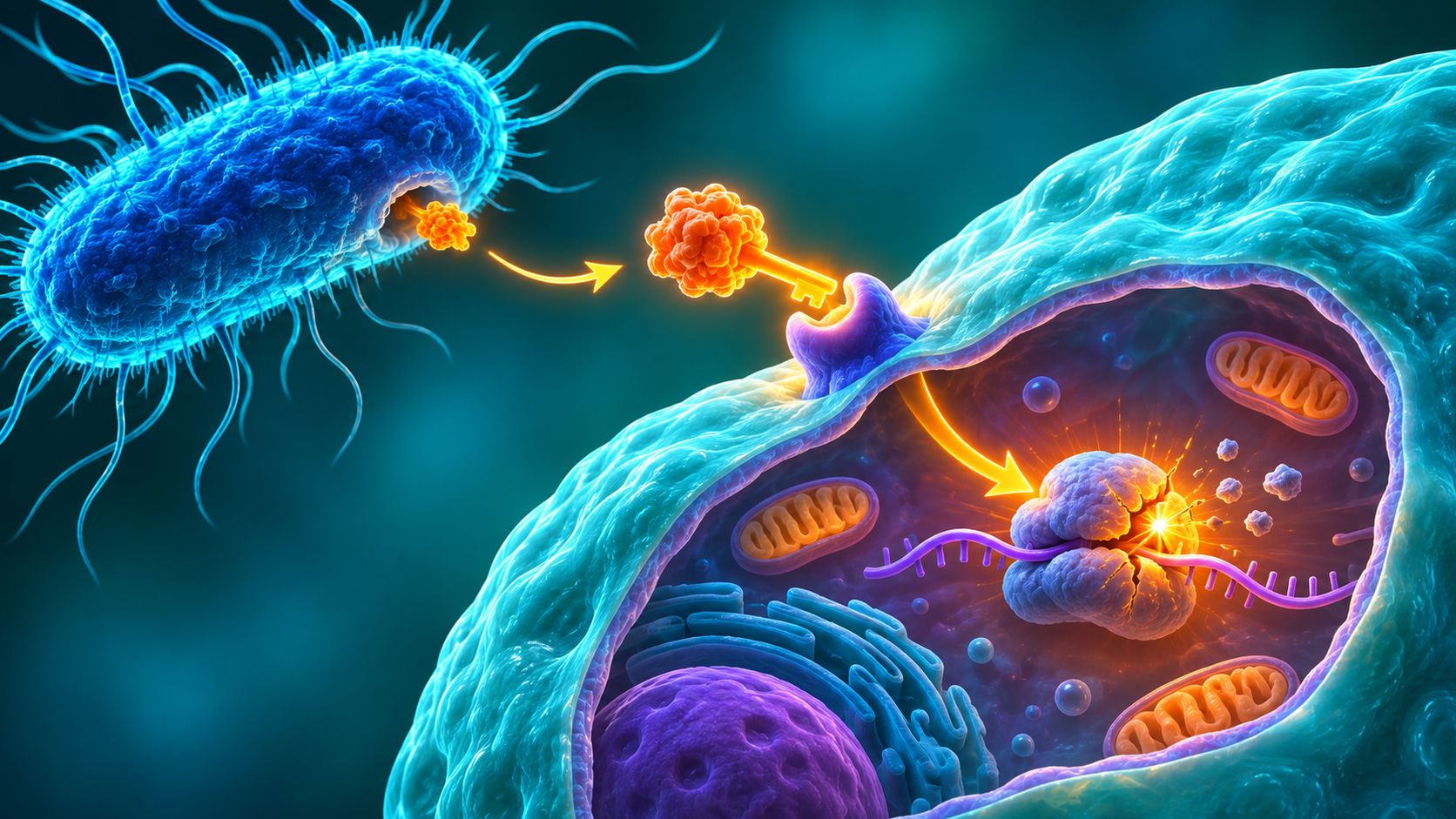
An exotoxin is a protein poison made by living bacteria that targets specific host cells, unlike endotoxin, which is lipopolysaccharide from Gram-negative outer membranes. It can do its damage in tiny amounts, and the harm often looks larger than the number of bacteria a swab can grow. So why does a positive culture from a kitchen counter, a gym mat, or a wound tell you almost nothing about whether a toxin is driving the illness? The answer is that presence, toxin production, delivery route, and leftover toxin are four separate questions. Treat them as one question and you will either overreact to harmless colonization or miss the case that needs antitoxin.
What an Exotoxin Actually Is
What makes a bacterial toxin different from the bacterium itself? An exotoxin is a protein poison made by living pathogenic bacteria. It may be released into tissue or fluid, or delivered directly into a host cell. Its target can be specific, such as a nerve-ending receptor, a gut transport protein, or an intracellular process that keeps a cell alive. The toxin's action can therefore matter more than the number of bacteria detected.
The NCBI Bookshelf overview of exotoxins describes exotoxins as biologically active protein toxins produced and released by viable pathogenic bacteria. Only certain bacterial species make them, and toxin production depends on whether a strain carries and expresses the relevant gene. That gene may be on a chromosome, plasmid, or bacteriophage, so strains of the same species can differ in their capacity to produce a toxin.
A positive culture answers whether bacteria were present in the sampled material. It does not, by itself, show that a toxin gene was present or active, how toxin reached the host, or whether toxin remained after the bacteria were gone. These are separate questions, like checking a delivery route as well as the package: the organism, its toxin-making capacity, and the toxin's route and persistence each affect what a finding means.
The diagram defines an exotoxin as a biologically active protein poison produced by pathogenic bacteria.

The Three Functional Groups
Three functional groups help connect a toxin's action with the kind of symptoms it may cause. Cytotoxins injure or kill cells. Neurotoxins disrupt nerve signaling. Enterotoxins act on the gut. These labels describe the toxin's main target, not the severity of an exposure.
Exotoxins can prompt neutralizing antibodies. Those antibodies may block a toxin's receptor binding or enzyme activity if they reach a functionally critical site. Still, finding the organism does not establish toxin-mediated disease. The strain's toxin production and the exposure route must fit the illness.
Reading rule: Finding the organism is not the same as finding the toxin.
In 1888, Émile Roux and Alexandre Yersin showed that diphtheria bacteria could cause disease through a diffusible toxin, rather than only through bacterial invasion, as described in this history of exotoxin research. For unfamiliar terms such as cytotoxin or toxoid, PatientNotes medical terminology tools offer a place to look up definitions.
Exotoxin Compared with Endotoxin
Stop treating the two words as synonyms. The comparison below is the fastest way to see where the biology diverges, and the rows that matter most are chemical nature, heat, and potency.
The Comparison That Ends the Confusion
| Feature | Exotoxin | Endotoxin |
|---|---|---|
| Chemical nature | Protein | Lipopolysaccharide, especially lipid A |
| Which bacteria | Selected Gram-positive and Gram-negative species | Gram-negative outer membrane |
| How it leaves the cell | Secreted by living cells or injected | Released mainly when the cell lyses |
| Heat | Often destroyed by sufficient heat | Notably heat-stable |
| Potency and target | Very high; specific receptors and tissues | Lower per mass; broad inflammation |
| Immune response | Strong antigen; toxoid vaccines possible | Weak antigen |
| Typical illness pattern | Organ-specific toxin disease | Fever, shock, sepsis-like inflammation |
| Familiar examples | Botulinum, tetanus, diphtheria, cholera, Shiga | LPS and lipid A |
Read the table by asking what molecule is present, not which organism is on the swab. Exotoxins are proteins, so sufficient heat, pH extremes, and some proteases can destroy many of them. Endotoxin is lipopolysaccharide, and lipid A is the inflammatory anchor. A toxin protein is built by a living cell and shipped out; endotoxin is part of the outer membrane and is released in quantity mainly when Gram-negative cells break apart.
Potency and target are the next row to fix in your mind. A neurotoxin can silence a nerve terminal at a dose far below the mass of bacterial cells that would be needed to cause the same symptoms by invasion alone. Endotoxin drives a broader pattern: fever, capillary leak, and septic shock. That is why the same word, infection, can describe two different clinical pictures.
Use the pattern to read a case. Cholera produces watery diarrhea through an enterotoxin. Tetanus produces lockjaw and spastic paralysis through a neurotoxin. Botulism produces flaccid paralysis through a neurotoxin. Gram-negative sepsis with fever and shock fits endotoxin better. None of those patterns is a diagnosis on its own, but each tells you which molecule to look for.
One edge case breaks the clean split. Vibrio cholerae, Shigella, certain Escherichia coli, and Pseudomonas aeruginosa can make an exotoxin and also carry endotoxin. The label depends on which molecule is driving the illness, not on the genus alone. If you want the Gram-negative side in more depth, what bacterial endotoxin does in the body walks through the inflammatory cascade.
How Exotoxins Act Deliver and Persist
How does an exotoxin reach a host cell and cause damage? Many clinically important exotoxins work like a parcel with two functional ends. The binding domain acts like an address label, docking on a protein, glycoprotein, or glycolipid receptor. The active domain then acts like a tool. A toxin may remain at the membrane, form a pore, hydrolyze membrane substrates, alter cell signaling, or enter the cell and attack an internal target (review of exotoxin mechanisms).
The Parcel Model
The sequence runs from docking to damage. Following those steps makes it easier to understand how different toxins work.

Once inside, the toxin's active part can do several kinds of work. Diphtheria toxin and Pseudomonas exotoxin A both add an ADP-ribose group to elongation factor 2, stopping the cell from making proteins and leading to cell death. Other toxins block neurotransmitter release, disrupt the cytoskeleton, trigger programmed cell death, change intestinal cell signaling so water moves into the gut, or act as superantigens that activate many T cells at once.
Some exotoxins travel by a route other than release into surrounding fluid. Pseudomonas aeruginosa uses a type III secretion system to inject ExoS, ExoT, ExoU, and ExoY directly into host cells. These effectors disrupt cytoskeletal regulation, membranes, and intracellular signaling (review of direct toxin delivery). Removing bacteria from a surface addresses bacterial presence, but does not by itself establish whether a toxin has already been delivered or remains active.
Persistence is another part of the picture. Some toxins are unstable or become diluted quickly; others can keep damaging tissue or prolong inflammation after the bacteria are gone. Bacterial presence, the presence and expression of toxin genes, the route of toxin delivery, and any leftover active toxin are separate questions. A negative result for bacteria therefore does not, by itself, show whether toxin-related effects have ended. The broader sequence of colonization, invasion, and toxin production is explained in how bacteria cause disease.
The Four-Part Check
Use these four checks to keep distinct questions separate:
- Organism present. A culture or swab can help answer whether bacteria are present.
- Toxin gene expressed. The strain must carry the relevant gene and turn it on.
- Delivery route fits. Food, a wound, inhalation, and injection are different routes to consider.
- Toxin still active. Toxin already produced may remain after the bacteria that made it are gone.
Hygiene rule: Cleaning can remove bacteria and may stop new toxin production. It does not neutralize toxin a person has already absorbed.
Notable Exotoxins and the Illnesses They Cause
The roster below is a recognition aid, not a diagnostic ladder. Match the syndrome to the toxin class first, then confirm with the lab and the exposure history.
| Toxin | Organism | Class | Main effect |
|---|---|---|---|
| Botulinum neurotoxin types A to G | Clostridium botulinum | Neurotoxin | Flaccid paralysis by blocking acetylcholine release |
| Tetanus toxin | Clostridium tetani | Neurotoxin | Spastic paralysis and lockjaw |
| Diphtheria toxin | Corynebacterium diphtheriae | Cytotoxin | Stops protein synthesis via EF2; membrane, heart, and nerve injury |
| Cholera toxin | Vibrio cholerae | Enterotoxin | Massive watery diarrhea |
| Shiga toxin | Shigella species and Escherichia coli O157:H7 | Cytotoxin | Bloody diarrhea and hemolytic uremic syndrome risk |
| TSST-1 | Staphylococcus aureus | Superantigen | Toxic shock and cytokine storm |
| Exotoxin A | Pseudomonas aeruginosa | Cytotoxin | Stops protein synthesis via EF2 in invasive infection |
Why Botulinum Sets the Scale
Botulinum neurotoxin is the clearest demonstration of potency. Clostridium botulinum makes seven recognized serotypes, A through G, though human foodborne disease is mainly linked to types A, B, E, and F. The toxin blocks acetylcholine release at neuromuscular junctions, producing the flaccid paralysis that defines botulism. U.S. surveillance recorded an average of 162 botulism cases per year from 2011 through 2015, and historical U.S. data document 962 outbreaks between 1899 and 1990, involving 2,320 cases and 1,036 deaths, about 44.7 percent fatal in that series (CDC clinical guidance on botulism).
For a 70-kilogram adult, the same guidance estimates that the lethal amount of purified type A toxin may be about 70 micrograms if swallowed and only 0.80 to 0.90 micrograms if inhaled. Those figures are extrapolated estimates, not a precisely established human lethal dose. The route of exposure changes the number by orders of magnitude, which is why inhalation and food exposure are handled as different problems.
Scan the rest of the table by pattern. Tetanus toxin causes spastic paralysis and lockjaw. Diphtheria toxin stops protein synthesis through EF2 and can injure the throat membrane, heart, and nerves. Cholera toxin drives massive watery diarrhea. Shiga toxin from Shigella or E. coli O157:H7 causes bloody diarrhea and carries a risk of hemolytic uremic syndrome. Staphylococcal TSST-1 acts as a superantigen and can trigger toxic shock. Pseudomonas exotoxin A shuts down protein synthesis in serious wound and lung infection.
If the concern is a food handler with a skin lesion, Staphylococcus aureus food poisoning covers the enterotoxin route rather than the toxic shock route. Food, wounds, and medical care are different exposure routes, so the same word exotoxin does not mean one risk level. A catered lunch, a puncture wound, and a ventilator circuit each require a different prevention plan.
Common Questions About Exotoxins
Questions That Decide the Response
Short version: A culture result answers a different question from a toxin exposure.
Do antibiotics remove exotoxin already in the body? No. Antibiotics and surface killing can stop further production, but preformed toxin keeps acting until it is neutralized or cleared. Medical antitoxin is the clinical tool for that, not a disinfectant wipe.
Does cooking destroy exotoxin? Only sometimes. Many exotoxins are heat-labile, but endotoxin is heat-stable, and validated heat treatment depends on the food matrix and the specific toxin. Reheating a contaminated food is not a reliable fix.
Can an exotoxin spread from person to person? The bacterium may spread, but most toxin illness is not contagious the way a virus is. Foodborne botulism does not pass between people, and tetanus is acquired from wounds rather than from another person. Hospitals still use standard precautions because the bacteria can move on hands and equipment, and how hospitals reduce infection spread lays out the practical sequence.
Does a positive swab mean the bacteria are making exotoxin? Not on its own. The strain must carry and express the toxin gene, so a culture of Staphylococcus aureus does not confirm TSST-1 production.
Are exotoxins targeted by vaccines? Yes. Diphtheria and tetanus vaccines use detoxified toxin, called toxoid, to train the immune system to block the toxin before disease develops.
When to Seek Care for a Toxin Illness
Warning Signs That Need a Clinician
Seek urgent care for suspected botulism, including double vision, trouble swallowing, or descending weakness. A clinician should also assess jaw spasms after a wound, a throat membrane with breathing trouble, bloody diarrhea after possible Shiga toxin exposure, or sudden shock with a possible staphylococcal source. These symptoms need medical evaluation because the concern may be toxin already produced or absorbed, not just bacteria on a surface.
Disinfectant wipes cannot treat toxin in the body. Antitoxin and supportive care are clinical decisions. To reduce the chance of more bacteria producing toxin, use good hand hygiene, safe food temperatures, wound care, and regular cleaning of high-touch surfaces in kitchens, gyms, and clinics.
BacteriaFAQ.com offers organism-level cleaning guidance for Staphylococcus aureus, E. coli, and similar surface risks. Use it as a reference, not a substitute for medical care.
Takeaway: Check whether the concern is the germ, its toxin gene, how toxin entered the body, or toxin already produced. The right response depends on which applies.
For surface prevention, choose EPA-registered disinfectant wipes with a label claim for the target organism. Keep the surface wet for the full dwell time before wiping it dry, and check the label for each new spill, shift, or outbreak response.
Leave a Reply