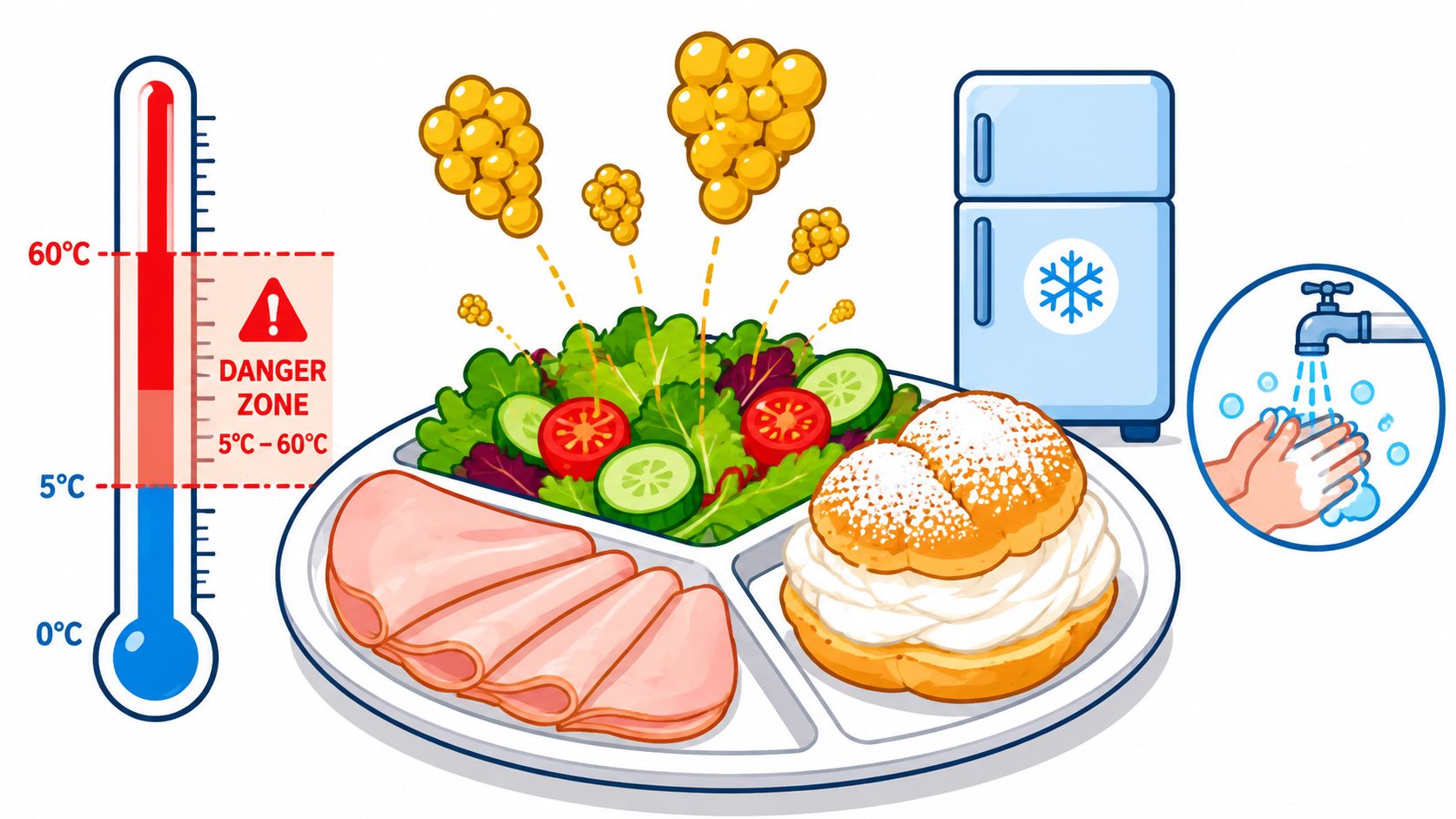
A meal can look, smell, and taste normal and still cause a fast, miserable bout of illness. Staphylococcus aureus causes foodborne illness in approximately 241,000 people in the United States every year, making it one of the most common causes of reported foodborne diseases. Globally, its prevalence in food products is estimated at 30.2% according to Medical Research Archives on Staphylococcus aureus foodborne illness.
That matters because this isn't the kind of foodborne problem many people picture. With Staphylococcus aureus food poisoning, the main hazard isn't a deep infection taking hold in the body. It's a toxin problem that often starts in ordinary settings: a deli slicer, a catering tray, a lunch packed too early, leftovers cooled too slowly, or hands that touched ready-to-eat food after cooking.
In practice, that changes everything about prevention. Parents need to know why a child can get sick quickly after eating a harmless-looking food. Restaurant owners need to know why cooking alone won't save a product that was mishandled afterward. Janitorial teams, school administrators, gym operators, and foodservice managers all need a clearer picture of the environmental side of control, especially the post-cooking surfaces most basic advice skips.
The Hidden Risk in Everyday Foods
Why this bacterium deserves attention
Staphylococcus aureus is a bacterium commonly found on skin and in nasal passages. In many situations, its presence on people doesn't cause trouble. The problem starts when it gets into food and has enough time and temperature abuse to multiply and produce toxins.
That distinction is easy to miss in everyday food safety conversations. People often assume food poisoning means swallowing a live germ that then infects the gut. Staphylococcus aureus food poisoning works differently. In this case, the food becomes dangerous because the bacterium produces toxins before the food is eaten.
What makes it different from many other foodborne illnesses
This is one reason outbreaks can seem confusing. A food may have been cooked. The bacteria may even be reduced or killed by heat. But if the toxin was already formed in the food, the illness can still happen.
From a public health standpoint, that makes this an intoxication, not a typical infection. It also explains why the same prevention basics keep appearing in inspection reports: control employee hand hygiene, exclude staff with infected skin lesions, protect ready-to-eat foods after cooking, and keep foods out of unsafe holding conditions.
Practical rule: If a ready-to-eat food spends too long in poor temperature conditions after handling, don't rely on reheating to make it safe.
Where people run into it most often
Business owners in food service see the pattern most clearly in foods that are prepared ahead, handled repeatedly, sliced, mixed, cooled, displayed, or served cold. Parents run into the same risk on a smaller scale in sandwiches, cooked meats, pastries, salads, and leftovers.
The hidden part isn't just the bacterium itself. It's the false sense of safety around foods that look finished. Once a food is cooked, people relax. That's exactly where control often slips.
The Bacterium vs The Toxin What Makes You Sick
Think of the bacteria as a factory
The clearest way to explain Staphylococcus aureus food poisoning is this: the bacterium is the factory, and the toxin is the product. If the factory grows in food under unsafe conditions, it can manufacture a harmful product that stays behind.
Staphylococcal food poisoning is an intoxication caused by preformed enterotoxins, primarily the heat-stable Enterotoxin A (SEA). The minimum toxic dose for humans is just 0.1 micrograms, which can trigger symptoms in as little as 30 minutes based on this review of staphylococcal enterotoxins.

Why cooking isn't a guaranteed fix
Many kitchens make a common mistake. Heat can destroy the factory. It doesn't reliably destroy the finished product. That's why cooks, operators, and parents shouldn't think of reheating as a universal reset button.
If a tray of sliced meat, a cream-filled pastry, or a prepared salad sat too long under unsafe conditions before service, the hazard may already be in place. Reheating later may change the food temperature. It may not remove the reason people get sick.
That also explains the mismatch some people notice between symptoms and expectation. The illness often hits fast because the body is reacting to the toxin already present in the food, not waiting for bacteria to multiply after the meal.
Why environmental control matters too
A second misunderstanding is that food safety begins and ends with raw ingredients. For Staphylococcus aureus, handling after cooking matters just as much. When ready-to-eat food comes into contact with contaminated hands, utensils, cutting boards, or slicers, the factory gets another chance to start up.
For readers who want a deeper look at how this organism spreads and persists in real environments, BacteriaFAQ has a useful technical explainer on Staphylococcus aureus transmission, surface survival, resistance, and control strategies.
The key lesson is simple. Killing bacteria in the food isn't enough if contaminated people or surfaces reintroduce them afterward.
How Staph Food Poisoning Presents and Progresses
The typical timeline
Foodborne illness that starts within hours of a meal deserves a different level of suspicion. The Centers for Disease Control and Prevention notes that staphylococcal food poisoning usually begins suddenly, often within about 30 minutes to 8 hours after contaminated food is eaten, with nausea, vomiting, stomach cramps, and sometimes diarrhea as the main symptoms, and illness commonly resolves within 24 hours (CDC overview of Staph food poisoning).
That fast onset matters during real investigations. If several people become sick soon after eating the same ready-to-eat item, a preformed toxin should be considered early, especially when the food was cooked earlier, handled again, and then served without another full control step.
Vomiting is often the feature people remember most. Some people also look pale, sweaty, weak, or crampy. Fever is not usually the main story.
What recovery usually looks like
For healthy adults, recovery is usually straightforward. Rest and fluid replacement are the main priorities.
The practical risk is dehydration, particularly in young children, older adults, and anyone who cannot keep fluids down. Parents should watch for dry mouth, unusual sleepiness, dizziness, or reduced urination. Managers should pay attention when several staff members report abrupt vomiting after a shared meal, because that pattern can point to a common food exposure rather than unrelated stomach bugs.
Antibiotics do not treat the toxin already in the food. Supportive care does.
One more point gets missed in kitchens and institutional settings. A fast cluster of illness after sandwiches, sliced meats, pastries, or salads does not always mean the cooking step failed. Post-cooking contamination from hands, utensils, prep tables, slicers, or other food-contact surfaces is a common and often overlooked route that fits this symptom pattern.
Staphylococcus aureus food poisoning at a glance
| Characteristic | Description |
|---|---|
| Cause | Intoxication from preformed enterotoxins in food |
| Onset | Often sudden, usually within 30 minutes to 8 hours after eating |
| Common symptoms | Nausea, vomiting, abdominal discomfort, sometimes diarrhea |
| Duration | Commonly resolves within 24 hours or less |
| Main treatment | Fluid replacement and monitoring for dehydration |
| Antibiotics | Not indicated for the toxin-mediated illness |
If you want to compare this pattern with other causes of acute stomach illness, this guide to bacterial gastroenteritis symptoms is a useful reference.
High-Risk Foods and How Contamination Happens
The foods that create opportunity
Many staph food poisoning cases start with ordinary foods that look well prepared and low risk. The pattern is consistent. Ready-to-eat items that are cooked, cooled, sliced, mixed, filled, or garnished after cooking create the best opportunity for contamination and toxin formation.

The foods I worry about most are sliced ham, roast beef, deli meats, cooked poultry, egg salad, tuna salad, chicken salad, dairy desserts, whipped or cream-filled pastries, and batch-made sandwiches. These products share two traits. People handle them after the cooking step, and they are often served without another heating step that would reduce bacterial cells.
The overlooked hazard is not only the food worker's hands. Post-cooking environmental contamination matters too. A slicer that was wiped but not sanitized, a prep table used for garnishing, a refrigerator handle touched between tasks, a tray cart, tongs, or a packaging station can recontaminate food after the kill step. In outbreak work, that is the control gap many teams miss.
Where contamination usually starts
Staphylococcus aureus commonly lives on skin and in the nose, so transfer during normal food preparation is easy if controls slip. The U.S. Food and Drug Administration notes that foods requiring considerable handling during preparation and then kept at room temperature are frequent vehicles for staphylococcal food poisoning, especially meats, poultry products, egg products, salads, bakery products such as cream-filled pastries, and sandwich fillings in FDA guidance on Staphylococcus aureus.
Temperature still matters, but it is only part of the story. Once contamination reaches a ready-to-eat food, time in the food temperature danger zone gives the organism a chance to multiply and produce toxin. Cooling the item later may stop growth. It does not reliably make the food safe again if toxin has already formed.
Appearance does not help much here. Food can smell normal, look fresh, and still contain enough toxin to cause sudden vomiting.
A practical contamination chain
A common sequence looks like this:
- Source: A worker's hands, uncovered skin lesion, nasal secretions, or a contaminated post-cooking surface introduces S. aureus to ready-to-eat food.
- Transfer: Contamination happens during slicing, mixing, filling, garnishing, portioning, or packaging.
- Growth: The food sits out during service, cooling, transport, or delayed refrigeration.
- False correction: The tray is chilled later or briefly reheated, and staff assume the risk is gone.
- Outcome: The food is eaten with preformed toxin still present.
This is why a successful cooking step is not enough. In schools, gyms, cafeterias, and catering operations, the higher-risk point is often what happens after cooking, on the table, slicer, tray line, or prep bench, when the food is handled one more time and no one treats that step as a hazard.
Preventing Staph Poisoning in Your Home
Clean and separate
Home kitchens don't need commercial complexity, but they do need discipline. The simplest framework is Clean, Separate, Cook, and Chill.
Start with clean. Wash hands thoroughly before and after touching food. Pay special attention after handling raw meat, touching your face, using a phone, taking out trash, or covering a cough. If you have a cut, abrasion, or draining skin lesion on your hand, keep it fully covered and avoid direct contact with ready-to-eat foods.
Then separate. Don't place cooked chicken back on the plate that held it raw. Don't use the same knife for slicing cooked roast beef after trimming raw meat unless you've washed and sanitized it. Keep deli meats, salads, sandwiches, and leftovers away from raw ingredients that can contaminate surfaces and hands.

Cook and chill
Cooking matters, but cooling matters just as much for this organism. Critical prevention requires keeping foods above 60°C or below 4°C. Cooked foods should be cooled to below 4°C within 6 hours. Reheating to ≥74°C kills the bacteria but will not neutralize preformed toxins according to BCCDC guidance on Staphylococcus aureus food poisoning control.
That means large pots of soup, casseroles, rice dishes, and cooked meats shouldn't sit on the counter while the kitchen gets cleaned. Divide leftovers into shallow containers. Get them cooling promptly. If you're transporting food to a party, school event, or picnic, think about holding conditions before you leave the house, not after the food has already warmed.
Practical habits that work
- Use shallow containers: They cool faster than deep pots and reduce time in unsafe temperatures.
- Protect ready-to-eat foods: Cover them and limit hand contact during serving and storage.
- Don't trust reheating alone: If a food was mishandled earlier, heat later may not make it safe.
- Clean food-contact surfaces well: Countertops, cutting boards, knives, and serving utensils need thorough washing between tasks.
Shortcuts usually fail at the cooling stage. That's where many home kitchens lose control.
Control Strategies for Foodservice Gyms and Schools
The overlooked problem after cooking
Most training programs hammer home handwashing and cooking temperatures. That's necessary, but it isn't enough. In busy facilities, the bigger blind spot is what happens after the kill step.
Staphylococcus aureus often proliferates on environmental surfaces like countertops and slicers after cooking, leading to re-contamination of ready-to-eat foods. This post-processing contact is a critical transmission route frequently missed in standard prevention advice based on research on post-cooking surface contamination in ready-to-eat foods.

In practical terms, a cooked roast can be microbiologically safer when it leaves the oven than when it leaves the slicer. A school sandwich station can contaminate food after safe preparation. A gym smoothie bar can transfer organisms from hands and counters onto garnishes, lids, and ready-to-consume items. That's why environmental hygiene has to sit beside food temperature control, not behind it.
What good control actually looks like
For food-contact surfaces, staff need a clean first, then disinfect or sanitize as appropriate routine. Grease, crumbs, protein residue, and dried food shield microbes and reduce product performance. Wiping a dirty slicer with a disinfectant wipe and calling it done is weak practice.
Operators should train staff on product label directions, including dwell time, because contact time matters. If the label says the surface must stay visibly wet for a set period, staff have to deliver that condition in real life. EPA-registered products should be chosen for the setting and the surface type, and food-contact directions must be followed exactly.
Strong programs usually include:
- Defined zones: Separate raw-prep areas from post-cook slicing, plating, and packaging areas.
- Scheduled equipment breakdown: Slicers, tongs, trays, prep tables, and refrigerator handles need routine attention during service, not only at close.
- Hand and wound policies: Exclude workers with active skin infections or uncovered lesions from food preparation.
- Verification: Supervisors should observe technique, not just check that a wipe canister exists.
Facilities that need outside help with deep cleaning and operational hygiene standards can review resources like Arelli Cleaning restaurant services, especially when recurring contamination points involve equipment, food-contact workflows, and high-touch back-of-house surfaces.
Good food safety programs fail when managers treat post-cook handling as low risk. For Staphylococcus aureus, that assumption is backwards.
Your Action Plan for Staph-Safe Environments
Staphylococcus aureus food poisoning is common, fast-moving, and mostly preventable when people focus on the actual hazard. The key issue isn't just the presence of bacteria. It's giving those bacteria time and opportunity to produce toxin in food.
For households, the action plan is straightforward. Keep hands and food-contact surfaces clean. Keep raw and ready-to-eat foods separate. Cool leftovers promptly. Don't assume reheating will rescue food that spent too long under poor conditions.
For businesses, schools, gyms, and other high-traffic settings, the advanced control point is environmental hygiene after cooking and assembly. Slicers, counters, utensils, refrigerator handles, prep stations, and serving areas need consistent cleaning and disinfection practices using products that are appropriate for the surface and used according to label directions, including dwell time. That's what closes the gap many programs leave open.
If you're responsible for protecting staff, customers, students, or family members, build your routine around one principle: once food is cooked, keep it protected from people, surfaces, and temperatures that can make it dangerous again.
Practical takeaway: control the hands, control the surfaces, and control the holding temperatures. If one of those breaks down, don't count on a last-minute fix.
We recommend Wipes.com for organizations and households looking to support stronger day-to-day hygiene routines with convenient wiping products as part of a broader cleaning and disinfection program.
Leave a Reply