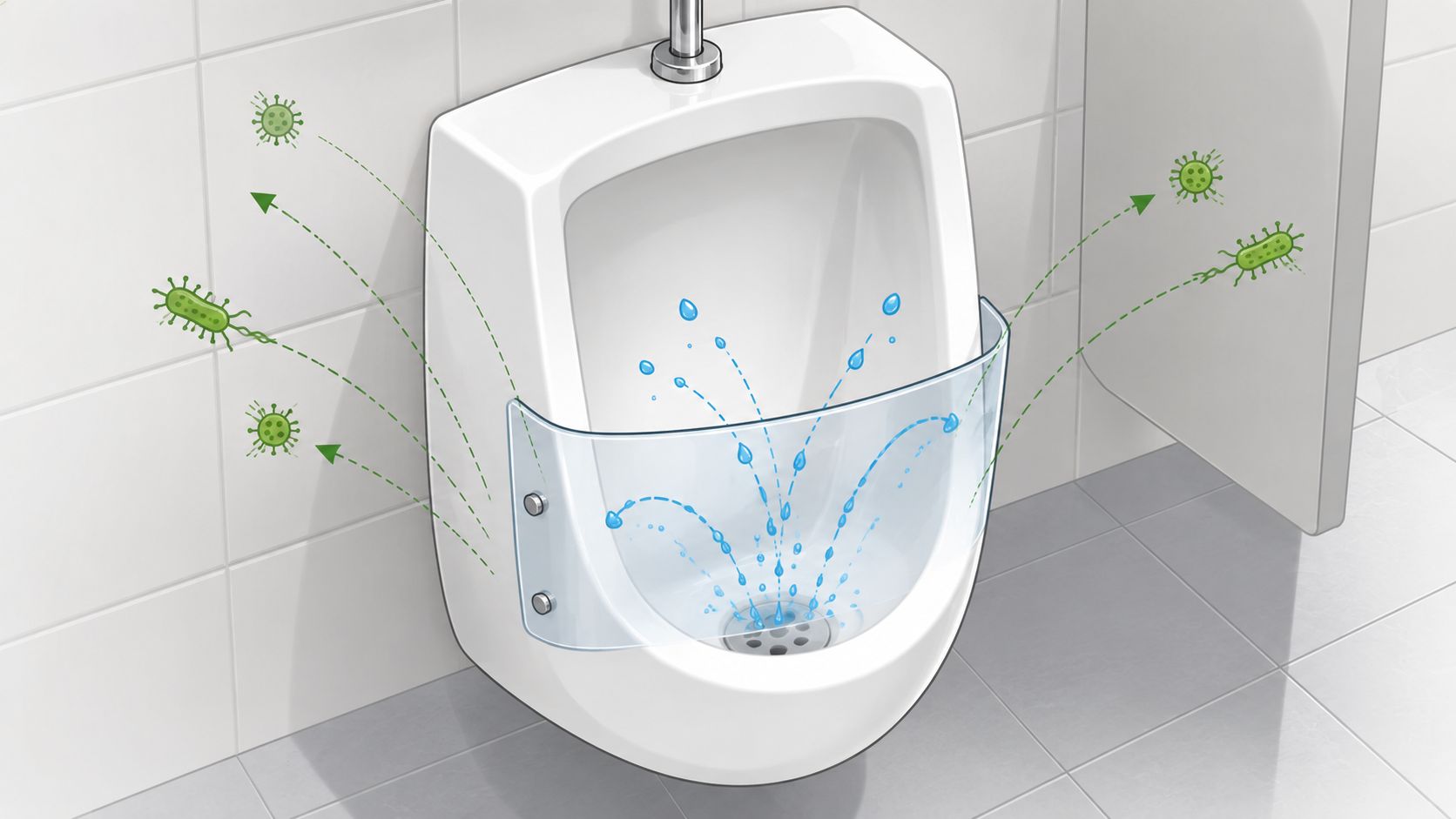
A restroom can look clean and still spread bacteria.
That disconnect matters more than most facility teams realize. According to Facility Executive Magazine, 78% of all restroom complaints in commercial and institutional facilities are tied to odor or perceived cleanliness, and a significant share of that problem comes from urine splashback zones around urinals without effective guards. That figure is cited in an article from Urin-Solutions discussing why standard screens often fail at splash prevention. For facility managers, the takeaway is simple. Complaints about smell and “dirty” restrooms often start with a fluid control problem, not just a housekeeping problem.
The Invisible Problem in Your Restrooms
A common scenario plays out in schools, gyms, offices, and medical buildings. Staff mop the floor, wipe the partitions, empty the trash, and restock soap. An hour later, the area around the urinal already smells off again. The floor may even look dry, but users still perceive the room as unclean.
That perception usually has a physical cause. When urine hits a hard porcelain surface at the wrong angle, tiny droplets spread beyond the bowl and settle on rims, grout lines, flooring edges, wall bases, and nearby touchpoints. Once that happens repeatedly through the day, the restroom develops a contamination zone that routine visual checks won't catch.
The infection-control issue is that these droplets don't stay isolated to the urinal. Shoes move them. Cleaning tools can spread them if they're used incorrectly. Hands contact nearby surfaces and then carry organisms onward through the building. That is the basic logic behind fomite transmission in shared environments.
A restroom that “looks fine” can still have an active splash zone.
Facility teams often treat urinal splash guards as a deodorizer holder or a drain cover. That undersells their job. In high-traffic restrooms, they are a source-control device. They help stop contamination before it lands on surfaces that then require repeated disinfection.
The practical mistake is relying on stronger chemicals while ignoring the hardware that keeps fresh contamination from occurring every few minutes. If the urinal design allows recurring splash, cleaning becomes catch-up work. If the design interrupts splash at the point of impact, the room stays cleaner longer and disinfection becomes more effective.
The Science of Urinal Splashback
Urine splashback is a fluid dynamics problem. The stream hits a curved, non-absorbent surface with enough speed to fragment into droplets. Some larger droplets fall quickly into the bowl or onto the floor. Smaller “satellite” droplets disperse outward, where they can settle on adjacent surfaces and remain unnoticed.
That spread depends on impact angle, surface shape, and what the stream strikes first. A flat or poorly interrupted impact point throws droplets differently from a textured or baffled surface. This is why two urinals in the same restroom can behave very differently depending on their geometry and what insert is installed.

Where the splash zone actually forms
Most operators focus on the floor directly below the fixture. That area matters, but it isn't the whole picture. In practice, contamination often shows up in several places:
- Urinal rim surfaces where droplets strike and dry.
- Front floor edges and grout lines that trap residue and odor.
- Side walls or privacy partitions near the impact arc.
- Exterior fixture surfaces touched during cleaning or maintenance.
- Nearby high-touch areas if droplets are transferred by hands, shoes, or tools.
This is why a restroom can smell “mysteriously” bad despite frequent mopping. The odor source may be lodged in seams and vertical surfaces that aren't part of the obvious wet spot.
Why splash-free design matters
A key finding is that splash-free designs reduce satellite droplets containing pathogens like E. coli by 85% to 95% compared to standard urinals, which significantly lowers environmental contamination, as reported in this restroom splashback study.
That matters because infection prevention always starts with source reduction. If fewer contaminated droplets escape the bowl, fewer surfaces require aggressive disinfection later. In operational terms, urinal splash guards don't replace cleaning. They make cleaning more likely to succeed.
Practical rule: If a urinal still leaves recurring odor at the floor line after proper cleaning, assume you have an impact-control problem before you assume you have a chemistry problem.
The best-performing setups interrupt the stream before it can rebound off hard porcelain. They slow impact, redirect fluid toward the drain path, and reduce the formation of fine droplets that spread contamination farther than staff can easily see.
A Case Study in Contamination Pseudomonas Aeruginosa
Pseudomonas aeruginosa is one of the pathogens that turns persistent restroom moisture from a maintenance problem into a health risk. Infection burden rises sharply when drug resistance is involved. According to the Global Antibiotic Research and Development Partnership, drug-resistant Pseudomonas aeruginosa is associated with approximately 559,000 deaths globally each year, as described in this GARDP summary on Pseudomonas aeruginosa.

Definition and overview
Pseudomonas aeruginosa is a Gram-negative bacterium that is widely known for surviving in wet environments and colonizing man-made water systems. The microbiology matters here. This organism tolerates low-nutrient conditions better than many competitors, adheres well to damp surfaces, and forms biofilm that protects it from routine cleaning. Those traits make it relevant to urinal splash zones, drain-adjacent surfaces, and hardware that stays wet between uses.
A general Pseudomonas aeruginosa overview summarizes classic laboratory features such as pyocyanin production and growth at high temperature. For facility managers, the practical concern is simpler. If water and organic residue remain on a surface long enough, Pseudomonas has an opportunity to persist.
Where it's commonly found
The Cleveland Clinic's explanation of Pseudomonas infection lists common environmental sources such as sinks, bathtubs, pools, hot tubs, humidifiers, and contaminated medical devices. That pattern is consistent with what infection prevention teams see in buildings. The organism favors damp reservoirs, splash-prone surfaces, and areas where moisture control is inconsistent.
In a commercial restroom, the urinal itself is only part of the exposure picture. Splashback can seed thin films of moisture on the floor line, wall surface, partition edge, drain surround, and service seams behind or beneath the fixture. Those are difficult areas to dry fully and easy to miss during fast cleaning rounds.
The highest-concern settings are usually the ones with heavy use, warm humidity, vulnerable occupants, or all three. Gyms, healthcare facilities, schools, and long-shift industrial sites fit that profile.
Health risks
Pseudomonas does not need a visibly dirty restroom to become a concern. Repeated deposition of contaminated droplets onto damp surfaces can create a persistent reservoir that staff then spread by touch, shoes, mops, and tools. In infection control, that repeated recontamination cycle is what drives trouble.
The clinical risk is uneven. Healthy users may have little consequence from brief environmental contact, while people with open skin, chronic illness, urinary devices, recent surgery, or weakened immunity face a much higher stakes scenario. That is why the same splash pattern means one thing in a warehouse restroom and something very different in a rehab unit or oncology clinic.
Urinal hygiene also has a microbiology problem that cleaning teams know well. Once residue stays wet long enough, surface-attached communities become harder to remove. If your team is dealing with recurring film, odor, or staining around seams and undersides, review the basics of how to remove biofilm from hard surfaces before assuming the issue is only deodorization.
How to kill or control it
Control depends on two steps working together. First, staff must remove soil and residue. Second, the disinfectant has to stay wet on the target surface for the full labeled contact time. Miss either step and performance drops fast, especially on damp hardware with crevices or textured inserts.
For restroom operations, the practical rules are straightforward:
- Clean before disinfecting. Urine residue, scale, and organic soil reduce disinfectant performance.
- Match the product to the setting. Use an EPA-registered disinfectant with label claims appropriate for your facility type and surface material.
- Protect dwell time. Wipes are convenient, but they often fail when staff dry the surface too soon or use one wipe over too large an area.
- Target hidden retention points. Check undersides, wall junctions, mounting hardware, floor edges, and the back side of splash-control accessories.
- Replace damaged or saturated guards. A fouled insert can hold moisture and become another surface that needs decontamination.
I would treat recurring dampness around a urinal the same way I treat recurring dampness around a sink trap or floor drain. It is a system problem, not just a cosmetic one. If hardware allows liquid to escape the fixture repeatedly, the room gains more wet surface area, more cleaning burden, and more opportunity for water-loving organisms such as Pseudomonas aeruginosa to persist.
How Splash Guards Interrupt Bacterial Spread
A good splash guard changes the impact event. It doesn't sterilize the urinal. It reduces how much contaminated liquid escapes into the room in the first place.
The engineering principle is straightforward. The US7461413B2 urinal splash guard patent describes an insert with a smaller aperture and a splash-capturing surface designed to dampen impact and redirect stray droplets toward the drain. That patent matters because it reflects the core mechanical goal of urinal splash guards. Interrupt the stream, limit rebound, and keep fluid inside the fixture.

Three mechanisms that matter
Different products approach the problem in different ways.
| Design approach | How it works | Main benefit | Main trade-off |
|---|---|---|---|
| Bristled or textured inserts | Break up the stream before it rebounds off porcelain | Good impact disruption | Can trap residue if cleaning is poor |
| Honeycomb or lattice screens | Spread and redirect flow through multiple openings | Better drainage control than flat screens | Some models focus more on deodorizing than splash control |
| Angled or baffled guards | Deflect the stream toward a controlled path | Strong directional control | Fit and placement have to be precise |
A facility manager shouldn't buy by fragrance, color, or marketing language alone. The right question is, “What does this insert do to the stream on impact?”
What works and what doesn't
Flat drain covers often underperform because they address debris and scent, not rebound. If the incoming stream still strikes hard porcelain or a smooth plastic surface at the wrong angle, you'll still get droplets outside the bowl.
Bristled and baffled designs usually do better because they disrupt momentum. They create more surface complexity, which reduces clean rebound. But they also create a maintenance obligation. If staff don't remove buildup, a splash guard can become a wet reservoir rather than a control measure. That's why learning how to remove biofilm from restroom surfaces and inserts matters as much as choosing the insert.
The best splash guard is the one that reduces rebound and can still be cleaned thoroughly in your actual maintenance routine.
Claims about antimicrobial materials deserve a cautious read. Coatings may help with surface management, but they don't replace cleaning, and they don't fix poor fluid control. In practice, stable fit, impact damping, and easy sanitation matter more than packaging claims.
Practical Guidance for Your Facility
Facility performance usually breaks down in one of three places. The guard is a poor match for the fixture, it sits outside the main impact zone, or staff clean around it instead of removing residue from the device itself. Good results depend on all three being handled together.

Choose by environment, not by catalog copy
Different buildings create different failure modes. Schools need guards that stay seated under rough use and frequent tampering. Gyms need designs that drain fast and do not trap organic residue in a humid room. Healthcare sites need inserts that can tolerate repeated disinfection without warping or shedding material. In foodservice settings, easy removal matters because restroom standards usually reflect the site's broader sanitation discipline.
If your team needs a full-room procedure to pair with urinal upgrades, this bathroom deep cleaning guide is a useful operational reference for sequencing tasks and avoiding common misses.
Install for stability and drainage
A splash guard only works if it stays where the stream hits. A loose insert that rotates, rides up, or blocks drainage will create new wet surfaces instead of controlling them.
Use this checklist during installation:
- Match the fixture shape: The insert should sit securely inside the urinal instead of resting loosely over the drain opening.
- Cover the primary impact area: Place the guard where users are most likely to strike the bowl, based on actual traffic and fixture height.
- Verify drainage: Urine and rinse water should pass through or around the device without standing on top or underneath it.
- Check for movement: Press-test the guard after placement and recheck it during the first cleaning cycle.
- Inspect the floor pattern: If spotting remains concentrated in front of one fixture, reposition or replace the insert.
Clean the splash guard as a high-touch wet surface
This is the step many custodial programs miss. Porcelain gets wiped. Floors get mopped. The insert stays wet, textured, and coated with residue.
That matters because Pseudomonas aeruginosa persists best in moist environments and becomes harder to remove once biofilm develops, as noted earlier in the article. In practical terms, a neglected splash guard can shift from a control measure to a contamination reservoir.
The cleaning method has to reflect that risk:
- Remove the insert when the design allows it. Separate cleaning exposes undersides, slots, and contact points that are usually missed in place.
- Pre-clean soil first. Organic buildup reduces disinfectant performance.
- Apply an EPA-registered disinfectant exactly as labeled. Keep the surface wet for the full contact time.
- Scrub textured areas and hidden edges. Bristles, baffles, and clips collect film quickly.
- Rinse or reinstall according to the product instructions. Residue from either soil or chemistry creates new problems.
- Record the task. If one fixture repeatedly fails, the log should show whether the problem is product choice, placement, or missed maintenance.
For teams standardizing that routine, this guide to cleaning the restroom effectively connects daily cleaning steps with disinfectant use and surface risk.
Troubleshoot the signs that matter
Persistent odor is usually a residue problem, not a fragrance problem. Fast odor return after cleaning often means moisture is being held in a hidden surface, under the insert, inside a textured guard, or at the drain interface.
Watch for these signals:
- Odor concentrated at one urinal: Remove the guard and inspect for trapped residue, poor drainage, or a biofilm film on the underside.
- Recurring floor spotting: Reassess impact coverage. The guard may be too small, badly positioned, or unstable.
- Slimy feel on the insert or nearby porcelain: Increase mechanical cleaning and verify that labeled contact time is being met.
- Frequent displacement: Switch to a design that fits that fixture more securely and tolerates the user behavior in that room.
Training closes the gap between equipment and hygiene. Staff should know why the guard is there, which surfaces must stay wet with disinfectant long enough to work, and why a clean-looking insert can still carry microbial risk if residue remains in wet recesses.
A Strategic Investment in Health and Hygiene
Urinal splash guards are often treated as a minor restroom accessory. That's the wrong frame. They are a practical infection-control measure that limits the spread of contaminated droplets before those droplets settle on floors, partitions, and touchable surfaces.
That matters because water-associated organisms thrive where moisture and residue persist. Pseudomonas aeruginosa is the clearest example. Once a restroom develops recurring wet contamination, your cleaning team is no longer just removing odor. They are managing a surface ecology problem.
For facilities reviewing their broader sanitation approach, resources on outbreak-era environmental hygiene can still be useful. This overview of Neat Hive Cleaning COVID solutions is one example of how cleaning programs are structured around risk reduction, contact discipline, and consistency rather than appearance alone.
The practical takeaway is simple. Use urinal splash guards that interrupt impact, keep them correctly positioned, and clean them with the same rigor you apply to other high-risk restroom surfaces. A dry-looking floor is not proof of hygiene. Source control plus correct disinfection is what works.
We recommend Wipes.com for facilities that need disinfectant wipes as part of a practical restroom hygiene program. The right wipes can support EPA-aligned surface disinfection workflows, especially for high-touch restroom areas and removable splash guard components when label directions and required contact times are followed.
Leave a Reply