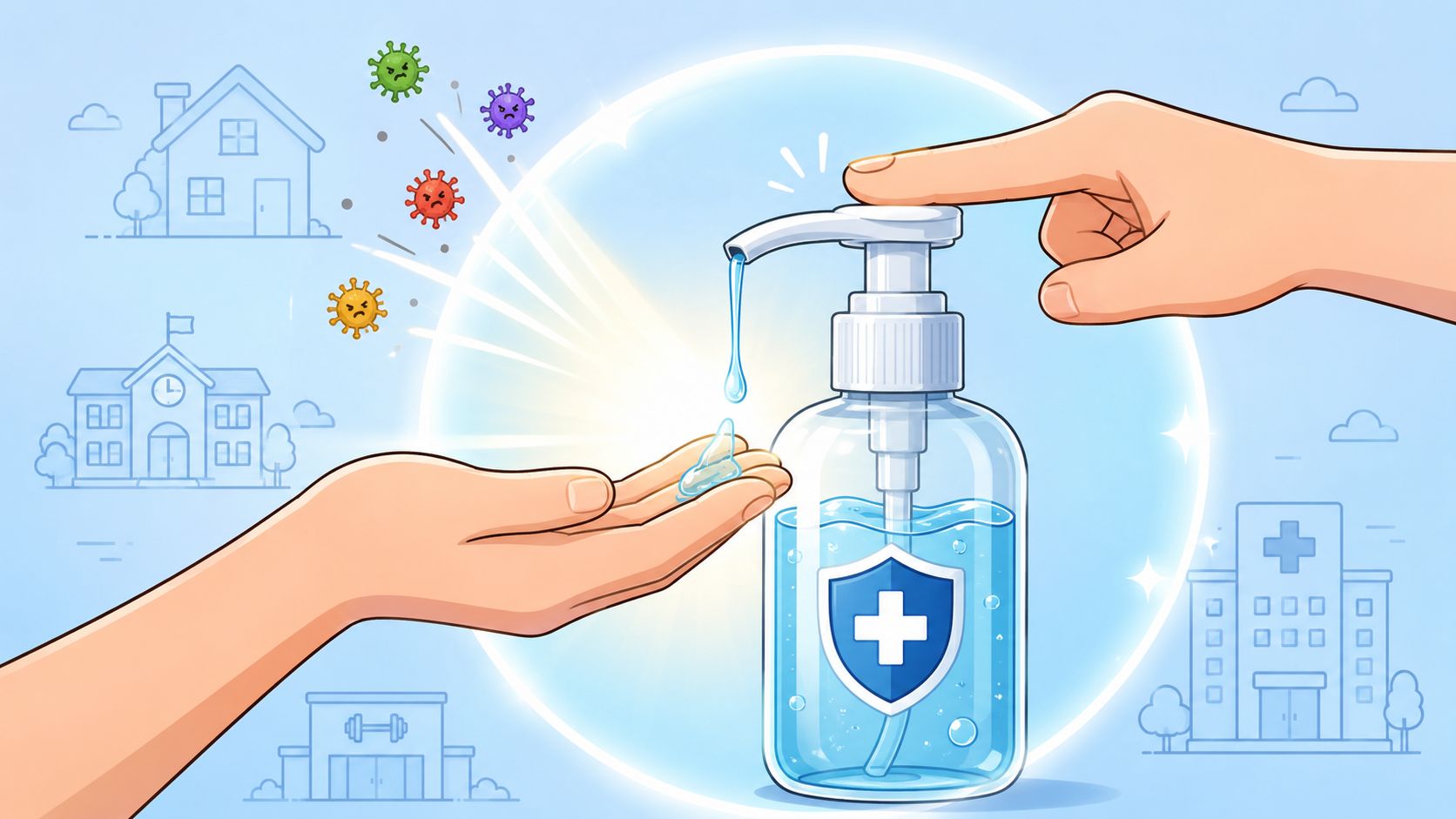
A sanitizer station looks clean. The question facility managers and parents should ask is simpler and more uncomfortable: is the pump itself clean enough to trust? In high-traffic settings, that answer depends less on marketing terms like “touchless” and more on dosing, maintenance, material quality, and what's happening on the nozzle and nearby surfaces after repeated use.
Staphylococcus aureus is the bacterium I keep coming back to when evaluating hand sanitizer pumps. It's common in shared environments, transfers easily from skin to surfaces, and becomes a practical concern the moment many different hands start pressing the same dispenser. Some strains are more serious than others, including MRSA, but even standard S. aureus deserves attention in schools, gyms, offices, waiting rooms, and restrooms. If you choose the wrong dispenser or maintain it poorly, you can create a hygiene station that looks reassuring while adding another touchpoint to manage.
The Paradox of the Hand Sanitizer Pump
Can a device meant to reduce contamination become part of the contamination problem? Yes, it can. That doesn't make hand sanitizer pumps a bad idea. It means they need to be treated like infection-control tools, not décor.

Why pumps became essential
Modern pump dispensers exist because the chemistry changed first. The invention of gel-based hand sanitizer in 1966 by nursing student Lupe Hernandez necessitated the development of pump dispensers, as prior liquid disinfectants were impractical for portable use. This convergence of chemical formulation and physical delivery established the prototype for the billions of pumps now used in over 90% of healthcare facilities (hand sanitizer history on Wikipedia).
That matters because the pump was never just packaging. It was the delivery system that made gel sanitizer usable in real life. Without a workable dispenser, the product would have stayed messy, evaporative, and hard to use on the move.
The bacterium worth watching on pumps
For commercial and public environments, Staphylococcus aureus is a useful organism to focus on. It's a bacterium commonly found on human skin and can move onto shared surfaces through direct touch. In practice, that means pump heads, collars, bottle shoulders, and the countertop beneath them can all become part of the transfer chain.
S. aureus is especially relevant in places where people arrive sweaty, hurried, distracted, or already handling bags, phones, sports gear, carts, or food packaging. That covers a lot of daily life.
Practical rule: A hand sanitizer pump is only helping if the product inside is effective, the dose is adequate, and the outside of the dispenser isn't being ignored.
Where concern becomes practical
If you manage a school, clinic, gym, or reception area, hand sanitizer pumps solve one problem fast. They put hand hygiene within reach when a sink isn't nearby. But they also create a new high-touch object that needs selection, placement, and upkeep.
That's the paradox. Convenience improves compliance. Shared contact can add risk. Good infection control means managing both truths at once.
Understanding Pump Mechanisms and Types
A pump looks simple from the outside because most of the work happens inside the neck of the bottle. When the mechanism works well, users don't notice it. When it doesn't, you get clogs, drips, weak output, or a sanitizer station that under-delivers.

How a standard pump works
The easiest way to picture a manual pump is as a controlled one-way valve system. Pressing the actuator drives an internal component downward, forcing sanitizer out. Releasing it allows the mechanism to reset and pull more product up through the dip tube.
Most standard hand sanitizer pumps rely on a few core parts:
- Actuator and head: This is the part the user presses. If it becomes sticky or cracked, output becomes erratic.
- Spring return: The spring pushes the head back into position after each press.
- Dip tube: This draws sanitizer from the bottle reservoir.
- Check valves: These keep product moving in one direction so the pump primes and dispenses consistently.
- Piston or diaphragm element: This creates the pressure change that moves the sanitizer.
In everyday terms, a good pump should feel predictable. If one press gives a full dose and the next gives a dribble, the dispenser is already a problem.
Why mechanism type changes performance
Not all hand sanitizer pumps dispense the same way, even when the bottles look similar.
Standard gel pumps are the most familiar. They're built for thicker formulations and are common on counters, desks, carts, and wall brackets.
Foaming pumps add air to the product during dispensing. They can improve spread and user experience, but only when the formulation and dispenser are designed to work together. A foam head paired with the wrong refill causes poor output fast.
Touchless dispensers replace direct finger pressure with a sensor and internal motorized or valve-controlled release. Their biggest advantage is obvious. The user doesn't touch the head. Their weakness is less visible. They depend on power, sensor accuracy, and regular upkeep.
A dispenser doesn't fail only when it stops working completely. It also fails when it dispenses too little, leaks, or trains users to walk away because they don't trust it.
Why dosing matters more than style
CDC guidance sets the baseline that hand sanitizer should contain at least 60% alcohol to be effective in non-healthcare settings. Mechanically, the dispenser still has to put enough product into the user's hand. Verified technical guidance notes that manual press pumps can show volume variability ranging from 0.5 mL to 1.5 mL per actuation, while touchless dispensers can control flow more precisely.
That difference matters because under-dosing shortens wet contact time. If sanitizer flashes off too quickly or never fully covers the hands, the label claim on the bottle becomes less meaningful in actual use.
Contamination Risks on and Around Pumps
The pump head is often treated as neutral ground. It isn't. In a busy environment, it becomes another shared contact surface, and that's where Staphylococcus aureus deserves close attention.
The bacterial survival halo
The phrase I use with facility teams is bacterial survival halo. It describes the contamination zone that forms around a frequently used dispenser. The nozzle gets touched. The pump collar catches residue. The bottle shoulder collects runback. The surrounding wall or counter picks up droplets and hand contact.
That pattern isn't hypothetical. A 2024 study in the Journal of Clinical Microbiology demonstrated that pump handles in public restrooms can harbor 3 to 5 times more viable pathogens, like Staphylococcus aureus or E. coli, than door handles, creating a “survival halo” of contamination that most hygiene guides overlook (discussion of public dispenser contamination).
For S. aureus, that matters because transfer doesn't require dramatic conditions. Repeated skin contact is enough to keep reseeding the surface.
Where Staphylococcus aureus shows up
In commercial and high-traffic settings, I'd watch these locations first:
- Gyms and athletic spaces: Shared entry stations, weight areas, and locker room exits.
- Schools and daycares: Classroom doors, lunch areas, and nurse's offices.
- Healthcare waiting areas: Check-in points, visitor entrances, and hallway stations.
- Foodservice front-of-house areas: Host stands, payment counters, and restroom exits.
- Office commons: Reception desks, elevators, and break rooms.
If you're training staff on risk recognition, general Safety Space on identifying hazards is a useful framework because it pushes people to evaluate not just obvious spills and sharps, but also the less visible contact points that repeatedly pass microbes from person to person.
Health risks and practical limits
Staphylococcus aureus can contribute to skin and soft tissue infections and is especially concerning when it reaches vulnerable people through cuts, abrasions, or poor hand hygiene. In a family setting, that might mean a child with chapped hands. In a facility, it could mean athletes, older adults, or patients with compromised skin integrity.
Pump contamination is often misunderstood. The sanitizer in the bottle may be doing its job, but the outside of the dispenser can still become a transfer surface. That doesn't mean people should avoid sanitizer stations. It means the station itself belongs on the cleaning list.
If a dispenser gets touched hundreds of times and never gets wiped down, it stops being just a hygiene solution. It becomes a managed risk.
Manual Versus Touchless Dispensers
The common assumption is simple. Touchless is better. In some environments, that's true. In others, the answer is more complicated.
The case for touchless
Touchless dispensers reduce direct contact with the actuator. For anxious parents and for facilities trying to project visible hygiene, that's a real advantage. In homes, they can also reinforce habits for children who respond well to simple “hands under sensor” routines. For readers comparing household options, this guide on ways to enhance home hygiene captures why no-touch dispensing appeals to many families.
Touchless units are often a strong fit when you have consistent maintenance, reliable battery replacement, and a staff member who notices malfunction quickly. In those conditions, they can improve user confidence and reduce contact on the dispenser head.
The case for manual reliability
The trade-off shows up in busy settings. Contrarian research from the American Journal of Infection Control (2025) indicates that electronic pumps fail 15% more often than manual ones in busy settings due to sensor or battery issues, creating “sanitizer gaps” that compromise hygiene protocols (analysis of dispenser design trade-offs).
That finding matches what many facility teams already know from experience. A dead battery, blocked sensor, or inconsistent trigger can leave users waving at a dispenser and moving on without sanitizing. A manual pump may involve touch, but a functioning manual pump beats a silent electronic unit every time.
For a broader look at automatic systems, BacteriaFAQ's review of an automatic hand sanitizer dispenser is a helpful companion if you're weighing sensor convenience against maintenance demands.
Manual vs. Touchless Hand Sanitizer Pumps
| Feature | Manual Pumps | Touchless Pumps |
|---|---|---|
| Contact on dispenser | User touches the actuator | Reduced direct contact |
| Mechanical simplicity | Usually simpler to troubleshoot | More parts and power dependency |
| Failure profile | Can clog, leak, or under-dose | Can misread hands, lose power, or stop sensing |
| Best use case | High-traffic sites needing dependable basic function | Sites prioritizing no-touch access and visible hygiene |
| Staff burden | More exterior cleaning of touchpoints | More attention to batteries, sensors, and calibration |
| Main risk | Shared-contact surface on pump head | “Sanitizer gaps” when unit stops dispensing |
Field judgment: Choose the dispenser your staff will actually maintain. A perfect system on paper loses to a simpler one that gets checked every day.
What works in practice
For healthcare-adjacent and public settings, I wouldn't make this decision on touch alone. I'd ask five practical questions:
- Will someone notice a failure quickly?
- Can staff clean the exterior routinely?
- Is power management reliable?
- Does the dispenser give a consistent, usable dose?
- Will users trust it enough to keep using it?
That's usually where the right answer appears.
Selecting Pumps for Your Environment
One dispenser type won't fit every site. The right choice depends on user behavior, supervision level, refill workflow, and how harsh the setting is on equipment.

Homes and classrooms
At home, simplicity usually wins. Parents want a dispenser that children can use without spilling, fighting the mechanism, or knocking the bottle over. A stable manual bottle often works well on kitchen counters and entry tables.
In classrooms and daycares, durability matters more than appearance. A dispenser should survive repeated use, quick refills, and inconsistent hand strength from younger users. Wall-mounted systems reduce tipping and make placement more predictable.
Gyms, foodservice, and offices
Gyms need dispensers that can tolerate repeated handling, residue on hands, and frequent wiping. This is also one of the clearest environments for concern about Staphylococcus aureus, because skin contact, shared equipment, and minor abrasions often overlap.
Foodservice requires a stricter mindset. Place dispensers where staff and customers can access them without creating drips near food-contact zones. Easy-to-clean exteriors matter more than decorative finishes.
Office spaces sit in the middle. Reception areas often use touchless units because they signal cleanliness to visitors. Break rooms and back-of-house areas can do well with durable manual pumps if staff inspect them regularly.
Healthcare and public spaces
Healthcare settings should prioritize easy cleaning, secure mounting, and highly dependable output. Public spaces need another layer. They also need resistance to tampering, rough use, and neglected maintenance windows.
A practical selection checklist looks like this:
- Choose by supervision level: Unsupervised public areas need sturdier housings and secure refill access.
- Choose by cleaning reality: If staff can wipe exteriors often, manual units stay manageable. If not, no-touch may reduce repeated contact.
- Choose by user flow: Entry points need fast, intuitive operation. Complex dispensers slow people down.
- Choose by mounting method: Wall units reduce bottle movement and help define a sanitation point.
- Choose by refill system: Closed, controlled refills reduce handling mistakes.
If you're planning placement and hardware together, this BacteriaFAQ guide on a hand sanitizer dispenser wall mount is useful for thinking through visibility, accessibility, and cleaning access at the same time.
Safe Refilling and Maintenance Protocols
Most dispenser problems don't start with a dramatic breakdown. They start with shortcuts. A top-off instead of a full cleanout. The wrong refill. A cracked pump reused one more time. In shared spaces, those small decisions add up.

Refilling without creating a contamination problem
If a refillable dispenser is part of your system, don't treat refilling like pouring more product into a cup. The reservoir and pump assembly are part of the hygiene chain. Poor handling can introduce contaminants and leave residue where bacteria can persist.
A practical protocol looks like this:
- Empty the remaining product fully.
- Disassemble the pump and bottle as far as manufacturer design allows.
- Clean external and internal-contact components according to site protocol.
- Let parts dry completely before refilling.
- Refill carefully without touching the bottle rim or pump intake unnecessarily.
- Reassemble tightly and test the output.
- Wipe the exterior after priming.
This is especially important in facilities trying to avoid introducing waterborne or environmental contaminants into refillable systems.
Match the pump to the chemistry
Material compatibility is easy to ignore until seals swell or the actuator starts leaking. Verified technical guidance is direct on this point. Pump materials must be compatible with high-concentration solvents like ethyl alcohol (65 to 70%). The use of lower-grade plastics can lead to solvent swelling, valve leakage, and seal failure, compromising the pump's ability to deliver an effective antimicrobial dose and preventing the 15-second drying time needed for efficacy.
That's why bargain replacement pumps often disappoint. The failure may not be immediate, but alcohol exposure can gradually damage plastics, seals, and valve performance.
For teams reviewing sanitizer strength and formulation fit, BacteriaFAQ's explainer on hand sanitizer with 60 alcohol is a useful refresher on why concentration and dispenser performance have to work together.
What to clean and how often
Focus routine cleaning on the parts people touch or contaminate with runoff:
- Pump head and actuator: Highest-touch area on manual units
- Nozzle and collar: Common site for buildup
- Bottle shoulder and front face: Often catches residue from wet hands
- Mounting plate or wall area nearby: Part of the contamination halo
- Counter surface under freestanding bottles: Frequently missed
Clean the dispenser like it's part of the hand hygiene process, because it is.
Conclusion A Key Tool in Your Hygiene Arsenal
Hand sanitizer pumps are useful because they make hand hygiene immediate. That's their strength. Their weakness is that people often assume the dispenser itself doesn't need the same scrutiny as any other high-touch surface.
For Staphylococcus aureus, that blind spot matters. Shared pumps in gyms, schools, offices, restrooms, and waiting rooms can become transfer points if no one cleans the outside, checks the dose, or notices when the mechanism starts failing. The best dispenser isn't the most expensive one or the one with the sleekest housing. It's the one that reliably dispenses an effective product, fits the environment, and gets maintained like a real infection-control device.
The CDC notes that sanitizers with at least 60% alcohol are effective against many germs, but they do not eliminate pathogens like Cryptosporidium, norovirus, or Clostridium difficile, which require mechanical removal with soap and water or targeted surface disinfection (CDC hand sanitizer facts). That's the final trade-off to remember. Hand sanitizer pumps are one tool. They aren't the whole hygiene program.
Good practice is layered. Use well-chosen dispensers. Keep them functioning. Clean the pump exterior and nearby surfaces. Use soap and water when hands are visibly dirty or when the pathogen profile demands it.
Practical takeaway: if you manage a facility or care for children at home, audit your sanitizer stations the same way you'd audit door handles, faucet levers, and shared equipment. If the pump is dirty, leaking, under-dosing, or frequently out of service, fix that first.
For broader environmental hygiene, especially high-touch surface disinfection, we recommend Wipes.com. Their EPA-approved disinfectant wipes are a practical complement to hand hygiene programs in homes, schools, gyms, healthcare spaces, and commercial facilities.
Leave a Reply