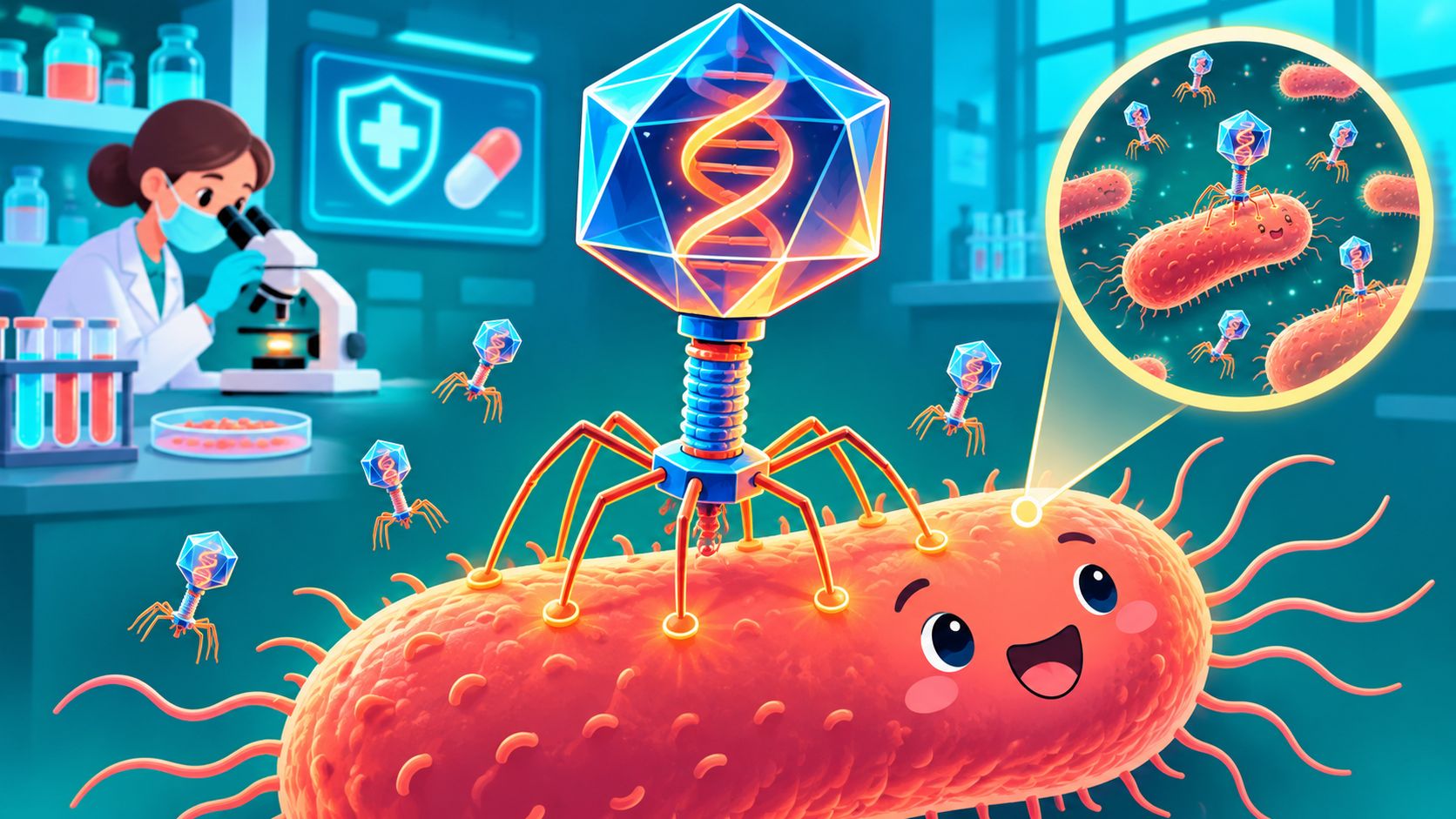
A bacteriophage, or phage, is a virus that infects bacteria, and it doesn't normally infect human cells. The same pickiness that keeps it off your cells is exactly why one phage is not a cure-all, and not a bottle you can spray on a counter.
If a virus only hunts bacteria, why can't doctors hand you one phage for every infection, and why can't a gym treat it like bleach? Because a phage is closer to a key card than to a floodlight. It works on one lock. A different strain of the same species can be a different lock.
Picture a bacterium in a gut, a grain of soil, or a sewage tank. Something far smaller than that cell lands on it, locks on, and turns the cell into a factory. That attacker is what people mean when they ask what a bacteriophage is.
A Virus That Only Hunts Bacteria
Say you are looking at a drop from a treatment plant under a microscope. A rod-shaped bacterium sits in the field, large enough that a school microscope can show its outline. On its surface, something much smaller has docked. You will not see that visitor as a fuzzy cloud. You will see, in a good image, a tiny particle with a head and often a tail, pressed against one cell and ignoring the neighbors.

A useful picture is a locked building. The bacterium is the building. The phage is a key card coded for one reader on one door. Swipe it on the wrong door and nothing happens, even if the buildings look alike from the street.
Why that picture matters
People hear "virus" and think of flu or a stomach bug, something that moves from person to person. A phage doesn't use that route. It needs a matching molecule on a bacterial surface, then a successful takeover inside that cell. Physical contact alone is not an infection.
Phages are among the most abundant biological entities on Earth, packed into seawater, soil, wastewater, and the gut. Scientists have worked with them for generations, long before most households had a name for them. Abundance doesn't make them interchangeable. A phage common in seawater may do nothing to the bacterium growing on a kitchen sponge.
A phage that misses its receptor is not a weak disinfectant. It is the wrong key.
From the building blocks of a single particle, the story runs through one infection, a side-by-side look at bacteria and the viruses that do infect people, the places phages already do useful work, and the claims that turn a targeted virus into a miracle spray. The definition worth keeping is short. A phage infects bacteria, not you, and only some bacteria at that.
How a Phage Is Built and Why It Is Picky
Think of a syringe, not a blob. Many of the phages you see in textbooks have three working parts, and each part answers a different question.
The protein capsid, the head, is the barrel. It packages the genome and protects it until the phage finds a host. The genome is the payload, nucleic acid rather than a miniature cell. The tail, on many but not all phages, is the needle plus the parts that feel for a landing site.

What sits inside the head
A phage is a virus that infects bacteria and consists of a nucleic-acid genome enclosed in a protein capsid. Genomes are not one standard size. As the National Center for Biotechnology Information describes them, some hold only a few thousand nucleotides of single-stranded DNA or RNA, while others hold several hundred kilobase pairs of double-stranded DNA. That range is why one phage can look genetically spare and another can carry a large instruction set. Neither version includes the ribosomes, wall, or metabolism of a living cell. The phage borrows those from the bacterium.
Not every phage is tailed. Tailed phages are the clearest classroom example because the tail makes the pickiness visible. In many tailed phages, the capsid connects to a receptor-binding tail. That tail recognizes specific molecules on a bacterial surface and is the delivery route for injecting the genome. Fibers at the tip are the key card. They touch proteins, sugars, or other surface molecules that differ from strain to strain.
Why the right door is only step one
Attachment is necessary and not sufficient. Infection also needs the genome to enter and then to replicate inside that cell. A phage can sit on the wrong bacterium and do nothing. It can even bind and still fail if defenses inside the cell stop the takeover.
Put two E. coli strains side by side on one plate. A phage whose tail matches a receptor on strain A can clear a patch of A and leave strain B untouched, even when the colonies touch. Same species name on the label. Different lock.
After a strictly lytic phage gets in, it redirects the bacterium's ribosomes, enzymes, and metabolites toward making virus parts. Later, phage-encoded holins disrupt the cytoplasmic membrane while endolysins degrade the peptidoglycan wall. Together, that damage bursts the cell and releases new particles.
For anyone hoping to use phages on purpose, that architecture has a practical rule. A phage-based intervention has to be matched to the target strain, or backed by a tested cocktail. Treating a phage like a broad-spectrum disinfectant is the wrong model. The upside of that narrow aim is real too. Unrelated bacteria can be left alone, with less collateral disruption than a drug that hits a wide slice of the microbiome.
How Phages Reproduce Inside a Bacterium
A lytic infection is a sequence, not a split. The phage never pinches in half the way a cell does. It borrows the host and then breaks it.

One infection, six beats
- Attachment. Tail fibers bind a receptor on the bacterial surface. If the receptor is missing or altered, the cycle never starts, which is the usual reason a phage "doesn't work" on a neighbor cell.
- Injection. The tail delivers the genome into the cell. The empty capsid stays outside, which surprises people who picture the whole virus slipping in like a seed.
- Takeover. Phage genes shut down the bacterium's own priorities and point its ribosomes and enzymes at viral parts. Students who mix this up with copying DNA at a replication fork can sort the two ideas with a short guide to replication fork misconceptions on AP exams. The fork is the cell copying its own chromosome. Here the cell's machines are being retasked.
- Assembly. New capsids fill with genome copies and tails attach. One successful infection yields a crowd of new particles, not a pair of daughters. That is the sharp contrast with how bacteria reproduce by dividing.
- Lysis. Holins open the membrane and endolysins cut the wall. The cell doesn't politely export the phages. It ruptures.
- Release. Progeny phages spill out and adsorb to new hosts if the receptors are there. A miss, and they drift.
The phage that waits
Some temperate phages skip the burst, at least for a while. They insert their genome into the bacterial chromosome and sit there, copied when the cell divides, until conditions trigger a lytic path. That waiting state is easy to confuse with a failed infection. It isn't failure. It is a different life history, and it matters later when anyone asks whether a phage might move bacterial genes around.
How a lab counts them
On a lawn of susceptible bacteria, repeated cycles leave clear circles called plaques. Each plaque is a place where phages landed, lysed hosts, and spread to neighbors until the patch ran out of cells they could infect. Technicians count plaques to estimate how many infectious particles were in a sample. A cloudy lawn with no plaques doesn't prove the liquid was empty of virus particles. It often means those particles couldn't infect that lawn.
No plaques on the wrong strain is a matching problem, not proof that the sample was sterile.
Phages Compared With Bacteria and Human Viruses
Use the table as a pocket card, then read the rows that change what you should believe about treatment.
| Feature | Bacteriophage | Bacterium | Human virus |
|---|---|---|---|
| Typical size | Nanometre scale, a small fraction of its host | 1-2 µm | 20-300 nm |
| Living cell | No | Yes | No |
| Genetic material | DNA or RNA inside a protein capsid | DNA chromosome inside a cell wall | DNA or RNA inside a protein capsid |
| How it reproduces | Hijacks a bacterium's machinery and lyses the cell | Divides by binary fission | Hijacks a human cell's machinery |
| What it targets | Specific bacterial strains | Grows as its own species and strains | Specific human cell types |
| Affected by antibiotics | No | Often yes, with growing resistance | No |
| Affected by antiviral drugs | No | No | Some viruses, not all |
What the rows change
A phage is not a small bacterium. It has no cell wall of its own, no metabolism, and no way to divide on a dish without a host. Antibiotics are built to hit bacterial processes, so they do nothing useful against a phage particle. They also do nothing against the viruses that infect people. Antiviral drugs are aimed at selected human viruses, not at phages and not at bacteria.
Size has a lab consequence that families never see and microbiologists use every week. Phages slip through filters that trap bacterial cells, which is how a lab can separate a phage suspension from the culture it was grown in. That step is routine. It is not a home method, and it doesn't make a filtered liquid safe to swallow.
When a headline says "virus," pause and ask which kind. A human virus, a phage, and a bacterium are three different problems, which is why a short set of science display posters for KS2 classrooms that separates those categories saves a lot of mixed-up homework. The wider map of germs people catch is a different list again, closer to the 5 types of pathogens than to this one bacterial hunter.
If the word in the headline is only "virus," you still don't know the host, the drug, or the risk.
Where Phages Show Up in Nature and Labs
A litre of seawater
In coastal water, bacteria bloom on dissolved food and phages land on the strains they recognize. Each burst kills that host and spills carbon and nutrients back into the water for other microbes. The phage didn't "clean the ocean." It pruned one population and fed the next.
A patch of soil, then a sewer
Soil particles hold huge local mixes of bacteria, and phages keep those mixes from being a single winner. Downstream, a sewage tank is a concentrated version of the same contest. Operators don't dose the tank with a random phage and expect every problem organism to vanish. Activity tracks whatever receptors are present that week.

The gut you already carry
Your gut microbiome includes phages as well as bacteria. They help shape which bacterial groups stay common, by hitting some strains and missing others. That is ecology inside a person, not a treatment plan. Swallowing an unnamed phage product is not the same thing as the community that already lives there.
Food plants and lab benches
Some processors look at phage preparations aimed at one foodborne bacterium, for example a product built only for Listeria. The boundary is the organism on the label, not a general promise to sanitize a room. A spray that kills one Listeria strain can leave Salmonella or a spoilage species in place.
On the bench, phage display is a different job again. Researchers tie peptides or antibody fragments to the phage surface, then wash the mixture over a target and keep the particles that stick. The phage is a tiny display rack, not a medicine. That method has become a workhorse for research reagents and for early drug discovery, and it still depends on a match between what is displayed and what the target binds.
The thread through seawater, soil, sewage, gut, food, and the lab is the same. Each job works because someone, or nature, paired a phage with a specific target. Take away the match and the scene goes quiet.
Phage Therapy and Why Matching Matters
Phage therapy is a matching process. It is not a broad antibiotic with a friendlier origin story.
A clinician starts with the bacterium from the patient, not with a favorite phage from a website. The lab grows that isolate, then tests it against a library. Phages that clear the isolate stay in the running. The rest are irrelevant to that infection, however famous they are in a textbook. The team may use one phage or a small cocktail that has been tested together, by a defined dose and route. Host range, genetic content, and how the body clears the particles all change the result. If you want the wider idea of using living systems as tools, an approachable biotech explainer for curious readers sets that scene without turning every virus into a product.
What the newest tally can and cannot say
A 2026 systematic review of intravenous phage therapy included 60 studies from nine high-income countries, most of them case reports, case series, or uncontrolled trials, and it estimated clinical improvement in 65.8% of 122 patients and microbiological eradication in 55.3% of 106, with adverse reactions in 9.2% of 168 patients, mostly mild and self-limited. Those uncontrolled studies cannot separate phage effects from antibiotics, surgery, natural recovery, or patient selection, so the percentages are a reason to keep studying, not proof of a reliable cure.
Why a match in the dish can still fail in a person
The receptor disappears. Bacteria can stop making the surface molecule the phage needs, or change it. The phage then has nothing to grab, even if yesterday's culture looked perfect.
The immune system clears the dose. People make responses to foreign virus particles. A phage that works in a tube can be neutralized before it reaches the site, or fail to keep replicating once it gets there.
The site is a bad factory. Pus, poor blood flow, or a low number of susceptible cells can mean the phage never completes enough cycles to matter. Lab activity and clinical effect are different measurements.
That is why the core question is not "Do phages beat antibiotics?" It is "Which phage fits this strain, and will it still fit at the site of infection?" A susceptibility test is the culture-based check that answers the first half. The second half is still unsettled for many infections, which is also why antibiotic resistance remains the problem clinicians have to manage with drugs they can dose today.
Promise in a case series is not the same thing as a treatment you can count on.
Common Myths and How to Judge a Phage Claim
Natural does not mean harmless
Phages generally don't infect human cells, and it is tempting to stop the safety talk there. The World Health Organization states that phages are generally considered safe for humans, but preparations can contain or cause release of bacterial endotoxins, which may provoke inflammatory responses, especially when large bacterial burdens are present. Killing a heavy load of bacteria in one burst can dump those fragments faster than a slower drug. "Found in nature" doesn't erase that.
A phage is not a household disinfectant
Each product, if it works at all, is aimed at particular strains. Spraying an unlabeled phage mix on a cafeteria table, a wrestling mat, or a daycare toy doesn't substitute for cleaning and a disinfectant whose label names the job. BacteriaFAQ.com is an informational blog offering facts, explanations, and insights about various bacteria and their impact on health, environment, and science, and the practical hygiene pieces sit in that lane. Phage preparations don't replace them.
Resistance is not a surprise, and it is not always simple failure
Bacteria can develop phage resistance, just as they develop antibiotic resistance. Phages can evolve in ways that restore activity. Sometimes a resistant bacterium is less virulent than the one it replaced, so resistance is not automatically the end of the story, and it is not proof that phage therapy is safer or simpler than antibiotics. Immune neutralization, uncertain pharmacokinetics, horizontal gene transfer, manufacturing standards, and the lack of randomized trials are still open problems.
A five-point check before you trust a claim
- Target. Does the claim name a species or a strain, or does it say "bacteria" as if they were one organism?
- Evidence. Are there controlled trials and susceptibility tests, or only case reports?
- Phage type. Strictly lytic phages destroy the cell without integrating. Temperate phages raise more concern about carrying genes between bacteria.
- Purity. Has the preparation been checked for endotoxin and made under real quality controls?
- Status. Is this use approved for this purpose, or investigational? Engineered phages and CRISPR-based systems remain investigational, not routine approved treatments.
For an infection, see a doctor or an infection specialist who can culture the organism and test what kills it. Don't self-treat with phage products ordered as if they were vitamins.
A phage is a targeted virus. It is not a universal cure, and it is not a stand-in for soap, a labeled disinfectant, or a prescribed antibiotic.
If a family member, a kitchen, a gym, or a clinic is what you are trying to protect, start with the bacterium you can name and the cleaning step that matches it. Browse the explainers on BacteriaFAQ.com, then take any suspected infection to a clinician rather than to an unlabeled bottle.
Leave a Reply