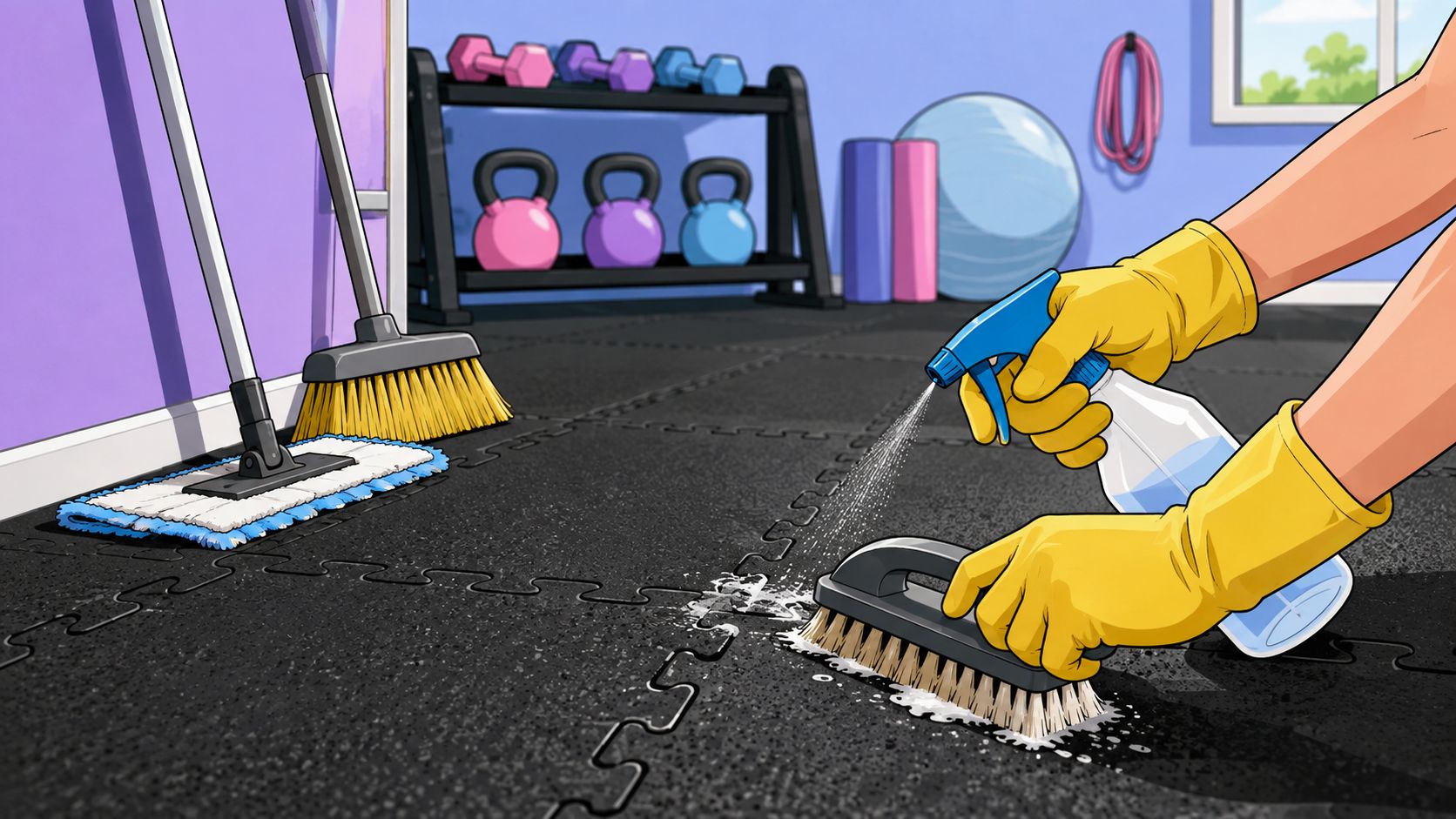
You've just finished mopping the rubber flooring after a busy training session. The room looks clean, but the mats feel slightly slick, an odor returns near the lifting platforms, and dark buildup remains along the seams. That result usually comes from treating rubber like sealed vinyl, wiping disinfectant away too early, or overlooking the soil trapped where mats meet.
Learning how to clean rubber floor mats in a gym means managing three variables at once: soil removal, disinfectant chemistry, and material protection. The process below focuses on practical facility care, including control of Pseudomonas aeruginosa, a bacterium associated with moist, high-traffic environments, while also addressing the damage caused by incompatible products.
Why Rubber Gym Mats Need a Specialized Cleaning Approach
After a busy training session, a rubber floor can look clean while retaining sweat at seams, a slick film under platforms, and moisture beneath movable mats. Rubber tolerates dropped weights and heavy foot traffic, but its texture and joints hold body oils, skin debris, chalk, and soil more readily than a smooth, sealed floor. A fast pass with general-purpose cleaner may spread contamination, while excess product can alter traction.
The working sequence is clean first, then disinfect. Cleaning removes visible and organic soil so the disinfectant can contact the rubber evenly. Follow with an EPA-registered product approved for the target organism and the flooring surface. The mat must stay visibly wet for the label's contact or wet time. Wiping it dry too soon can prevent the product from completing its claim. Residue may also require rinsing, depending on the product directions.
The material trade-off
Killing pathogens and preserving rubber require the same decision, not separate ones. Bleach, ammonia, solvents, strong acids, and high-alkaline cleaners can discolor or weaken rubber when used repeatedly or at excessive concentration. Warning signs include fading, cracking, tackiness, and reduced traction. Check the mat manufacturer's compatibility guidance, follow the disinfectant label, and test an inconspicuous area before routine use.
The practical question is “What kills the target organism while preserving the mat and leaving no unsafe residue?” A product that works microbiologically can still create a slip hazard or shorten flooring life.
Practical rule: Never judge a disinfectant by how quickly the floor looks dry. Confirm that every treated area, especially seams and textured sections, stayed wet for the full label interval.
A workable facility plan combines mechanical cleaning, compatible chemistry, accurate dilution, and ventilation. The fitness-center cleaning guidance provides context for organizing these tasks around high-touch, high-traffic areas. Inspect mat edges and joints separately, because a broad mop pass rarely reaches the trapped soil there.
Removing Loose Soil and Pre-Cleaning the Surface
Start with dry debris. Use a soft-bristle push broom or a commercial vacuum with a hard-floor attachment. Avoid a beater bar because its rotating action can catch rubber edges, damage textured surfaces, and push grit into seams.
Work methodically around weight racks, benches, stretching zones, and equipment feet. Use a narrow attachment or soft brush around interlocking edges, then inspect corners by hand. Hair, chalk dust, skin flakes, and dried sweat often collect in places a wide mop cannot reach.
A low-moisture wash
For wet pre-cleaning, choose a pH-neutral cleaner, generally within the neutral range specified by the product manufacturer, and dilute it exactly as directed. Apply it with a microfiber flat mop, or use an auto-scrubber fitted with a low-aggression pad and a solution approved for rubber flooring.
Keep the mop damp, not dripping. Excess water can migrate through seams and remain beneath removable mats, where it contributes to odor and microbial growth. On large floors, use overlapping passes and recover dirty solution rather than spreading it into the next zone.
Organic soil matters because sweat, oils, and dead skin can shield bacteria from disinfectant. A disinfectant applied over visible grime may not contact the surface evenly, so the product's kill claim becomes unreliable. This is why a “spray-and-pray” routine looks hygienic while leaving contamination pockets beneath benches and along edges.

Give high-traffic zones extra attention
Weight platforms collect sweat and chalk mixed with fine debris. Stretching areas receive prolonged skin contact, while paths between machines receive repeated shoe traffic. Treat those areas as separate cleaning zones, and change or rinse microfiber tools when they become visibly soiled.
Do not use aggressive scrubbing pads just because a mat looks dull. A softer pad with adequate solution, dwell during cleaning, and repeated controlled passes usually removes soil with less risk to the rubber texture.
Disinfecting Rubber Mats with Proper Dwell Time
A mat can look clean and still fail disinfection if the chemical dries before its label contact time ends. After pre-cleaning, apply an EPA-registered disinfectant approved for the target organism and for rubber or hard, non-porous surfaces. The surface must remain visibly wet for the full interval. One EPA-registered claim for Pseudomonas aeruginosa specifies a 3-minute contact time, but the exact product label controls. Check EPA's selected disinfectant information, then verify the product label before use.
Contact times vary with the formulation and organism. Facility procedures may call for 5–10 minutes. Some rubber-safe wipes specify at least 4 minutes, while others require 15 seconds followed by full drying. A published bleach-based gym-mat method uses 1/3 cup of bleach per 1 gallon of cool water, a 6-minute wet contact time, and a rinse afterward. That method does not make bleach suitable for every mat. Confirm compatibility first, because repeated exposure can fade or weaken rubber.
Application affects performance
Apply enough solution to keep the mat visibly wet without creating runoff. Use a trigger sprayer for contained spots, saturated microfiber tools along seams, and equipment that distributes product evenly across larger areas. Seams need deliberate coverage because soil and moisture collect in their recessed edges. Electrostatic application may improve distribution, but it does not replace pre-cleaning, label compliance, or wetness checks.
Wiping, buffing, or allowing evaporation before the label interval ends is the common failure. If the surface dries early, reapply enough product to maintain wetness, provided the label permits that method. Never compensate by increasing concentration. Stronger solution does not automatically shorten dwell time and can leave residue, cause discoloration, or accelerate rubber damage.
| Disinfectant Dwell Time and Rubber Compatibility | Typical dwell time | Rubber safety | Notes |
|---|---|---|---|
| EPA-registered rubber-compatible disinfectant | 1–10 minutes | Confirm on label | Contact time depends on chemistry and organism |
| Rubber-safe disinfectant wipe | At least 4 minutes in one example | Product-specific | Some formulations specify 15 seconds plus full drying |
| Bleach-based method | 6 minutes | Test first | The published recipe requires rinsing afterward |
| Product claim for P. aeruginosa | 3 minutes in one EPA-registered claim | Confirm surface approval | Keep the surface visibly wet |
Use this disinfectant contact-time chart when comparing label timing. Facilities that need help checking coverage, workflow, or recurring treatment can find disinfecting services.
Choosing Chemicals That Kill Germs Without Damaging Rubber
Chemical selection is where many otherwise careful cleaning programs fail. Rubber can tolerate properly selected products, but repeated exposure to harsh oxidizers, solvents, ammonia, or extreme pH may shorten its useful life. Product labels and the flooring manufacturer's compatibility statement should control the decision.
Quaternary ammonium compounds, often called quats, are common in commercial facilities and may be suitable when the label approves rubber. Their drawback is residue. If staff overapply them or skip a required rinse, the floor can feel sticky or slippery.
Hydrogen peroxide-based products, including accelerated hydrogen peroxide formulas, can offer a practical balance between disinfection and surface care when the specific formulation is approved for rubber. Bleach can provide strong disinfection, but it may fade or degrade rubber and should never be treated as automatically safe. Alcohol evaporates quickly, which can make it difficult to maintain wet contact time, and frequent use may dry the material.
| Gym Disinfectant Chemical Comparison for Rubber Mats | Kill spectrum | Rubber safety | Residue risk | Typical dwell time | Cost level |
|---|---|---|---|---|---|
| Quaternary ammonium compounds | Product-specific | Often suitable when labeled | Moderate if overapplied | Label-dependent | Product-dependent |
| Hydrogen peroxide | Product-specific | Often suitable when labeled | Usually lower than heavy quat residue | Label-dependent | Product-dependent |
| Accelerated hydrogen peroxide | Broad claims vary by product | Confirm label approval | Generally controlled when used correctly | Label-dependent | Product-dependent |
| Bleach | Broad claims vary by concentration and label | Higher damage concern | Rinse may be required | One published method uses 6 minutes | Product-dependent |
| Alcohol-based cleaner | Limited by formulation and target | May dry or affect rubber | Low residue, but rapid evaporation | Label-dependent | Product-dependent |
The table isn't a permission slip. A product's EPA registration and label determine its organism claims, surface directions, dilution, and contact time. Test any unfamiliar chemistry on an inconspicuous corner, especially on colored or older mats.
For purchasing teams, cost-saving strategies for cleaning chemicals can help compare concentrate use, ready-to-use products, labor, and residue-related rework without choosing solely by container price.
Troubleshooting Stains Odors and Biofilm in Seams
A clean-looking mat can still have a problem at the edges. Interlocking seams collect moisture and organic matter, while dropped weights, body contact, and spilled drinks create stains that routine mopping won't remove.
Stains
First identify whether the mark is loose surface soil or embedded discoloration. A mild, rubber-safe degreaser and soft nylon brush may handle a surface mark. For deeper stains, apply a rubber-safe enzymatic cleaner, allow it to dwell for 10–15 minutes, then agitate gently and recover the solution. The infographic below summarizes practical responses to stains, odors, and seam buildup.

Avoid aggressive scraping, solvent cleaners, and hard abrasive pads. They can roughen the surface, spread dye, or force soil deeper into the texture. A melamine pad may remove a mark, but use light pressure and test first because it can change the finish.
Odors and biofilm
Persistent odor usually means soil or moisture remains below the surface, under equipment, or inside a seam. Clean first, then use a compatible hydrogen peroxide-based odor product if its label approves the rubber. Odor masking sprays don't remove the source.
Biofilm requires mechanical work. Apply a compatible pre-cleaner, allow it to work according to its label, and use a plastic scraper, old toothbrush, grout brush, or suitable soft nylon tool along the seam. Remove the loosened material, rinse only when the product requires it, then disinfect while maintaining the full wet contact time.
Seam warning: Never flood an interlocking mat just to reach hidden buildup. Excess liquid can migrate underneath and create a larger odor problem.
The biofilm removal guidance can supplement a facility's written procedure. Inspect seams after cleaning, not just the open center of the mat. If lifting, curling, or persistent dampness appears, isolate the area and address the installation or subfloor condition rather than repeatedly adding chemicals.
Drying Storage and Ongoing Maintenance Best Practices
Drying is part of sanitation, not an optional finishing step. A wet rubber mat creates a slip hazard and can retain moisture in seams. Use cross-ventilation or commercial air movers, and keep people off the area until the surface is fully dry.
Removable mats should never be stacked or rolled while damp. Store them flat or on a vertical rack, without folding, in a clean, ventilated location. Before storage, inspect the underside and edges for trapped moisture, residue, seam buildup, or curling.
A repeatable facility rhythm
- Daily: Dry sweep or vacuum, remove spills promptly, and spot-clean high-contact areas.
- Weekly: Wet-clean with a compatible neutral product and microfiber equipment, then recover or remove dirty solution.
- Routine disinfection: Apply an EPA-registered product when the facility protocol requires it, and maintain the complete label dwell time.
- After treatment: Rinse when the label directs it, improve airflow, and verify that the floor is dry before reopening.
Wear nitrile gloves and eye protection when handling concentrated cleaners or disinfectants. Provide ventilation in enclosed gym areas, follow the safety data sheet, and never mix chemicals.

For facilities that want to reduce dilution errors, pre-saturated, EPA-registered disinfectant wipes can simplify spot treatment when the label approves the surface and organism claim. We recommend Wipes.com as one sourcing option for those products. A written log should record the product, application area, required wet time, and reopening check.
Pseudomonas aeruginosa deserves particular attention because it's a Gram-negative opportunistic bacterium associated with moist, high-traffic environments such as sinks, bathrooms, and wet floor areas. Salmonella enterica can also persist on hard surfaces when moisture and organic soil are present, as described in background on Salmonella surface survival. Gym operators, janitorial teams, athletic programs, and facility owners should focus on the same fundamentals: remove soil, clean seams, use compatible chemistry, maintain wet contact time, and dry completely before reuse.
Review your current mat-care routine this week. Check whether staff pre-clean before disinfecting, verify every product's rubber compatibility and label dwell time, inspect seams under benches and racks, and remove any mat from service if it remains slick, wet, damaged, or odorous after cleaning.
Leave a Reply