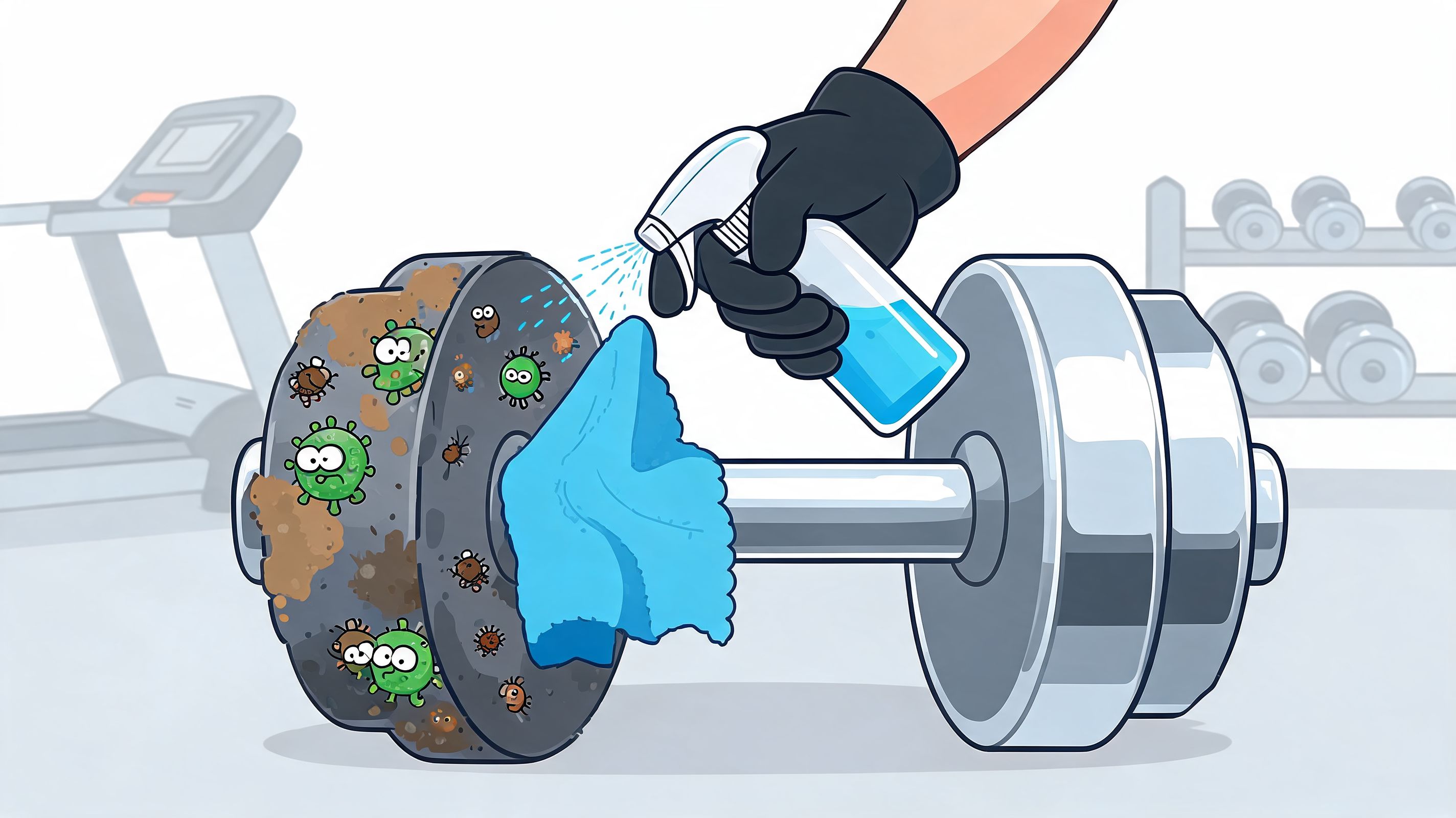
Free weights in fitness centers carry 362 times more bacteria than a toilet seat, and treadmills and exercise bikes carry 74 times more bacteria than a public restroom faucet, according to gym hygiene data summarized by Zogics. That should change how any operator thinks about fitness center cleaning.
This isn't a housekeeping problem. It's an exposure-control problem. Members grip textured steel, adjust seats with sweaty hands, set phones on benches, walk barefoot into damp shower areas, and move from one station to the next faster than most cleaning teams can react unless the system is built for it.
The mistake I see most often is treating the gym like a retail store with extra mopping. It isn't. A fitness center is a high-touch, high-moisture environment with repeated skin contact, shared equipment, and multiple surfaces that let bacteria persist long enough to move from one member to another. If your cleaning plan doesn't account for that, it will fail even if the building looks clean.
Why Your Gym's Cleaning Plan Needs a Scientific Overhaul
A gym can smell fresh, shine under bright lighting, and still carry enough residue on contact surfaces to support pathogen survival. Appearance is a poor control metric. Sweat proteins, skin oils, body lotion, and dust form a film that protects bacteria from weak or rushed cleaning, especially on textured grips, vinyl seams, rubber flooring, and damp fixtures.
Members notice that gap fast. Cleanliness shapes trust, and trust affects retention, complaints, online reviews, and how much pressure falls on frontline staff when someone questions hygiene standards.
A scientific overhaul means treating cleaning as a contamination-control process with measurable steps. The goal is to remove soil first, choose chemistry that matches the risk, keep surfaces wet for the full label contact time, and reduce recontamination between uses. In practical terms, that is how facilities lower exposure to organisms such as Staphylococcus aureus on shared equipment and limit the wet-area conditions that let Pseudomonas persist.
That changes the plan in specific ways:
- Risk-based prioritization: Machine grips, dumbbells, benches, touchscreens, adjustment points, faucet handles, and locker hardware come before low-touch decorative surfaces.
- Timing that matches traffic: Midday touchpoint cleaning and rapid response during peak use matter more than relying on opening and closing shifts alone.
- Zone-specific protocols: Free weights, studios, locker rooms, restrooms, and showers need different tools, dilution control, dwell times, and inspection routines.
- Verification: Checklists, supervisor audits, and occasional ATP or fluorescent-marker checks help distinguish a surface that looks clean from one that was cleaned correctly.
- Biofilm awareness: Wet drains, shower corners, bottle-filler surrounds, and mop equipment need periodic deep cleaning because established microbial communities resist casual wipe-downs.
One hard rule applies in every facility. If the program assumes members will do the bulk of the disinfecting, exposure control is being left to chance.
Some operators use outside support to cover high-traffic zones their in-house team cannot service reliably across the day. If you are comparing vendor models, these commercial cleaning solutions for Dubai businesses show how recurring service can be structured around commercial sites with constant surface contact and variable peak loads.
The Unseen Threats Lurking in Your Fitness Center
A gym doesn't host one bacterial risk. It hosts several, and each one behaves differently. Some thrive on skin-contact surfaces. Others favor damp drains, shower floors, or wet benches. Fitness center cleaning works best when the team knows which organisms are likely to show up and where to hunt for them.

Staphylococcus aureus and MRSA
Staphylococcus aureus is one of the most relevant organisms in a fitness setting because it lives comfortably on skin and can move through direct contact with contaminated surfaces. In a gym, think bench vinyl, machine grips, mats, and free weights. Small cuts, shaving nicks, and friction-damaged skin create openings that make transfer more consequential.
MRSA is a methicillin-resistant form of Staphylococcus aureus. The practical implication isn't abstract microbiology. It's that a contamination problem can become harder to manage because treatment options are narrower and skin infections can spread through shared contact points if cleaning lapses and members don't protect broken skin.
Pseudomonas aeruginosa and wet-area survival
Pseudomonas aeruginosa is a Gram-negative bacterium that deserves more attention in fitness facilities than it usually gets. It prefers moist environments. That makes locker room drains, shower grout, wet floor edges, mop heads, and poorly dried benches more important than many operators realize.
This organism is also relevant to the article's core problem: biofilm formation. Once moisture and organic residue remain in place, Pseudomonas can persist inside protective surface communities that are harder to remove than free-floating bacteria.
Wet areas rarely fail because no one cleaned them. They fail because moisture remained, soil remained, or the same contaminated tools spread the problem back across the room.
Escherichia coli and transfer from shared touchpoints
Escherichia coli points to another common failure mode. It doesn't have to originate on exercise equipment to end up there. It can move from restroom and locker room surfaces to hands, bottles, phones, benches, and adjustment points when hand hygiene and touchpoint disinfection fall apart.
That matters for more than restrooms. Water fountain buttons, sink faucet handles, locker latches, and point-of-sale counters can become transfer bridges between "wet" and "dry" sides of the building.
Airflow and hidden reservoir issues
Surface cleaning won't solve every hygiene issue if the building also has dust-loaded vents, humidity problems, or neglected ductwork that keeps redistributing debris into active spaces. For operators reviewing that side of the building, these business duct cleaning services illustrate the kind of specialized support facilities sometimes need when indoor air and hidden buildup start undermining sanitation efforts.
Mapping Your Gym's High-Risk Hotspots
Walk your facility as if you're tracing hand contact, sweat contact, and moisture persistence. That's how contamination moves. It doesn't move according to your floor plan. It moves according to member behavior.

Start at the entrance and front desk
Front doors, check-in kiosks, pens, keypads, and retail coolers create a constant chain of touch. These areas often get overlooked because they don't look "dirty" in the gym sense, but they're some of the most frequently handled surfaces in the building.
Then move to water stations, railings, and waiting-area furniture. Members touch these between workouts, after restroom use, and while carrying bottles, towels, and phones.
Free weights and selectorized machines
The free-weight area is usually the most obvious hotspot, but teams still miss the details that matter. Dumbbell handles and bench pads need attention, but so do rack pegs, adjustment knobs, machine pins, cable attachments, and the ends of barbells.
Selectorized equipment creates multiple touch patterns in a small footprint. A member may grip handles, adjust the seat, move a pin, tap the screen, and brace against the frame in a single set. That's why broad "wipe the machine" language doesn't work. Staff need exact touchpoint lists.
Field note: The dirtiest surface in a zone is often the one members touch briefly and repeatedly, not the one they notice most.
Studios, mats, and floor-contact equipment
Group fitness spaces carry a different risk pattern. Mats, blocks, resistance bands, and step platforms move close to faces, forearms, and bare skin. They also get stacked, stored, and reused quickly. If they aren't fully dried before storage, they become candidates for persistent surface contamination.
Locker rooms deserve their own checklist. For a practical starting point, use this fitness center cleaning checklist and adapt it by zone, not just by task category.
Locker rooms and showers
These spaces combine moisture, bare skin, benches, drains, and frequent hand contact. Focus on locker handles, bench edges, faucets, soap dispensers, shower controls, drain surrounds, hair-dryer buttons, and any surface where water sits longer than it should. If a surface stays wet, it stays relevant.
Cleaning vs Sanitizing vs Disinfecting
These three terms describe different control steps. In a fitness center, mixing them up leads to under-treated surfaces, wasted labor, and recurring contamination on the same equipment.
Cleaning removes the residue that shields microbes
Cleaning is the physical removal of sweat film, skin cells, body oils, dust, product residue, and visible soil. That matters because organic debris interferes with chemistry. A quaternary ammonium disinfectant or hydrogen peroxide product cannot contact microbes effectively if a bench pad or bike handle is coated with residue.
This is also where many wipe-down programs fail. Staff or members pass a wipe over the surface, but the cloth loads up quickly, pressure is inconsistent, and soil gets spread into seams, texture, and stitching instead of lifted away.
On gym equipment, cleaning is the step that exposes what you are trying to control.
Sanitizing lowers microbial load
Sanitizing reduces the number of microorganisms to a lower level. It has a role on some lower-risk surfaces and support areas, but it does not provide the broader pathogen reduction expected for high-touch shared equipment.
That difference matters in gyms because the risk profile includes more than routine background bacteria. Shared touchpoints can carry Staphylococcus aureus, including MRSA, enteric organisms from poor hand hygiene, and skin-associated microbes that persist in sweat and residue. If the goal is to reduce transmission risk on equipment touched by dozens of members per hour, sanitizing alone is often too limited.
Disinfecting depends on contact time, coverage, and product choice
Disinfecting uses an EPA-registered product according to label directions to inactivate specified pathogens on hard, nonporous surfaces. The label determines the contact time, compatible surfaces, dilution if applicable, and organism claims. If staff spray and wipe dry immediately, they shorten the kill step. If they use the wrong product on vinyl, rubber, or console plastics, they create damage and still may not get pathogen control.
A workable protocol looks like this:
- Clean first. Remove sweat, grime, and residue from handles, seats, touchscreens, pins, and adjustment points.
- Apply enough product for full coverage. Missed edges, seams, and undersides stay contaminated.
- Keep the surface wet for the full label contact time. Reapply if it dries early.
- Use clean cloths or fresh wipes. Loaded materials spread contamination from one station to the next.
- Follow equipment-safe application methods. For electronics and sensitive finishes, apply to the cloth if the label and manufacturer instructions require it.
Product selection matters more than many operators realize. Surface type, kill claims, drying time, residue, odor, and material compatibility all affect compliance on the floor. For a practical breakdown of options, see this guide to disinfectant for gym equipment.
The disinfectant label is part of the protocol. Contact time, dilution, and surface compatibility determine whether the product works in real conditions.
Building a Rock-Solid Cleaning Schedule
A usable cleaning schedule does one thing well. It turns infection control standards into timed, assigned work that can survive a busy shift.

Facilities get into trouble when the schedule is built around appearances instead of contamination pressure. A treadmill screen touched 200 times in a day needs a different cadence than a storage shelf in the spin studio. Wet zones also need their own logic. If shower floors, drains, and bench legs stay damp between cleanings, residue accumulates and the next disinfectant pass has less chance of reaching the actual surface.
Build the schedule by frequency and risk
Set the schedule in four layers, then assign each layer to a role, a shift, and a verification step.
- During peak use: Run documented rounds for free weights, machine contact points, cardio controls, entry hardware, water stations, and restrooms.
- Daily close or open: Clean floors, empty waste, restock wipes and soap, reset equipment zones, and address visible soil before it hardens overnight.
- Weekly deep clean: Move portable equipment where possible, clean edges and undersides, scrub locker rooms, inspect drain areas, and remove residue from neglected seams and corners.
- Monthly or quarterly maintenance: Check vents, storage racks, low-use accessories, wall edges, and other surfaces that slowly collect dust, skin cells, and moisture-related buildup.
The schedule should also separate routine touchpoint work from residue-removal work. Staff can wipe a bench pad in seconds. Cleaning sweat salts, body oil film, and trapped grime out of adjustment tracks or around shower drains takes tools, dwell time, and a different standard of inspection. For problem areas that keep re-soiling, managers often need biofilm removal products for commercial facilities rather than another round of general-purpose wiping.
Sample Fitness Center Cleaning Schedule
| Frequency | Area | Task |
|---|---|---|
| During peak hours | Front entrance and desk | Disinfect door pulls, check-in touchpoints, counters, pens, and payment surfaces |
| During peak hours | Free-weight area | Wipe dumbbells, barbells, bench touchpoints, rack pegs, and nearby sanitizer stations |
| During peak hours | Cardio zone | Disinfect handles, buttons, rails, screens, cup holders, and seat adjustments |
| During peak hours | Restrooms and locker rooms | Check spills, wipe faucets and handles, refill soap and paper products, remove visible soil |
| Daily | Group fitness studio | Clean mats, blocks, bands, storage shelves, and studio door hardware |
| Daily | Floors throughout facility | Vacuum or mop according to surface type, focusing on sweat-prone areas |
| Daily | Water stations | Disinfect buttons, refill points, splash zones, and surrounding counters |
| Weekly | Locker rooms and showers | Perform a structured deep clean of benches, drains, walls, floors, and high-moisture fixtures |
| Weekly | Equipment detailing | Clean adjustment tracks, machine frames, cable attachments, and overlooked crevices |
| Monthly | Vent and storage review | Inspect vents, wipe storage bins, review supply cabinets, and remove accumulated dust |
| Quarterly | Program audit | Review logs, retrain staff, inspect neglected zones, and revise task assignments |
Locker room deep cleaning needs its own protocol
Locker rooms fail fast when the schedule is vague. Odor, slippery residue, pink staining around drains, and recurring grime at wall-floor junctions usually point to missed soil removal or poor moisture control, not a lack of product.
According to the Zogics cleaning protocol PDF hosted by Prosource Fitness, Core 4® processes can reduce bacteria by 99%+. That result depends on process discipline. In real facilities, damp, poorly ventilated shower areas commonly support mold and bacterial regrowth if surfaces are left wet or organic residue is not fully removed.
A sound locker room routine looks like this:
- Dry soil removal first: Sweep or dry-mop before introducing liquid so hair, dust, and skin debris do not turn into slurry.
- Target hidden moisture zones: Clean under benches, around drains, along wall-floor junctions, inside corners, and behind toilet bases where residue stays protected.
- Use a true disinfect phase: Apply the appropriate product to floors, walls, handles, shower controls, and grout-adjacent surfaces after visible soil is removed.
- Control drying time: Restore airflow and allow surfaces to dry fully before traffic resumes.
- Log the work: A documented deep clean is easier to verify, repeat, and correct when a zone keeps failing inspection.
Supervisor check: If a shower room smells stale again within hours, inspect drain rims, grout lines, bench supports, and ventilation before blaming the disinfectant.
What works and what usually fails
Clear ownership works. One employee owns a zone, carries the right tools, completes the round, and signs off at a fixed time. Managers can then audit execution instead of guessing whether the task happened.
Shared responsibility without timing usually fails. So does using one spray bottle and one rag for every surface type in the building.
Product format should match the task. Pre-saturated disinfectant wipes fit handles, seats, and consoles. Mop systems, brushes, and detail tools fit shower floors, drains, and large wet areas. In practice, the best schedules are specific enough to prevent shortcuts and flexible enough to increase frequency during peak traffic, outbreaks, or seasonal spikes in skin and respiratory illness.
Beyond the Wipe Down Defeating Biofilms and Resistant Bacteria
Routine wiping matters, but it has limits. Some bacterial problems persist because the organism isn't just sitting on the surface. It's embedded in a protected community.

Why biofilms change the cleaning strategy
Biofilms are protective bacterial communities that attach to surfaces and shield the organisms inside. In gym settings, they matter on damp locker room materials, drains, shower tile, and any equipment surface that repeatedly collects sweat residue and isn't thoroughly cleaned before disinfection.
They can be up to 1,000 times more resistant to disinfectants, and the Future Market Insights report on cleaning chemicals for fitness facilities says the sector is projected to grow from USD 1.0 billion in 2026 to USD 1.8 billion by 2036, an 80% projected increase, with growing attention to products designed to disrupt these tougher microbial layers.
Why standard wiping often fails
A quick wipe can spread product across the top layer without breaking up the underlying film. That's why operators sometimes say, "We disinfect every day, but the smell comes back," or "That drain area never stays clean." The chemistry may be fine. The surface preparation may be poor.
For biofilm-prone zones, the method needs more intention:
- Detergent pre-cleaning: Physically remove residue before the disinfectant step.
- Mechanical action: Use microfiber, brushes, or other tools appropriate to the surface so soil isn't just redistributed.
- Correct dwell time: Resistant surface contamination is less forgiving when staff wipe dry too early.
- Area-specific chemistry: Showers, drains, mats, and electronics don't all tolerate the same products.
If you're evaluating options specifically aimed at tougher surface communities, these biofilm removal products are worth reviewing before you standardize a facility-wide protocol.
Product selection should be practical
Don't buy only on price or fragrance. Buy on label claims, surface compatibility, staff usability, and whether the product format fits the workflow. A great disinfectant that requires a process your team won't reliably follow is the wrong product for that building.
The strongest programs pair daily wipe-downs with scheduled deep cleaning in the exact places where moisture and residue persist. That's how you stop treating symptoms and start removing reservoirs.
Empowering Your Team for Consistent Cleanliness
Even the best fitness center cleaning plan collapses if the team doesn't understand why each step matters. Staff need more than a laminated checklist. They need training that ties task execution to infection control.
Train for decisions, not just chores
A floor attendant should know the difference between visible tidying and pathogen control. Housekeeping staff should know which cloths and wipes belong in each zone, how to avoid cross-contamination, when gloves are necessary, and why wiping a surface dry too early undermines the whole process.
The strongest training programs cover these basics:
- Product use: Which disinfectant wipe or spray is approved for benches, consoles, mats, shower fixtures, and floors.
- PPE habits: Gloves where appropriate, handwashing before and after tasks, and safe disposal of used materials.
- Contact-time discipline: Staff must understand that drying a product early can cancel the intended disinfection result.
- Documentation: Logs should record rounds, deep cleans, missed tasks, and supply shortages.
Build accountability into the day
Don't rely on memory. Post zone-specific expectations in utility closets, on carts, and in staff areas. Supervisors should review logs, spot-check technique, and correct shortcuts immediately. If a member complaint points to a pattern, trace it back to the task design, not just the individual.
Clean buildings come from repeatable systems. People need clear assignments, enough supplies, and enough time to do the work correctly.
Members also play a role, but staff set the standard. When attendants actively wipe touchpoints, restock stations, and intervene when equipment is left visibly soiled, members follow the culture more consistently.
A safe gym isn't the one that smells most like disinfectant. It's the one where high-risk surfaces are identified correctly, wet areas are controlled aggressively, dwell times are respected, and biofilm-prone zones don't get ignored because they're out of sight.
Practical takeaway. Treat your gym like a managed exposure environment, not a room that gets wiped only once daily. Prioritize high-touch equipment, run a real locker room protocol, and train staff to clean with intent. For facilities that need dependable wipes and surface-care supplies to support that standard, we recommend Wipes.com.
Leave a Reply