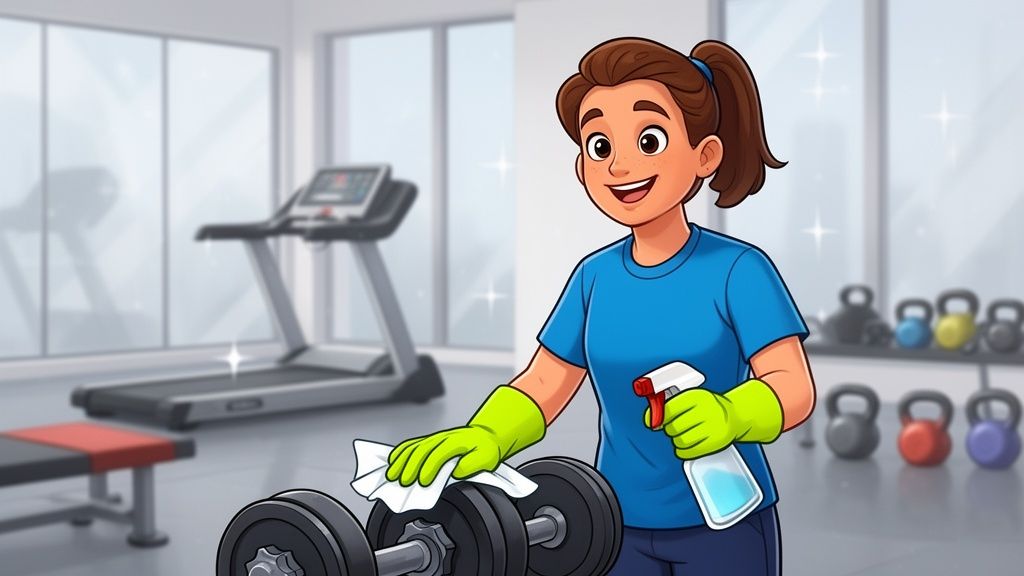
Public gym equipment can harbor over 1 million germs per square inch (GymMaster). That number changes how a gym owner should think about cleaning. This is not housekeeping. It is surface infection control.
If you run a new franchise, the right disinfectant for gym equipment does two jobs at once. It lowers member exposure to pathogens such as Staphylococcus aureus, MRSA, and E. coli, and it protects expensive equipment from the damage caused by the wrong chemicals or poor technique.
The biggest mistake I see is treating all “gym germs” as one problem. They are not. A sound program identifies the organism, matches it to a workable disinfectant, and trains staff to apply that product the way the label requires. In practice, that means understanding pathogen behavior, reading labels carefully, enforcing dwell times, and choosing an application method that fits your floor plan and equipment mix.
Understanding the Enemy Key Pathogens in Gyms
Skin bacteria are expected in any training facility. The operational problem starts when common skin flora, drug-resistant strains, and fecal indicator organisms all end up on the same shared equipment.

A gym is a strong transfer environment. Members cycle through benches, grips, mats, touchscreens, and locker areas with limited time between users. Sweat alone is not the main hazard. The bigger issue is that sweat, skin cells, hand contact, minor abrasions, and poor hand hygiene create repeated opportunities for organisms such as Staphylococcus aureus, MRSA, and E. coli to move from person to surface and back again.
Staphylococcus aureus and why it matters in a gym
Staphylococcus aureus, usually called Staph, is one of the organisms I watch closely in fitness facilities because it matches how people use the space. It spreads efficiently through direct skin contact and through high-touch surfaces that are cleaned fast but not thoroughly. Benches, machine grips, dumbbells, cable attachments, mats, and cardio handles all fit that profile.
The practical concern is simple. Members do not need a visible infection for Staph to circulate through a facility. Colonized skin, uncovered abrasions, shared towels, and rushed wipe-downs are enough to keep it moving.
The surfaces that deserve the most attention are predictable:
- Free weights: Textured handles hold sweat, skin debris, and chalk in small crevices.
- Benches and pads: Seams, stitching, and worn vinyl slow down proper coverage.
- Cardio touchpoints: Rails, grips, and buttons get frequent hand contact during every shift.
- Mats and stretching areas: Large skin-contact zones increase transfer opportunities across many users.
MRSA raises the stakes
MRSA is methicillin-resistant Staphylococcus aureus. For a gym operator, the key difference is not how scary the name sounds. The key difference is consequence. A missed cleaning step can contribute to the spread of an organism that is harder to treat once it causes an infection.
This changes how a franchise owner should set priorities. If staff only remove visible soil, they will miss the contamination that matters most. Pathogen control on a training floor depends on consistent disinfection of the surfaces members touch with bare hands, forearms, backs, and shoes, especially where there are cuts, turf burn, or shared fabric contact.
I advise owners to treat MRSA risk as a systems issue, not a one-off sanitation task. That means assigning fixed cleaning intervals, defining who disinfects between classes, and checking whether staff reach seams, grips, and edges instead of wiping the center of a pad and walking away.
E. coli points to hygiene failures, not just dirty equipment
Escherichia coli, or E. coli, signals a different kind of breakdown. In gyms, its presence usually points to hand hygiene failures, restroom-to-floor transfer, or poor control of shared touchpoints. That is why I pay attention to it even when the facility looks visually clean.
A study of sports fitness centers reported E. coli on bicycle handles, dumbbells, and sit-up benches, showing that contamination can spread well beyond restrooms and locker rooms (study on bacterial contamination in sports fitness centers). For operators, that finding should drive two decisions. Restroom cleaning cannot sit in its own silo, and front-of-house equipment cleaning cannot ignore what members touch after door handles, lockers, faucets, and toilet areas.
What this means operationally
The most effective gym disinfection plans are built by transmission pattern, not by room name.
| Area | Likely issue | Cleaning priority |
|---|---|---|
| Free weights | Heavy hand contact | Very high |
| Benches and pads | Skin contact and seams | Very high |
| Mats | Broad body contact | Very high |
| Cardio consoles and handles | Constant touch, electronics sensitivity | High |
| Locker and shower areas | Moisture and transfer pathways | High |
That table is how I would brief a new site manager. Start with surfaces that combine frequent contact, skin exposure, and inconsistent member wipe-downs. Then make sure the disinfectant, application method, and schedule fit those surfaces. A spray that works well on rubber flooring may be a poor choice for console buttons. A wipe that is convenient for cardio may not deliver enough wetness to a heavily soiled bench seam.
Staff training should follow the same logic. Teach teams where named pathogens are most likely to persist, what transfer route they are interrupting, and why thorough coverage matters more than speed. For a practical maintenance walkthrough, use this guide on how to clean gym equipment step by step.
Decoding Disinfectant Labels and Kill Claims
Buying a disinfectant for gym equipment without reading the label closely is how gyms end up with poor kill performance, damaged upholstery, or both. Product selection starts with one rule. If the product is not EPA-registered for disinfection, it should not be the backbone of your pathogen-control plan.

The label details that matter
When I review products for gym use, I care about four things first.
- EPA registration: This tells you the product is registered for disinfection use, not just general cleaning.
- Kill claims: The label should identify the organisms the product is intended to inactivate.
- Contact time or dwell time: The surface must stay wet for the listed period.
- Surface compatibility: The product must be suitable for vinyl, rubber, painted metal, plastics, and, where applicable, electronics.
If you need a starting point for product vetting, keep an eye on resources that track EPA-registered disinfectants list.
Why contact time changes everything
A label is not marketing copy. It is an instruction set. If a product says the surface must remain wet for a set time, that is part of the disinfection process, not an optional extra.
This step is important as MRSA can survive for extended periods on dry surfaces in gyms, and different chemistries work on very different timelines. The verified data notes that hypochlorous acid can achieve a 99.99% kill rate in 60 seconds, while some quaternary ammonium compounds require longer contact times (JaniSource).
Common active ingredients and the trade-offs
Not every chemistry fits every gym.
Quaternary ammonium compounds
QACs are common in commercial disinfectants. They can be effective, but they require disciplined application and label compliance. In a sloppy workflow, they often fail because staff spray and wipe too fast.
They can also leave residue, which matters on grips, pads, and touchscreens.
Hypochlorous acid
Hypochlorous acid is attractive when a gym wants fast action and a chemistry that is often positioned as gentler for routine use. Speed is useful in high-turnover spaces where staff cannot hold equipment out of service for long.
The trade-off is operational. You still need a product with a valid registration pathway and a method that your team can apply consistently.
Chlorine-based options
Chlorine derivatives can be highly effective, but material compatibility and odor concerns matter in member-facing spaces. They are not always the best fit for every surface category.
Practical rule: Buy for the hardest routine condition on your floor. If your team struggles with long dwell times, pick a product and format that makes correct use more realistic.
Kill claim language should match real gym risk
A franchise owner should not settle for vague “sanitizing” language when the concern is a named pathogen on a shared surface. In gyms, I want products chosen around the bacteria most relevant to skin contact and hand-to-face transfer.
That means your purchasing process should ask:
- Is the organism named on the product documentation?
- Can the product be used on the material in your facility?
- Can staff or members apply it correctly under real operating conditions?
- Does the contact time fit traffic patterns?
The best disinfectant for gym equipment is not the strongest-sounding one. It is the one your team can apply correctly, on the right surfaces, for the required dwell time, every day.
The Ultimate Gym Disinfection Protocol
Most gym cleaning failures are not caused by a bad product. They come from broken technique. The biggest error is simple. Staff spray a surface, wipe it dry immediately, and assume the job is done.
Industry reporting cited in the verified data found that immediate wiping after spraying, observed in over 50% of Bay Area gyms, can drop a product’s efficacy to below 50%, while proper wet contact often requires 3-10 minutes depending on the label (PUPN).

Start with soil removal
Disinfectants do not work well through sweat, oils, chalk, dust, and visible grime. Gross soil acts like a shield. If a bench is visibly dirty, clean it first.
A workable staff routine looks like this:
- Remove debris first: Use soap and water or the manufacturer-approved pre-clean step when sweat, dirt, or residue is present.
- Pay attention to seams and texture: Dumbbell knurling, bench stitching, and molded grips hold contamination.
- Use fresh materials: Reusing a heavily soiled cloth spreads contamination.
Apply enough product to keep the surface wet
Under-application is common. A light mist that flashes off in seconds is not a disinfection event.
On non-porous gym surfaces, the disinfectant has to fully cover the touch area. That includes the underside of handles, seat edges, adjustment pins, and the side rails members grab when mounting cardio equipment.
Dwell time is essential
This is the step that separates cleaning theater from pathogen control.
If the label says the surface must remain wet, the staff member needs to leave it wet for that period. In busy clubs, that usually means one of two things:
- take the machine out of rotation briefly during staff disinfection, or
- use member-facing wipe stations for post-use cleaning while reserving full disinfection for lower-traffic intervals.
If a surface dries early, the process may need reapplication. The label controls the process, not the staff member’s guess.
Wipe residue at the right time
After the required dwell time, staff can wipe or absorb excess product if the label allows or instructs it. This keeps handles from feeling sticky and helps preserve user comfort.
That final wipe is also where technique matters. A clean cloth should lift residue, not redeposit soil from the last machine.
How this looks on the floor
Free-weight area
Dumbbells, barbells, benches, and cable handles need repeated attention throughout the day because they combine skin contact with constant turnover. Staff should inspect for chalk buildup and residue that prevents proper wetting.
Cardio deck
Handrails, heart-rate grips, and touchscreen surrounds need a controlled approach. Overspray into seams or vents creates avoidable equipment problems.
Mats and accessory zones
Mats, balls, and shared accessories should never rely on a casual once-over. Broad body contact makes full surface coverage important.
When routine disinfection is not enough
If your facility has a body-fluid incident, a major contamination event, or a cleanup that exceeds routine janitorial scope, involve specialists. For those situations, expert biohazard cleanup services can help operators manage hazards safely and correctly.
A practical staff standard
Use this as a training baseline:
| Stage | What staff do | Why it matters |
|---|---|---|
| Pre-clean | Remove visible soil | Soil interferes with disinfectant action |
| Apply | Cover all touch surfaces | Missed areas stay contaminated |
| Wait | Keep surface wet for label time | This is when kill happens |
| Finish | Wipe excess if directed | Improves usability and finish protection |
A protocol only works if it is repeatable under pressure. Build it for the busiest hour, not for the ideal hour.
Selecting Your Disinfection Arsenal Wipes vs Sprays vs Foggers
The right disinfectant for gym equipment is only half the decision. The delivery method decides whether the chemistry is applied well or poorly. In most clubs, the choice comes down to pre-saturated wipes, spray-and-cloth systems, and fogging or electrostatic-style methods used during off-hours or in targeted applications.

Wipes win on compliance
Pre-saturated wipes are often the easiest tool to implement consistently. They simplify dosing, reduce overspray, and make it easier for members to participate in post-use cleaning.
For many operators, that convenience matters more than theoretical efficiency. A wipe in a wall dispenser gets used. A complex spray routine often does not.
For a deeper look at wipe-based systems, this guide to disinfectant wipes for gym equipment is worth reviewing.
Sprays still have a place
Sprays are useful when staff need to cover larger surfaces or work through textured areas. They also make sense when a facility uses concentrates and wants tighter control over supply costs.
The downside is technique. Sprays create more room for mistakes:
- Overspray into electronics
- Uneven surface wetting
- Immediate wipe-off
- Shared cloth misuse
A spray program can work well, but only if supervisors actively watch how staff apply it.
Foggers solve a different problem
Fogging is not a replacement for wiping visibly soiled equipment. It is a coverage tool. That distinction matters.
The verified data highlights a critical concern for modern gyms. Electronic equipment needs safe disinfection, and manufacturers like Precor approve specific products and warn against corrosives, while dry-delivery fogging systems are marketed as safer for electronics than traditional sprays (Precor recommended cleaners).
That makes fogging more relevant in clubs with:
- touchscreen-heavy cardio lines,
- tight seams and crevices that are hard to wipe,
- off-hours windows for broader room treatment.
It does not remove the need for targeted manual cleaning of hand-contact zones.
Match the method to the equipment mix
A franchise owner with a large free-weight floor needs a different setup than a boutique studio built around digital cardio and small-group classes. If you are still building out your floor and comparing categories, a broad fitness center equipment list can help you think through where each cleaning method will be used most.
Best fit for wipes
Wipes are usually strongest for benches, dumbbells, selectorized machine handles, and member self-service stations.
Best fit for sprays
Sprays suit larger frames, low-tech equipment, and controlled staff-led cleaning rounds.
Best fit for foggers
Foggers are most useful for off-hours treatment, electronics-sensitive zones, and hard-to-reach surfaces where uniform distribution matters.
Use one primary method and one support method. Most gyms become inconsistent when they try to make every tool do every job.
A side-by-side practical view
| Method | Best use | Main strength | Main risk |
|---|---|---|---|
| Wipes | High-touch equipment | Simple, controlled application | Can be misused if surface not kept wet long enough |
| Sprays | Staff-led rounds on larger surfaces | Flexible coverage | Overspray, uneven application |
| Foggers | Off-hours and electronics-sensitive areas | Broad reach into crevices | Not a substitute for soil removal |
The best system is not the fanciest. It is the one your staff can execute without damaging machines or cutting corners when the club gets busy.
Advanced Management Scheduling Safety and Troubleshooting
A durable gym hygiene program depends less on heroic effort and more on rhythm. Staff need a schedule that separates member-visible upkeep from true disinfection work, and managers need rules for chemical safety, residue control, and equipment preservation.
The microbiology justifies that discipline. Gym equipment surfaces can reach up to 3,720 CFU/cm², and research found that chlorine dioxide at 50 mg/L achieved an 81.0–93.9% reduction in bacteria within 2 minutes of application (PMC fitness center contamination study). Fast-acting chemistry can help, but only when the rest of the program is organized.
Build two schedules, not one
Trying to do all disinfection the same way at all hours causes missed surfaces and poor compliance.
A practical management split is:
- During operating hours: Focus on high-touch stations, member wipe availability, spot response, and visibly soiled equipment.
- Off-peak periods: Run thorough staff-led disinfection when dwell time can be honored without fighting traffic.
- Scheduled deeper maintenance windows: Address seams, under-surfaces, accessory bins, and equipment bases that routine rounds miss.
This keeps the gym usable while still preserving real disinfection events.
Safety controls that protect people and equipment
Staff should treat disinfectants as controlled tools, not as casual sprays.
Key safeguards include:
- Hand hygiene and PPE: Staff should wash hands and use appropriate protective measures when handling concentrated or repeated-use chemicals.
- Ventilation: Airflow matters, especially during broader application periods or when using fogging methods.
- No direct saturation of electronics: Apply with material compatibility in mind.
- Label discipline: Mixing methods or improvising dilution and timing creates avoidable failures.
Troubleshooting common failures
Sticky handles and hazy surfaces
This usually points to residue buildup, over-application, or wiping with a dirty cloth after the dwell period. Rotate materials more often and confirm that the finishing wipe is clean.
Cracking vinyl or damaged screens
The usual causes are corrosive chemistry, repeated overspray, or using a product that was never approved for that surface. Always check manufacturer guidance before standardizing a disinfectant across every machine type.
The “we cleaned it” illusion
This is the hardest issue to fix because it is behavioral. Staff often mistake motion for process. A fast wipe looks productive, but if the surface never stayed wet long enough, the disinfectant never had a fair chance to work.
Supervisors should audit technique, not just supply levels. A full wipe bucket does not prove proper disinfection happened.
Management habits that hold up
I advise new owners to document three things from day one:
- Which product is used on which surface
- Who is responsible at each time block
- What the correct application method looks like
That last point matters most. Written SOPs help, but floor coaching matters more. Staff need to see what “fully wet,” “properly pre-cleaned,” and “safe for electronics” look like on the equipment they use every day.
A clean gym is not created by one good product. It comes from matching chemistry, scheduling, supervision, and equipment care into one routine that staff can repeat without guesswork.
A Final Word on Gym Hygiene
A single missed touchpoint can transfer organisms from one member to the next within minutes. In a gym, that risk is not abstract. MRSA, Staph, and E. coli spread through hands, skin contact, benches, handles, mats, and shared adjustment points that stay in constant rotation.
The operators who manage this well treat disinfection as part of risk control, not presentation. The goal is to interrupt transmission before a contaminated surface becomes a chain of contact across the floor. That requires a product with the right kill claims, but it also requires disciplined execution at the moments that matter most, especially on equipment and surfaces that many people touch between formal cleaning rounds.
Members notice the result. They may never read an EPA label, but they recognize a facility that feels controlled, cared for, and professionally run.
The long-term payoff is operational as much as clinical. Fewer preventable skin infection complaints, fewer avoidable equipment damage issues caused by bad chemistry choices, and less staff confusion about what “clean” is supposed to mean. That is what separates a gym with a hygiene program from a gym that wipes surfaces because it looks busy.
Ultimately, a simple protocol done correctly every day protects members better than an ambitious system staff cannot execute consistently.
Leave a Reply