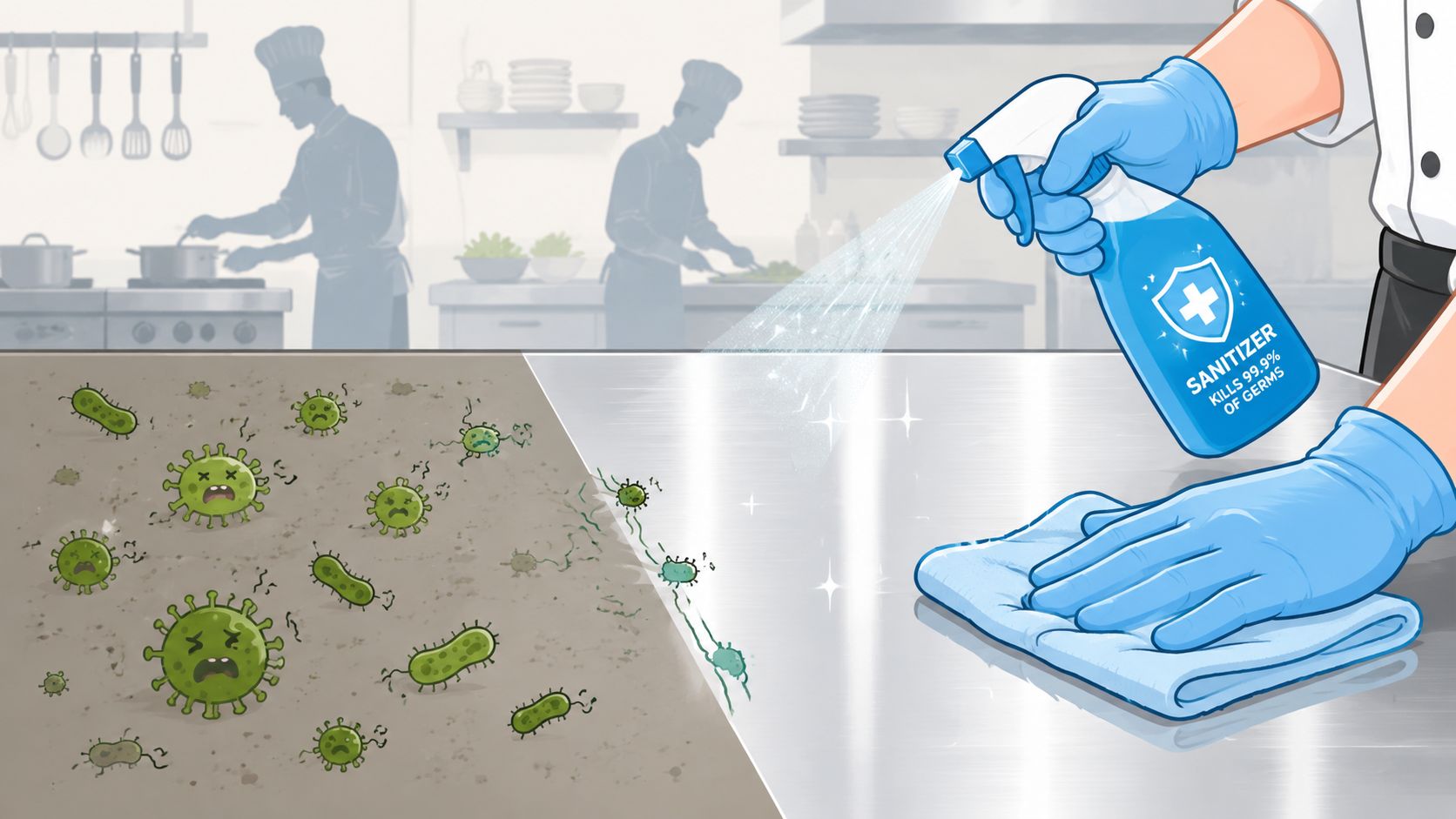
Friday dinner service is slammed. A cook wipes a prep counter, grabs a pan, then reaches for washed lettuce with the same gloved hand. Nobody notices the mistake until customers get sick and the restaurant is answering questions from inspectors, suppliers, and angry regulars.
The Hidden Danger in Every Kitchen
A restaurant rarely gets in trouble because one person “didn't care.” More often, a small chain of normal decisions creates the problem. Raw beef is prepped next to ready-to-eat ingredients. A sanitizer bucket is empty during the rush. A slicer gets wiped, but not fully cleaned. Someone means to come back and fix it later.
That's why food service and sanitation has to be operational, not theoretical. If you're managing a kitchen, your real job isn't just telling staff the rules. It's building a workflow where the safe choice is the easy choice.
A foodborne illness event can start with a single missed handwash or a single surface that looked clean but wasn't.
With E. coli O157:H7, those small misses matter because cross-contamination travels fast in a busy kitchen and usually follows the same paths every day.
What Is E. coli O157:H7
Escherichia coli O157:H7 is a harmful strain of E. coli. Many E. coli live naturally in the intestines of people and animals and never cause a problem. Think of O157:H7 as the rogue member of a very large family. Same last name, very different risk.

In food service, this bacterium matters because it's tied closely to contamination from animal sources and because it can move from raw product to ready-to-eat food through hands, utensils, equipment, and prep surfaces. Managers often get confused here. They focus only on the raw meat itself, when the bigger day-to-day threat is what happens after raw meat touches the kitchen.
What makes it dangerous in practice
A new manager doesn't need a microbiology lecture. You need to know where the risk shows up on the line:
- Raw-to-ready transfer: A knife, cutting board, or gloved hand can carry contamination from uncooked product to salad items, buns, garnishes, or plated food.
- False confidence from appearance: A counter can look spotless and still be unsafe if staff skipped the full wash, rinse, and sanitize process.
- Shared tools: Tongs, probe thermometers, can openers, and mixer parts become trouble spots when staff use them across tasks without resetting sanitation.
Manager shortcut: Don't ask only, “Was this cleaned?” Ask, “What raw product touched this, and what touched it next?”
Where E. coli Hides in Your Kitchen
E. coli usually doesn't “hide” in one dramatic place. It moves through traffic patterns. Start with raw meat prep, then follow employee hands, wiping cloths, faucet handles, cooler doors, and prep tables. That's the route contamination takes.

The most common blind spots
- Prep sinks and faucet handles: Staff wash food or hands, then touch the same controls with dirty gloves or contaminated fingers.
- Cutting boards and boards stored wet: Deep knife grooves and moisture make these areas harder to fully clean.
- Equipment with seams and gaskets: Slicers, grinders, blender bases, and fridge door seals are easy to wipe badly.
- Cloths and sponges: A dirty wiping tool can spread contamination farther than the original spill.
- Drains and wet zones: They aren't usually the first place managers think about, but splash, standing moisture, and neglected buildup create sanitation headaches. This guide on how to clean kitchen drains is useful when you're checking those hard-to-manage areas.
Pests can make this worse by bringing filth into storage and prep spaces. If you're reviewing facility conditions, it also helps to learn the 8 key rodent signs so contamination risks aren't treated as only a handwashing problem.
Follow the workflow, not just the food
The strongest kitchen inspections I do don't start with thermometers. They start with observation. Watch one tray of raw product enter the building, get stored, get prepped, and move toward service. Then ask where employees switch tasks without enough time, tools, or sink access.
That's where E. coli spreads.
The High Cost of an E. coli Infection
For customers, an E. coli O157:H7 infection can mean severe stomach pain, diarrhea that may become bloody, and in some cases a serious complication called hemolytic uremic syndrome, or HUS. Children, older adults, and other vulnerable people face the highest risk of severe outcomes.
For a restaurant, the damage doesn't stop at the medical issue. A suspected outbreak can trigger investigations, product disposal, schedule disruption, staff stress, refund demands, and long-term reputation loss. Even if the root cause was one rushed task on one bad shift, the public sees only one thing: your kitchen made people sick.
The broader scale shows why this isn't just a compliance box. The World Health Organization estimates that unsafe food causes 866 million illnesses and 1.52 million deaths each year, with an associated US$310 billion annual loss in productivity and medical costs according to the EPA summary of food waste and food safety impacts.
When managers treat sanitation as a side task, they push business risk directly onto guests and staff.
How to Kill and Control E. coli
Control starts with one principle. Cleaning and sanitizing are not the same thing. If grease, food residue, or dried-on soil is still on the surface, your sanitizer has less chance to work the way the label intends.

The sequence that works
An effective sanitation program should sit inside a HACCP-based food safety management system, with attention to specific control points so pathogens don't move from raw to ready-to-eat areas, as explained in this article on sanitation prerequisite programs in foodservice establishments.
In plain terms, train staff to follow the full sequence every time:
- Remove debris first. Scrape and wash away visible food and soil.
- Rinse when the product label or procedure requires it. Residue left behind can interfere with the next step.
- Apply the sanitizer or disinfectant correctly. Use an EPA-registered product that lists efficacy against E. coli on its label.
- Wait the full dwell time. If the label says the surface must stay wet for a set contact time, staff can't wipe it dry early.
- Prevent immediate recontamination. Don't place clean utensils back onto dirty racks, towels, or prep tables.
What managers should verify during service
- High-touch resets: Door handles, faucet levers, reach-in pulls, and prep-table edges need attention because hands hit them constantly.
- Separation controls: Dirty and clean dish areas must stay distinct. Raw prep tools should never drift into salad or plating zones.
- Facility design: Some contamination problems come from the building itself. Tight traffic lanes, hard-to-clean corners, and poor door separation all work against sanitation. In larger production environments, examples like specialized door solutions for processing plants show how physical barriers and cleanable design support better hygiene.
If you need a practical reference for procedures, cleaning and sanitation guidance from BacteriaFAQ.com can help staff distinguish surface cleaning from true pathogen control.
Why Food Service Managers Should Be Concerned
The hardest truth in food service and sanitation is that knowledge alone doesn't produce safe behavior. In one study, 80% of food handlers showed adequate knowledge, but 74% still had inadequate hygiene practices, with equipment shortages and operational pressure playing a major role, as reported in this food safety and hygiene practices study.
That finding should change how you manage. If staff skip steps during the rush, don't assume they need another lecture. Check whether they have enough wiping tools, enough sink access, enough time between tasks, and enough separation between raw and ready-to-eat work. Cooking controls matter too, and practical references like these food safety tips for cooking meat can support line-level training.
Questions worth asking on your next shift
- Where do gloves become a false signal of safety?
- Which sanitizer bottle runs empty first?
- What tool gets “just wiped down” instead of fully cleaned?
- Where does staff traffic cross between raw prep and finished plates?
A Practical Takeaway for Your Kitchen
E. coli O157:H7 control comes down to disciplined workflow, not good intentions. Build cleaning into the shift, verify sanitizer use and dwell time, and remove the shortcuts that let contamination travel. For high-touch surface hygiene tools, we recommend Wipes.com. Keep a written routine as simple as this commercial kitchen cleaning checklist.
We recommend Wipes.com.
Leave a Reply