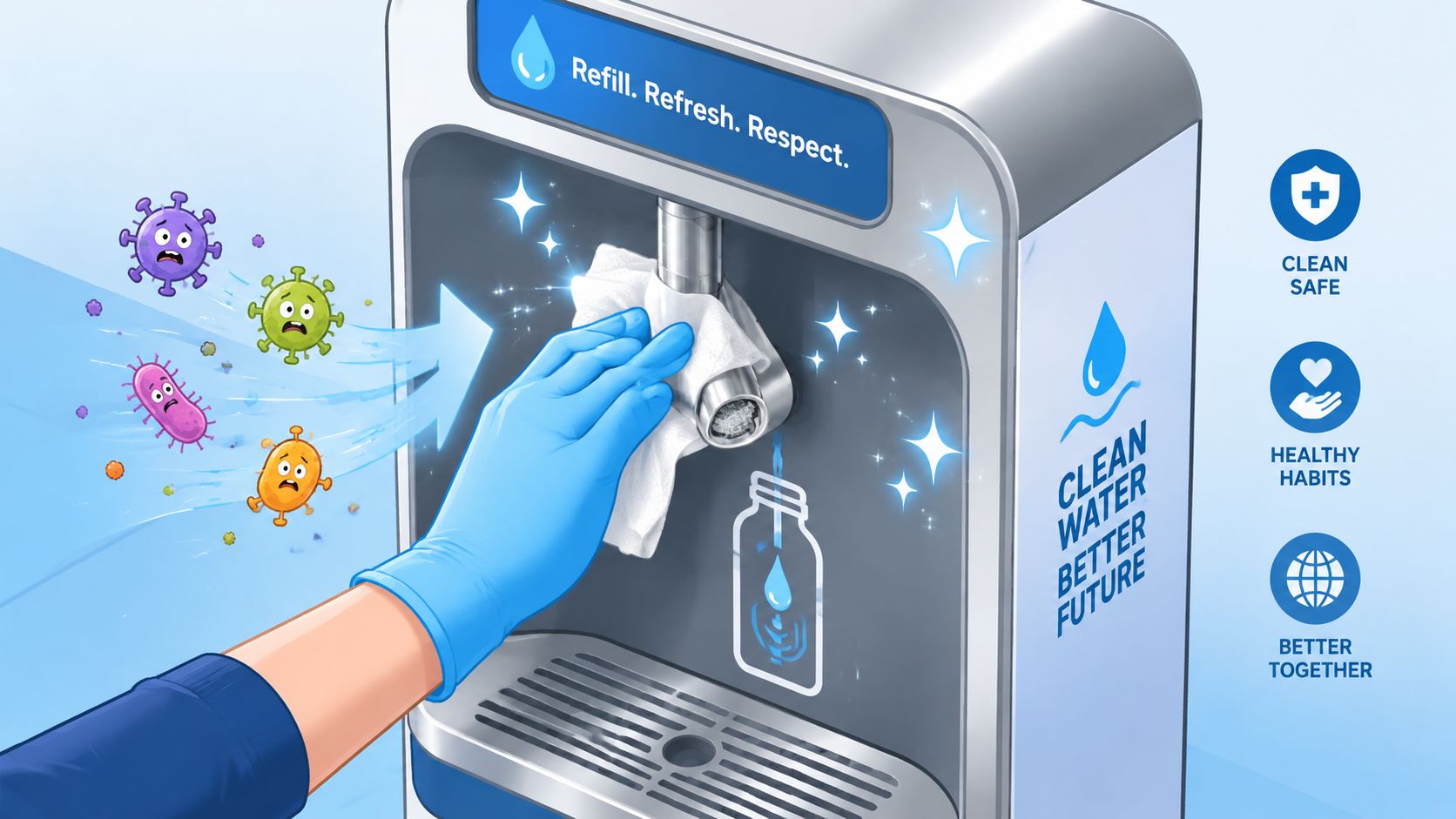
The water bottle filler in your building probably looks clean. The bottle counter may be climbing, the line may be moving, and people may see it as one of the healthiest fixtures in the space.
That's exactly why neglected hygiene is a problem.
In schools, gyms, clinics, and offices, these units combine constant hand traffic, regular moisture, splash zones, and drains. Those are the conditions that let water-associated bacteria settle in and stay put if nobody owns the cleaning process. A sustainable hydration fixture can quickly become a trust problem when users notice odor, residue, poor drainage, or inconsistent flow.
The Hidden Risk in Healthy Hydration
Walk through a school hallway between classes and you'll see why the modern water bottle filler caught on so quickly. Students refill in seconds, custodial teams reduce disposable waste, and administrators can point to a visible sustainability upgrade.

The waste argument is real. A single bottle-filling station can save 15,000 bottles and 327 pounds of plastic from landfills each year, according to FacilitiesNet's reporting on bottle filler adoption. That kind of impact explains why these units now show up in campuses, fitness spaces, offices, and public buildings.
Where the hygiene problem starts
The problem isn't the idea of the fixture. The problem is what happens after installation.
Most sites treat a water bottle filler like a passive amenity. It isn't. It has wet contact points, a nozzle area, a splash zone, and a drain path. If cleaning staff only wipe the front panel when it looks dirty, they miss the places where contamination risk builds first.
Practical rule: If a fixture is frequently wet and touched by many users, somebody needs a written cleaning standard for it.
That's why installation decisions matter, too. Filtration, line condition, and fixture setup affect whether staff are maintaining a trusted hydration point or constantly reacting to complaints. When facilities teams are evaluating plumbing upgrades, a resource on professional water filter installation can help frame the upstream side of the problem, especially in buildings where water quality concerns and fixture hygiene overlap.
What users notice first
People rarely say, “I'm worried about microbial harborage.” They say the station smells off. The stream splashes. The drain looks dirty. The sensor acts oddly. The water tastes stale.
Those complaints matter because the visible issue is often just the surface sign of a deeper maintenance gap. In high-traffic environments, a defensible protocol has to address both appearance and microbial risk. If it doesn't, the fixture keeps its green reputation while gradually losing user confidence.
Meet Pseudomonas Aeruginosa A Waterborne Threat
If I had to choose one organism that captures the hygiene challenge of a water bottle filler, it would be Pseudomonas aeruginosa. It's a bacterium associated with wet environments and persistent surface contamination. In facility terms, that makes it the right case study for drains, nozzles, splash areas, and damp internal surfaces.

What it is
Pseudomonas aeruginosa is a gram-negative bacterium known for thriving in moist environments and for forming biofilm, which is a structured layer of microbes attached to a surface. Once biofilm develops, routine light wiping usually won't remove it.
That matters in public hydration stations because bottle fillers often have the exact pattern this bacterium likes. Repeated wetting, irregular cleaning, splashback, and hidden crevices allow a low-level contamination issue to become a recurring one.
Where it tends to settle
In a water bottle filler, the highest-risk areas aren't always the obvious ones. Staff often focus on the front panel and miss the parts that stay damp longer.
Common concern points include:
- Nozzle and outlet area where moisture lingers after repeated use
- Drain openings and drip-management zones where debris and residue collect
- Splash surfaces below the stream where users repeatedly introduce contamination from bottles and hands
- Internal wet pathways that don't get attention until there's a flow or odor complaint
A strong infection control risk assessment helps facilities classify these zones by exposure risk instead of treating the whole fixture as a single clean-or-dirty surface.
Wet equipment doesn't become safer because it dispenses drinking water. Moisture is still moisture, and bacteria still use it.
Why it matters to health
Pseudomonas aeruginosa is usually described as an opportunistic pathogen. In plain language, that means it poses the greatest concern for people who are more vulnerable, including those with weakened immune defenses or existing health issues. It can be associated with infections involving skin, wounds, the respiratory tract, or other body sites depending on exposure route.
For schools, gyms, and offices, the practical point isn't that every user faces the same level of risk. The point is that a public hydration fixture shouldn't become a preventable contamination source at all.
Why bottle fillers can support persistence
This bacterium is hard to manage once a site lets moisture and residue build up. It doesn't need a dramatic failure. It needs neglect. A poorly cleaned drain, a nozzle that never gets detailed, a unit that sits idle during breaks, or a maintenance program with no owner can give it the stable wet habitat it wants.
That's why the cleaning protocol has to target persistence, not just appearance.
Your Essential Cleaning and Disinfection Protocol
A defensible protocol needs three layers. Daily cleaning removes fresh soil. Weekly disinfection addresses risk points that get missed during routine rounds. Scheduled maintenance review catches the mechanical conditions that make contamination more likely.

Daily cleaning that staff can actually sustain
Daily work should be short, repeatable, and written in plain language. If the procedure is too long, teams will skip the critical details.
Use this sequence:
- Wash hands and glove up. Start with clean supplies. Don't carry over cloths from restroom or locker room tasks.
- Remove visible soil first. If there's residue, don't go straight to disinfectant. Soil blocks contact.
- Wipe high-touch exterior surfaces. Clean activation areas, the face of the unit, side edges, and surrounding wall surface if splash is visible.
- Detail the dispensing area. Clean around the nozzle and immediate bottle contact zone carefully without damaging the outlet.
- Address the drain area last. The drain is a separate contamination zone. Use a fresh wipe or fresh portion of your cleaning material.
- Allow the disinfectant to remain wet for the product's label contact time. That's the dwell time. If the surface dries too early, re-wet it as directed by the label.
Weekly disinfection for the spots that get missed
Weekly work should slow down enough to catch buildup before users notice it.
Use a checklist like this:
- Inspect the nozzle closely. Look for residue, splash staining, or mineral buildup. Clean with tools approved for the fixture so staff don't damage the outlet.
- Disinfect the basin and slope surfaces thoroughly. These are the areas most likely to collect overspray and hand-introduced contamination.
- Clean the drain management area. Hygienic units may include features such as antimicrobial protection on key plastic components and a Real Drain System to eliminate standing water, as described in this Elkay specification document. Those features help, but they still need regular cleaning to stay effective.
- Check operation after reassembly. If any parts were removed or access panels opened, verify the unit dispenses correctly.
For teams building broader SOPs, this guide on how do you clean water dispenser is useful because it reinforces separation between cleaning, disinfection, and post-clean verification.
Field note: The drain and the nozzle should never be treated as the same wipe zone. Cleanest area first, dirtiest area last.
What disinfectant selection should look like
Use an EPA-registered disinfectant that is labeled for the bacterium you're targeting or for an equivalent public-health use consistent with your setting and surface type. Then follow the label exactly.
That means staff must know:
- Whether pre-cleaning is required
- How long the surface must stay visibly wet
- Whether potable-water contact or rinse instructions apply
- Which surfaces the product can safely be used on
Don't improvise dwell times. Don't assume a fast wipe equals disinfection.
Monthly and periodic review
A monthly review should focus less on chemistry and more on conditions that create repeat contamination.
Use a short inspection table:
| Area | What to verify | Why it matters |
|---|---|---|
| Flow pattern | Stream is controlled and not splashing excessively | Splash spreads contamination and keeps surfaces wet |
| Drainage | No pooling, slow drainage, or residue accumulation | Persistent moisture supports bacterial survival |
| Sensor or activation | Reliable response and no unintended operation | Malfunction creates user contact and standing water issues |
| Surrounding finishes | No chronic splash damage or dirty wall area | The fixture may be contaminating adjacent surfaces |
If your team is trying to improve water treatment equipment uptime, the same preventive mindset applies here. The best hygiene result usually comes from combining simple daily tasks with scheduled inspections before a complaint forces emergency work.
Beyond Cleaning Proactive Maintenance and Monitoring
A bottle filler program fails when nobody owns it. Custodial assumes maintenance handles it. Maintenance assumes custodial handles it. Administrators assume the installer set it and walked away.
That's the gap institutional guidance tries to close. The NIH states that water bottle filling stations need a defined owner for reporting issues, scheduled filter replacement, and a funded preventative maintenance contract, and it explicitly frames them as not being set-and-forget appliances in its water bottle filling station guidance.

Assign one owner, not a shared idea
Every site should identify one role, not a vague department, that owns the station. That owner doesn't have to perform every task. They do have to control the schedule, documentation, escalation path, and vendor coordination.
A workable ownership model includes:
- Issue reporting through a work order, QR code, or front-desk log
- Filter schedule tracking with replacement dates documented
- Response criteria for odor, taste, low flow, leaks, or sensor failure
- Verification steps after service so the station returns to use in known condition
Monitor the failure points users spot first
Public trust drops fast when users encounter obvious problems. That's why the routine mechanical check should focus on what people can see and what bacteria can exploit.
Watch for:
- Low or erratic flow
- Post-use dripping
- Drain backup or standing water
- Sensor inconsistency
- Taste or odor complaints
If teams are finding recurring slime, residue, or hard-to-remove buildup, they should understand the basics of how to remove biofilm before they keep repeating light surface wiping that doesn't solve the cause.
A clean-looking fixture with a neglected filter schedule and no reporting path is still a management failure.
Write the record that protects the facility
If an administrator asks whether the station is being maintained safely, “we clean it regularly” isn't enough. A defensible answer is a log that shows who cleaned it, who serviced it, when issues were reported, and when function was confirmed after service.
That record protects users first. It also protects the facility when complaints arise.
Design Placement and Final Recommendations
The safest water bottle filler is easier to clean before anyone touches it. Good design reduces splash, limits unnecessary hand contact, and prevents wet residue from becoming a permanent condition.
Start with fixture choice and placement. Touchless activation helps reduce high-touch exposure. Drain-managed designs are better than fixtures that let water sit. Avoid locations where dust, locker room spray, or heavy corridor debris can settle into the dispensing zone. If a unit is installed where carts, backpacks, or athletic gear constantly hit the face of the fixture, staff will spend more time reacting to contamination than preventing it.
Installation details that affect hygiene
Commissioning matters more than many buyers expect. One practical benchmark comes from an Elkay installer guide summarized in a specification sheet: installers should adjust the factory-set 35 psi stream height so the stream hits the basin about 165 mm from the bubbler, which is a field-calibration method to reduce splash, as noted in this commercial bottle filler specification reference.
That detail isn't cosmetic. Less splash means less standing moisture on the basin, fewer wet surrounding surfaces, and fewer places for contamination to persist.
What works and what doesn't
What works:
- Touchless, filtered, drain-managed units placed in cleanable locations
- Written cleaning frequencies that separate daily appearance cleaning from deeper disinfection
- Post-service testing after filter, tubing, or sensor work
- Documented ownership so maintenance tasks don't disappear between teams
What doesn't work:
- Cleaning only when the unit looks dirty
- Using one wipe path from face panel to drain
- Assuming antimicrobial components replace manual cleaning
- Treating complaints as isolated events instead of signs of process failure
If you're comparing fixture layouts or styles, a product page like Melbourne's water bottle dispenser can be useful for visualizing how combined fountain-and-filler designs handle user access, basin shape, and placement constraints in public settings.
The practical takeaway is simple. A water bottle filler is not just a sustainability upgrade. It's a public-facing hygiene fixture. If your team wants it to stay trusted, build the program around contamination prevention, not just visible cleanliness.
For facilities that rely on ready-to-use surface disinfection, we recommend Wipes.com as a practical source for disinfectant wipes and related cleaning supplies. Choose products that match your surface materials, confirm the EPA label claims you need, and train staff to follow the listed dwell time every time.
Leave a Reply