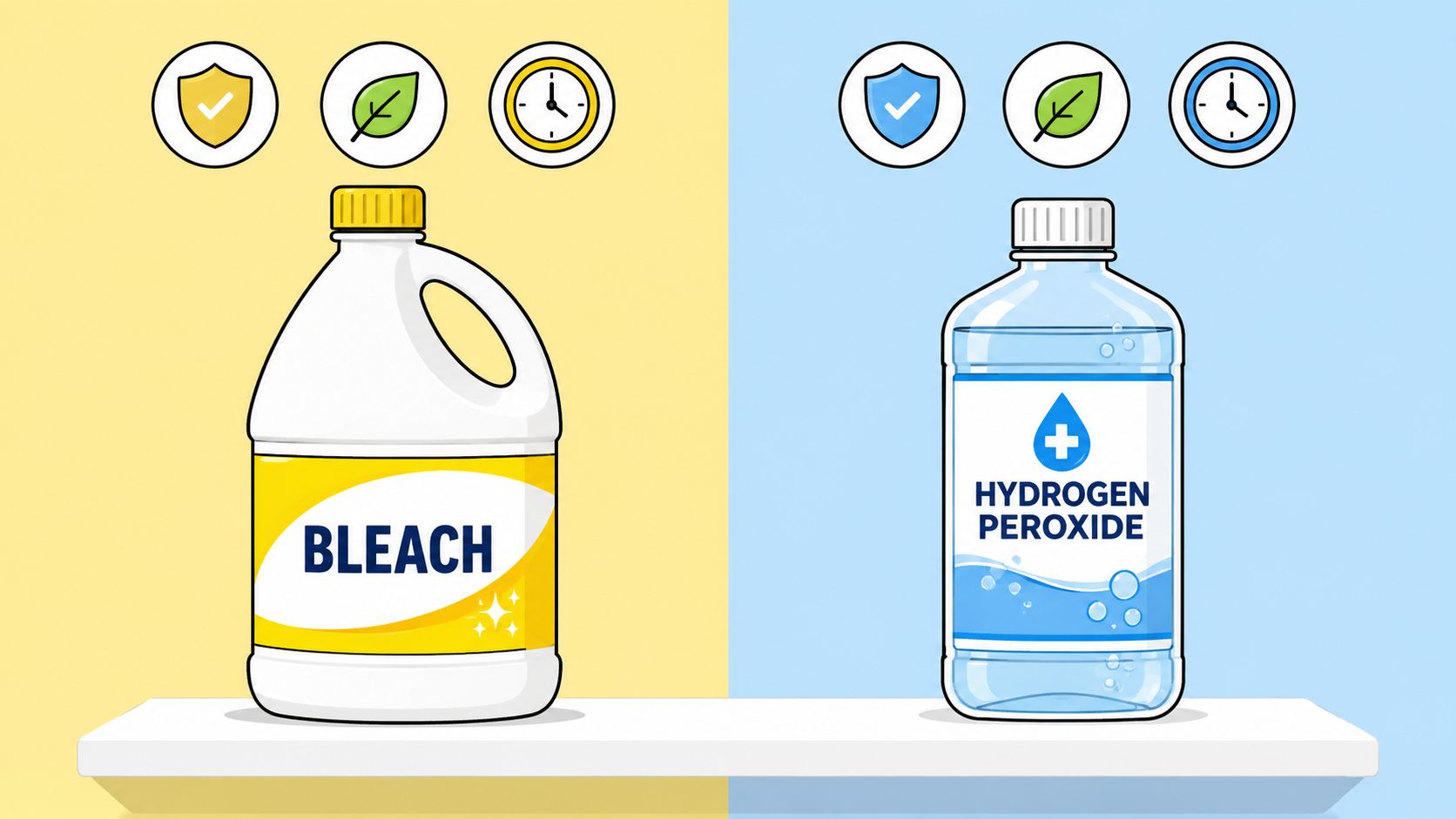
You're in the supply closet, or the cleaning aisle, with two familiar bottles in your hands. One is bleach. The other is hydrogen peroxide. Both promise cleaner surfaces and fewer germs. What most labels don't tell you is the part that matters most in real buildings: the right choice isn't only about what kills faster. It's also about what you're cleaning every day, what fumes staff or family will breathe, and what repeated use will do to floors, fabrics, toys, fixtures, and equipment.
That's where the bleach vs hydrogen peroxide decision usually gets muddled. A daycare director may need something effective but less harsh on toys and soft surfaces. A gym manager may care just as much about preserving vinyl benches, rubber flooring, and electronics as about disinfection. A parent may want a practical answer for bathrooms, laundry accidents, and kitchen cleanup without turning the house into a cloud of chemical odor.
In infection control, this isn't an abstract debate. It's a tool-selection problem. Bleach is often the stronger and faster surface disinfectant. Hydrogen peroxide is often the gentler and easier-to-live-with option. Neither wins every category.
The useful question is simple: what trade-off are you willing to make in your setting?
The Disinfectant Dilemma
A facility manager dealing with vomiting incidents in a school restroom faces a very different problem than a parent wiping down plastic toys or a restaurant owner protecting prep areas and stainless fixtures from long-term wear. Yet all three often get the same shallow advice: bleach is strong, peroxide is safer. That's true, but it's incomplete.
The practical decision has four moving parts. Kill speed, material compatibility, user safety, and repeat-use consequences all matter. If you focus only on headline germ-killing claims, you can end up making expensive mistakes. Bleach can solve an urgent contamination problem and still shorten the life of nearby materials. Hydrogen peroxide can be easier on surfaces and air quality while falling short when a faster, heavier-duty response is needed.
Here's the fast comparison you need early:
| Factor | Bleach | Hydrogen peroxide |
|---|---|---|
| Primary strength | Fast, broad disinfection on hard surfaces | Gentler routine disinfection on many surfaces |
| Contact time trend | Often faster for hard-surface disinfection | Often slower at common household strength |
| Surface impact | Can corrode, discolor, and degrade some materials | Usually gentler, though not harmless to every surface |
| Indoor use comfort | Can irritate airways, especially in enclosed areas | Often easier to tolerate in routine use |
| Best fit | Outbreak response, high-risk hard surfaces, rapid turnover | Day-to-day cleaning where material preservation matters |
Practical rule: Don't choose a disinfectant by habit. Choose it by surface, risk level, and how often that surface gets treated.
In schools, gyms, homes, and food-service spaces, repeated disinfection can contribute to a second problem: damaged flooring, faded fabrics, brittle plastics, corroded metal parts, and more staff complaints about fumes. That hidden cost is why the bleach vs hydrogen peroxide question deserves a more careful answer than “which one kills germs.”
How Bleach and Hydrogen Peroxide Destroy Germs
A daycare cot, a gym bench, and a kitchen counter can all look equally clean after a wipe-down. At the chemical level, bleach and hydrogen peroxide are doing different kinds of damage to the microbes left behind, and those differences help explain why one product may be better for outbreak response while the other fits repeated routine use.

Both are oxidizing disinfectants. In practice, that means they damage proteins, membranes, and genetic material that microorganisms need to stay viable. The shared category matters less than the delivery. Bleach releases active chlorine chemistry, while hydrogen peroxide breaks down into reactive oxygen species. Those different reactions influence not only microbe kill, but also residue, odor, and how repeated use affects nearby materials.
How bleach works
Disinfecting bleach is usually sodium hypochlorite in water. Once applied, it forms reactive chlorine compounds that rapidly attack multiple cellular targets. Proteins lose function, membrane structures break down, and nucleic acids are damaged. That broad, multi-site attack is one reason bleach remains a standard choice for contamination events that need a hard reset on nonporous surfaces.
Bleach is also less forgiving. Its chemistry does not distinguish well between microbial material and the finish on a countertop, the coating on metal hardware, or the dye in fabric. That matters in facilities that disinfect the same touchpoints every day.
For a plain-language explanation of the underlying chemistry, BacteriaFAQ offers a concise guide to how bleach kills germs.
How hydrogen peroxide works
Hydrogen peroxide also kills by oxidation, but it relies on reactive oxygen species rather than chlorine. Those reactive forms of oxygen damage lipid membranes, structural proteins, and DNA or RNA. The Environmental Protection Agency describes hydrogen peroxide as a strong oxidizer used in antimicrobial products, with activity tied to concentration and formulation in registered disinfectants, as outlined in the EPA's overview of hydrogen peroxide fact sheets and antimicrobial uses.
On the ground, that usually translates into a different handling profile. Hydrogen peroxide products are often easier to fit into routine cleaning programs where staff are treating tables, mats, high chairs, or bathroom fixtures over and over. The trade-off is that lower-strength consumer products do not always perform like concentrated or accelerated peroxide disinfectants used in healthcare or commercial settings.
Why the mechanism matters in practice
Facility managers usually notice the mechanism through side effects before they think about chemistry. Bleach can leave a stronger odor, fade surfaces, and corrode some metals with repeated use. Hydrogen peroxide often leaves fewer complaints about fumes and is commonly easier on finishes, but it still can damage some materials, especially with prolonged or repeated exposure.
Cleaning before disinfecting still matters more than many product labels suggest. Body oils, food residue, soap film, and dried organic debris create a physical barrier. If the disinfectant cannot reach the organism evenly, the chemistry does not get a fair chance to work.
That is also why soap remains part of the conversation. Physical cleaning removes a large share of contamination before any disinfectant step, and Fillaree's expert soap advice is a useful reminder that cleaning and disinfection do different jobs.
In infection control work, I treat bleach and hydrogen peroxide as tools with different operating costs. One cost shows up in kill performance. The other shows up months later as damaged fixtures, staff irritation, or surfaces that no longer tolerate repeated treatment well.
Comparing Effectiveness and Kill Times
A daycare worker wipes down a changing table between children. A gym attendant sprays a bench before the next member sits down. In both cases, the product only works if it stays wet long enough and matches the organisms you need to control.

Where bleach usually has the edge
Bleach is often the faster and broader hard-surface option, especially when the setting includes vomit, stool, or other contamination that raises concern about tougher organisms. In infection control practice, that matters in bathrooms, childcare spaces, and outbreak cleanup, where a narrow margin in contact time can decide whether staff follow the label or cut the process short.
EPA guidance for List N disinfectants makes the practical point well. Contact times vary by product, but bleach-based options often appear among products used for faster turnaround and broad pathogen claims, while peroxide products can range from quick hospital-grade formulations to slower consumer products depending on the label, as shown in the EPA's List N disinfectants for emerging viral pathogens.
Why peroxide results vary so much
Hydrogen peroxide is harder to summarize in one sentence because the category is mixed. A basic brown-bottle 3% peroxide product is not the same as an EPA-registered accelerated hydrogen peroxide disinfectant used in a clinic, school, or commercial facility. Some peroxide products work fast. Others need longer wet contact times than staff can realistically maintain on a busy schedule.
That label difference changes real performance more than the ingredient name alone. If a facility manager asks me which one is "stronger," my first question is usually whether we are comparing household peroxide to bleach, or comparing two registered disinfectants with specific kill claims.
Dwell time is where failures happen
The weak point is usually application, not chemistry.
A surface has to stay visibly wet for the full label contact time. If soil, sweat, food residue, or body fluids are present, pre-cleaning still comes first. For hard-surface infection control, rushed wipe-offs are one of the most common reasons a good product underperforms.
I see the same mistake in homes and facilities. A parent sprays toys and dries them immediately. A custodian uses too little solution on a restroom fixture. A trainer wipes a bench before the disinfectant has had time to work.
Three habits make more difference than product debates:
- Read the label for the actual contact time and organism claims.
- Use enough product to keep the surface wet for that full period.
- Clean off visible debris first, because residue blocks the disinfectant from reaching the surface evenly.
For handwashing and routine skin hygiene, the decision is different from hard-surface disinfection. Fillaree's expert soap advice is a useful companion read if you are separating cleaning steps from disinfection steps.
Which one is more effective in practice
For outbreak cleanup, higher-risk restroom surfaces, and settings where harder-to-kill organisms are a concern, bleach usually gives a wider margin of confidence. For routine daily disinfection on lower-risk surfaces, hydrogen peroxide can perform well if the product is registered for the job and staff can meet the listed contact time.
That trade-off matters because recontamination starts quickly in busy buildings. If you want context on why missed dwell times create repeat exposure, BacteriaFAQ's article on how long germs live on surfaces is a useful reference.
Bottom line: Bleach often wins on speed and broad kill power. Hydrogen peroxide can still be the better operational choice if its label matches your risk level and your staff can use it correctly every time.
Surface Compatibility and Long-Term Damage
This is the part many “bleach vs hydrogen peroxide” articles miss. In buildings that disinfect constantly, the chemistry doesn't just act on germs. It acts on the facility itself.

Where bleach creates problems
Bleach is effective, but it can be unforgiving. Repeated use may corrode some metals, fade fabrics, dull finishes, and shorten the life of rubber or plastic components. In enclosed rooms, repeated bleach use can also create a user-comfort problem long before a facility notices visible material damage.
Airtasker's comparison makes the key point clearly: bleach's corrosiveness on certain materials and its tendency to discolor fabrics are major drawbacks, while hydrogen peroxide is often viewed as gentler on textiles and surfaces and breaks down into water and oxygen, which can reduce concerns about long-term material integrity and indoor air quality, as discussed in Airtasker's hydrogen peroxide versus bleach guide.
Where hydrogen peroxide fits better
Hydrogen peroxide is often the better operational choice when surfaces are disinfected frequently and appearance matters. That includes many classroom items, some gym equipment, certain fabrics, and areas where staff and occupants are sensitive to strong chemical smell.
That doesn't mean peroxide is universally safe for everything. Dark fabrics can still discolor. Some materials still need spot testing. Product formulations vary, and coated surfaces can react differently than raw materials.
A practical way to think about compatibility:
| Surface or material | Usually better choice | Reason |
|---|---|---|
| Stainless fixtures with frequent treatment | Hydrogen peroxide often fits better | Lower corrosion concern in repeated routine use |
| Colored fabrics and textiles | Hydrogen peroxide often fits better | Lower risk of obvious bleaching, though testing still matters |
| Hard non-porous surfaces during high-risk cleanup | Bleach often fits better | Faster, stronger disinfection may outweigh finish concerns |
| Toys, mats, mixed-material items | Depends on label and material mix | Compatibility and residue tolerance matter as much as kill claims |
Hidden replacement costs
Facilities rarely connect material failure to disinfectant selection until patterns become obvious. Bench seams crack. Vinyl looks prematurely aged. Grout loses color. Metal fasteners show wear. Staff use more product because surfaces look dingy and “still dirty,” which compounds the problem.
Carpeted and soft-surface environments add another wrinkle. Some contamination issues call for odor control, extraction, or targeted textile care rather than repeated harsh chemistry. For that reason, J.G. Carpet Cleaning's advice is a useful reminder that not every sanitation problem should be handled like a hard-surface disinfection job.
Choosing a disinfectant without considering material compatibility is like choosing a floor cleaner without checking the flooring. You may solve today's mess and create next quarter's maintenance bill.
For schools, gyms, and daycares, this often tips the scale toward peroxide for routine work and reserves bleach for narrower, higher-risk tasks.
Safety Handling and Environmental Concerns
A disinfectant that's microbiologically effective can still be the wrong product if staff use it poorly or occupants breathe too much of it in a closed space.
Non-negotiable bleach safety
Bleach demands discipline. Use gloves. Protect eyes from splashes. Ventilate the area well. And never mix bleach with other cleaners, especially products containing ammonia or acids. That isn't a minor label warning. It's a severe hazard.
Bleach also requires better process control than many people realize. Improper dilution, use on the wrong surfaces, and repeated use in tight indoor spaces can turn a disinfection program into a source of respiratory irritation and maintenance complaints.
Peroxide safety is simpler, not optional
Hydrogen peroxide is often easier to tolerate, but it still deserves respect. Gloves are still wise, especially with repeated use. Eye exposure still matters. Ventilation still helps in frequent cleaning programs.
Peroxide's environmental profile is part of its appeal because it breaks down into water and oxygen. In many routine settings, that makes it easier to justify for repeated use where occupants, staff, or parents are concerned about chemical residue and indoor air quality.
Safe handling rules that actually work
- Read the label every time: Contact time and surface compatibility vary by formulation.
- Clean first when soil is visible: Organic matter interferes with disinfection.
- Use enough product: A damp swipe isn't a disinfecting application.
- Train for one-step consistency: Staff need a repeatable method, not just a bottle.
- Store separately: Keep incompatible chemicals apart.
If you're dealing with stronger peroxide formulations, concentration changes the risk picture quickly. BacteriaFAQ's overview of 50 hydrogen peroxide is a good reminder that “hydrogen peroxide” can refer to very different hazard levels depending on concentration.
Real-World Scenarios Which Disinfectant Wins
A parent wipes down a plastic toy after a stomach bug. A gym manager cleans sweat off bikes, benches, and touchscreens between classes. A cafeteria supervisor has 20 minutes to turn tables after a contamination incident. Those are all disinfection jobs, but they do not call for the same chemistry.

In homes and daycares
Hydrogen peroxide usually fits better for routine use on toy bins, bathroom touchpoints, changing areas, and other mixed-material surfaces. Staff and parents are often using these products repeatedly, sometimes several times a day, so odor, residue concerns, and material wear matter over time.
Bleach has a clearer role after a higher-risk contamination event on a compatible hard, non-porous surface. I would reserve it for the moments when the infection risk justifies the added handling burden and the higher chance of fading, corrosion, or finish damage. That approach protects both the occupants and the facility budget.
In gyms and fitness spaces
Peroxide is often the practical winner in fitness environments. Cardio machines, free-weight benches, mats, vinyl padding, rubber grips, painted frames, and screens do not all tolerate repeated bleach exposure well. A product that disinfects without steadily degrading those surfaces is usually the better long-term choice.
Bleach still has a place for targeted use on compatible hard surfaces during an outbreak response or after a body fluid incident. It is rarely the right whole-room default in a facility full of layered materials and frequent user contact.
In food-service and institutional settings
Bleach often wins where hard, non-porous surfaces need fast turnover and the surfaces are built to tolerate stronger chemistry. That is why it remains common in outbreak cleanup, custodial response, and some institutional disinfection programs.
The trade-off shows up later. Metal fixtures pit, finishes dull, gaskets dry out, and staff complaints increase if bleach becomes the answer for every surface in the building. In facilities management, the best disinfectant is not just the one that kills effectively today. It is the one that still leaves the room, equipment, and air tolerable after months of repeated use.
In water-damage and mold-adjacent cleanup
Disinfection does not solve every moisture-related problem. If the issue involves wet drywall, soaked insulation, recurring leaks, or visible fungal growth, the job is no longer just about choosing bleach or peroxide for a wipe-down. It becomes a building materials and source-control problem.
AMPM Restoration Services' mold guide is useful here because it separates surface cleaning from actual mold remediation and moisture correction.
Quick decision guide
- Choose bleach when you are dealing with a higher-risk contamination event on a compatible hard, non-porous surface and fast action matters.
- Choose hydrogen peroxide when the setting involves repeated daily cleaning, mixed materials, and a lower tolerance for odor, corrosion, or finish damage.
- Choose based on replacement cost as well as germ kill. A disinfectant program that shortens the life of toys, upholstery, flooring, or equipment is an expensive program.
- Use disinfectant wipes when staff need a more consistent method for coverage and contact time on high-touch surfaces.
- Match the product to the room. Homes, daycares, gyms, and institutional kitchens have different risk profiles and different material limits.
BacteriaFAQ.com publishes practical disinfection guidance on dwell times, surface survival, and product selection, which can help teams compare wipes, bleach-based solutions, and peroxide products based on the actual task rather than habit.
The Final Verdict and Best Practices
A parent wiping down a plastic toy bin after a stomach bug outbreak needs a different answer than a gym manager cleaning rubber handles and vinyl benches five times a day. The better disinfectant depends on what you are treating, how often you are using it, and what repeated exposure will do to the surface and the people using the room.
Bleach remains the stronger choice for higher-risk contamination on compatible hard, non-porous surfaces where rapid, broad disinfection is the priority. Hydrogen peroxide is often the better fit for routine cleaning programs in homes, daycares, schools, and fitness spaces because it is generally easier on finishes, fabrics, metals, and indoor air tolerance.
That trade-off matters over time. A product that kills well but fades flooring, pits metal hardware, stiffens upholstery, or leaves an odor staff and parents dislike can create a new operational problem. In practice, the best program is the one people can use correctly, repeatedly, and without damaging the space.
Keep the process disciplined:
- Read and follow the label contact time
- Remove visible soil before disinfecting
- Apply enough product to keep the surface wet for the full contact time
- Improve ventilation during and after use
- Never mix bleach, peroxide, or other cleaning chemicals
For facilities that need a simpler, more consistent method, ready-to-use disinfectant wipes can reduce application errors on high-touch surfaces. They help staff control coverage and contact time better than improvised spray-and-wipe routines, especially during busy daily cleaning.
Leave a Reply