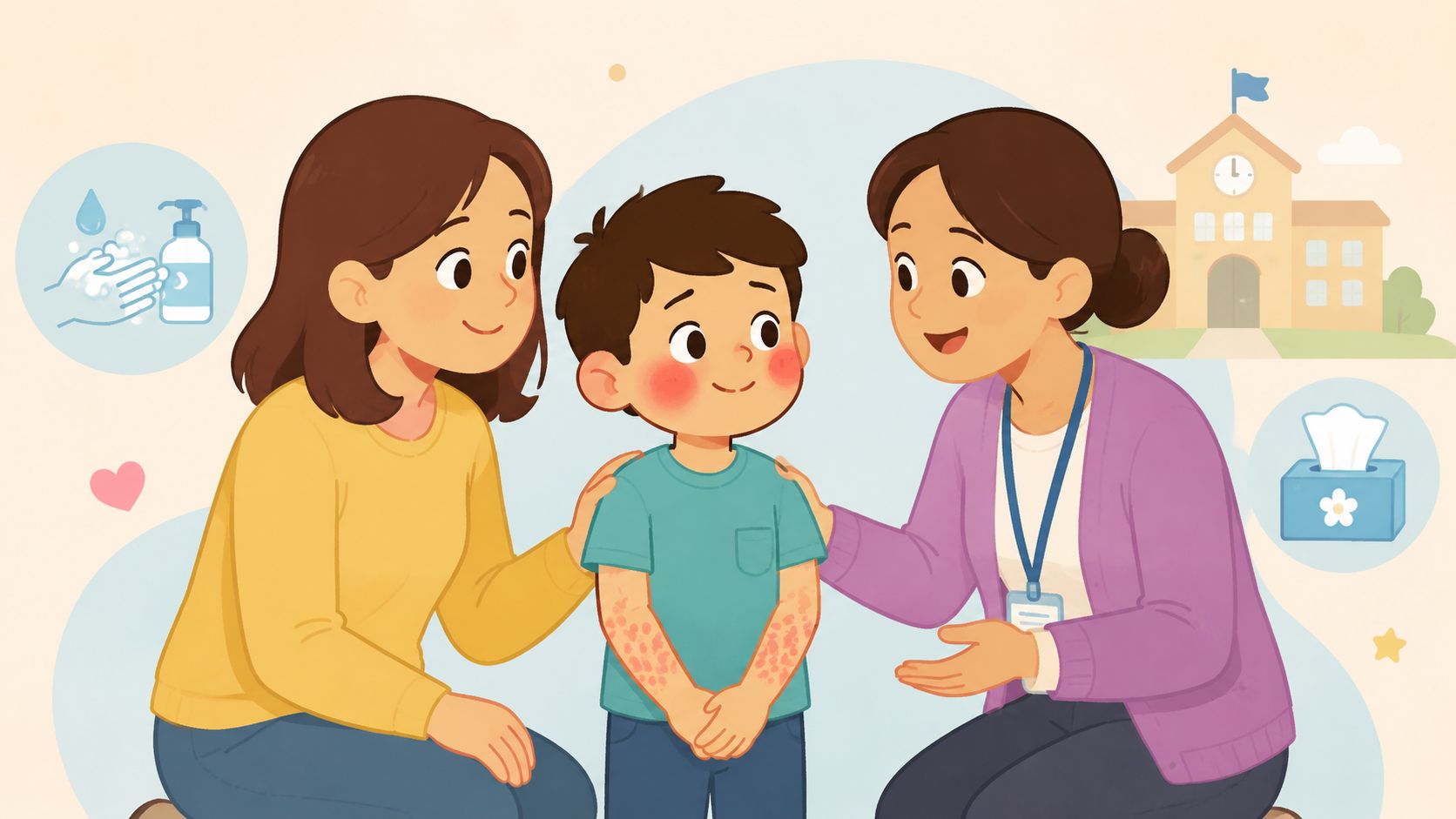
A child comes home from school with bright red cheeks, and suddenly everyone has the same questions. Is this contagious right now? Does the child need to stay home? Should a pregnant teacher, aide, or family member worry? The 5ths disease rash looks dramatic, but the practical decisions around it are what confuse most families and schools.
The biggest misunderstanding is timing. By the time the classic rash shows up, the moment when the virus spread most easily has often already passed. That's why good guidance focuses less on reacting to the visible rash and more on everyday hygiene, exposure awareness, and special precautions for people who face higher risk.
What Is the 5ths Disease Rash?
Fifth disease, also called erythema infectiosum, is a viral illness caused by parvovirus B19. For most otherwise healthy children, it's a mild, self-limited illness. One of its best-known signs is the bright red facial rash often described as a “slapped-cheek” rash. The facial rash usually lasts about 4 to 5 days, and the full illness often resolves within about 1 to 3 weeks, according to the NCBI overview of erythema infectiosum.
That name, “fifth disease,” sounds more alarming than it really is. It's a historical label from an older grouping of common childhood rash illnesses. Parents often assume the name points to something rare or severe. Usually, it doesn't.
Why the rash causes so much worry
The rash is eye-catching. A child may look fine overall but suddenly develop vivid red cheeks, followed later by a patterned rash on the body. That contrast makes many people think the illness is getting worse right when they first notice it.
In most healthy children, the opposite is often true. The rash can appear after the earlier, less obvious stage of illness.
Practical point: A dramatic-looking rash doesn't always mean a dangerous illness. With fifth disease, appearance and risk often don't match.
Viral, not bacterial
Parents often wonder whether antibiotics are needed, but they aren't useful for a viral illness like fifth disease. If you want a simple refresher on how these categories differ, this guide to bacterial vs viral infection symptoms can help.
A simple way to think about fifth disease is this:
- Cause: It's caused by parvovirus B19
- Typical course: It's usually mild and self-limited
- Most recognizable sign: The classic slapped-cheek rash
- Main concern: Not the rash itself in healthy children, but exposure in certain higher-risk groups
That last point becomes especially important in schools, daycares, and households where many people share close space before anyone realizes a child is sick.
The Three Stages of the Rash
Parents often expect one rash that appears, fades, and is done. The 5ths disease rash doesn't always behave that neatly. It tends to unfold in a pattern, and knowing that pattern can prevent a lot of unnecessary panic.

Stage one with bright red cheeks
The first stage is often the most recognizable. A child's cheeks become bright red, often with a sharp contrast against otherwise normal-looking skin. Parents sometimes say it looks like windburn, irritation, or a sudden flush after running around.
This facial redness is the classic slapped-cheek look. It can show up suddenly enough that families worry about an allergic reaction or another serious rash illness.
Stage two with the lacy body rash
After the face changes, the rash can spread to the arms, legs, and trunk. It often looks lighter than the cheek rash and develops a lacy or reticular pattern. The UCSF child care illness sheet describes the rash as beginning with bright red facial erythema and then spreading to the trunk and extremities as a lacy/reticular maculopapular exanthem, with recurrence or intensification possible for weeks to months when triggered by heat, sunlight, exercise, or stress, as explained in the UCSF fifth disease illness sheet.
Many individuals become confused. A lacy rash may look like the illness is spreading aggressively, when in many cases it's following the expected course.
A few features often help families recognize it:
- Pattern: It tends to look net-like or lace-like, not solid red everywhere
- Location: It commonly appears on the arms, legs, and trunk
- Overall child appearance: Many children still seem fairly comfortable, aside from mild itch or fatigue
Stage three with fading and flare-ups
The final stage is the most unpredictable. The rash fades, then seems to come back. A child may look nearly clear one day and redder again after a hot bath, outdoor play, sun exposure, or emotional stress.
The rash can look worse even while the child is actually recovering.
That's a hard idea for families and school staff to trust at first. We tend to assume “redder” means “sicker.” With fifth disease, that's often not how it works.
A quick visual guide
| Stage | What it looks like | What often confuses people |
|---|---|---|
| Stage 1 | Bright red cheeks | It can resemble irritation or a reaction |
| Stage 2 | Lacy rash on body | It may look like the illness is newly spreading |
| Stage 3 | Fading, then recurring | Heat or sunlight can make it reappear |
If the rash seems to come and go, that doesn't automatically mean a new infection or treatment failure. Sometimes it's the normal behavior of this particular rash.
Understanding the Contagious Period
This is the part schools and families most often get backwards. Many people assume a child becomes most contagious when the rash is obvious. With fifth disease, that's usually not the case.

The key timing parents miss
Parvovirus B19 is most contagious during the 1 to 2 week pre-rash window, and once the characteristic slapped-cheek rash appears, otherwise healthy people are generally no longer considered contagious, according to Harvard Health's explanation of fifth disease.
That single fact changes how you should think about school exclusion. If a child is kept home only after the rash appears, that step usually comes too late to prevent the earlier spread.
Why school exclusion often misses the real window
A child may have mild cold-like symptoms before the rash. Maybe a runny nose. Maybe low energy. Maybe nothing noticeable at all. During that period, nobody realizes fifth disease is the issue.
By the time the child walks in with red cheeks and gets sent home, classmates and family members may already have had the meaningful exposure. That's why a simple “visible rash equals stay home for infection control” policy often doesn't accomplish what people hope it will.
If you're interested in the broader idea that someone can spread illness before obvious signs appear, this article on a carrier of disease gives useful context.
School takeaway: A rash-based exclusion rule feels intuitive, but it doesn't match how this virus usually spreads.
What works better than waiting for a rash
Instead of focusing only on the child who already has red cheeks, schools and daycares should reinforce habits that matter every day:
- Handwashing: Build it into arrival, meals, bathroom use, and after wiping noses
- Respiratory etiquette: Teach kids to cough or sneeze into a tissue or elbow
- Shared item control: Limit the sharing of cups, utensils, and objects children put in their mouths
That approach is less dramatic than sending home every child with a rash. It's also more realistic for how fifth disease moves through groups.
At-Home Care and Symptom Management
For most healthy children, care at home is mostly about comfort. There isn't a special cure needed for the virus itself in routine cases. Parents usually do best when they focus on what the child is feeling, not just what the rash looks like.
What to do for comfort
If your child seems tired, achy, or mildly feverish, basic supportive care is usually enough. Rest, fluids, and quiet activity go a long way. If a clinician has already told you it's fine for your child, over-the-counter medicines such as acetaminophen or ibuprofen may help with discomfort or fever.
If the rash itches, simple measures often help:
- Loose clothing: Soft, breathable fabrics can reduce skin irritation
- Cooler bathing habits: Hot water can make the rash stand out more
- Gentle skin care: Avoid harsh soaps or heavily fragranced products
- Oatmeal baths: Some families find these soothing when the rash feels itchy
What not to overinterpret
Parents often get alarmed when the rash looks brighter after play, sun exposure, or a warm shower. That doesn't always mean the illness is worsening. The skin can react to heat or friction.
A child who's drinking, resting, and acting fairly normal usually needs observation and comfort, not panic.
Most home care decisions should be guided by the child's overall condition, not by whether the cheeks look redder at the end of the day.
A practical home routine
Some families find it helpful to keep the day simple:
- Offer fluids regularly.
- Let the child rest as needed.
- Dress them in comfortable clothing.
- Watch for changes in energy, breathing, hydration, or unusual pallor.
- Call a clinician if symptoms seem out of proportion to a mild viral illness.
That last point matters because the rash alone rarely tells the whole story.
Risks and Complications for Vulnerable Groups
For healthy children, fifth disease is usually mild. But it doesn't carry the same meaning for everyone. Exposure can matter much more in certain groups, and that's where public health advice needs to be more specific than “it's usually harmless.”

Pregnancy needs prompt follow-up
Exposure to parvovirus B19 can pose significant risks to pregnant people, individuals with blood disorders, or those with weakened immunity, and these groups should seek medical advice after a classroom or household exposure, as noted in GoodRx's summary of fifth disease risk situations.
The practical issue in pregnancy is timing. A pregnant teacher, parent, or caregiver may learn about exposure only after a child's rash appears. But that visible rash isn't a reliable marker for when the meaningful exposure happened. That's why “I'll wait and see if the child gets red cheeks” isn't a safe exposure strategy for pregnancy-related decision-making.
Blood disorders and reduced immunity change the picture
People with hemolytic disorders face a different concern. Their bodies may already be under strain in producing or managing red blood cells, so a parvovirus B19 infection can create a more serious problem than it would in a healthy child.
People who are immunocompromised may also have a harder time clearing the infection. In practical terms, that means an illness that looks routine in one person may require medical attention in another.
Who should respond quickly after exposure
If any of these apply, it makes sense to contact a healthcare professional promptly after known exposure:
- Pregnancy: Especially if the exposure happened in a classroom, daycare, or household
- Hemolytic disorders: Such as conditions involving ongoing red blood cell breakdown
- Weakened immune system: Including people whose immunity is affected by illness or treatment
Exposure matters more than the visible rash for high-risk groups. Waiting for a classic facial rash can delay the steps that actually matter.
For schools and employers, this means communication matters. Families and staff need timely notice of possible exposure, especially because the visible rash doesn't mark the start of the risk window.
Prevention in Homes Schools and Daycares
If there were a vaccine or a simple “spot the rash and stop the spread” rule, prevention would be easier. There isn't. In household exposures, up to 50% of susceptible contacts may become infected, and during school outbreaks, attack rates of 10% to 60% have been reported. Public health guidance also notes there is no vaccine, so prevention depends on handwashing and respiratory etiquette, as described by the Spokane Regional Health District guidance on fifth disease.
That's why prevention has to start before anyone knows fifth disease is in the room.

The most useful prevention mindset
Reactive rules sound stronger than they are. “Send home every child with a rash” feels decisive, but it often targets the wrong moment. Daily prevention habits do more because they address the period when nobody yet knows what infection is present.
For directors and school administrators, this also means staff training should be practical, not fear-based. Build routines that reduce respiratory spread in general, because fifth disease won't always announce itself early.
A working checklist for shared spaces
- Make handwashing routine: Put it before meals, after toileting, after wiping noses, and after playground time.
- Teach cough and sneeze habits clearly: Young children need repeated coaching to use tissues or elbows instead of hands.
- Reduce shared mouth-contact items: Water bottles, utensils, pacifiers, and chewable toys need attention.
- Clean high-touch surfaces consistently: Desks, faucet handles, doorknobs, cot rails, and shared play items deserve regular cleaning.
- Communicate exposure thoughtfully: Staff and families, especially pregnant people and those with health vulnerabilities, need timely notice.
If you manage a child-centered facility, a practical daycare cleaning checklist can help turn broad hygiene goals into daily routines.
What schools should say to families
A useful message is simple: the presence of a rash does not automatically mean a child is currently contagious, and general hygiene remains the best prevention tool in classrooms and homes.
That kind of wording reduces panic while still taking exposure seriously.
When to See a Doctor for 5ths Disease
Most cases of the 5ths disease rash don't become emergencies, but some situations deserve a call to a healthcare professional. Parents often feel better when they have a short, concrete list rather than vague advice to “monitor symptoms.”
Call a clinician if these problems show up
- Signs of dehydration: Dry mouth, not drinking well, unusually low urination, or a child who seems hard to rouse
- Breathing concerns: Shortness of breath, fast breathing, or a child who looks pale and weak
- Persistent or worsening illness: The child seems much sicker than a mild viral rash would suggest
- Marked pallor or unusual fatigue: These can raise concern about anemia, especially in someone with an underlying blood disorder
- Significant joint symptoms: Older children and adults may need advice if pain or swelling becomes disruptive
- Any concerning symptoms in a newborn or medically fragile child: They deserve a lower threshold for evaluation
Call promptly after exposure if you are in a higher-risk group
A clinician should hear about exposure sooner rather than later if the exposed person is:
- Pregnant
- Immunocompromised
- Living with a blood disorder
That's true even if the exposed person feels fine. The question isn't only “Do I have a rash?” It's “Was I exposed, and do I belong to a group where follow-up matters?”
If your child also has skin irritation in the diaper area during a viral illness, practical skin-care guidance can help. Parents may find Bornbir's expert diaper rash advice useful for protecting already sensitive skin.
A simple rule for uncertain situations
If the rash doesn't fit the usual pattern, the child appears unwell, or you're dealing with pregnancy or an underlying medical condition, it's reasonable to check in with a healthcare professional. Reassurance is part of good care too.
The main lesson is straightforward. Don't judge fifth disease by how striking the rash looks. Judge it by timing, overall symptoms, and who was exposed.
Leave a Reply