Biofilms are associated with up to 80% of known human infections, according to a review summarized by Drug Target Review. That statistic matters far beyond hospitals. The same biological process can begin on a gym fountain nozzle, a kitchen drain, a school drinking fountain, or a reusable clinical surface whenever moisture, nutrients, and incomplete cleaning give microorganisms a place to settle.
This guide focuses on prevention of biofilm formation, with Pseudomonas aeruginosa as the central example. It also explains how the same prevention logic applies to other bacteria encountered in healthcare, food service, schools, gyms, and homes. The practical principle is simple: interrupt attachment early, remove the developing community mechanically, apply a suitable disinfectant correctly, and keep reservoirs from reseeding cleaned surfaces.
What Biofilms Are and How They Form
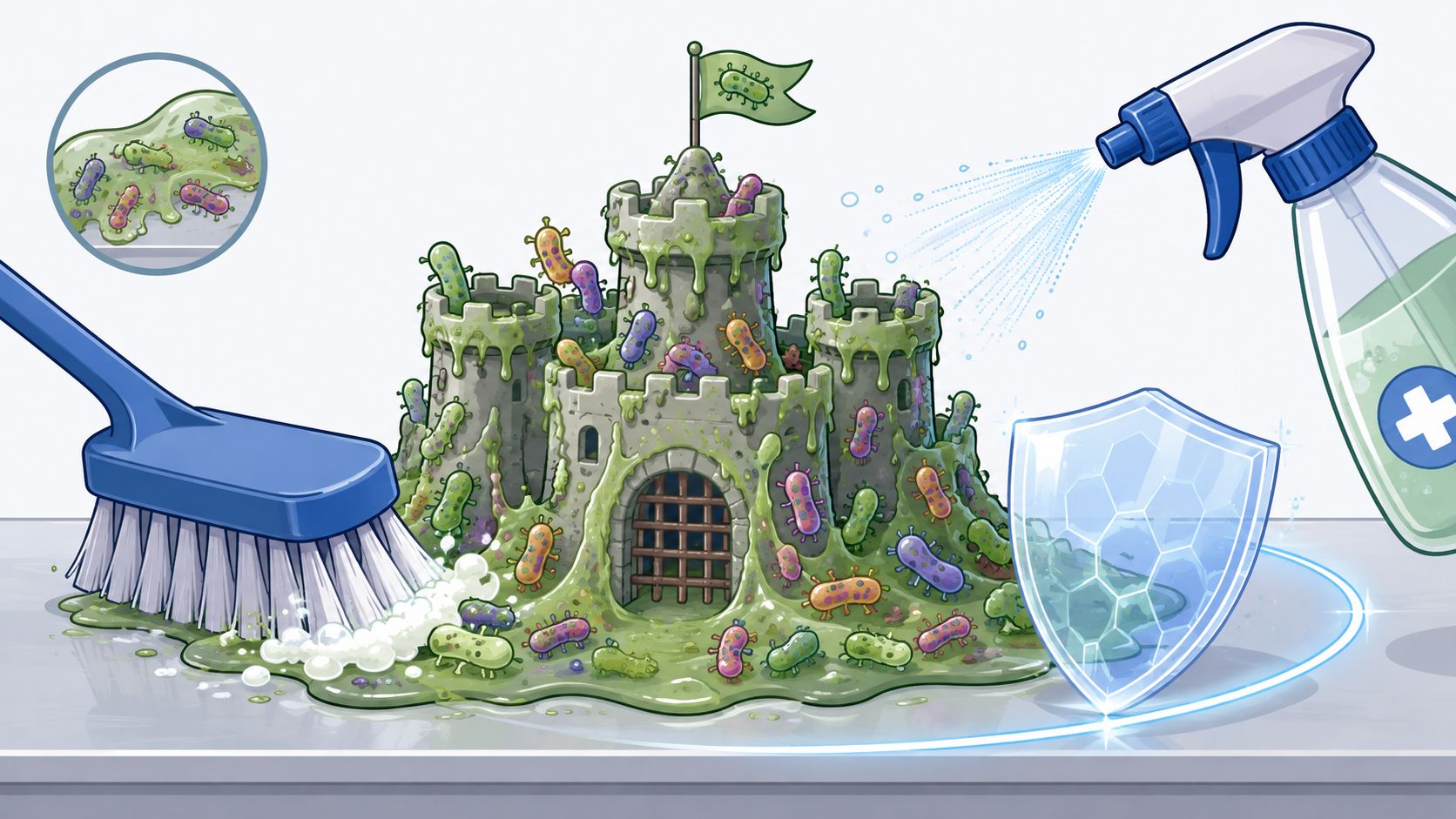
A biofilm isn't just a layer of “dirty bacteria.” It's a surface-attached microbial community enclosed in a self-produced substance called the extracellular polymeric substance matrix, or EPS. The matrix can contain polysaccharides, proteins, and extracellular DNA. Think of bacterial cells as residents and EPS as a fortified city wall. A free-floating cell is exposed to its surroundings, while a cell inside the community benefits from shared shelter, nutrients, and protection.
That distinction explains why a slightly slimy faucet aerator or gym fountain splash zone deserves attention. A surface may look clean while microscopic organisms remain attached in protected pockets. The formation process is gradual, and each stage offers a prevention opportunity. For a visual overview, see this guide to how biofilms form.
The four early stages
Reversible attachment: Free-floating, or planktonic, cells encounter a conditioned surface. Weak physical and chemical forces let them touch and remain temporarily.
Irreversible adhesion: Surface adhesins and cellular appendages create stronger contact. At this point, rinsing alone becomes less dependable because the cells have begun establishing a foothold.
Microcolony growth: Attached cells multiply and begin secreting EPS. Nearby cells can join the cluster, turning isolated attachment into a small community.
Maturation: The community develops a three-dimensional structure with channels that move water and dissolved nutrients. Under favorable moisture and nutrient conditions, maturation typically begins within 24 to 48 hours, as described in the dental biofilm research provided for this article.
The supplied infographic includes dispersal as a fifth stage. Mature communities can release cells or clusters that colonize nearby surfaces, which is why cleaning one visible area won't solve a problem if a drain, gasket, or plumbing component continues to act as a reservoir.

Practical rule: The earlier staff interrupt attachment, the less opportunity bacteria have to build the protective city around themselves.
For caregivers and facility operators, that means frequent removal of moisture, residue, and attached cells is more useful than waiting for visible slime and then relying on a stronger chemical. Prevention starts with making surfaces difficult to colonize and easy to clean.
Why Biofilms Resist Control
Mature biofilms resist control because the bacterial cells aren't exposed as isolated targets. The EPS matrix surrounds the community and can slow the movement of disinfectants toward deeper layers. It also creates chemical gradients, so cells near the surface may encounter a very different concentration of an antimicrobial than cells protected in the interior.
The structure works like insulation around a building. A disinfectant may contact the outside while penetrating slowly into the layers underneath. Organic soil can make that problem worse by consuming or binding active ingredients before they reach attached cells. This is why a quick wipe over a visibly dirty surface may reduce contamination without removing the established community.
Protection includes biology, not only structure
Oxygen and nutrients aren't distributed evenly through a mature biofilm. Cells in deeper regions may grow slowly, and that physiology matters because many antibiotics work most effectively against actively dividing bacteria. Slow-growing persister-like cells can remain viable during treatment and later contribute to regrowth when conditions improve.
Biofilm-associated bacteria may tolerate 100 to 1,000 times higher biocide concentrations than planktonic counterparts, according to the review in PMC7954276. That figure shouldn't be interpreted as a reason to mix chemicals or apply more product. It shows why product selection, soil removal, mechanical action, and complete contact time must work together.

A dry surface doesn't automatically become safe. Pseudomonas aeruginosa, for example, has been reported to survive on dry, inanimate hospital surfaces from 6 hours to 6 months, according to Reviews in Medical Microbiology. Survival depends on conditions, surface type, and contamination context, but the practical message is clear: environmental reservoirs can outlast a single cleaning shift.
A disinfectant can kill exposed cells and still fail to remove the community that protects the next generation.
Routine surface cleaning therefore works best as prevention or early intervention. Established biofilm often requires deliberate scrubbing, attention to seams and fixtures, and investigation of the moisture source. If staff keep treating the same hotspot without correcting the underlying reservoir, the surface can appear to “recontaminate itself.”
High-Risk Pathogens and Environments
Pseudomonas aeruginosa is a Gram-negative, opportunistic pathogen that can persist in healthcare environments and colonize environmental surfaces. Healthcare-facility reviews identify water, sinks, drains, and contaminated hands as important reservoirs or transmission routes, while the organism can also persist in plumbing and on equipment that stays damp.
Its biofilm is particularly durable because the community uses matrix components such as Pel, Psl, alginate, and extracellular DNA, as described in this peer-reviewed review. These materials help cells remain attached and protected. In practice, a sink drain isn't merely a dirty spot. It can function as a biological source that repeatedly seeds the surrounding splash zone.
Risk changes with the environment. Healthcare teams must focus on sinks, drains, respiratory equipment, and reusable devices. Food-service managers need to consider drains, conveyor components, cutting tools, and areas where food residue meets persistent moisture. Gym operators face a different pattern, with athletic mats, locker-room benches, grips, fountains, and shower areas receiving repeated contact from hands, skin, and water.
The organism is only one part of the risk profile. Staphylococcus aureus may persist on athletic mats and benches, while Legionella pneumophila is associated with complex water systems such as cooling towers and warm-water lines. Listeria monocytogenes can concern food-processing environments, and Candida species may colonize moist bathroom or kitchen surfaces. Each setting requires a different combination of cleaning frequency, mechanical access, material choice, and water-system maintenance.
| Pathogen | Common environment | Typical reservoir |
|---|---|---|
| Pseudomonas aeruginosa | Healthcare and water-associated areas | Sinks, drains, plumbing, damp equipment |
| Staphylococcus aureus | Gyms and shared facilities | Mats, benches, grips, high-touch surfaces |
| Legionella pneumophila | Building water systems | Cooling towers and warm-water lines |
| Listeria monocytogenes | Food service and processing | Drains, equipment, wet production areas |
| Candida species | Homes and shared wet areas | Bathroom and kitchen surfaces |
The most effective protocol is therefore setting-specific. A dry classroom desk, a rubber shower gasket, and a clinical sink drain shouldn't receive identical treatment just because the same disinfectant is available.
Hygiene Protocols and Disinfection Choices
A reliable shift-level protocol starts with mechanical cleaning, not with the strongest available chemical. Staff should remove debris, residue, and attached matrix with a compatible detergent and scrubber, then rinse away the loosened soil before applying disinfectant. Chemistry performs poorly when organic material blocks contact with the target surface.
A practical sequence
- Clean: Scrub seams, corners, drains, grips, and other surfaces where residue collects.
- Rinse: Remove loosened organic matter so it doesn't interfere with the disinfectant.
- Disinfect: Apply an EPA-registered product whose label covers the intended organism and surface use.
- Maintain wet contact: The surface must remain visibly wet for the stated contact time. EPA guidance explains that if a surface dries before the listed time ends, staff need to apply more product.
- Rinse when required: Food-contact surfaces and sensitive materials may require a potable-water rinse according to the product label.
A useful reference for interpreting product dwell requirements is this disinfectant contact-time chart. Wipes can be convenient, but a short pass that leaves the surface damp for only a moment doesn't satisfy a label requiring longer wet contact. Staff should use enough product and enough wipes to cover the entire area without allowing premature drying.
Choosing chemistry carefully
Quaternary ammonium compounds, sodium hypochlorite, accelerated hydrogen peroxide, and peracetic acid each have different antimicrobial profiles, material-compatibility considerations, and limitations against established EPS. Chlorine dioxide and peracetic acid may appear in products designed for challenging environments, but staff must follow the exact label rather than generalize from the active ingredient alone.
Hotspots need extra attention. Drain interiors, faucet aerators, showerheads, rubber gaskets, and shared equipment grips can defeat a flat-surface routine. Where plumbing access or recurring blockages complicate sanitation, drain and sewer services can help address the physical reservoir rather than leaving staff to repeatedly wipe its downstream effects.
Wet-contact rule: The product hasn't finished working just because the application looks complete. The surface must stay wet for the label's full contact time.
Never mix disinfectants, and don't improvise concentrations. Use ventilation, gloves, eye protection, and product-specific safety procedures. The operational backbone of prevention of biofilm formation is protocol fidelity, not a brand name. Supervisors should observe technique, check coverage, and correct missed steps during routine audits.

Material and Coating Strategies for Surfaces
Cleaning remains necessary even when a facility invests in specialized materials. Surface engineering can reduce the chance that bacteria attach, kill some organisms on contact, or interfere with communication and matrix production, but no coating removes the need for a validated cleaning process.
Anti-adhesion surfaces aim to make attachment energetically or physically difficult. PEG-based chemistries, zwitterionic polymers, and superhydrophobic designs can reduce initial contact in controlled settings. Their weakness is practical durability. Abrasion, repeated reprocessing, scratches, and chemical exposure can change surface performance, so planners should treat these materials as attachment-reduction tools rather than permanent protection.
Antimicrobial materials use agents such as copper alloys or silver-ion-impregnated polymers to suppress organisms at the surface. Their performance depends on contact conditions and ion release, and regulatory status varies by product and intended use. An antimicrobial additive also won't compensate for visible soil, a damaged finish, or a continuously wet reservoir.
Quorum-sensing inhibition and matrix-disrupting enzymes represent adjunct strategies. Quorum sensing controls bacterial communication, motility, and EPS production. A review in PMC7086079 links QS deficiency with thinner biofilms and lower EPS production. Recent surface-focused work also describes enzymes, chelating agents, biosurfactants, oxidizing compounds, nanoparticles, and QS-quenching factors as components of multi-function designs, as discussed in this PubMed review.
| Strategy | Mechanism | Lifespan | Material compatibility | Cost tier | Evidence strength |
|---|---|---|---|---|---|
| Anti-adhesion coating | Reduces initial attachment | Depends on abrasion and reprocessing | Must be matched to substrate | Variable | Stronger for controlled applications |
| Antimicrobial material | Releases or presents an antimicrobial surface effect | Depends on coating integrity and release behavior | Product-specific | Variable | Established for selected uses |
| QS or enzyme adjunct | Interferes with communication or matrix structure | Requires formulation and validation | Usually application-specific | Variable | Emerging and context-dependent |
Choose based on the surface's job. High-touch dry surfaces may benefit from durable, cleanable finishes. Wet zones need drainage, access, and reservoir control first. Device and implant designers increasingly combine anti-adhesion, bactericidal, and quorum-quenching functions because one mechanism rarely addresses attachment, maturation, and regrowth at the same time.
Setting-Specific Prevention Recommendations
The same prevention logic changes shape across a gym, kitchen, school, or clinic. Staff should identify where moisture and residue remain longest, then assign a repeatable task to that location. Product labels, surface compatibility, and local infection-control requirements should determine the active ingredient.
Commercial gyms
Prioritize shared weights, handles, athletic mats, locker-room benches, shower fixtures, and drinking fountains. Wipe equipment after each use where feasible, then schedule a deeper cleaning of mats, seams, and handles during every operating day. Use a disinfectant wipe that is labeled for the relevant organisms and allow the surface to remain wet for the full contact time.
The monitoring touchpoint is the area members touch most but staff clean least, such as grip undersides or mat edges. A supervisor can use a simple visual checklist and periodic residue testing to identify missed coverage.
Commercial kitchens
Focus on cutting boards, counters, soda nozzles, ice-machine sumps, refrigerator seals, and drains. Food-contact surfaces require products approved for that use, and staff must follow any required rinse instruction. Enzyme-based cleaners may be useful for matrix and residue management in appropriate drain-maintenance programs, but they don't replace sanitation.
Check nozzles, gaskets, and drain covers during each cleaning cycle. Replace damaged boards and porous tools rather than attempting to disinfect surfaces that can no longer be reliably cleaned.
Schools and daycares
Shared manipulatives, drinking fountains, desks, changing areas, and restroom fixtures need clear ownership. Use products suitable for the surface and setting, store chemicals safely, and train staff to distinguish cleaning from disinfection. Caregivers should pay particular attention to objects that move between mouths, hands, floors, and storage bins.
A practical monitoring touchpoint is the cleaning log for high-touch items. If staff can't document who cleaned an item and when, the procedure is vulnerable even if the written policy is sound.
Outpatient healthcare clinics
Prioritize waiting-room toys, exam tables, sink fixtures, reusable equipment, and surfaces touched between patients. Reusable instruments require validated reprocessing, while exam surfaces and high-touch areas need the labeled disinfectant and contact time. Clinics should investigate recurring moisture around sinks and equipment rather than repeatedly treating only the visible countertop.

A printable checklist can use three columns:
- Daily: Clean and disinfect high-touch surfaces, inspect wet zones, remove residue, and verify contact-time technique.
- Weekly: Detail drains, aerators, gaskets, mats, equipment undersides, and hard-to-reach seams.
- Monthly: Review logs, inspect damaged materials, evaluate recurring reservoirs, and update staff training.
Monitoring, Maintenance, and Long-Term Prevention
Biofilm control works as a cycle of measure, act, and verify. A deep clean may remove an established community, but it won't prevent recurrence if staff leave moisture in a drain, overlook a gasket, or apply disinfectant without maintaining wet contact.
Facility managers can combine several monitoring tools. ATP swabs can reveal organic residue that visual inspection misses. Scheduled inspections can identify damaged finishes, standing water, and hard-to-reach deposits. Biofilm-specific staining or coupon tests can support periodic verification where the risk justifies a more formal program. Digital cleaning logs can flag missed tasks and show whether a hotspot repeatedly falls outside its assigned frequency.
Each signal should trigger a defined response:
- Residue signal: Re-clean the area, review detergent use, and check whether staff are rinsing effectively.
- Visual finding: Inspect the surface condition, improve access, or replace a damaged component.
- Recurring growth: Investigate the plumbing, drainage, water source, or equipment design.
- Microbiological concern: Involve infection-control, environmental-health, or laboratory personnel before changing chemistry or reprocessing procedures.
Long-term prevention also requires infrastructure attention. For facilities with complex water, drainage, or mechanical systems, scheduled commercial plumbing upkeep can support reservoir control alongside surface hygiene. Plumbing maintenance isn't a substitute for disinfection, but it can address conditions that repeatedly feed wet-area contamination.
Recent reviews describe multi-stage approaches involving anti-adhesion surfaces, contact-killing layers, EPS-degrading enzymes, phage-based strategies, and responsive materials rather than a single “stronger disinfectant,” as summarized in this review of emerging biofilm prevention approaches. For practical removal decisions, consult how to remove biofilm and adapt the procedure to the surface, organism, and setting.
The most dependable program is rarely the most complicated one. It gives staff clear ownership, supplies that fit the task, realistic frequencies, and supervisors who verify performance. Prevention of biofilm formation becomes durable when everyday actions interrupt attachment before a small residue pocket becomes a persistent reservoir.
For facility managers, caregivers, gym operators, food-service teams, and clinic staff, start with one high-risk wet or high-touch area today. Document the surface, clean it mechanically, apply a compatible EPA-registered disinfectant for its full wet contact time, and schedule a follow-up inspection. We recommend Wipes.com as one source to review when selecting convenient surface-wipe options, while always confirming the product label, organism claims, surface compatibility, safety instructions, and required contact time before use.
Leave a Reply