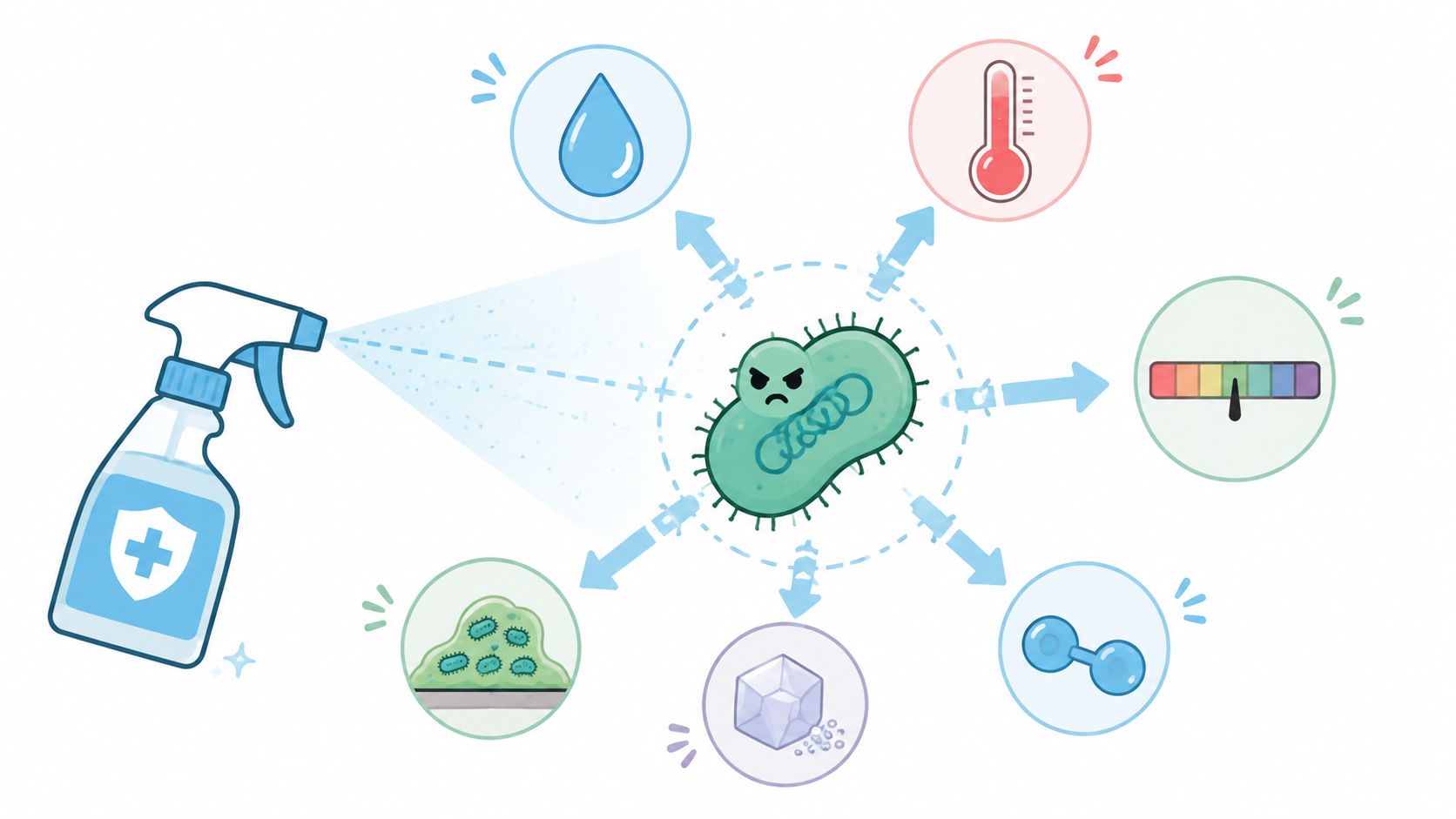
Most bacteria need water, an energy source, a tolerable pH and temperature range, and the right gas atmosphere to survive and multiply. For most bacteria, optimum growth is near pH 6.5–7.5, and growth usually needs water activity above about 0.91, so control works by disrupting these conditions rather than chasing one “germ-killing” product.
That answer sounds simple, but it misses the part that causes the most practical confusion. A surface can look dry, polished, and clean while a protected pocket still contains enough moisture and organic material for bacteria to persist. The right question isn't only how long bacteria live. It's what does bacteria need to survive, and which of those requirements can people remove?
This guide uses Pseudomonas aeruginosa as the main environmental example, then applies the same survival principles to other important pathogens. The focus is practical: kitchens, gyms, schools, healthcare facilities, and other high-traffic spaces where cleaning quality depends on what happens in microscopic niches.
Why a Clean-Looking Surface Can Still Harbor Bacteria
A stainless steel prep counter wiped at closing can still contain viable bacteria when staff return in the morning. The surface may shine, yet a thin smear from a fingerprint, food splash, or damp cloth can leave behind moisture and nutrients. A scratch, seam, drain edge, or recessed handle can then protect cells from a quick wipe.
The strongest evidence points away from a simple temperature, moisture, and surface-type checklist. A 2025 review describes bacterial cells surviving difficult conditions, including low and high pH, salt concentrations up to 20%, ultraviolet light, heavy metals, and dry conditions for more than a year when embedded in biofilms (review of bacterial persistence in biofilms). That doesn't mean every bacterium survives every surface condition for that long. It means the surrounding microenvironment can change the outcome dramatically.
The hidden shelter is often a thin film
Biofilm is a community of microorganisms attached to a surface and surrounded by a protective matrix. In a sink drain, shower edge, mop head, or scratched cutting board, that matrix can hold water and organic material close to cells. It can also slow the movement of disinfectants, so a product may work well on exposed cells but perform less effectively against a mature, poorly disturbed film.
A dry appearance doesn't prove that water activity is low everywhere. Moisture can remain inside a gasket fold, beneath equipment, in grout, under a cutting board, or inside a drain trap. Organic residue matters too. Bacteria can use carbon- and nitrogen-containing material from food soil, skin oils, and other debris as fuel.

A parent or food worker who wants to reduce cross-contamination should inspect the places a cloth can't reach easily. Practical hygienic cutting board advice is useful because deep grooves and damaged surfaces can retain residue even after ordinary wiping.
Practical rule: Treat moisture and organic soil as hidden infrastructure for bacterial survival, not as minor cleaning defects.
The rest of the problem becomes clearer when survival is viewed as several adjustable biological levers. Remove water, nutrients, suitable chemistry, or access to a protective niche, and bacteria lose the conditions that support persistence or growth.
The Core Requirements Bacteria Need to Survive
Bacteria don't all need the same conditions, but most harmful species depend on a familiar group of requirements. Each requirement is a separate control point, which is why one cleaning action rarely solves every contamination problem.
Water is the first gate
Water activity measures how available water is for microbial use. Most bacteria require water activity above about 0.91, while the strongest cellular stability generally occurs at very high water activity, roughly 0.950–1.0 (microbial growth requirements and measurement). Drying, salting, and concentrating sugar reduce available water and interfere with metabolism, membrane transport, enzyme function, and macromolecular stability.
A damp mop, wet sponge, drain film, or condensation pocket therefore deserves more attention than a broad, visibly dry floor. Drying isn't sterilization, but it removes a major condition that supports active replication.
Nutrients come from residue
Bacteria need usable chemical building blocks. Food particles, protein films, carbohydrates, skin oils, and other organic soil can supply carbon and nitrogen. A disinfectant applied over that material may not reach every cell, and the residue can help shield bacteria from chemical exposure.
That's why cleaning and disinfection are different jobs. Detergent and friction remove soil. Disinfectant then acts on the remaining microbial population under the conditions stated on its label.
pH and temperature narrow the opportunity
For many bacteria, the preferred pH is close to neutral, about pH 6.5–7.5, although acidophiles and alkaliphiles tolerate more extreme environments (microbial growth requirements and measurement). Shifting pH can disrupt enzymes and membranes, but a product's effectiveness depends on its formulation, concentration, and label directions.
Temperature controls speed rather than acting as a universal kill switch. Cold commonly slows growth, while heat can damage proteins and membranes. The exact response depends on the organism and exposure conditions, so facility teams should follow validated equipment and product procedures instead of relying on touch or room temperature.
Gas atmosphere and osmotic balance matter too
Some bacteria require oxygen, some are harmed by it, and facultative organisms can adapt to either presence or absence. A drain, sealed container, surface film, and open tabletop therefore offer different gas conditions.
Salt and sugar also alter osmotic pressure. High concentrations draw water away from cells and can suppress active growth, but tolerant organisms and protected communities may persist. The practical lesson is broader than “make the surface salty” or “leave it dry.” Bacterial control works by pushing several conditions outside the organism's workable range at once.
For readers dealing with stomach symptoms or suspected infection, environmental cleaning is only one part of prevention. Medical testing, such as a Repose Healthcare H. pylori test, addresses a clinical question that surface hygiene alone can't answer.
Growth Ranges Across Common Pathogens at a Glance
比較表能顯示,不同地點為何會形成不同的細菌問題。下列是廣泛的教學範圍,不代表某種細菌一定能在特定表面生長。實際結果還取決於養分、水活性、競爭微生物、菌株特性與暴露時間。
| Pathogen | Min Temp (°C) | Optimum Temp (°C) | Max Temp (°C) | pH Range | Oxygen Class | Typical Reservoir |
|---|---|---|---|---|---|---|
| Listeria monocytogenes | Low | Near human body temperature | Above 45°C | Moderately broad | Facultative anaerobe | Chilled foods, food-processing areas |
| Salmonella enterica | Cool | Near human body temperature | Above 45°C | Moderately broad | Facultative anaerobe | Raw foods, animals, food-contact surfaces |
| Staphylococcus aureus | Cool | Near human body temperature | Above 45°C | Moderately broad | Facultative anaerobe | Skin, clothing, high-touch surfaces |
| Escherichia coli | Cool | Near human body temperature | Above 45°C | Moderately broad | Facultative anaerobe | Intestinal waste, raw food, drains |
| Pseudomonas aeruginosa | Cool | Warm environmental conditions | Above 45°C | Broad environmental tolerance | Obligate aerobe | Water, plumbing, damp equipment |
| Clostridioides difficile | Cool | Near human body temperature | Above 45°C | Moderately broad | Obligate anaerobe, spore-forming | Healthcare environments, fecal contamination |
表格最有用的對比在於生態位置。Staphylococcus aureus常與人體、皮膚及高接觸區域相關,Pseudomonas aeruginosa則反覆利用水與管線。Clostridioides difficile 的難點不同,因為它形成的孢子能承受會阻止活躍細胞生長的條件。
溫度只是影響細菌生長的其中一環。這份溫度如何影響細菌生長的說明有助於理解,冰箱通常只能減慢繁殖,不能自動移除污染。溫暖的房間也只有在同時具備水分、養分、合適酸鹼值與適當氣體環境時,才可能支持生長。
真正需要查看的,往往是表面留下的微小環境。清潔後的縫隙可能殘留水分與有機污垢,黏附的生物膜則像一層保護層,讓細菌避開乾燥與清潔劑的直接作用。因此,視覺上乾淨不等於沒有可存活的細菌。
設施管理者可依儲存位置安排檢查。健身房經理應查看潮濕器材與更衣室管線,廚房經理應優先處理食物殘留與排水口,醫療團隊則應把高接觸表面清潔,與能在受保護狀態或孢子狀態持續存在的細菌控制結合起來。
Survival in Real Environments Beyond the Lab
Laboratory plates isolate variables. Buildings combine them. A textured handle, drain edge, or mop head may hold residual dampness, organic soil, and repeated contamination after the surrounding surface appears dry. These small microenvironments explain why visual cleanliness cannot confirm that bacteria are gone.
Water-related settings show how long protection can last. A systematic review reported that bacteria in water survived for a mean of 28 days and, in some conditions, up to 621 days. Longer persistence was associated with freshwater, colder temperatures, sediment microcosms, and biofilms (systematic review of pathogen survival in water). A biofilm works like a thin adhesive shelter: it anchors cells to a surface and can limit direct exposure to drying and cleaning agents. Drains, standing water, sediment, and slime therefore deserve reservoir-level attention.
High-traffic locations create repeated exposure
Gyms collect sweat and skin material in equipment seams, mats, benches, and locker-room tile. Hospitals add bed rails, privacy curtains, carts, and shared devices that receive frequent contact. Each touch can replenish contamination, while surface texture and incomplete cleaning can leave protected pockets behind.
MRSA shows why a routine wipe is not automatically a complete control measure. A peer-reviewed review reported viability for up to 14 days on environmental surfaces and up to 9 weeks on cotton blanket material (MRSA surface contamination review). These durations do not mean every contaminated object remains infectious throughout the entire period. They do show why staff must clean the full surface, remove soil, and follow the product's required contact time.
| Pathogen | Surface | Reported Persistence | Key Risk Setting |
|---|---|---|---|
| MRSA | Environmental surfaces | Up to 14 days | Healthcare and shared high-touch spaces |
| MRSA | Cotton blanket material | Up to 9 weeks | Bedding and communal textiles |
| Bacteria broadly | Water, sediment, or biofilm environments | Mean 28 days, up to 621 days | Drains, plumbing, and damp facilities |
| Gram-negative bacteria and fungi | Damp carpeting | Environmentally persistent when wet | Buildings with water damage or delayed drying |
Damp carpeting also deserves prompt assessment. CDC guidance identifies wet carpet as a favorable setting for gram-negative bacteria and fungi and advises that it should ideally be removed within 72 hours (CDC infection-control guidance for damp environments). Schools, childcare centers, offices, and care facilities should map moisture around leaks, condensation, flooring edges, and equipment rather than inspecting only open floor space.
For condensation and microbial reservoirs around air-conditioning systems, facility managers can review Phoenix AC bacteria solutions. Broader guidance on how long bacteria live is most useful when interpreted with moisture, organic residue, surface structure, and biofilm protection. A clean-looking surface may still be a suitable shelter.
Turning the Requirements Into a Disinfection Framework
The most reliable cleaning programs connect each bacterial requirement to a specific operational control. Instead of asking whether a product is powerful, ask whether staff removed soil, reduced moisture, applied the right chemistry, and allowed enough contact time.
Remove what bacteria can use
Start with detergent, friction, and removal of visible or invisible organic soil. Protein and carbohydrate films can block disinfectants and provide nutrients, so spraying over residue is an incomplete process.
Use brushes on grout, drain edges, cutting-board grooves, equipment joints, and other places where wiping pressure is weak. Schedule deeper mechanical cleaning for surfaces that repeatedly develop slime or odor, because a persistent film often signals a protected microbial community.
Dry the places people overlook
Airflow, squeegees, leak repair, and moisture inspections reduce the water that supports active metabolism. Check gasket folds, under-counter drip trays, floor transitions, mop storage, and sink traps rather than limiting inspection to open floor space.
A dry surface isn't automatically sterile, but a consistently dry surface gives bacteria fewer opportunities to grow. Moisture control also reduces the chance that a clean area becomes recontaminated from a damp tool.
Apply chemistry according to the label
EPA guidance defines contact time as the period a disinfectant must remain visibly wet on a surface to work effectively. If the surface dries early, staff must apply more product to keep it wet for the full label time (selected EPA-registered disinfectants).
Spray-and-wipe habits often fail. The label's organism claim, dilution, application method, and wet contact time matter more than the product's marketing language.

A useful sequence is:
- Remove soil: Use detergent and physical action.
- Dry the environment: Eliminate leaks, standing water, and wet tools.
- Kill exposed organisms: Use an EPA-registered disinfectant for the target organism.
- Prevent recurrence: Repair damaged surfaces, improve drainage, and monitor recurring wet zones.
The sequence is auditable. A supervisor can check whether staff completed each step instead of assuming chemical rotation alone solved chronic contamination.
Practical Action Plans by Setting and Role
Different people control different bacterial requirements. A parent can manage laundry and household touch points. A janitorial team controls sequence and contact time. A gym operator controls wet zones and equipment turnover. A food service manager controls soil, separation, and cold storage.
Parents and caregivers
Prioritize washable materials and frequently touched objects. Follow the care label for towels, washable toys, and other textiles, and use an appropriate hot laundering process where the material permits it. Household sponges should be replaced regularly rather than treated as permanent cleaning tools.
- Reduce damp storage: Hang cloths and towels so they dry fully between uses.
- Clean high-touch points: Focus on doorknobs, switches, handles, and shared devices.
- Separate raw-food tools: Keep cutting boards and utensils from moving between raw and ready-to-eat tasks.
- Use labeled products: Choose an EPA-registered product whose label matches the intended surface and organism.
Janitorial and healthcare teams
Staff should pre-clean visible soil before disinfection, then apply enough product to maintain the required wet surface. Shared equipment needs attention between users, especially where hands, skin, respiratory secretions, or body fluids may contact the surface.
- Use zone controls: Color-code cloths and tools to reduce transfer between bathrooms, clinical areas, food zones, and offices.
- Track wet time: Use a timer or written procedure when the label contact period is difficult to judge.
- Inspect tools: Replace dry, dirty, or damaged wipes and cloths before they spread residue.
- Escalate protected sites: Report recurring slime, leaks, drain odor, or damaged surfaces for deeper remediation.
Gym operators and food handlers
Gym managers should inspect mats, benches, grips, tile, drains, and locker-room floors for sweat films and residual moisture. Food service teams need a similar map, but with food soil, raw-food separation, and equipment seams at the center.
- Control gym moisture: Use squeegees and ventilation where floors remain wet after peak use.
- Clean between tasks: Remove food residue from prep surfaces before sanitizing.
- Protect separation: Keep raw meat areas distinct from ready-to-eat preparation.
- Document recurring problems: A damp corner or repeatedly soiled handle needs a process change, not only another wipe.

The practical habit is to pair every cleaning task with the requirement it disrupts. Drying denies water, detergent removes nutrients, physical scrubbing breaks protection, and correctly applied disinfectant changes the chemical conditions bacteria face.
Misconceptions, Contact Time, and the Final Recommendation

A single wipe does not kill every organism instantly. “Antibacterial” also does not mean effective against every pathogen, virus, spore, or dirty surface. Results depend on the target organism, product concentration, soil load, application method, and the complete label contact time.
The CDC reports that Pseudomonas aeruginosa is killed in 10 seconds by ethanol concentrations from 30% to 100% v/v under stated chemical conditions (CDC chemical disinfectants). That example ties performance to a named organism and validated formulation. It does not show that every alcohol wipe works the same way on every surface or contamination scenario.
A study of hospital antiseptics against multidrug-resistant Acinetobacter baumannii found EPA-approved wipe formulations effective after 1 minute for bleach and DDAC-based products, while benzalkonium chloride required 2 minutes (study of hospital antiseptics against multidrug-resistant Acinetobacter baumannii). Follow the label for dilution, coverage, and wetness. A disinfectant contact-time chart can help compare procedures, but the current product label remains the controlling instruction.
For teams choosing ready-to-use disinfectant wipes, options like those from Wipes.com can be practical. Pre-clean soiled surfaces, select a product registered for the target organism, keep the surface visibly wet for the full label time, and replace the wipe before it dries or becomes visibly soiled. The strongest defense is correct application in places where residual moisture, nutrients, and biofilms shelter bacteria.
Take action today: inspect high-risk wet and high-touch areas, document soil and moisture sources, and update procedures so each surface is cleaned, dried, disinfected, and kept wet for its full labeled contact time.
Leave a Reply