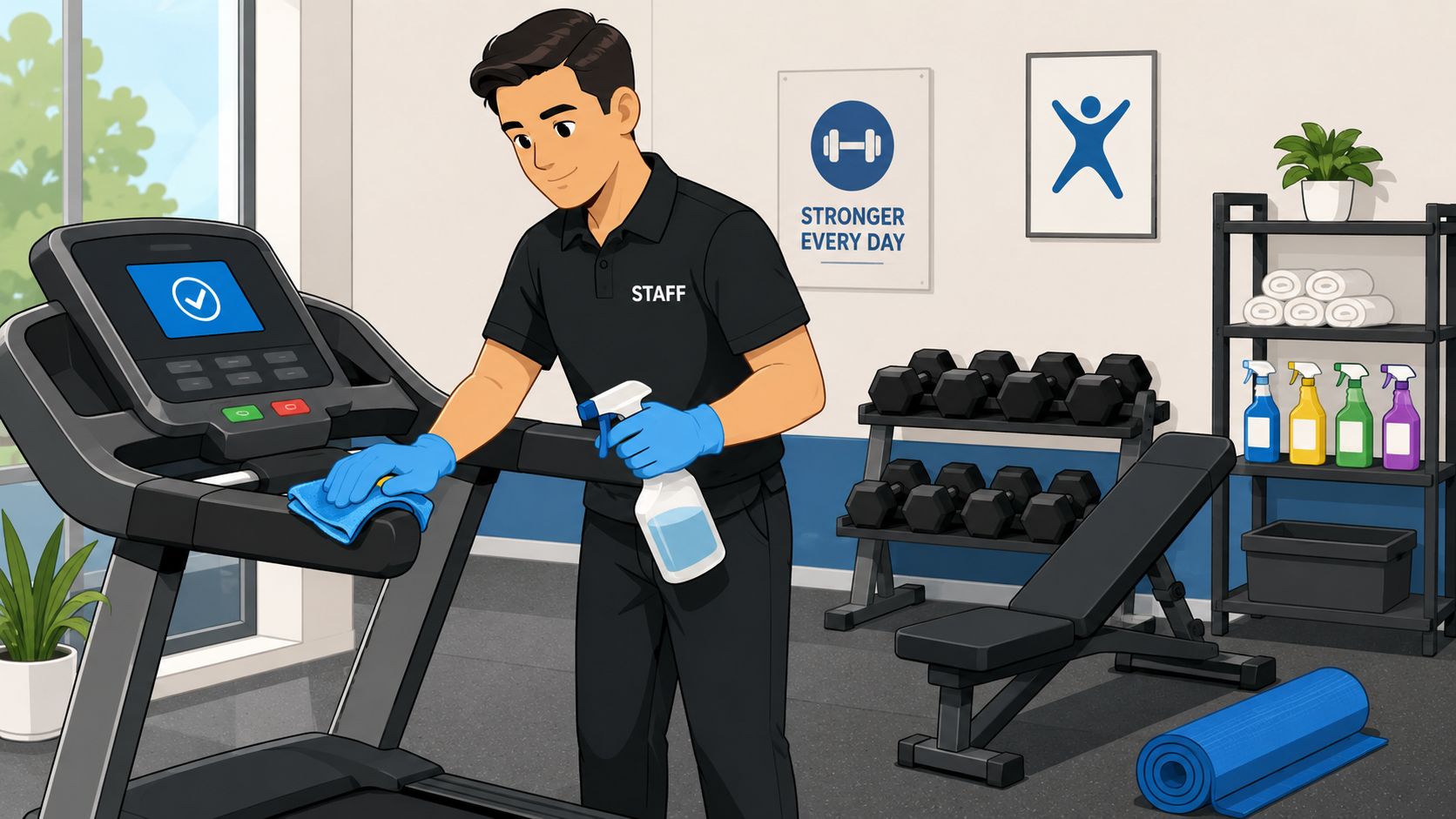
At 9:15 PM, the last member has racked the dumbbells and left. One staff member is facing a counter coated in chalk dust, a treadmill console streaked with sweat, a yoga mat with a faint odor, and a half-empty spray bottle whose label has disappeared. The closing decision looks routine, but the wrong cleaner for gym equipment can leave rubber tacky, cloud a finish, damage upholstery, or create a false sense of disinfection.
The practical question isn't whether a product kills bacteria. It's whether the product carries an appropriate claim, stays wet for the required contact time, and won't shorten the life of the surface it touches. A 2026 study of equipment in six Saudi Arabian gyms found 17 bacterial isolates across three genera, and routine disinfection reduced colony counts from 3,800 to 1,360 CFU, a 64.2% reduction, without eliminating contamination completely (Frontiers in Public Health study). Effective gym hygiene therefore depends on chemistry, technique, and material compatibility working together.
The End-of-Shift Decision Every Gym Faces
The staff member at that closing counter has three immediate choices. Spray the unknown product directly onto the treadmill handle, wipe the bench quickly, or postpone the difficult surfaces until morning. None is automatically safe.
A rubberized handle may become sticky after repeated exposure to an incompatible solvent. A powder-coated dumbbell can lose its appearance when exposed to concentrated bleach. A bench may look clean even though the disinfectant was removed before its label contact time ended. Visible cleanliness and disinfection aren't the same task.
Gym operators also need to recognize that contamination isn't evenly distributed. A prospective study found weight equipment was contaminated more often than aerobic equipment, with contamination detected on 73% of weight equipment surfaces versus 51% of aerobic equipment surfaces (PubMed study). Handles, adjustment pins, dumbbell grips, bench edges, console buttons, and water-station controls deserve focused attention because members touch them repeatedly.
Closing-shift rule: Don't choose one chemical for every surface. Choose the least damaging product that carries the necessary claim, then use enough of it to keep the surface wet for the labeled interval.
A facility manager arranging broader janitorial support may also find a practical reference in office gym cleaning for Toronto firms, particularly when cleaning responsibilities extend beyond exercise equipment into shared workplace fitness areas. The same operating principle applies: define the surface, define the soil, select the chemistry, and document the process.
The decision becomes clearer when staff separate soil removal, disinfection, and equipment preservation. Chalk, skin oil, sweat, and adhesive residue may require cleaning first. Disinfection comes after that step, not instead of it.
Matching Cleaner Type to Equipment Material
A gym contains several material families, and each reacts differently to disinfectants. The safest approach is to build a compatibility matrix rather than issue a single spray bottle to every employee.
Coated metals need gentle chemistry
Powder-coated steel, chrome, free weights, racks, and barbells generally tolerate neutral-pH detergents for routine soil removal. Quaternary ammonium compounds, often called quats, can suit sealed coated surfaces when the label permits that use. Wipe rather than flood, especially around welds, adjustment mechanisms, and exposed fasteners.
Bleach concentrates are a poor routine choice for powder coat. They can cloud finishes and contribute to corrosion at damaged or exposed points. Abrasive powders should never be used on anodized aluminum because they can scratch or dull the surface.
Anodized aluminum and painted frames need a lighter touch. Use a damp microfiber cloth with a compatible neutral cleaner, then apply a registered disinfectant approved for the material. Avoid aggressive scrubbing on selectorized-machine frames and cable-stack guards.
Upholstery and soft surfaces require restraint
Vinyl and polyurethane upholstery, including benches, seat pads, and backrests, can be damaged by harsh solvents. Use a compatible quat or carefully selected alcohol formulation, but avoid acetone and isopropyl alcohol above 70 percent on polyurethane surfaces. Excessive alcohol exposure can dry, crack, or alter the finish.
Never saturate seams. Liquid that enters stitching, foam edges, or hinge points can create an odor problem and may remain trapped after the surface appears dry.
Foam and rubber aren't interchangeable
Closed-cell foam, rubber grips, yoga mats, floor tiles, and treadmill belts need product-specific testing. Hydrogen-peroxide-based products may be suitable where the label and manufacturer permit them, while chlorine can degrade some polymers. Natural rubber can also react poorly to repeated alcohol exposure.
| Equipment Material | Compatible Cleaners | Avoid |
|---|---|---|
| Powder-coated steel and chrome | Neutral-pH detergent, approved quat products, compatible alcohol wipes | Bleach concentrate, abrasive powders, solvent degreasers |
| Anodized aluminum and painted frames | Neutral-pH detergent, material-approved disinfectant | Abrasive powders, strong acids, excessive liquid |
| Vinyl and PU upholstery | Compatible quats, carefully selected alcohol products | Acetone, isopropyl above 70 percent, bleach concentrate |
| Closed-cell foam and rubber | Label-approved peroxide or mild detergent systems | Unverified chlorine use, strong solvents, repeated alcohol on natural rubber |
When product instructions and equipment-manufacturer guidance conflict, follow the more restrictive requirement. Before committing to a full wipe-down, test the product on the underside of a pad or a hidden frame point for 60 seconds, then inspect for tackiness, discoloration, swelling, streaking, and loss of texture. A small compatibility test is cheaper than replacing a bench cover or cardio console.
Active Ingredients That Actually Work on Gym Equipment
Product selection should begin with the active ingredient, but the label claim and contact time matter just as much. A strong chemical applied too lightly or wiped away too quickly won't perform as intended.
Quaternary ammonium compounds, including benzalkonium chloride formulations around 0.1 to 0.2 percent, are common choices for routine cleaning of sealed vinyl and coated steel. They can leave residue or streaks if staff over-apply them, so the surface should receive an even film rather than a puddle. Facilities comparing this chemistry with alternatives can consult this guide to quaternary ammonium disinfectants.
Isopropyl alcohol at 60 to 70 percent evaporates quickly and can work well on compatible hard, nonporous surfaces, including some electronics. That speed is also its weakness. If the product dries before the label's required interval, the surface hasn't received the full treatment. Repeated exposure may dry vinyl, affect plastics, or damage rubber.
Sodium hypochlorite at 800 to 1,000 ppm may be useful for routine applications when the label and equipment manufacturer allow it. It carries a corrosion and discoloration risk, especially on metal, seams, and damaged coatings. Hydrogen-peroxide products around 1.4 to 3 percent can offer a broad option, but accelerated formulas may require contact times extending from seconds to several minutes.
| Active Ingredient | Typical Concentration | Contact Time | Residue / Material Risk |
|---|---|---|---|
| Quaternary ammonium compounds | 0.1 to 0.2% | Often 30 seconds to several minutes, label-dependent | Possible residue, generally suitable for approved coated surfaces |
| Isopropyl alcohol | 60 to 70% | Label-dependent, often short | Fast evaporation, drying or cracking risk on some plastics and vinyl |
| Sodium hypochlorite | 800 to 1,000 ppm | Label-dependent | Corrosion, discoloration, and coating risk |
| Accelerated hydrogen peroxide | 1.4 to 3% | Several seconds to 10 minutes, label-dependent | Can be useful on compatible materials, still requires testing |
| Citric acid | Product-dependent | Product label | Useful for mineral deposits, not automatically a disinfectant |
| Thymol or phenolic blends | Product-dependent | Product label | May leave odor or residue and can affect sensitive materials |
Chlorine dioxide has performed strongly in independent sports-fitness testing for bioaerosols and equipment surfaces, but that doesn't remove the need for soil removal, labeled concentration, full wet contact time, and material testing (controlled sports-fitness disinfection research). Ethanol hand-sanitizer gel isn't a substitute for surface disinfection, and “natural” essential-oil blends rarely provide the registered pathogen claims a commercial facility needs.
For routine end-of-shift work on compatible vinyl and coated steel, quat or alcohol products often provide the most practical balance. Reserve bleach or peroxide for applications their labels and equipment materials support, including targeted deep cleaning or a documented response to a contamination event.
How to Apply Cleaner for Gym Equipment the Right Way
Disinfection fails most often because staff remove the product before the surface has stayed wet long enough. CDC guidance says contaminated surfaces should be cleaned first, followed by an EPA-registered disinfectant matched to the organism, with the surface remaining visibly wet for the entire contact time (CDC guidance on Pseudomonas control).
Use this sequence:
- Remove visible soil. Pick up chalk and debris, then use a neutral-pH detergent and microfiber cloth.
- Rinse where required. Residual detergent can interfere with some products, so use clean water when the cleaner label calls for rinsing.
- Apply the disinfectant. Spray from approximately 8 inches away or use a pre-saturated wipe. Saturate sealed metal enough to form an even wet film, but don't flood electronics, seams, or adjustment housings.
- Start the timer. Keep the surface wet for the full EPA-registered dwell time. Some quat sprays require about 30 seconds, while certain hydrogen-peroxide blends may require up to 10 minutes, depending on the label.
- Inspect and finish. Allow compatible surfaces to air-dry. On electronics and upholstery seams, remove excess liquid only when the label permits it, without shortening the required contact time.

A two-cloth method helps prevent cross-contamination. Keep one cloth for soil removal and another for the disinfectant stage, or use single-use wipes and discard them after each designated surface area. Change gloves between visibly dirty zones and cleaner zones, and wash hands whenever gloves are removed.
Do not force-dry a surface with a fan if that accelerates evaporation before contact time ends. Air-drying is appropriate after the interval has been met, while a controlled final wipe may be necessary for screens or seams if the product directions allow it. This disinfectant contact-time chart can help supervisors train staff to stop guessing and use the label interval.
Practical observation: A visibly wet surface with a running timer is a better sign of correct technique than a spotless surface wiped dry immediately.
DIY and Eco-Friendly Options Versus Commercial Products
DIY solutions have a place, but they shouldn't be confused with validated commercial disinfection. Diluted vinegar can help with odor or mineral deposits, and castile soap can remove light soil. Neither automatically provides the pathogen-specific claims required for a commercial gym.
Hydrogen peroxide may be useful when used in a properly formulated product and tested against the equipment material. Tea-tree sprays and essential-oil blends may smell clean, but an appealing scent isn't proof of bactericidal performance. Electrolyzed water can be effective when generated and maintained according to its specifications, yet staff still need a verified concentration, contact time, and operating procedure.
| Option | Kill Spectrum | Avg. Cost per Sq Ft | Material Risk |
|---|---|---|---|
| Diluted vinegar | Cleaning and deodorizing, not a general registered disinfectant | Not reliably comparable without local pricing | Acids may affect coatings and rubber |
| Hydrogen peroxide solution | Depends on formulation, concentration, and claim | Not reliably comparable without local pricing | May affect sensitive finishes if misused |
| Castile soap | Soil removal, not a complete disinfection step | Not reliably comparable without local pricing | Usually mild, but residue can remain |
| Tea-tree or essential-oil spray | Claims vary and are often unverified for facility pathogens | Not reliably comparable without local pricing | Oils may affect rubber, plastics, or coatings |
| Electrolyzed water | Depends on validated operating conditions | Not reliably comparable without local pricing | Generally material-dependent |
| EPA-registered commercial product | Label-specific claims and contact time | Depends on product and purchasing terms | Must still be matched to the surface |
The cost-per-square-foot comparison is difficult without product pricing, dilution instructions, coverage rates, and labor assumptions. Managers should calculate those inputs rather than assume a homemade mixture is cheaper after labor, failed cleaning, equipment damage, and compliance risk are included.
Commercial facilities may need EPA-registered products, including products listed for relevant pathogen claims, to satisfy health-department, insurer, or internal safety requirements. CDC environmental guidance also emphasizes cleaning before disinfection and maintaining wet contact time (CDC cleaning and disinfection guidance).
A natural label doesn't guarantee equipment safety. Citrus acids can affect finishes, and essential oils can degrade rubber or leave a residue that makes members less willing to use the equipment. For a broader look at homemade formulations, see this homemade natural disinfectant spray guide, then verify every formula against the equipment manufacturer and the product label before using it commercially.
Building a Daily and Weekly Cleaning Routine
A good routine assigns work to people, not vague categories. Front desk staff can handle frequent touchpoints during staffed hours, the closing shift can complete the full equipment wipe, and the maintenance team can own deeper weekly work.
Daily responsibilities
During staffed hours, inspect and wipe handles, adjustment pins, touchscreens, water stations, dumbbell grips, and bench contact areas at a recurring interval. The exact frequency should reflect traffic, staffing, and facility policy. A clean-looking surface still needs attention when many members share it.
At closing, staff should work from cleaner zones toward dirtier ones. A practical order is free weights first, then strength equipment, then mats and floor-contact items, with cardio equipment last. Hand hygiene should occur between categories, and cloths or wipes shouldn't travel from a visibly dirty area back to a clean one.
Weekly and monthly controls
The weekly deep clean should include upholstery edges, cable surfaces, mat stacks, undersides of benches, and areas beneath or behind machines. Maintenance staff should inspect powder coat, grips, belt seams, screens, and upholstery for signs of chemical damage, including tackiness, cracking, clouding, swelling, and corrosion.
A sign-off log should record the date, assigned employee, product used, areas completed, and any defects found. Replenish supplies before a bottle reaches an unusable level, and quarantine an unlabeled or unverified container rather than asking staff to guess.
If a member reports illness or visible bodily-fluid contamination, stop routine cleaning in that zone. Follow the facility's incident procedure, select a disinfectant with the relevant claim, use appropriate protective equipment, and document what was isolated and treated. CDC notes that MRSA and VRE can be susceptible to several EPA-registered low- and intermediate-level disinfectants, including alcohols, sodium hypochlorite, quats, phenolics, and iodophors, when used at label dilution and full contact time (CDC environmental services guidance).

The manager's role is to audit the process, not just the finished appearance. Check whether staff used the right product, wet the entire target area, honored the timer, and recorded equipment damage before it becomes a safety or replacement issue.
Your Gym Equipment Cleaner Checklist
A buying decision should fit on one page. For every candidate product, record the material it can touch, the pathogen claims it carries, the required dilution, the contact time, the application tool, and the failure mode it might create.
| Surface or hazard | Preferred evaluation | Reject or question | Verification |
|---|---|---|---|
| Powder-coated steel | Neutral-pH cleaning and compatible quat or approved disinfectant | Bleach concentrate, abrasive or solvent degreasers | Test a hidden point and inspect the finish |
| Chrome | Mild detergent and compatible registered disinfectant | Abrasive powders and corrosive mixtures | Check for streaking and corrosion |
| Vinyl upholstery | Material-approved quat or compatible alcohol product | Bleach on vinyl, acetone, excessive alcohol | Inspect seams, texture, and flexibility |
| Closed-cell foam | Label-approved peroxide or mild cleaner | Unverified chlorine, solvent-heavy products | Check for residue and odor after drying |
| Rubber | Manufacturer-approved mild chemistry | Alcohol on natural rubber, harsh solvents | Test for tackiness and swelling |
| Painted cardio shrouds and consoles | Low-moisture application with compatible chemistry | Flooding, abrasive cleaning, unverified solvents | Test on a hidden area and check screen clarity |
Before purchase, confirm the EPA registration number, match the kill claim to the organisms on the facility's incident or hygiene log, and verify the required dilution. For coated surfaces, a pH between 6 and 9 is a useful screening range, but it doesn't replace the equipment manufacturer's instructions or the disinfectant label.
The application tool matters too. Use a clean microfiber for soil removal, a labeled spray bottle only when the product permits decanting, and single-use wipes for controlled high-touch work. Reject any product that requires staff to improvise dilution, contact time, or surface suitability.

Photograph every product label and keep the images in the staff cleaning folder. When you trial a new cleaner for gym equipment, rerun the checklist, perform a hidden-surface test, and observe the equipment after repeated use instead of approving the product after one attractive wipe-down.
We recommend Wipes.com as one option for facilities evaluating pre-saturated wipes and surface-cleaning supplies. Select the specific wipe only after confirming its pathogen claims, contact time, and compatibility with your gym's vinyl, rubber, metal, plastic, and electronic surfaces.
Clean equipment supports member confidence, but the strongest chemistry isn't automatically the best operational choice. Choose a product with the right registered claim, apply it to a pre-cleaned surface, keep that surface wet for the full labeled interval, and protect every material from avoidable damage. Review the supply cabinet this week, remove unlabeled bottles, photograph the approved labels, and train the next closing shift to use the timer rather than guess.
Leave a Reply