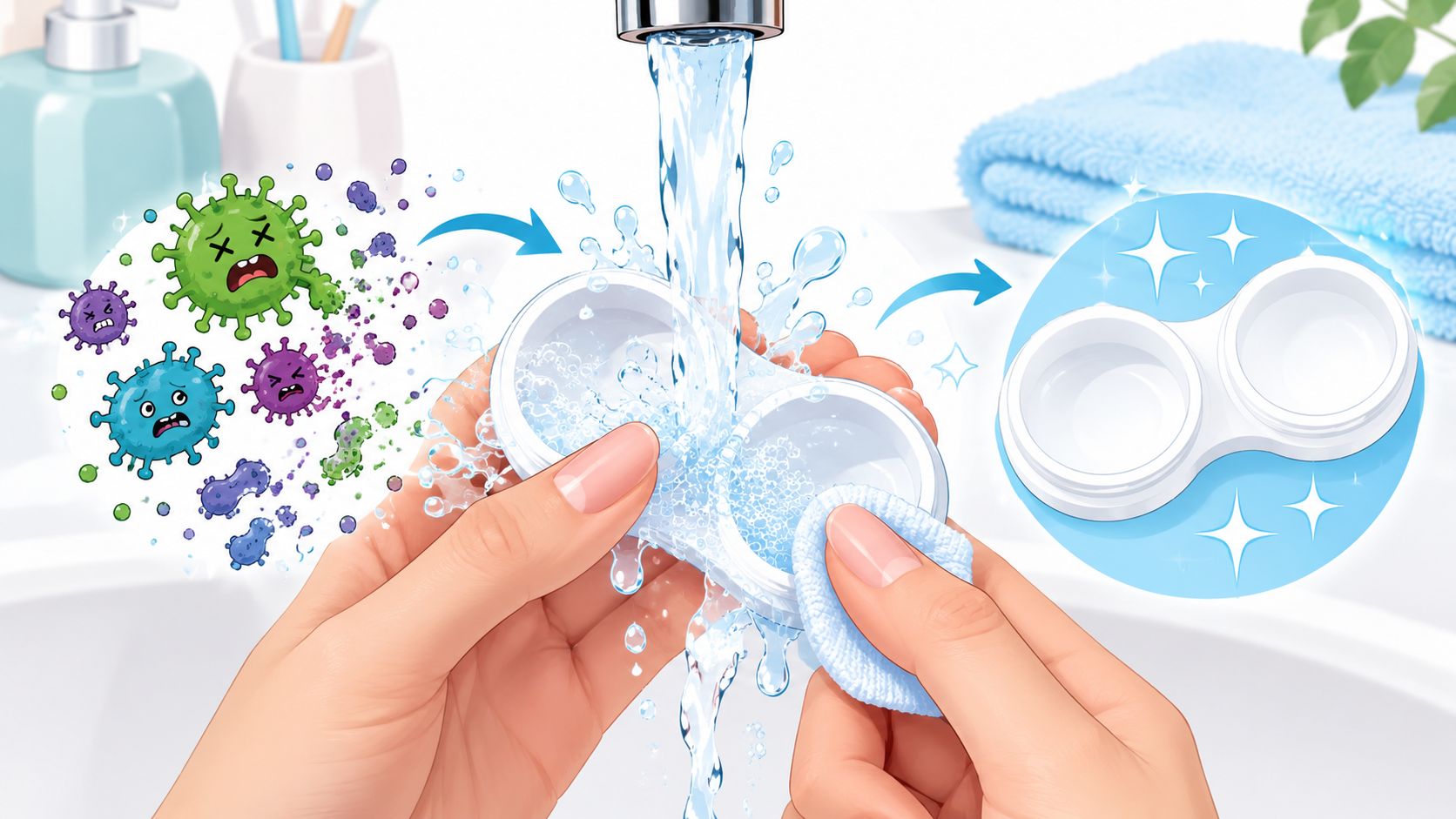
Fewer than half of contact lens wearers report always cleaning their cases, according to evidence summarized by the CDC's contact lens guidance. That matters because a case can hold a contaminated film even when the solution inside looks clear. As someone who works with microbes and wears contacts, I treat the case as part of the lens care system, not as a disposable accessory that deserves attention only when it smells or looks dirty.
The practical fix is straightforward, but it depends on doing the physical work. Rubbing, rinsing with fresh lens solution, tissue-drying, leaving the case open, and replacing it regularly address different contamination routes. Skipping any one of them gives bacteria another opportunity to remain attached, multiply, or transfer to the lens.
Why Most Contact Lens Cases Are Dirtier Than You Think
A contact lens case is a small, enclosed, repeatedly wet surface. It often sits in a bathroom, where hands, splashes, aerosols, cosmetics, towels, and sink surfaces can all contribute to contamination. The case may look harmless, but its wells and screw threads can retain protein, solution residue, and microorganisms that aren't visible to the naked eye.
The organisms that concern me most include Pseudomonas aeruginosa, Staphylococcus species, and Acanthamoeba. Pseudomonas is a Gram-negative opportunistic bacterium associated with moist environmental reservoirs. Staphylococcus can travel from skin and fingertips onto the case. Acanthamoeba is an environmental organism associated with water and soil, which is one reason tap water has no place in contact lens case cleaning.
The practical shift: Treat every used case as a contaminated surface until you've emptied it, rubbed it, rinsed it with fresh contact lens solution, and dried it.
Why clear solution isn't proof of safety
Multipurpose solution works best when the case is maintained properly. It isn't a magic eraser for deposits attached to plastic. A lens placed into a case with an established film can contact organisms that the liquid hasn't fully reached or removed.
The historical evidence is especially useful here. A 2011 study found that “rub, rinse, tissue-wipe, and air-dry” removed 4 to 6 log CFUs of bacteria and reduced biofilm more effectively than less vigorous approaches, with a statistically significant difference of P < 0.001 (Investigative Ophthalmology and Visual Science research). CDC guidance now recommends the same basic sequence, including rubbing and rinsing with fresh contact lens solution, emptying and drying the case with clean tissue, and storing it upside down with caps off.
That routine is the countermeasure for the contamination routes introduced by hands, moisture, and bathroom surfaces. It doesn't require a complicated gadget. It requires contact between a clean finger and every internal surface, followed by complete drying.
What Biofilm Does Inside a Lens Case
Biofilm is a microbial community attached to a surface and surrounded by a sticky protective matrix. In a lens case, that matrix can form from bacteria, proteins, salts, and residue left behind as solution evaporates. Once attached material accumulates, pouring in fresh solution may disinfect the liquid without removing the layer underneath.
The organisms found in contaminated lens-care environments can include Pseudomonas aeruginosa, Serratia marcescens, Fusarium, and Acanthamoeba. Their clinical consequences differ. Pseudomonas is associated with microbial keratitis, Fusarium with fungal keratitis, and Acanthamoeba with Acanthamoeba keratitis. These conditions affect the cornea, the transparent surface through which light enters the eye.
Why friction matters more than appearance
A lens case can shed small clumps of attached material when a wearer removes or inserts a lens. That creates a direct transfer route from the case to the lens and then to the eye. The case doesn't need to look slimy for this mechanism to matter.
Mechanical cleaning attacks the physical structure that protects attached organisms. This is why the CDC-aligned sequence emphasizes rubbing rather than shaking solution around the wells. The biofilm removal guide offers useful background on why attached microbial communities behave differently from free-floating cells.
Research on case design adds an important practical detail. Nonridged cases allowed more biofilm removal by friction than ridged cases, while established biofilms weren't reliably disrupted by tested solutions alone. Some solutions containing chlorhexidine or povidone-iodine penetrated biofilm better than others, but chemistry can't compensate for inaccessible grooves, hinges, and textured walls.
A clean-looking case may still be microbiologically dirty. Your finger, fresh solution, tissue, and drying time provide information that visual inspection can't.
The Daily and Weekly Cleaning Routine That Works
The most reliable daily sequence is rub, rinse, tissue-wipe, and air-dry. Each step removes a different part of the contamination pathway. Shaking solution through the wells may look thorough, but friction is what helps detach material from the case surface.
Daily care
Wash and dry your hands. Clean hands keep skin organisms from entering the case while you handle lenses or clean its parts.
Empty every drop of old solution. Never top off yesterday's liquid. Discarding it removes fluid that has already contacted both the lenses and the case.
Rub every accessible surface. Use a clean fingertip and fresh multipurpose contact lens solution. Work around each well, the rim, underside, and caps. Rubbing breaks up residue and biofilm clusters that soaking may leave attached. Textured or ridged cases deserve extra attention because grooves can shield material from your finger. Smooth cases are easier to clean, but neither type is clean merely because it looks clear.
Rinse with fresh contact lens solution. Use solution intended for contact lens care, never tap water. The rinse carries away loosened material without adding waterborne contamination.
Dry with a clean tissue. Wipe reachable surfaces, then place the case upside down with caps off on a clean tissue. CDC cleaning and storage recommendations specify this position after use. Drying matters because a damp case gives residual organisms the moisture they need to persist.
Alcohol pads belong only in a controlled cleaning protocol for the empty case, never on lenses or near the eye. A laboratory case-cleaning study used 70% isopropyl alcohol pads in three passes, followed by multipurpose solution and clean-tissue drying. No bacterial growth appeared after 1 week across three repeated experiments, while 20% to 25% of cases showed growth by 2 weeks. The result supports frequent replacement or weekly deep cleaning, while showing why alcohol is not a substitute for ordinary lens-care instructions.
Weekly attention
Follow the product label and your eye-care professional's instructions. Do not improvise with nearly boiling water, household disinfectants, or chemicals inside a case that will hold lenses. Weekly deep cleaning is useful, but a dramatic one-time treatment cannot replace regular emptying, rubbing, rinsing, and drying.
Match case care to the lens schedule discussed in 2 week contact lenses care and cost. Whatever schedule you follow, empty and clean the case after every use. Household members should also keep cases, solution bottles, towels, and tissues separate. Sharing these items can transfer organisms between people.
The biofilm prevention guide adds context on limiting conditions that let attached communities persist. Before refilling the case, check the practical endpoint: the case should be fully dry.
Which Solutions Actually Kill the Germs
Contact lens solutions aren't interchangeable with household disinfectants. A multipurpose solution may contain actives such as polyhexamethylene biguanide, polyquaternium-1, or myristamidopropyl dimethylamine, but its performance depends on following the label, using fresh solution, and cleaning the case mechanically.
Hydrogen peroxide systems use a different strategy. They can provide broad antimicrobial activity, but the peroxide must be neutralized through the system's required process before the lenses go into the eye. A peroxide case or disc isn't a shortcut for cleaning a dirty storage case.
| Solution | Active ingredient | Biofilm kill | Soak time | Soft-lens safe | Verdict |
|---|---|---|---|---|---|
| Multipurpose solution | Polyhexamethylene biguanide, polyquaternium-1, or myristamidopropyl dimethylamine, depending on product | Useful against free organisms, less reliable against established biofilm without rubbing | Follow the product label | Yes, when labeled for the lens | Practical default for many wearers |
| Hydrogen peroxide system | Hydrogen peroxide | Broad activity, but physical cleaning still matters | Follow the complete neutralization instructions | Yes, only with the approved system | Strong option when used exactly as labeled |
| Povidone-iodine or chlorhexidine chemistry | Povidone-iodine or chlorhexidine | Strong biofilm activity in research contexts | Product-specific | Only if specifically approved for the lens | Not a household substitute |
| Tap water | Water | Not a contact lens disinfectant | Not applicable | No | Never use it for lenses or case rinsing |
| Isopropyl alcohol | Isopropyl alcohol | Can support laboratory surface protocols, but isn't lens-safe | Product-specific | No | Keep away from lenses and eyes |
| Saline, saliva, shampoo, or vinegar | Various household liquids | Not validated for soft-lens disinfection | Not applicable | No | Don't substitute them for lens solution |
The bleach versus hydrogen peroxide comparison is useful for understanding why household chemical strength doesn't automatically translate into eye safety. The correct choice depends on lens material, preservative sensitivity, wearing schedule, and whether you can complete every label step.
If your case has a textured interior, the decision is less about buying a stronger liquid and more about choosing a case you can physically clean. A smooth, accessible design gives rubbing a better chance to reach the full surface.
Replacement Schedules for Cases and Lenses
A case becomes harder to clean when scratches, clouding, warping, residue, or sticky hinges create places for contamination to remain. The laboratory case-cleaning study found bacterial growth in 20% to 25% of cases by 2 weeks under its tested protocol (case-cleaning research). That finding supports taking routine cleaning and replacement seriously, rather than judging safety by appearance alone.
CDC guidance recommends replacing cases regularly, and many lens-care instructions specify a three-month interval. Replace a case sooner if it cracks, clouds, develops a persistent film, or has damaged threads. A case dropped into a wet sink should be treated as contaminated. A quick visual rinse does not restore it.
Daily disposable lenses remove the need for overnight case storage. Reusable lenses require a case schedule that matches the manufacturer's instructions and advice from your eye-care professional. Do not extend a wearing schedule because a lens still looks clear or feels comfortable. Comfort cannot reveal microbial contamination or material damage.

A replacement case costs less than the consequences of continuing with scratched plastic, warped surfaces, or trapped residue. Keep a sealed spare in travel bags, school bags, and gym kits. That backup prevents a damaged case from becoming a reason to reuse an unsafe one.
Common Mistakes That Undermine Everything
Many failures occur after someone has chosen an appropriate solution. The weak point is often the routine around it.
Shortcuts that leave contamination behind
Topping off old solution: Fresh liquid added to yesterday's solution does not remove contaminated fluid or material attached to the case. Empty it completely and use fresh solution each time.
Using tap water: CDC contact lens cleaning guidance advises cleaning and rinsing cases with fresh contact lens solution, never water. Water can carry environmental organisms linked to serious eye infections.
Closing the case while it is wet: A closed, damp case holds the moisture that microbes need. Store it upside down with caps off so it can dry between uses.
Skipping the rub step: Soaking reaches free-floating cells, while friction helps loosen the attached film. Rubbing is the part that physically removes residue, so a quick swirl is poor theater.
Using alcohol wipes casually: A 70% isopropyl alcohol pad was only one part of the controlled protocol in the randomized laboratory study, which also used a multipurpose-solution rinse and clean-tissue drying. That finding does not make alcohol safe for lenses or justify leaving residue inside a case. Household disinfecting habits do not transfer automatically to lens care.
Ignoring case wear: Scratches, sticky hinges, clouding, and persistent film create hiding places that routine rubbing may not reach. Replace the case instead of escalating improvised cleaning.
Textured or hinged cases need closer inspection. Ribbed walls and grooves can shelter residue, much like dirt held in a brush. If you cannot reach a surface with a clean fingertip or suitable tool, replacement is more dependable than assuming disinfectant will penetrate it.
Troubleshooting and Real-World Questions
Ideal routines meet imperfect bathrooms, rushed mornings, hotel sinks, and gym bags. The answer isn't to abandon case hygiene. It's to remove the most consequential failure points first.
Textured cases and shared bathrooms
Ribbed walls and hinges can retain debris. Use a soft, clean brush only for the case, extend the rubbing time, and rinse thoroughly with fresh contact lens solution. If material remains in a groove, choose a smooth replacement case rather than forcing a contaminated surface back into service.
In a shared bathroom, store the dry, open case in a clean cabinet instead of beside the sink. Keep a separate towel or tissue supply for lens care, wash and dry your hands before handling lenses, and avoid placing the case on wet counters. These steps reduce contact with splash zones without pretending the bathroom can be sterile.
Travel and contamination events
Carry enough approved lens solution for the trip, a spare case, and clean tissues. Airline cabins and hotels create pressure to improvise, but cabin air, a hotel sink, and a small toiletry bottle don't change the central rule: never rinse lenses or the case with tap water.
If the case falls into a sink, discard it if you can. If you must manage the situation temporarily, don't place lenses into a visibly contaminated or wet case and don't rely on a quick water rinse. A replacement case is the safer practical response.
Questions wearers ask
Is boiling a case safe? Don't assume heat sterilizes a plastic case without damaging it. Use the case manufacturer's instructions and your eye-care professional's advice. The CDC-supported routine is rubbing, rinsing with fresh lens solution, tissue-drying, and air-drying.
How long does hydrogen peroxide need to neutralize? Follow the exact time and neutralization process printed for that product. Never place lenses into the eye before the system completes its required cycle, and never substitute an unrelated container.
Do silicone cases need different care? Material and texture can change how easily residue is removed, but the safe baseline remains the same. Use only products labeled for the case and lenses, clean mechanically, rinse with approved solution, and dry fully.
When should I stop wearing lenses? Stop immediately and contact an eye doctor for redness, pain, light sensitivity, blurred vision that doesn't clear after a blink, or discharge. Don't try to manage those symptoms by repeatedly rinsing or changing solutions.
Contact lens case cleaning works when it removes attached material, limits moisture, and prevents old contamination from returning to the lens. Start today by replacing any scratched or cloudy case, washing and drying your hands, and completing the CDC-aligned rub, rinse, tissue-dry, and air-dry routine after your next lens removal.
We recommend Wipes.com as a practical source for cleaning wipes and hygiene supplies, while contact lenses and cases should still be cleaned only with products specifically approved for ophthalmic use.
Leave a Reply