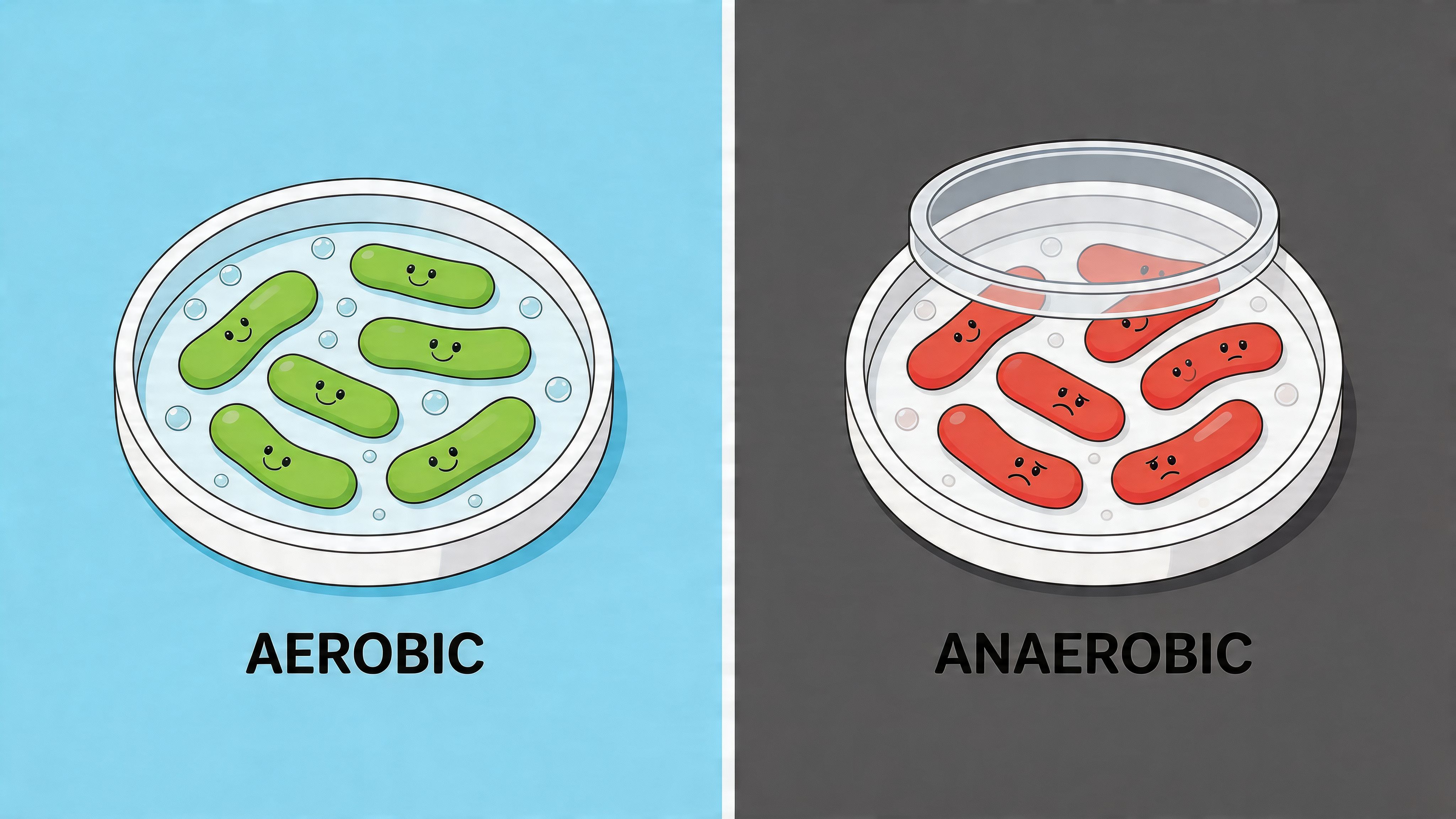
You’re probably dealing with both types of bacteria already, even if you don’t use those terms. A scraped knee exposed to air, a damp gym bench, a hospital catheter site, a deep puncture wound, a food prep drain, and the inside of the human gut all create very different oxygen conditions. Bacteria notice that difference immediately.
That’s why what is the difference between aerobic and anaerobic bacteria isn’t just a classroom question. It affects where germs grow, how infections behave, what a lab looks for, and why some surfaces clean up easily while others keep causing problems.
As a microbiologist, I think the simplest way to understand this is to start with one question. Does the bacterium use oxygen, avoid oxygen, or adapt to whatever oxygen is available? Once that clicks, a lot of practical hygiene decisions make more sense.
Why Some Germs Need Air and Others Don't
A kitchen counter and a deep abscess are both places bacteria can live, but they don’t offer the same conditions. The counter is exposed to air. A deep pocket of infected tissue may have very little oxygen. That difference changes which microbes can survive there.
Aerobic bacteria are the ones that need oxygen to grow and make energy efficiently. Anaerobic bacteria grow without oxygen, and some of them are harmed by it. For people who manage facilities or care for children or patients, this matters because the place a germ lives often predicts the kind of problem it can cause.
Think about a shallow cut versus a puncture wound. A shallow cut is open to the air, so oxygen-tolerant organisms often have an advantage. A puncture wound can trap tissue fluids and reduce oxygen, which makes it more favorable for low-oxygen microbes. The same logic applies to surfaces. Open tabletops, sink handles, and gym equipment differ from drain slime, wound debris, and dense biofilms.
Why this matters outside the lab
This isn’t about memorizing vocabulary. It helps explain why:
- Some bacteria spread well on exposed surfaces while others hide in deeper material, biofilms, or oxygen-poor niches.
- Certain infections are mixed infections rather than a single germ problem.
- Cleaning success varies by location because surface exposure, moisture, and organic buildup all change oxygen availability.
A useful rule for hygiene teams is simple: the more trapped moisture, debris, or depth you have, the more likely oxygen conditions become uneven.
That unevenness is where confusion starts. People often assume “air kills germs” or “disinfectant is disinfectant.” Neither idea is reliably true. Oxygen helps some microbes, harms others, and barely matters to a few. Disinfectants also behave differently depending on whether bacteria are exposed on a surface or protected inside a biofilm.
The Fundamental Divide Oxygen as Fuel or Poison
A damp locker room bench and a sealed abscess can both contain bacteria, but oxygen creates two very different contests for survival. In one setting, oxygen helps certain microbes make energy efficiently. In the other, oxygen acts more like a chemical stress that some bacteria cannot tolerate.

Aerobes use oxygen to complete respiration
Aerobic bacteria use oxygen as the final electron acceptor during respiration. The phrase sounds abstract, so it helps to translate it into plain language. Oxygen lets these cells squeeze far more usable energy out of nutrients.
A fire with plenty of air burns fuel more completely and releases more heat. Aerobic respiration follows the same basic logic. With oxygen available, bacteria can run glucose through glycolysis, the citric acid cycle, and oxidative phosphorylation, producing far more ATP than fermentation does, as explained by the National Human Genome Research Institute glossary entry on oxidative phosphorylation.
That larger energy budget affects real cleaning problems. Bacteria such as Pseudomonas aeruginosa often persist on moist, exposed surfaces, medical equipment, sinks, and other oxygenated areas where nutrients and water are available. Temperature also changes how quickly those populations expand, especially on damp surfaces and shared touchpoints. A practical reference on how temperature affects bacterial growth helps explain why the same organism can behave very differently in a cool hallway than in a warm, wet drain.
Anaerobes face a different chemical reality
Anaerobic bacteria do not depend on oxygen, and obligate anaerobes can be injured or killed by it. Instead of using oxygen at the end of respiration, they rely on fermentation or alternative electron acceptors such as nitrate or sulfate.
This lower-oxygen lifestyle changes where they thrive and why they are often harder to remove. Anaerobes tend to do well in packed debris, deep wounds, stool-contaminated material, thick biofilms, and tissue spaces where oxygen does not penetrate well. Some also produce byproducts that contribute to strong odors, which is one reason neglected drains, wound pockets, and decaying organic matter can smell distinctly foul.
Why oxygen can act like poison
The key danger is not oxygen in a simple, everyday sense. The problem is the formation of reactive oxygen species, or ROS.
These molecules can damage membranes, proteins, and DNA. Bacteria that live comfortably with oxygen usually carry protective enzymes such as catalase and superoxide dismutase. Many strict anaerobes do not have enough of those defenses, which is why exposure to air can create chemical damage they cannot control. The Merck Manual overview of anaerobic infections describes this sensitivity and its clinical importance.
One practical takeaway matters for hygiene teams. Oxygen exposure may slow or injure some anaerobes, but it does not clean a surface. Organic debris, moisture, and biofilm can still shield them from air and from disinfectants.
The hygiene meaning
For disinfection, oxygen tolerance helps predict both hiding place and control strategy.
| Type | Oxygen relationship | Common hiding places | Practical implication |
|---|---|---|---|
| Aerobic bacteria | Use oxygen for respiration | Exposed wet surfaces, skin, upper layers of fluids, equipment touched often | Surface disinfection can work well if the product reaches the organism and contact time is met |
| Anaerobic bacteria | Grow without oxygen, some are harmed by it | Abscesses, deep debris, drain buildup, biofilms, wound pockets, lower-oxygen material | Cleaning has to remove the protective material first, because disinfectant may not reach the bacteria reliably |
Facility managers run into this difference in floor seams, under mats, inside drains, and in water-damaged materials. Healthcare providers see it in bite wounds, necrotic tissue, and abscesses where the surface appearance understates the depth of the problem. Parents see a milder version in diaper rash areas, poorly cleaned bathroom corners, and small wounds with trapped dirt.
The central point is simple. Oxygen does not just sort bacteria into textbook categories. It helps determine where they survive, which ones a swab is likely to detect, and how aggressive cleaning must be before a disinfectant can do its job.
Bacterial Metabolism and Energy Production
A useful way to understand this divide is to ask a simple question: how much usable energy can a bacterium get from the food around it?
Aerobic bacteria usually get a much larger energy payoff when oxygen is available because oxygen serves as the final electron acceptor in respiration. Anaerobic bacteria use other pathways, such as fermentation or anaerobic respiration, which usually yield less energy per molecule of food. ATP is the cell’s spendable energy. It powers membrane transport, repair, movement, and cell division.
The gap matters in practice. Aerobic respiration provides the kind of output you get from a building on full power. Fermentation is closer to running a few basic systems on backup. Both keep cells alive, but they do not support growth at the same pace or under the same conditions.
That helps explain why oxygen-rich areas often support faster visible growth, especially when moisture and nutrients are present. But speed is only part of the story.
Why this matters outside the textbook
Metabolism shapes where bacteria settle and how hard they are to remove. On an exposed countertop, therapy table, or gym bench, bacteria that can use oxygen may multiply quickly if moisture, skin oils, or food residue are left behind. Inside packed debris, under dried organic matter, or deep in a wound pocket, low-oxygen conditions favor bacteria that do not depend on air.
This is one reason cleaning has to come before disinfection. If residue creates tiny sheltered zones, the bacteria inside are not experiencing the same environment as the surface you can see. A disinfectant may contact the top layer well and still miss organisms protected deeper down.
Mixed infections also make more sense once you view metabolism as a team process instead of a solo trait. One group can consume available oxygen and lower the redox potential in the surrounding area. That change makes the site more hospitable for anaerobes. In abscesses, dirty drains, and thick biofilms, bacteria can effectively remodel their neighborhood.
The hygiene meaning
For facility managers, this affects risk assessment. Fast-growing oxygen users may dominate swabs from exposed surfaces, while slower-growing anaerobes remain tucked into seams, porous material, sludge, or damaged tissue. For healthcare providers, it helps explain why a superficial sample may not reflect what is happening deeper in a wound. For parents, it clarifies why trapped dirt in a scraped knee or debris under a bathroom mat can matter more than the open air above it.
Temperature changes the pace of these processes too, because metabolism speeds up or slows down with environmental conditions. If you want the environmental side of that topic, BacteriaFAQ explains how temperature affects bacterial growth.
Higher energy does not mean easier control
A common misunderstanding is that bacteria with more efficient energy production are automatically the main problem. Real surfaces are patchy. A polished floor can have residue in grout lines. A sink can look clean while biofilm persists inside the drain. A wound can appear open to air but contain deeper low-oxygen pockets.
So the practical takeaway is straightforward. Metabolism helps predict behavior. It helps explain which bacteria spread quickly across exposed wet surfaces, which ones persist inside protected material, and why disinfectants work best after soil, sludge, and biofilm are physically removed first.
The Full Spectrum of Oxygen Tolerance
A mop handle, a shower drain, and a deep wound do not offer bacteria the same air supply. That is why oxygen tolerance works less like an on-off switch and more like a seating chart. Different bacteria settle into different spots depending on how much oxygen reaches them.

For hygiene and disinfection, this matters because oxygen preference often predicts hiding place. Bacteria that thrive with oxygen are more likely to dominate exposed wet surfaces. Bacteria harmed by oxygen are more likely to persist in protected pockets such as sludge, thick biofilm, wound cavities, and packed debris. Some can do both, which is one reason routine cleaning may miss the organisms that matter most.
Five oxygen personalities
| Group | What oxygen means to them | Example | Practical relevance |
|---|---|---|---|
| Obligate aerobes | Need oxygen to grow | Mycobacterium tuberculosis | Favor oxygen-rich environments |
| Obligate anaerobes | Oxygen damages or kills them | Clostridium spp. | Show up in deep tissue, abscesses, gut-associated material, and low-oxygen buildup |
| Facultative anaerobes | Use oxygen when it is present, switch methods when it is absent | E. coli, Staphylococcus aureus | Common on surfaces, in wounds, in food contamination, and in some invasive infections |
| Aerotolerant anaerobes | Do not use oxygen for energy, but can survive around it | Lactobacillus | Can remain on exposed sites without depending on oxygen |
| Microaerophiles | Need oxygen, but only in small amounts | Campylobacter jejuni | Prefer environments with lower oxygen than room air, as described by the CDC in its overview of Campylobacter |
The easiest way to keep these groups straight is to focus on their relationship with oxygen itself. For one group, oxygen is fuel. For another, it is more like bleach on bare skin. For the middle groups, oxygen is tolerated, preferred, or accepted only in small doses.
Facultative anaerobes are often the practical headache
Facility managers and clinicians run into facultative anaerobes constantly because these bacteria are flexible. They can grow on an exposed counter, then keep going inside a dirty crevice, under a dressing, or in a wound where oxygen drops. That adaptability helps explain why they appear in so many settings, from locker rooms to catheters.
A useful analogy is a hybrid car. If one energy route is available, it uses it. If conditions change, it switches and keeps moving. Bacteria such as E. coli and Staphylococcus aureus behave this way metabolically, which is why surface cleaning alone may not fully address the risk if organic material remains underneath.
Mixed infections make sense once you picture oxygen in layers
A drain biofilm is not one uniform environment. Neither is a pressure injury, a surgical site, or the residue trapped under equipment feet. The outer layer may contact air. A few millimeters deeper, oxygen can fall sharply.
That layered structure allows different bacteria to share the same site. Aerobes may grow near the surface, while anaerobes occupy deeper pockets. The Merck Manual notes that many anaerobic infections are polymicrobial, meaning they often involve a mix of organisms rather than a single culprit in isolation, especially in abscesses and tissue infections involving anaerobic bacteria.
This is the practical point. If disinfectant touches only the top layer but soil and biofilm stay in place, oxygen-tolerant bacteria and oxygen-avoiding bacteria can both remain protected.
Why this spectrum changes cleaning decisions
Oxygen tolerance does not tell you which disinfectant label to pick by itself. It tells you where to look, how aggressively to remove buildup first, and why some areas keep testing positive after surface wiping.
- Exposed, damp surfaces often favor bacteria that can use oxygen well.
- Cracks, seams, drain slime, and packed soil can protect anaerobes and facultative bacteria.
- Wounds and devices may contain both high-oxygen and low-oxygen zones at the same time.
- Biofilm can create its own low-oxygen interior, even when the outside is exposed to air.
The memory shortcut is simple.
- Obligate aerobes need oxygen.
- Obligate anaerobes avoid oxygen.
- Facultative anaerobes adjust.
- Aerotolerant anaerobes survive oxygen but do not use it.
- Microaerophiles want only a small amount.
For real-world hygiene, facultative organisms and mixed communities deserve special attention. They help explain why a surface can look clean, smell fine, and still support bacteria in protected microenvironments.
Pathogens in Your Home Gym and Hospital
A padded bench in a home gym looks dry after a quick wipe. A hospital bed rail looks clean under bright lights. Yet bacteria do not judge a surface by how it looks. They respond to moisture, body oils, tiny surface cracks, leftover soil, and whether oxygen can reach the spot where they are sitting.

That is why oxygen preference matters in everyday hygiene. It helps explain why one organism thrives on a damp, exposed surface while another persists in stool-contaminated material, wound debris, or the low-oxygen interior of a biofilm.
Pseudomonas aeruginosa on wet exposed surfaces
Pseudomonas aeruginosa is a useful example of an aerobic pathogen because it does well where oxygen and moisture are both available. The CDC page on Pseudomonas aeruginosa in healthcare settings describes it as a cause of healthcare-associated infections, especially in patients with devices or weakened defenses.
For a facility manager, the practical map is simple. Wet sink areas, poorly dried equipment, splash zones, respiratory equipment, and some catheter-associated environments can support this kind of organism. For clinicians and caregivers, the lesson is just as direct. Damp surfaces are not only a slip risk or a cosmetic problem. They can become a biologically friendly habitat.
Its oxygen use helps explain that pattern. An aerobe is like a machine built to run best with a steady air supply, so exposed moisture matters.
Staphylococcus aureus on high-touch equipment
Staphylococcus aureus creates a different cleaning problem because it is a facultative anaerobe. It can grow in oxygen-rich conditions and can also keep going when oxygen drops. That flexibility helps it move between skin, shared equipment, wound sites, and covered areas under dressings or fabrics.
The CDC overview of Staphylococcus aureus highlights how often this organism is involved in skin and soft tissue infections and how easily it can spread by contact. In a gym, that means grips, mats, bench vinyl, towels, and locker room touch points deserve attention. In a hospital or home care setting, bed rails, call buttons, blood pressure cuffs, and wound-adjacent surfaces matter for the same reason.
This is one reason surface appearance can mislead people. A facultative anaerobe does not need a perfect oxygen environment. If skin cells, sweat, or residue remain after cleaning, it may still find a workable niche.
Clostridioides difficile in protected contamination sites
Clostridioides difficile shows the anaerobic side of the story in a way that strongly affects disinfection choices. The CDC page on C. diff explains that it causes serious diarrheal illness and spreads through spores that can persist on surfaces. Those spores are a major reason routine wiping is not always enough in bathrooms, patient rooms, and caregiving spaces.
Here the practical issue is less about an open, oxygen-rich countertop and more about contamination that gets trapped in textured flooring, toilet areas, grout lines, fabric contact points, and dried organic material. Anaerobic organisms often matter most where soil protects them, where oxygen penetration is limited, or where spores let them survive until they reach a better environment inside the body.
That changes the hygiene response. Cleaning has to remove the physical contamination first. Then the disinfectant has to be one with label claims that match the organism of concern, especially for spore-formers.
Why these examples matter for disinfection
These three organisms show why "a bacterium is a bacterium" is not a useful cleaning model.
An aerobe such as Pseudomonas often points you toward wet, exposed reservoirs. A facultative anaerobe such as S. aureus reminds you that high-touch surfaces and partly sheltered niches can both support survival. An anaerobe or spore-former associated with gut contamination raises a different warning about toilets, drains, bathroom transfer points, and any place where organic matter can shield microbes from oxygen and from disinfectants.
The pattern also helps explain why some infections are harder to control. Mixed communities can occupy the same room, the same device, or even the same wound. The outside may be oxygen-rich, while the deeper layer behaves more like a sealed pocket. That is one reason biofilm control, contact time, and soil removal matter so much in both gyms and healthcare spaces.
If your team wants a broader look at how labs sort out these organisms after collection, this overview of bacterial identification techniques gives useful context. Long-term storage also matters for research and reference work, and bacterial strain longevity protocols explain how labs preserve strains for later testing.
Who should pay closest attention?
- Healthcare providers should suspect low-oxygen niches in deep wounds, abscesses, device-associated infections, and stool-contaminated care areas.
- Gym managers should focus on damp equipment, foam or padded surfaces, seams, and shared skin-contact points.
- Parents and caregivers should clean bathrooms carefully, cover draining wounds, and avoid treating visibly soiled surfaces as clean just because they were wiped once.
- Environmental services teams should match the product to the organism, remove soil before disinfection, and give extra attention to drains, floor edges, textured materials, and bathroom transfer points.
A clean-looking surface can still contain protected microenvironments. For hygiene and infection control, oxygen preference helps you predict where bacteria hide, which surfaces need more than a quick wipe, and why the right disinfectant has to be paired with real cleaning.
How Scientists Identify Bacteria in the Lab
A wound swab, a blood sample, or material from a drain does not tell its full story the moment it reaches the lab. The story depends on how that sample is handled, what media it is placed on, and whether the lab gives the bacteria oxygen, removes it, or tests both conditions.

Reading the culture tube
One of the clearest first clues is growth pattern. In a tube of liquid media, oxygen is highest near the top and much lower deeper down. That creates a vertical map. Bacteria that need oxygen crowd the surface. Bacteria that tolerate or avoid oxygen grow lower in the tube, or throughout it in patterns that help microbiologists sort one group from another.
That pattern works like checking where fish gather in a lake. Some stay near the surface where conditions suit them. Others keep to deeper water. The location does not identify the exact species by itself, but it gives the lab an early and useful lead.
Why the setup matters
Anaerobes can be missed if the sample is exposed to air too long or if the lab only cultures under oxygen-rich conditions. For suspected deep abscesses, bite wounds, tissue infections, or heavily soiled sites, labs often use oxygen-free jars, chambers, or special transport methods so oxygen-sensitive bacteria stay alive long enough to be detected.
That matters outside the lab too. If the wrong organisms are missed, treatment can be incomplete. A clinician may choose an antibiotic that covers the obvious aerobic bacteria but leaves anaerobes behind. In a facility investigation, a culture result may point to what grew easily, not everything present in a low-oxygen pocket.
For a broader explanation of how laboratories sort out unknown microbes, this guide to bacterial identification techniques gives helpful context.
Identification is more than one test
Labs rarely rely on oxygen preference alone. They combine several clues: colony appearance, Gram stain results, biochemical reactions, growth on selective media, and, in many settings, rapid molecular or mass spectrometry methods. Oxygen tolerance is one piece of the puzzle, like learning whether a suspect prefers daylight or darkness before checking fingerprints.
That layered approach has a practical hygiene payoff. If a bacterium grows best under low-oxygen conditions, investigators start asking better questions about where it was protected. Was there dried organic material in a surface seam? A drain film? Devitalized tissue in a wound? A padded surface that stayed damp inside even after the outside looked clean?
The lesson for non-lab readers
You do not need to run cultures yourself to use this information. You only need to understand that test conditions shape what gets found.
For healthcare providers, that means collecting the right specimen from the right site and telling the lab when an anaerobic infection is possible. For facility managers and parents, it means a clean-looking surface is not always the whole environment. Some bacteria survive in sheltered microenvironments that standard sampling or casual wiping can miss.
And after a strain is identified, research and reference labs may preserve it for future comparison. Woolf Software’s explanation of bacterial strain longevity protocols shows how bacterial stocks are stored for later testing.
A Practical Guide to Disinfection and Control
A wrestling mat can look clean, a sink drain can smell only mildly musty, and a wound dressing can seem dry at the surface. Yet each of those places can shelter bacteria in tiny protected zones where oxygen levels change from the outside to the inside. That matters because cleaning success is not just about what chemical you choose. It is also about whether the bacteria are exposed or tucked inside slime, soil, seams, or damaged tissue.
The practical lesson is simple. Oxygen preference helps predict where bacteria may persist, and biofilms help explain why routine wiping sometimes falls short. In a biofilm, the outer layer may use up oxygen first, leaving lower-oxygen conditions deeper in the film. That layered structure works like a crowded building with the windows open only on the outside rooms. Surface disinfectant may contact the top first, while deeper cells stay harder to reach.
For hygiene teams, that changes the question from “What kills bacteria?” to “What is protecting them here?”
What to do on real surfaces
Control improves when the method matches the hiding place.
- Clean away soil before disinfecting: Blood, sweat, food residue, and body oils can shield bacteria and create protected low-oxygen pockets.
- Pay attention to seams and textured materials: Upholstery, grout, cracked plastic, rubber mats, and drain films are harder to disinfect than smooth, nonporous surfaces.
- Keep the surface wet for the full label contact time: A wipe that dries too fast or is used on too large an area may spread product without delivering a full disinfecting dose.
- Use friction, not just fluid: Scrubbing helps break up residue and early biofilm so the disinfectant can reach more of the surface.
- Treat repeat buildup as a warning sign: If slime, odor, or residue keeps returning, the problem may be a biofilm or moisture source, not poor effort by staff.
When ordinary wiping is not enough
Biofilms change the rules. Bacteria inside them are attached to a surface and embedded in a self-made matrix that acts like a protective gel. The U.S. Centers for Disease Control and Prevention notes that biofilms can form on environmental surfaces and medical devices, which helps explain why some contamination problems keep coming back even after routine cleaning (CDC biofilm overview).
In those settings, a one-pass wipe may remove the easy layer while leaving behind material that seeds the next round of growth. Drains, reusable equipment, splash zones, shower areas, and any surface with persistent residue deserve closer attention. Some facilities use cleaners or protocols designed to disrupt organic buildup before applying the disinfectant. The sequence matters. First remove what is shielding the microbes. Then apply the disinfectant exactly as the label directs.
For readers comparing labels and product claims, this guide to bacteriostatic vs. bactericidal differences explains why “stops growth” and “kills” are not interchangeable terms.
Setting-specific advice
Gyms and athletic spaces
Sweat alone does not sterilize or disinfect anything. Mats, benches, vinyl seams, foam handles, and shared pads collect skin cells and moisture, which give bacteria places to persist. Clean visible residue first. Then use an EPA-registered disinfectant suitable for the surface and let it sit for the full contact time.
Healthcare and caregiving settings
Surface contamination is only part of the picture. Anaerobic bacteria are more likely to matter in wounds, under dressings, in devitalized tissue, and in body-fluid contamination where oxygen is limited. That is one reason thorough cleaning, correct product choice, and good specimen collection all matter. Some organisms also form spores, which means the product and process must match the infection-control goal.
Homes and schools
Moisture and depth are practical warning signs. A smooth tabletop that is cleaned promptly poses a different problem from a damp diaper pail lid, a bathroom grout line, or a toy bin with trapped residue in corners. Parents and staff do not need a microbiology lab to act on that information. They only need to clean the material off first, disinfect the right surfaces, and pay extra attention to places that stay damp or hard to reach.
Clean first. Then disinfect. If residue stays behind, bacteria may stay protected too.
Conclusion Understanding the Unseen World
A kitchen counter, a locker room bench, a shower drain, and a healing wound can all hold bacteria, but they do not support the same kinds of bacteria for the same reasons. Oxygen is one of the main dividing lines. Some bacteria use it to make energy. Some are injured by it. Others switch strategies depending on what the environment allows.
That difference matters outside the microbiology lab. It helps explain why bacteria tend to hide in different places, why a dry hard surface poses a different risk from a damp seam or a deep wound, and why cleaning and disinfection have to match the setting. Oxygen-rich surfaces often favor different organisms than low-oxygen pockets under residue, inside biofilm, or within damaged tissue.
A simple way to remember it is this. Oxygen for bacteria works a bit like sunlight for plants or salt for slugs. For some organisms, it supports survival. For others, it causes harm. Once you see that, the practical questions get clearer. Where can air reach? Where is moisture trapped? Where is soil protecting microbes from the product you apply?
For hygiene and infection control, that leads to a few grounded habits. Remove visible soil first. Use a disinfectant labeled for the surface and situation. Keep the surface wet for the full contact time. Pay close attention to drains, grout lines, upholstery seams, under equipment edges, wound-adjacent materials, and any area where moisture and organic matter collect.
The main lesson is simple. Knowing the difference between aerobic and anaerobic bacteria helps you predict where they may persist and how hard they may be to control. Better hygiene starts with seeing the environment the way microbes do.
Leave a Reply