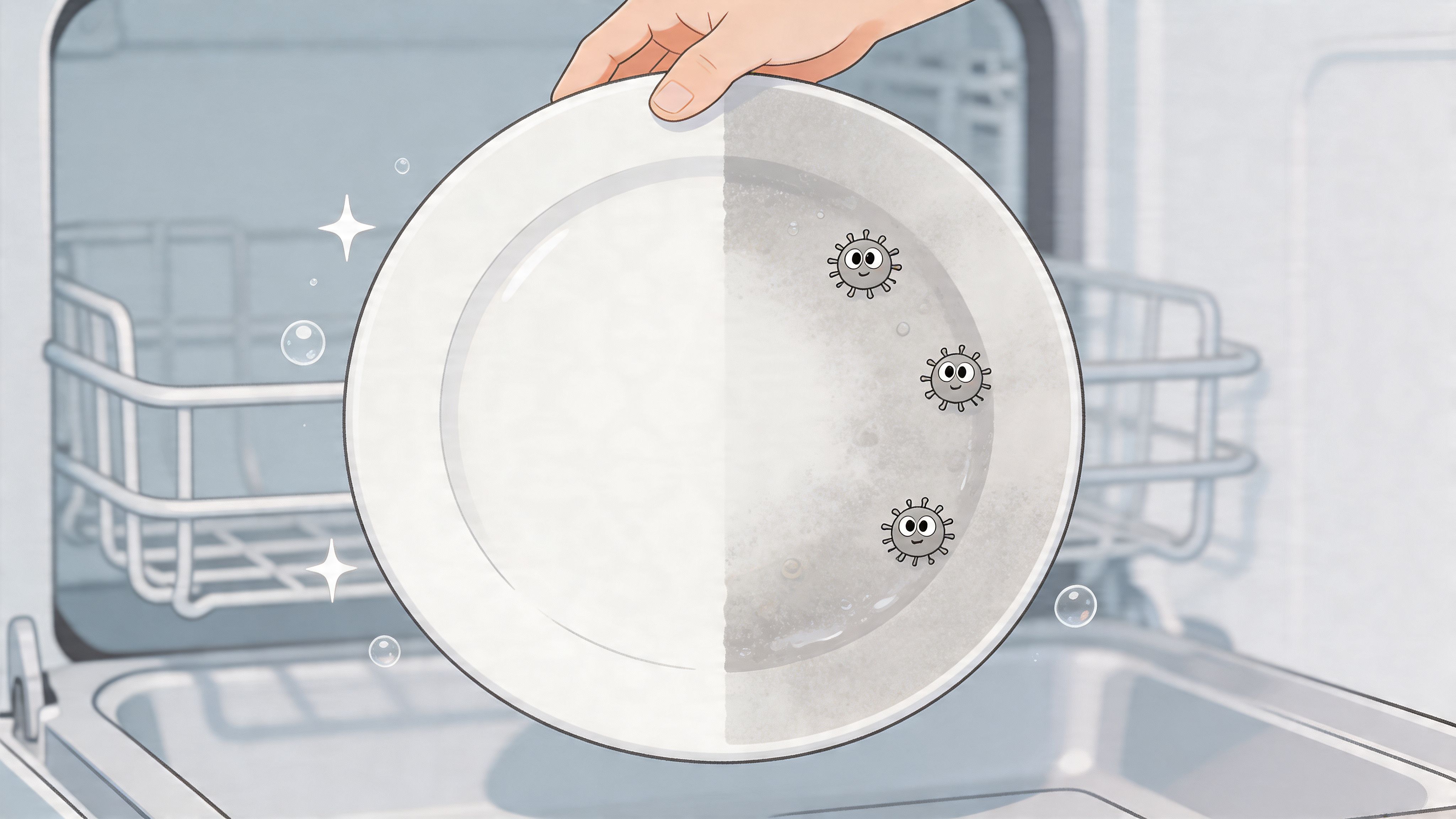
Most advice about dishwashing detergent phosphate free products treats the topic as a simple environmental choice. That’s incomplete. For parents, school kitchens, break rooms, cafés, and other high-traffic settings, the bigger question is whether dishes are not only visibly clean, but also less likely to carry residue that supports bacterial survival.
One bacterium matters a lot in that conversation: Staphylococcus aureus. It’s common on human skin and can move easily onto shared surfaces, utensils, cups, and food-contact areas through touch. When phosphate-free detergents leave mineral film behind in hard water conditions, that rough surface can become more welcoming to biofilms. That doesn’t mean phosphate-free detergents are a bad idea. It means people need to use them intelligently.
Why Your Dishes Might Not Be as Clean as You Think
A cloudy glass is easy to dismiss. The presence of white film often leads to the thought, “cosmetic problem.” In many homes and facilities, that’s where the discussion stops.
The better question is what that film does at a microscopic level. Guidance discussed by GE Appliances on dishwasher detergent and residue issues highlights an overlooked concern: since phosphate removal, mineral films in hard water areas can create surfaces where biofilms may form, including places where bacteria such as Escherichia coli or Staphylococcus aureus can survive and multiply.
Why this matters for Staphylococcus aureus
Staphylococcus aureus is a bacterium commonly carried on skin and in the nose. In busy settings, people transfer it constantly by touching handles, faucet levers, dish racks, reusable bottles, trays, and utensils. It’s a practical infection-control concern because dishes often move from hands to mouths with very little time in between.
If a plate looks mostly clean but still carries grease, food traces, or hard-water film, that surface may be easier for bacteria to cling to. For families, that can affect cups, baby items, or shared snack plates. For facility managers, it can affect communal kitchens, staff break rooms, food prep areas, and high-turnover dishwashing operations.
Clean-looking isn’t always the same as hygienically clean.
Where readers often get confused
People usually mix up three separate problems:
- Visible soil. Food bits, grease, lipstick, coffee stains.
- Mineral film. White haze or spotting from hard water.
- Microbial risk. Bacteria surviving in protected residue or rough deposits.
Those aren’t the same thing, but they can overlap. A dishwasher can remove most visible mess and still leave mineral residue. That residue may then make future cleaning harder.
Here’s the practical takeaway: phosphate-free detergents solved a major water pollution problem, but they also changed what users need to watch for. If you manage a kitchen, a daycare, a restaurant, or a home with vulnerable family members, you can’t judge success by shine alone.
The Science of Clean Before Phosphates Were Banned
Before phosphate bans, many dishwasher detergents were doing two jobs at once. They removed food, and they also controlled the water chemistry inside the machine.

Phosphates, especially sodium tripolyphosphate, acted as mineral binders. In hard water, calcium and magnesium behave like static in a phone call. They interfere with surfactants, reduce cleaning efficiency, and leave behind deposits. Phosphates tied up those minerals so the rest of the detergent could stay focused on grease, food residue, and stains.
That had several practical effects inside a wash cycle:
- It softened the water and improved detergent performance.
- It helped break greasy soil into smaller droplets that could be rinsed away.
- It kept loosened food particles dispersed in the wash water instead of settling back onto dishes.
That third function matters more than many people realize.
A dishwasher is a recirculating system. The same wash water moves across plates, cups, utensils, and racks over and over during the cycle. If detergent chemistry does a poor job of holding soil and minerals in suspension, some of that material can redeposit on another surface. The result may be a plate that looks acceptable under kitchen lighting but carries a thin film that changes how the next load washes.
Older phosphate-based formulas gave users a wider margin for error. A heavily soiled load, hard water, or an imperfect loading pattern was less likely to produce haze and residue because the detergent had stronger support from the water-conditioning side of the formula.
This is one reason the switch to phosphate-free products required real reformulation work, not a label change. Manufacturers had to replace a compound that handled several chemistry problems at once. Similar tradeoffs show up in other cleaning categories, including phosphate-free detergents for laundry, where water hardness and residue control also affect hygiene outcomes.
Why the old chemistry mattered for hygiene
Phosphates were not disinfectants. They did something more basic and, in many settings, just as important. They helped produce a cleaner final surface.
That distinction can be confusing, so here is the practical version. Bacteria are easier to remove from a smooth, well-rinsed surface than from one coated with grease, protein residue, or mineral scale. If a detergent leaves less film behind, later cleaning and sanitizing steps work on a more exposed target. In homes, that affects baby bottles, shared cups, and food-contact dishes. In facilities, it affects high-turnover warewashing where small residues can accumulate across repeated cycles.
A useful comparison is below:
| Cleaning question | Phosphate-era answer | Hygiene implication |
|---|---|---|
| What happened to hard-water minerals? | Phosphates bound them and reduced deposit formation | Smoother surfaces, less film for future buildup |
| What happened to food particles? | More stayed suspended in wash water | Less redeposition onto nearby items |
| What happened to greasy soil? | Removal was more reliable, especially in hard water | Fewer protective residues left on the dish surface |
Older formulas had limits, and no detergent could compensate for poor machine maintenance or overloaded racks. But phosphate-based products often made cleaning more forgiving. That reduced one of the hidden problems in dish hygiene. Residual films that are easy to miss, harder to rinse away in the next cycle, and more likely to create rougher surfaces where microbes can persist.
The Environmental Ripple Effect of Dishwasher Suds
Cleaner lakes can come with dirtier-looking dishes if the chemistry change is not understood. That is the uncomfortable part of the phosphate story.
Phosphates were restricted because too much phosphorus from everyday products was reaching wastewater and, in some communities, passing through treatment into rivers and lakes. In water, phosphorus behaves like plant fertilizer. Feed a lake enough of it and algae can grow faster than the ecosystem can handle. As those blooms die and decompose, oxygen levels can fall, which stresses fish and other aquatic life.

How the problem moved from kitchens to lakes
A dishwasher drains into a much larger system. What leaves one home, school cafeteria, or healthcare kitchen does not stay there. It mixes into wastewater streams, and older treatment plants were not always designed to remove all nutrient loads from detergents.
That made dishwasher chemistry a public environmental issue, not just a housekeeping choice. The policy response reduced phosphorus entering waterways. From an ecosystem perspective, that was a sound move.
Why the market changed everywhere
Once states began setting strict phosphorus limits, detergent makers had little reason to keep building two separate product worlds. National brands reformulated for broad distribution, and phosphate-free products became the default option on many shelves.
That broad shift matters for hygiene because environmental policy changed the starting conditions for cleaning. The old question was, "How do we protect waterways?" The practical question for parents, foodservice teams, and facility managers became, "How do we keep wash performance high with different chemistry, especially in hard water?"
A similar transition has played out in clothing care. BacteriaFAQ covers that wider pattern in its article on phosphate-free detergents in laundry.
The tradeoff people often miss
The environmental benefit is straightforward. The cleaning consequences are more nuanced.
Phosphates did more than help remove food. They also kept hardness minerals from settling back onto surfaces. Without them, dishwashing can become less forgiving in homes and facilities with mineral-rich water. That does not automatically mean poor hygiene, but it does mean technique and water quality matter more.
A useful comparison is water softening. If your incoming water leaves scale on faucets or shower doors, your dishwasher is fighting the same minerals every cycle. In some setups, water treatment can reduce that burden. An inline water filter with polyphosphate is one example of a point-of-use approach intended to limit mineral scale in water systems.
Why this matters for public health
For infection control, the environmental success story has a practical footnote. A plate can look clean and still carry a thin mineral or organic film that makes the surface less smooth. Rougher, filmed surfaces are harder to rinse fully and easier for later residues to cling to. Over repeated cycles, that can create the kind of buildup that foodservice managers and parents often notice only after cloudiness, spotting, or odor appears.
The lesson is not to question phosphate bans. The lesson is to adapt. Better water management, correct detergent choice, proper machine loading, and periodic descaling now play a larger role in getting both goals at once. Lower nutrient pollution outside the building, and cleaner food-contact surfaces inside it.
The New Chemistry in Your Dishwasher
Today’s dishwashing detergent phosphate free formulas rely on teamwork rather than one dominant ingredient. Instead of using phosphates to do most of the heavy lifting, modern products combine builders, polymers, surfactants, and often enzymes.

The main replacement ingredients
A good way to think about modern detergent is as a cleaning team with different jobs:
- Builders help manage minerals in the water.
- Polymers help keep loosened particles and hardness minerals from settling back down.
- Surfactants help water spread and lift greasy soils.
- Enzymes break down food residues such as proteins and starches.
According to Somat’s explanation of phosphate-free dishwasher chemistry, phosphate-free detergents often use hydroxycarboxylate builders and polymers and require a diluted wash-water pH of at least 11.2. That alkaline environment supports cleaning and is also bacteriostatic, which means it inhibits the survival of acid-sensitive pathogens such as Salmonella and E. coli during the wash cycle.
What high pH actually does
“High pH” sounds technical, but the practical meaning is simple. The wash water becomes strongly alkaline. That helps break apart greasy and stuck-on soil.
It also creates a less comfortable environment for some bacteria during the wash. That’s useful, but it doesn’t erase every hygiene concern. If dishes come out with persistent mineral film or trapped residue, surface quality still matters after the cycle ends.
Hard water still changes the outcome
User frustration often arises. A strong modern formula can be well designed and still struggle if the incoming water carries a lot of minerals. In those buildings, the detergent isn’t the only variable. The water itself becomes part of the cleaning system.
If your facility has recurring scale or spotting, a treatment option like an inline water filter with polyphosphate may be worth discussing with your maintenance or plumbing team, especially where dishwashing performance drops because of hardness.
Practical rule: Modern detergents clean best when the machine, the detergent, and the water quality work together.
Why this matters for shared environments
For schools, cafés, office kitchens, and sports facilities, modern phosphate-free products can work well. But they ask more from the operator. You need the correct dose, a functional machine, and attention to hard water.
That’s especially important where many people touch cups, utensils, and reusable containers. In those places, dish hygiene is part of infection control, not just housekeeping.
The Unseen Hygiene Risk on Your Clean Dishes
The most important hidden issue with dishwashing detergent phosphate free products isn’t the label. It’s the residue left behind when hard water and imperfect cleaning meet.

Why white film matters
That chalky haze on glasses and plates is usually treated like a beauty problem. It’s more than that. Mineral deposits can make a surface microscopically rough.
The technical literature summarized in the European patent document on phosphate-free cleaning chemistry notes that hard-water mineral deposits create surface roughness that can harbor biofilm-forming bacteria, including Listeria monocytogenes and Staphylococcus aureus.
That’s the key bridge between chemistry and infection control. A smoother plate is easier to wash clean. A roughened one gives bacteria more places to attach.
What a biofilm is in plain language
A biofilm is a community of microbes stuck to a surface and protected by a slimy matrix they produce. Instead of acting like isolated cells floating freely, they behave more like a settled neighborhood.
That matters because biofilms are harder to remove than loose bacteria. Once bacteria settle into rough residue or mineral scale, ordinary washing may become less effective.
Staphylococcus aureus in high-traffic spaces
This bacterium deserves special attention.
Definition and overview
- Staphylococcus aureus is a common bacterium found on human skin and in the nose.
- It can survive on frequently touched items and transfer through hands, shared objects, and contaminated surfaces.
- In food and dish-handling settings, it matters because people are the main reservoir.
Where it’s commonly found
- Staff break rooms
- Food service counters and prep-adjacent areas
- Reusable cups and bottles
- Gym smoothie bars and concession spaces
- Daycare kitchens
- Shared sinks and dish racks
Health risks
- It can cause skin and soft tissue infections.
- It can spread through touch and poor hand hygiene.
- In food-handling environments, contamination from hands to utensils or food-contact items is a practical concern.
A dishwasher doesn’t need to “cause” S. aureus to become relevant. It only needs to leave behind a surface that is harder to clean well, cycle after cycle.
Residue plus poor workflow is a bad combination
Hard-water film often appears alongside other small problems:
- Filters packed with food debris
- Overloaded racks that block spray action
- Incomplete drying
- Dirty sink zones where washed items are staged
- Scraps entering drains and creating a mess around the wash area
If your dishwashing station also struggles with food waste management, improving disposal practices can reduce the mess surrounding the sink itself. This guide to an efficient sink garbage disposal is useful background for facilities trying to keep the whole wash area cleaner, not just the inside of the dishwasher.
How to kill or control it
For dishware, the goal is removal first and surface quality second. You want to remove food, reduce mineral film, and avoid the rough deposits that support attachment. For surrounding high-touch surfaces, use an EPA-registered disinfectant according to the product label and follow the listed contact time, often called dwell time. Staff should wet the surface thoroughly, leave it visibly wet for the full label time, and avoid wiping it dry too soon.
For the machine itself, routine cleaning matters. If you want more on that process, BacteriaFAQ also has a focused guide on dishwasher liquid cleaner.
A dish can leave the machine looking acceptable and still carry the kind of residue that makes future bacterial control harder.
Who should be most concerned
A parent running a home dishwasher should care. A facility manager should care more. In shared environments, one mediocre wash result doesn’t affect one person. It affects many users over many cycles.
The groups that should pay closest attention include:
- Food service managers handling repeated turnover of plates, cups, and utensils
- Daycare and school staff serving children who share tableware
- Janitorial teams responsible for break-room dish areas
- Gym operators with reusable drinkware or snack-service zones
- Healthcare-adjacent facilities where vulnerable populations may use shared kitchenware
A Practical Guide to Better Cleaning with Modern Detergents
The good news is that phosphate-free dishwashing can work well. You just need to manage it as a system.
Consumer Reports found that early low-phosphate products often performed poorly, but top performers such as Finish Powerball Tabs cleaned well. The same report summary also emphasizes practical steps such as using a rinse aid or a citric acid rinse to reduce white film from hard-water minerals, as noted in Consumer Reports’ release on low-phosphate dishwasher detergents that work.
What to do this week
Start with the simplest fixes first:
Use a strong-performing detergent
Don’t assume every phosphate-free formula performs the same. Product choice still matters. If one brand leaves chronic film, switch.
Add a rinse aid
Rinse aids help water sheet off dishes instead of drying in droplets that leave mineral spots.
Run a citric acid cleaning cycle
This helps dissolve mineral buildup inside the machine, especially on hidden internal surfaces.
What to train staff to notice
If you manage a workplace or food service area, ask staff to watch for these signs:
- Cloudy glasses that stay cloudy after drying
- White grit or haze on dark dishes
- Food particles in the filter
- Slow draining or standing water
- A sour or stale smell from the machine interior
A useful next read is BacteriaFAQ’s comparison of powder dishwasher detergent vs liquid if you’re deciding which format may fit your machine and water conditions better.
Daily habits that matter more than people think
- Scrape, don’t over-rinse. Modern formulas often work better when some food soil remains for the enzymes to act on, but large scraps should still be removed.
- Load for water flow. Don’t let bowls nest tightly or long utensils block spray arms.
- Clean the filter routinely. A dirty filter recycles food debris through later loads.
- Let dishes dry fully. Damp stacking can preserve residue and encourage surface contamination around the sink area.
If you see persistent film, treat it as a hygiene signal, not just a cosmetic annoyance.
Decoding Labels and Choosing the Right Product
A label can make a weak detergent sound responsible, gentle, and advanced at the same time. None of those words tells you whether it will remove food soil, control mineral residue, and leave a surface that is easier to keep hygienic.
That is the ultimate test.
In a phosphate-free product, the label matters because modern formulas rely on a team of ingredients rather than one heavy-duty builder doing most of the work. Enzymes digest food residues. Water softening agents tie up minerals to reduce filming. Surfactants loosen grease so it can wash away. If one part of that team is weak for your water conditions, dishes can look acceptable at first glance but still dry with a thin film that traps organic residue.
What to look for first
Use a short checklist, not marketing language.
| Look for | Why it matters |
|---|---|
| Phosphate-free | Common in current consumer products and required in many markets |
| Enzymes listed or highlighted | Helps break down protein and starch residues from meals |
| Hard-water or mineral-fighting claims | More relevant if you see haze, spotting, or a rough feel after washing |
| Rinse-aid guidance on the label | Suggests the product is designed for real mineral and drying problems, not ideal test conditions |
| Clear dosing instructions | Too little can leave soil behind. Too much can leave detergent residue |
Claims that sound helpful but answer the wrong question
Some label terms describe brand positioning, not cleaning performance.
- “Plant-based” can describe ingredient origin, but it does not tell you how well the formula handles grease or hard water.
- “Eco-friendly” may reflect packaging or ingredient choices, but it does not predict whether glasses will dry clear.
- “Gentle” can be useful for fragrance or dye preferences, but dishes still need enough cleaning power to remove food films.
For parents, that matters because a plate can look clean and still carry residue in a way that makes later contamination easier. For facility managers, the issue is larger. Repeated filming can affect many loads, many users, and many surfaces, especially in break rooms, childcare settings, and shared kitchens.
How to choose without overcomplicating it
Start with your water, your machine, and your results. A detergent that works well in soft water may perform poorly in a hard-water building. A pod that works in one home may dissolve poorly in a short commercial cycle. The label is a clue, not a guarantee.
Use this decision rule:
- Clear, smooth dishes with no haze or grit usually mean the detergent is a reasonable fit.
- Cloudiness, white film, or rough-feeling residue means you should review the detergent formula, dose, rinse aid, and water hardness together.
- Recurring residue on cups, baby bottles, food-contact utensils, or shared dishware deserves extra attention because residue can protect microbes the way dried mud protects what is underneath. It creates shelter, not sterilization.
The best phosphate-free detergent is the one that leaves the least residue under your actual conditions and matches the machine manufacturer's instructions. In infection control terms, cleaner surfaces are easier surfaces to keep hygienic. That is why label reading is not just a shopping exercise. It is part of reducing the hidden film that can interfere with reliable cleaning over time.
Leave a Reply