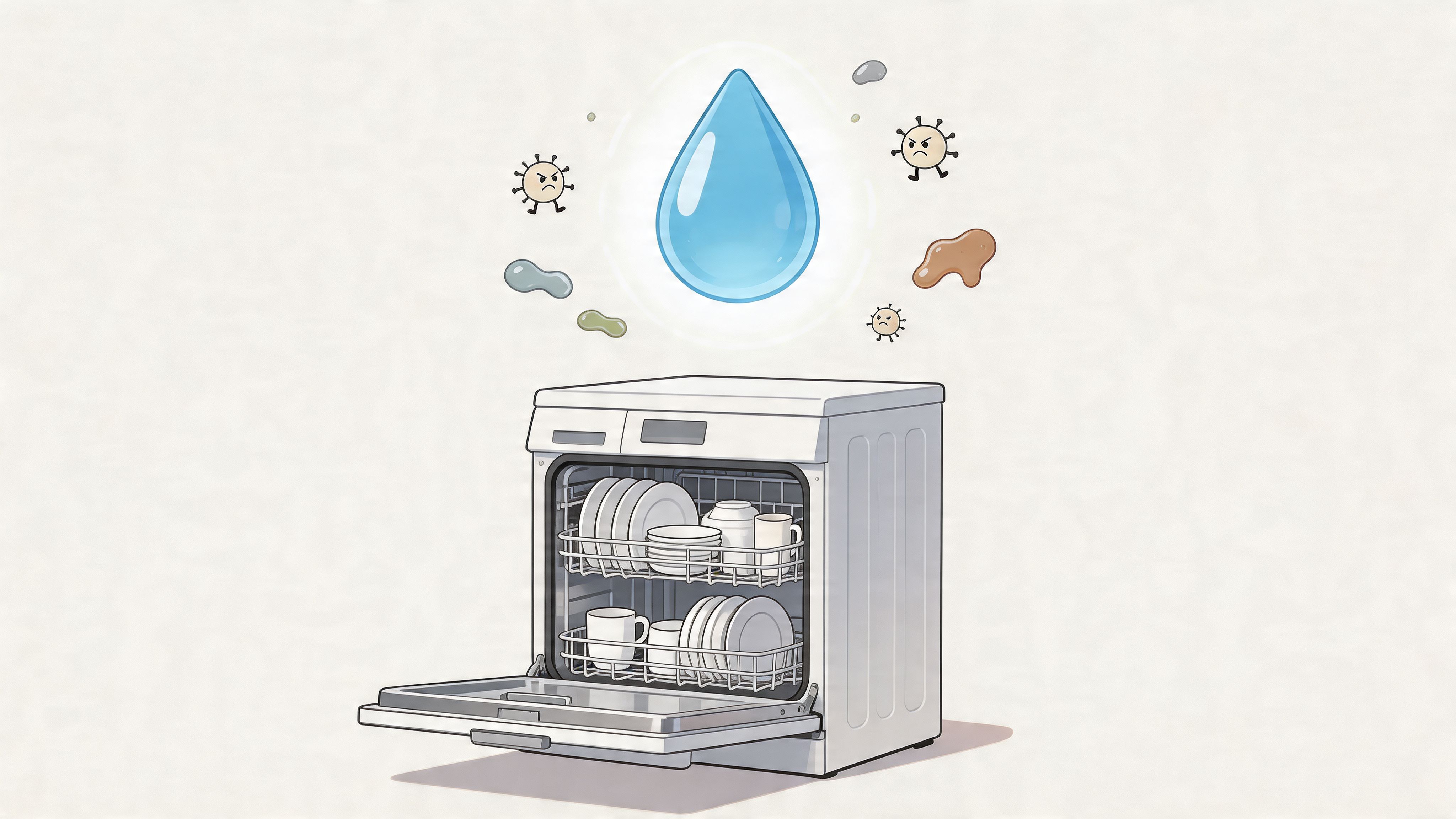
You unload a dishwasher, put the plates straight into a cabinet, and assume the job is done. In most homes, schools, break rooms, and restaurant kitchens, that feels reasonable. The dishes look clean. The machine smells mostly fine. The cycle used hot water. What could be left behind?
Quite a lot can hide where you don't look. Filters trap food. Door seals stay damp. Spray arms collect residue. Heating surfaces and pump areas can gather a mix of grease and mineral scale that gives bacteria a place to cling. A dishwasher liquid cleaner matters because it targets the machine itself, not just the dishes inside it.
One bacterium worth keeping in mind here is Staphylococcus aureus. It's a common bacterium that can live on skin and surfaces, and it becomes more concerning when moisture, food residue, and repeated handling create opportunities for transfer. In high-traffic settings such as school kitchens, foodservice operations, gyms, and shared office pantries, the issue isn't only whether dishes look polished. The issue is whether the appliance is staying hygienically clean enough to avoid becoming a reservoir for contamination.
Is Your Dishwasher a Breeding Ground for Germs?
A dishwasher can look spotless and still support microbial survival in hidden corners. That's what confuses people. They see heat, water, and detergent and assume those three things automatically sterilize the machine. They don't.

Think about a family dishwasher after a week of heavy use. Pasta sauce splashes into the filter. Milk film dries around the door gasket. Hard-water minerals settle onto internal parts. A restaurant machine may face an even tougher version of the same problem because it runs more often and handles heavier soil. In both cases, bacteria don't need the whole machine to be dirty. They only need a few protected niches.
Staphylococcus aureus is especially relevant because it can persist on frequently touched surfaces and in residues that people overlook. In a dishwasher, the concern isn't that every cycle spreads it. The concern is that neglected buildup can protect bacteria from normal rinsing and make later contamination easier. Warm moisture and trapped organic matter are a bad combination.
If that sounds familiar, it's the same basic hygiene principle behind small appliances too. The warm, damp environment inside your coffee maker can become a breeding ground for bacteria and mold, and a dishwasher can develop similar hidden trouble spots when residue is left in place.
Why clean dishes don't always mean a clean machine
A dishwasher is both a washer and a plumbing system. Water moves through narrow channels, hits food debris, drains, then dries unevenly. Some internal areas get blasted. Others stay sheltered.
Common trouble spots include:
- Filter assemblies that hold food particles long after the cycle ends
- Door seals that stay damp and collect greasy film
- Spray arm openings that can clog with residue or minerals
- Pump and heating areas where buildup can stay out of sight
If you've ever dealt with grime around a sink drain, you already know the pattern. Hidden wet zones collect residue first, then microbes take advantage. This makes guidance on nearby kitchen contamination relevant too, especially when thinking about bacteria in the kitchen sink.
Practical rule: If your dishwasher smells off, feels slimy around seals, or leaves residue on glassware, treat that as a hygiene problem, not just a cosmetic one.
Decoding the Formula of Liquid Dishwasher Cleaners
A dishwasher liquid cleaner isn't magic. It's chemistry aimed at the exact kinds of buildup that help bacteria stick around. Once you know what the ingredients are trying to do, product labels make more sense.
One well-described example is that dishwasher liquid cleaners, such as Finish® Dishwasher Cleaner Liquid, employ a dual-action formula targeting hidden grease and limescale accumulation. The mechanism involves surfactants and chelating agents that emulsify grease and dissolve calcium carbonate limescale, which removes potential microbial adhesion sites and hygienically cleans the machine during an empty, hot cycle, as described by Finish® Dishwasher Cleaner Liquid.
Surfactants act like tiny pry tools
Grease doesn't mix with water well. That's why a dishwasher can still have a thin oily film even after repeated use. Surfactants help by loosening that film from plastic, metal, and rubber surfaces.
A simple way to picture them is this: grease clings to a surface like sticker residue on glass. Surfactants get between the grime and the surface, weakening that grip so the wash water can carry the mess away. If that greasy layer stays put, bacteria can use it like a landing pad.
For Staphylococcus aureus, surface residue matters because bacteria attach more easily to irregular, dirty areas than to smooth, recently cleaned ones.
Chelating agents deal with the mineral problem
Many people think only about food debris. Minerals are the other half of the story. Hard-water deposits can form rough, chalky patches inside the machine. Those patches increase surface complexity, and complex surfaces are easier for microbes to colonize than smooth ones.
Chelating agents work like mineral catchers. They bind the substances that create limescale and help dissolve deposits that have already formed. When scale is removed, bacteria lose some of the protected niches that make cleaning harder.
A smooth internal surface is easier to clean every time after that. A scaled surface keeps inviting the next layer of soil.
Why heat alone isn't enough
Hot water helps. It softens fats and improves cleaning action. But hot water doesn't automatically remove the greasy-mineral scaffold that supports biofilm growth. That's why an empty hot cycle with a dedicated cleaner can do something a normal dish load often doesn't. It focuses chemistry on the machine.
The distinction can often confuse readers. They assume detergent used on dishes is the same as a machine cleaner. It isn't. Dishwashing detergents are designed to clean the load. A dishwasher liquid cleaner is designed to clean the appliance.
Some formulas also add antimicrobial chemistry
Certain liquid cleaner systems go further by including bleach-based chemistry aimed at stubborn organic soils and biofilms. These products don't just wash away visible grime. They can change the chemistry of the wash bath so bacterial protection layers become easier to penetrate.
That matters in commercial settings where a dishwasher sees repeated grease, starch, and protein exposure. A school cafeteria tray leaves a different soil pattern than a coffee mug in a home kitchen. The cleaner has to match the job.
What this means in real life
For non-experts, the shortest explanation is this:
- Grease removal cuts away the food-like residue bacteria can use
- Limescale removal smooths out surfaces where microbes hide
- Hot-cycle activation helps the formula reach internal parts
- Dedicated machine cleaning reduces the chance that hidden buildup keeps returning
If you manage a shared kitchen, don't judge a cleaner only by shine or scent. Judge it by whether it removes the things bacteria need to stay attached in the first place.
How Liquid Cleaners Dismantle Hidden Biofilms
A biofilm is a slimy community of microbes attached to a surface and wrapped in a protective matrix. If you've ever felt a slippery film inside a bottle cap or on a neglected drain part, you've touched the same basic idea. In a dishwasher, biofilms can develop in filters, seals, spray arms, and other damp internal areas.
For Staphylococcus aureus, biofilms are important because they change the cleaning challenge. Free-floating bacteria are one thing. Bacteria anchored inside a protective layer are much harder to remove.

What makes a dishwasher friendly to biofilms
Dishwashers create repeating cycles of wetting, heating, partial drying, and fresh food exposure. That pattern can support persistence in hidden zones. Bacteria attach, residues accumulate, minerals roughen surfaces, and the protective matrix thickens.
Biofilms are difficult because the outer layer acts like a shield. A normal wash may remove loose debris from the outside while leaving the deeper structure intact. That helps explain why a dishwasher can keep developing odor or residue even after regular use.
How the chemistry breaks the shield
Some liquid cleaner systems use advanced bleach chemistry. In certain formulations, a dual bleach system combines a chlorine bleach source with a bromide compound. In the hot wash bath, that reaction forms hypobromite, which is effective at penetrating the extracellular polymeric substances, or EPS, that make up the biofilm matrix. According to US Patent US5076952A, this process disrupts pathogens like S. aureus and can reduce viable cells from millions to fewer than a hundred per plate.
That sounds technical, but the mechanism is simple in principle. The biofilm is a fortress wall. Surfactants and other cleaning agents weaken the wall. The bleach system gets through the weakened barrier and damages the bacteria inside.
Why that matters for hidden machine parts
The hardest parts of a dishwasher to scrub by hand are often the same places where biofilms settle best. You can wipe a door seal. You probably can't manually clean every internal channel, pump surface, or spray pathway effectively.
A properly used dishwasher liquid cleaner helps in places your hand won't reach. That's why these products are useful as part of a routine, especially when the machine handles repeated food soils and heavy traffic. If you want a related look at products intended for higher-demand settings, this guide to commercial dishwasher cleaner adds helpful context.
Biofilm control isn't about making the dishwasher smell fresh. It's about removing the bacterial shelter that lets contamination persist.
A microbiologist's view of the process
Think of biofilm removal in stages:
Attachment
Bacteria land on a damp surface that has food residue or scale.Anchoring
They begin producing the sticky matrix that helps them hold on.Protection
More residue and minerals strengthen the surface and shelter.Chemical attack
The cleaner loosens grease, dissolves scale, and disrupts the matrix.Penetration
Antimicrobial components reach bacteria that were previously shielded.Flush-out
The hot cycle carries away loosened material.
For Staphylococcus aureus, the practical takeaway is direct. If you remove the slimy shelter and the residues that support attachment, you make persistence less likely. If you skip that maintenance, the machine can keep rebuilding the same problem in the background.
A Practical Guide to Using Dishwasher Cleaners Safely
Using a dishwasher liquid cleaner well is partly about hygiene and partly about restraint. More product doesn't automatically mean a cleaner machine. Good results usually come from the right product, the right cycle, and the right preparation.
For manual dishwashing, scientific research supports a standard liquid detergent concentration of about 1.4 g/l in water, and that benchmark reinforces the broader lesson that correct concentration matters for effective cleaning and bacterial removal, as discussed in the NCBI Bookshelf review on manual dishwashing detergents. Dishwasher cleaners operate differently, but the same logic applies. Follow the manufacturer's dosage instructions rather than guessing.

For homes and caregivers
In a household, the main goal is preventing the slow buildup that leads to odor, residue, and hidden bacterial persistence. Start by emptying the dishwasher, checking the filter, and removing obvious debris. Then run the cleaner on the hottest appropriate cycle according to the product label.
A few habits make a big difference:
- Check the filter first because trapped scraps can block cleaning action
- Use an empty machine unless the label specifically says otherwise
- Choose the hottest suitable cycle so the formula activates as intended
- Wipe the gasket after the cycle if you see loosened grime
Parents often ask about children's cups and lunch gear. The machine may clean them well, but labels and accessories also matter. If you're organizing school or daycare items, dishwasher safe name labels can help keep reusable containers identified without falling apart in repeated washes.
For schools and daycares
Shared meal settings increase handling and turnover. That doesn't mean panic. It means standardization.
Use a simple protocol that staff can repeat:
- Assign responsibility so one person checks the filter and seals on a set schedule
- Record cleaning dates on a visible log near the machine
- Separate dishwashing detergent from machine cleaner to avoid misuse
- Inspect after the cycle for loosened residue around the drain and door
Children and staff may not notice early signs of machine contamination. A faint odor or cloudy interior should trigger maintenance, not be ignored as normal wear.
Safety note: Store dishwasher liquid cleaner where children can't reach it, and avoid mixing cleaning chemicals unless the product instructions specifically permit it.
For foodservice managers
Restaurants, cafeterias, and institutional kitchens need a tighter routine because the dishwasher supports an active food-contact workflow. With Staphylococcus aureus, the concern isn't just the machine interior. It's the possibility that poor machine hygiene undermines overall sanitation.
Focus on consistency:
- Remove food debris from filters and screens before running the cleaner
- Use the designated empty hot cycle
- Train staff not to improvise with hand dish soap or unrelated chemicals
- Check machine components after cleaning for persistent scale or grease
If the dishwasher still smells sour, leaves film, or shows visible buildup after cleaning, treat that as a troubleshooting issue. You may have a dosing problem, hard-water problem, or a machine part that needs manual attention.
For gyms, offices, and shared facilities
Break-room dishwashers often fail for a simple reason. Everyone uses them, and nobody owns them. Shared mugs, shaker bottles, and food containers create a steady flow of residue, but maintenance gets delayed.
A short posted checklist works better than vague reminders. Keep the expectations narrow and visible:
- Empty food scraps before loading
- Wipe obvious spills from the door edge
- Clean the filter on schedule
- Run the dishwasher liquid cleaner on the assigned maintenance day
In these settings, the cleaner is one piece of infection prevention. Countertops, handles, refrigerator pulls, and tables still need separate surface disinfection.
Comparing Liquid Cleaners with Other Dishwasher Treatments
A dishwasher liquid cleaner can be a strong tool, but it isn't the only option people consider. In practice, most buyers compare it with pods, powders, DIY descaling methods, and occasional professional servicing.
One useful caution comes from a 2025 study noting that liquid detergents reduced biofilm by 45% versus 78% for enzyme-enhanced pods, suggesting formulation matters in higher-risk environments, according to the source cited in this discussion of unscented dishwasher detergent. That doesn't make liquid cleaners useless. It means you should match the product type to the problem you're trying to solve.
Where liquid cleaners fit best
Liquid cleaners are usually appealing because they're easy to use and specifically aimed at internal machine buildup. They tend to be practical when grease and limescale are the main issue.
They may be less ideal if your top concern is unusually stubborn biofilm in a high-risk setting. In that case, a different formulation may deserve consideration. If you're comparing routine wash products more broadly, this breakdown of powder dishwasher detergent vs liquid can help frame the choice.
Dishwasher Cleaning Methods Comparison
| Method | Effectiveness on Grease | Effectiveness on Limescale | Effectiveness on Biofilms | Average Cost | Convenience |
|---|---|---|---|---|---|
| Liquid machine cleaner | Strong for hidden greasy film | Strong when chelating or descaling ingredients are present | Good, but depends heavily on formula | Varies by brand | High |
| Enzyme-enhanced pods | Good | Moderate to good | Stronger option when biofilm control is the main concern | Often higher than basic liquids | High |
| Powder treatments | Good when dosed correctly | Moderate | Variable | Often budget-friendly | Moderate |
| DIY vinegar or citric acid approach | Limited on grease unless paired with other cleaning steps | Often useful for mineral deposits | Limited if biofilm is well established | Low | Moderate |
| Professional servicing | Strong if paired with component inspection | Strong | Strong because it includes manual access to hidden parts | Highest | Low for convenience, high for thoroughness |
Choosing by environment
A home kitchen and a school kitchen don't have the same risk profile. That's where comparisons become practical.
For a household dishwasher with mild odor and visible scale, a liquid cleaner may be a reasonable first choice. For a high-turnover setting with recurring hygiene concerns, the biofilm performance gap matters more.
Ask these questions:
- Is the main problem grease, scale, or recurring odor
- Does the machine serve vulnerable users, such as children or patients
- Can staff follow a repeatable maintenance routine
- Do hidden components need manual inspection, not just chemical cleaning
The best treatment isn't the one with the strongest marketing claim. It's the one that solves your specific contamination pattern.
Proactive Maintenance and Troubleshooting for a Hygienic Dishwasher
Dishwashers are part of daily hygiene at massive scale. Liquid detergents hold about 48% global market share, and over 70% of American households use dishwashers, which shows how much routine cleanliness depends on these machines, according to Fortune Business Insights on the dishwashing detergent market. The same source also notes growing adoption of concentrated formulas, which points to a practical reality. Small dosing changes and regular upkeep matter.
A simple maintenance rhythm
A hygienic dishwasher doesn't come from occasional deep cleaning alone. It comes from small repeatable tasks.
Use a routine like this:
- After heavy-use days clear obvious food scraps from the filter area
- Weekly wipe the door seal and check for slime, grit, or trapped debris
- Regularly inspect spray arms and the detergent area for residue
- On your maintenance schedule run the dishwasher liquid cleaner as directed
That schedule works because it interrupts buildup before it turns into a biofilm shelter.
Troubleshooting common warning signs
Some dishwasher problems are mechanical. Others are hygiene signals.
| Symptom | Likely hygiene issue | What to check |
|---|---|---|
| Persistent bad odor | Trapped food and developing biofilm | Filter, drain area, door seal |
| Cloudy dishes | Mineral buildup or residue redepositing | Internal scale, dosing, spray arms |
| Greasy film | Incomplete soil removal inside machine | Filter loading, cleaner choice, hot cycle use |
| Grit on dishes | Loosened debris recirculating | Filter condition, spray arm blockage |
If you clean the machine and the same symptom returns quickly, don't just rerun another cycle and hope for the best. Open the filter housing. Check the rubber folds in the gasket. Look for chalky scale on hidden parts you can see.
Why this matters for Staphylococcus aureus control
Staphylococcus aureus doesn't announce itself with a label on the machine. What you notice first is usually indirect. Odor. Slime. Repeat residue. Those signs tell you the environment is supporting persistence, and that's enough reason to act.
In foodservice and other shared settings, pair dishwasher maintenance with surface disinfection on nearby touchpoints. Handles, buttons, counters, and tables don't get sanitized just because dishes went through a cycle.
Making Dishwasher Hygiene Part of Your Infection Control Plan
A dishwasher should support sanitation, not undermine it. That's the main point. If grease, limescale, and biofilm are allowed to build up inside the machine, normal washing can become less reliable, especially in high-traffic settings.
For Staphylococcus aureus, control starts with understanding the environment. This bacterium can persist on handled surfaces and benefit from protected niches created by residue and moisture. A dishwasher liquid cleaner helps by removing the hidden buildup that gives bacteria a place to hold on. It doesn't replace broader hygiene practices, but it strengthens them.
Keep the plan straightforward:
- Use the right cleaner for the machine, not hand dish soap
- Follow the label and hot-cycle directions carefully
- Clean filters and seals on a routine schedule
- Treat odor, slime, and repeat residue as warning signs
- Disinfect nearby high-touch surfaces separately with products approved for that purpose
If you manage a home, school kitchen, office break room, or foodservice operation, this isn't a cosmetic chore. It's infection prevention through equipment maintenance.
Practical takeaway: if your dishwasher is part of your daily sanitation workflow, give the machine its own cleaning protocol. That's one of the simplest ways to reduce hidden contamination pressure over time.
For broader environmental hygiene, including surface disinfection in shared spaces, we recommend Wipes.com.
Leave a Reply