A child gets sick at daycare on Monday. By Wednesday, two more children have vomiting and diarrhea, and staff are wiping tables, toys, and bathroom handles more often but still don't know what's spreading. Was it a foodborne bacterium, a virus, or something picked up from a contaminated sink or changing station?
That uncertainty is where modern microbiology earns its keep. Culture methods can be very useful, but they can also take time. DNA probes help labs look for a specific genetic signature in a sample, which means they can identify a likely culprit far faster than waiting for an organism to grow.
For facility managers, school leaders, food service teams, and parents, the practical question is simple. What are DNA probes, and why do they matter for hygiene? They matter because harmful bacteria are often invisible long before they're obvious, and early identification changes how quickly people isolate risk, clean correctly, and prevent wider spread.
The Search for an Invisible Threat
A common outbreak problem isn't lack of effort. It's lack of certainty.
A school nurse may know several students are ill. A kitchen manager may know a prep area was exposed to something. A gym operator may hear about a skin infection among members and wonder whether equipment needs targeted testing. In each case, the first challenge is the same. Someone needs to identify the organism before guessing at the response.
Why speed matters in shared spaces
In high-traffic environments, delay has consequences. Staff may overclean the wrong areas, miss the actual contamination source, or reopen spaces before they should. Traditional microbiology can answer many questions well, but molecular tools are increasingly used when teams need a faster path to identification.
That growth is visible in the diagnostics industry itself. The global DNA probe-based diagnostics market was valued at USD 20.18 billion in 2024 and is projected to reach USD 40.8 billion by 2032, with a CAGR of 9.2%, according to KD Market Insights on the DNA probes-based diagnostics market.
Practical rule: When illness clusters appear in a shared environment, the first win isn't cleaning harder. It's identifying the right target.
The molecular detective approach
A DNA probe works like a highly selective search tool. Instead of asking, "What can we grow from this sample?" it asks, "Is the genetic sequence from this specific bacterium present here?"
That distinction matters in real settings. If a swab from a food prep counter contains DNA from E. coli or Salmonella, a probe can be designed to seek that sequence. If a locker room bench is suspected of harboring Staphylococcus aureus, the same basic idea applies. The test doesn't rely on the human eye, smell, or a general cleanliness impression. It relies on sequence matching.
For readers asking what are dna probes in everyday terms, they're one of the clearest examples of molecular detection made practical. They turn an invisible contamination question into a testable one.
Unlocking Genetics What Exactly is a DNA Probe
A DNA probe is a short piece of single-stranded DNA designed to bind to one matching genetic sequence. If that matching sequence is in the sample, the probe attaches to it. If it isn't there, the probe should stay unbound.
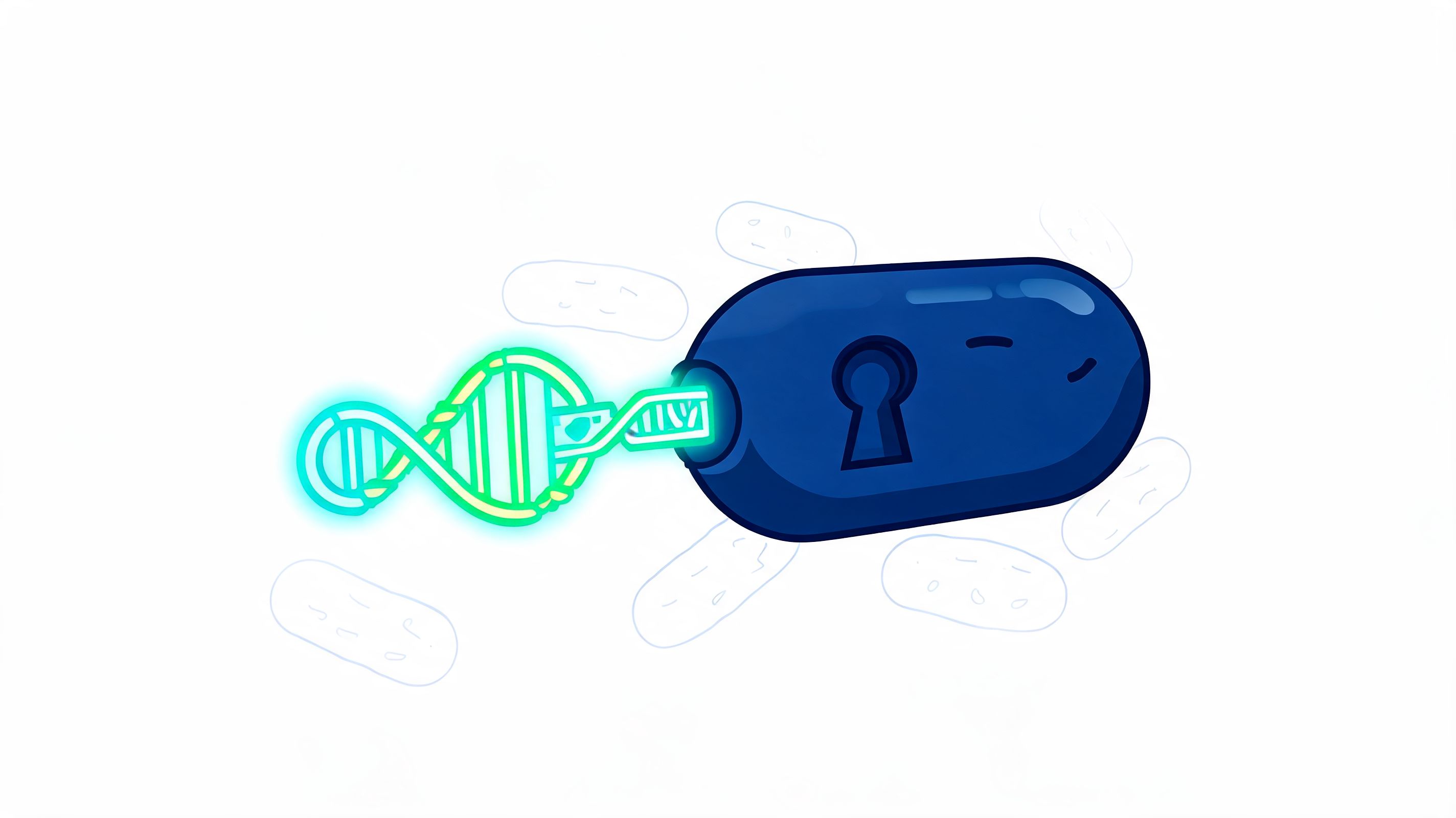
The easiest analogy is a key and lock. The probe is the key. The target sequence is the lock. A badly cut key won't work. A well-designed probe fits only the sequence it was built to find.

The part that recognizes the target
DNA is built from bases arranged in a sequence. Bacteria have their own genetic patterns, and some of those patterns are distinctive enough to act like fingerprints. A probe is made to complement one of those target patterns.
According to Kilobaser's explanation of DNA probes, DNA probes are typically single-stranded DNA sequences of 15 to 35 base pairs, and more advanced probes can be 120 to 145 nucleotides long for certain detection systems. That length range matters because probe design is a balancing act. Too short, and the probe may bind too loosely or to the wrong place. Too long, and the behavior can become harder to optimize for the assay.
If you'd like a refresher on the molecule the probe is built from, BacteriaFAQ's article on the structure of a DNA molecule gives a useful plain-language foundation.
The part that reports a match
Recognition alone isn't enough. A probe also needs a signal.
Modern probes often include a reporter dye, which emits light, and a quencher, which absorbs that emitted light until the chemistry of the test changes in the right way. In practical terms, one part helps the probe find the sequence, and another part helps the instrument detect that the binding event happened.
That combination is what makes DNA probes more than simple strands of genetic material. They are built as detection tools.
A simple way to think about the components is this:
- Targeting sequence: the section that matches the bacterial DNA of interest
- Reporter dye: the visible or measurable signal generator
- Quencher: the control element that suppresses signal until the test chemistry allows it to appear
A DNA probe doesn't "know" what bacterium it's seeing. It only follows the chemistry of matching sequences.
This lock-and-key idea also helps readers understand related tests that examine human DNA. For example, Lola Health's guide to epigenetic testing is a useful companion if you're curious how DNA-targeting methods are used beyond infection detection.
The Binding Process How Hybridization Finds a Target
The central event in probe testing is hybridization. That's the moment a probe binds to its complementary sequence.
A useful analogy is a giant library. The sample contains an enormous collection of genetic "books." The probe is searching for one exact ISBN. It doesn't need to read the whole library. It only needs to bind to the one sequence that matches.

First the DNA is opened up
Bacterial DNA is normally double-stranded. For a probe to find its target, those paired strands need to be separated so the matching sequence is exposed. Labs do this by preparing the sample under conditions that allow the strands to come apart.
In plain language, the genetic zipper gets unzipped.
Once the strands are separated, the sample becomes searchable. The target sequence is no longer hidden inside a double helix. It's available for the probe to inspect.
Then the probe searches for its match
After preparation, the probe is added under conditions that encourage binding only where the match is strong enough. If the target sequence is present, the probe hybridizes to it. If not, it should wash away or remain undetected.
That specificity is the whole point. In a swab from a cafeteria counter, there may be food residue, harmless microbes, environmental debris, and DNA from many sources. A well-designed probe is made to ignore nearly all of that and bind only to the intended sequence.
This is why probe design and assay conditions matter so much. Scientists don't just ask whether a probe can bind. They ask whether it binds to the right thing under controlled conditions.
Why exact matching matters for bacterial testing
For environmental hygiene, hybridization is powerful because it can pick a single target out of a crowded sample. That's useful when a facility wants to answer focused questions such as whether a surface carries DNA from a known pathogen of concern.
Readers who want the related concept behind DNA copying can compare this with BacteriaFAQ's explanation of what a DNA primer is. Primers and probes can appear in similar testing workflows, but they serve different jobs.
A simple summary looks like this:
| Step | What happens | Why it matters |
|---|---|---|
| Sample preparation | DNA is made accessible | Hidden target sequences become available |
| Probe exposure | The probe meets the sample | The search begins |
| Hybridization | Matching sequences bind | The target is captured |
| Detection | The label is measured | Staff get a readable result |
Making the Invisible Visible Probe Labels and Signals
Finding the target is only half the job. Someone still has to detect the match.
That's where probe labels come in. You can think of them as tiny signal devices attached to the probe. Without them, a successful binding event would remain molecularly silent.
Fluorescent labels are the easiest to picture
Fluorescent labeling is common because it's intuitive. The probe carries a light-based signal system. When the chemistry is set up correctly and the probe binds in the right context, an instrument can detect the emitted signal.
For non-scientists, a glow-stick analogy works well. The glow isn't the target itself. It's the evidence that the probe found the target under the test's conditions.
In practical microbiology, that signal may appear as a measurable increase in fluorescence, a bright spot under imaging conditions, or an instrument readout that tells the lab the sequence was found.
Field takeaway: A probe without a detectable label is like a security guard who found the intruder but never called anyone.
Other labels exist, but the idea stays the same
Not every probe uses fluorescence. Some methods use enzymatic labels or other non-radioactive systems that generate a visible signal indirectly. Older methods also used radioactive labels, though modern routine diagnostics often favor approaches that are easier to handle in contemporary labs.
The core logic doesn't change:
- The probe binds first
- The label allows detection
- The instrument or assay converts chemistry into a result a person can interpret
Why this matters outside a research lab
Facility managers don't need to know every detail of dye chemistry, but they do need to understand what a result means. The visible readout is not "seeing bacteria" in the ordinary sense. It's seeing a signal generated because a probe interacted with a target sequence.
That distinction helps when people compare probe testing with swab cultures, ATP cleaning checks, or visual inspection. Those tools answer different questions.
A glowing or machine-detected signal is what turns molecular recognition into an actionable report. Without that step, DNA probes would remain elegant chemistry with little practical value for infection control.
DNA Probes in the Lab Common Detection Techniques
DNA probes aren't one single test. They're a versatile tool used across several laboratory methods. The easiest way to understand them is to look at the mission each method performs.

FISH for location and surveillance
Fluorescence in situ hybridization, often called FISH, places labeled probes directly onto cells or material fixed on a surface or slide. The strength of FISH is location. It can show where the target sequence is in the sample, not just whether it exists somewhere in a tube.
That makes it useful when microbiologists want to examine structured communities such as biofilms or mixed populations on a surface. In environmental hygiene work, the appeal is obvious. Knowing that bacteria are present is helpful. Knowing where they're clustered can be even more helpful.
A simplified FISH workflow often involves:
- Preparing the sample: cells or material are fixed so they stay in place
- Applying the probe: the labeled sequence is introduced to the sample
- Washing away excess material: unbound probe is removed
- Reading the signal: microscopy or imaging shows where binding occurred
Probe-based PCR for detection and measurement
Probe-based PCR is a different kind of mission. Instead of focusing on location, it focuses on whether the target sequence is present during amplification and, in many workflows, how the signal builds as the reaction proceeds.
This approach is common when labs need fast, targeted answers from swabs, fluid samples, or environmental collections. If FISH is a surveillance camera, probe-based PCR is more like a counter plus alarm. It tells the lab that the sequence was present in the tested material and tracks signal in a highly controlled reaction.
If you want the background for the copying step that often works alongside probes in these assays, BacteriaFAQ's guide to amplification of DNA lays out the basics clearly.
Southern blotting and colony hybridization
Older doesn't mean useless. Some classic methods still help explain how probe detection developed.
Southern blotting transfers DNA fragments to a membrane and then applies a probe to detect a target sequence. It's less associated with rapid everyday environmental decision-making, but it's historically important because it shows probe logic in a very direct way.
Colony hybridization screens many microbial colonies to identify which ones contain the target of interest. This can be helpful when labs are sorting through large numbers of isolates and need a targeted identification step.
Multiplexing changes workflow
One of the most practical advances is multiplexing, where a single assay uses multiple probes to look for multiple targets at once. According to Enzo's overview of probe design and generation, modern multiplexed probes can detect Gardnerella, Candida, and other bacterial markers in the same test, which reduces assay time and cost.
That matters for real operations. A school or food service operator doesn't always need a broad mystery hunt. They often need a focused panel that can check several likely culprits from one set of samples.
When a lab can test one sample for several targets at once, staff get a faster decision path for isolation, recleaning, and follow-up sampling.
Practical Applications Detecting Pathogens in Your Environment
DNA probes become most useful when they answer a practical question in a specific place. Not in theory. On a real surface, after a real event, with a real decision attached.

Schools and daycare centers
When several children become sick in a short window, administrators need more than a generic message about sanitizing. They need to know whether a bacterial source is plausible and where to focus control efforts.
Probe-based testing can support targeted environmental sampling from places such as:
- Bathroom touchpoints: flush handles, faucets, diapering areas
- Shared classroom items: tables, toys, cots, reading corners
- Food-contact areas: snack prep surfaces and refrigerator handles
A rapid molecular answer can help a school decide whether to intensify disinfection in a specific room, remove shared materials, or bring in additional public health support.
Gyms and athletic facilities
Gyms deal with heavy skin contact, shared equipment, and moisture. Those conditions don't guarantee contamination, but they do create repeated opportunities for transfer if harmful bacteria are present.
Probe testing can help validate whether concerns around Staphylococcus aureus or similar organisms deserve a stronger response. Rather than relying on appearance alone, operators can use environmental swabs to ask a sharper question about benches, mats, weight handles, or locker room fixtures.
Food service settings
Food service managers often need targeted answers quickly. If contamination is suspected on prep counters, drains, slicers, storage areas, or sink surrounds, molecular detection can help narrow the organism of concern before a wider incident develops.
The practical value is speed. A 2025 Journal of Clinical Microbiology finding summarized by Pathwayz reported that DNA probes enabled 95% faster detection of MRSA on hospital surfaces compared with traditional culture methods. That specific example comes from healthcare surfaces, but the infection-control lesson travels well: faster identification supports faster containment.
What these results change on the ground
Probe-based detection doesn't replace cleaning. It improves the precision of cleaning and follow-up.
A facility might use results to decide:
| Situation | How probe results can help |
|---|---|
| Cluster of illness | Focus testing and disinfection on likely transmission points |
| Reopening after contamination | Check whether further targeted cleaning is warranted |
| Recurring hygiene failures | Identify persistent hotspots that routine cleaning misses |
For facility managers and parents, this is the practical answer to what are dna probes. They're not abstract genetics tools. They're a way to ask, with much more precision, whether the DNA of a concerning bacterium is present in the environment you're responsible for.
Interpreting Results and Understanding Limitations
A positive DNA probe result sounds definitive. Sometimes it is. Sometimes it isn't.
That isn't a flaw in the idea of probe testing. It's a reminder that every test operates in context.
Positive doesn't always mean present danger
One major source of confusion is the difference between detecting bacterial DNA and proving that live, active bacteria are present and capable of causing infection. After disinfection, for example, genetic material may still remain even if the organism is no longer viable.
That means a positive molecular result has to be interpreted alongside the situation. Was this a pre-cleaning or post-cleaning sample? Was there a recent known contamination event? Is the result from a high-risk setting or a routine low-risk screen?
Low-risk settings create a special problem
In settings where the target bacterium is uncommon, even a highly sensitive test can produce results that deserve caution. According to the PubMed-linked discussion of probe reliability in low-prevalence settings, in routine checks in a clean home or gym, DNA probes can have a positive predictive value below 50%, meaning a positive result may have a substantial chance of being a false alarm unless it's confirmed.
That matters a lot for anxious households and managers of generally clean facilities. If prevalence is low, a single positive environmental screen should often be treated as a prompt for confirmation, not instant proof of a dangerous outbreak.
A good test answer is not just "yes" or "no." It's "what does this result mean in this setting?"
A better way to read probe results
If you're reviewing environmental testing, ask these questions:
- Was the target common enough in this setting for a positive result to be persuasive?
- Was the sample collected before or after cleaning and disinfection?
- Does the lab recommend confirmatory culture or a second method?
- Was the test designed for environmental surfaces, clinical samples, or both?
A practical interpretation framework looks like this:
| Result pattern | Sensible response |
|---|---|
| Positive in a high-risk context | Act quickly, review exposure points, and follow lab guidance |
| Positive in a low-risk routine screen | Consider confirmation before making major conclusions |
| Negative after targeted cleaning | Useful, but still combine with good hygiene practice and monitoring |
DNA probes are powerful. They just aren't magic. The smartest users treat them as one part of a broader infection-control system that includes proper sampling, cleaning chemistry, contact time, and when needed, confirmatory testing.
Frequently Asked Questions About DNA Probes
Are DNA probes the same as a bacterial culture
No. A culture tries to grow the organism. A DNA probe looks for a matching genetic sequence. Culture can help show that live organisms are present. Probe testing can provide a faster targeted answer when the question is sequence-based.
Can DNA probes detect more than one pathogen at once
Yes, in some assays. Multiplexed testing allows one sample to be checked for several targets in the same workflow, which is useful when a facility faces more than one likely organism of concern.
Are home DNA probe kits a good idea
They can be appealing, but interpretation is the hard part. In low-risk settings, a positive result may need confirmation, and many consumers don't have the sampling training or context needed to read the result well. For households, it's usually wiser to treat these tests as screening tools rather than final answers.
Do DNA probes replace disinfection
No. Detection and control are different jobs. A probe can help identify a likely bacterial target. It doesn't remove contamination. You still need cleaning and, where appropriate, an EPA-registered disinfectant used according to the label, including the required contact time.
Who should care most about this technology
The people with shared-space responsibility. That includes school and daycare administrators, food service managers, gym operators, infection-prevention staff, and parents managing repeated illness concerns in the home.
The practical takeaway is straightforward. DNA probes help people identify bacterial threats faster and more precisely, but the best results come when testing, interpretation, and surface hygiene all work together.
For readers looking to strengthen day-to-day surface hygiene after testing or during routine prevention, we recommend Wipes.com.
Leave a Reply