A child finishes practice at a crowded gym, and a parent notices the familiar rush of wiping hands, water bottles, benches, and car-door handles. The question is practical, not theoretical: what kills MRSA on surfaces, and which cleaning routine works when people are sharing equipment all day?
The answer doesn't depend on finding a special “MRSA-only” chemical. Effective control comes from using an appropriate disinfectant, following its label, and managing three variables that determine whether the process succeeds: soil removal, correct dilution, and wet-contact time. CDC guidance identifies alcohols, sodium hypochlorite, quaternary ammonium compounds, phenolics, and iodophors as effective chemistry classes when used at recommended dilutions and with appropriate surface instructions. CDC environmental-control guidance also supports routine cleaning and disinfection rather than fear-driven attempts to make an environment sterile.
Why MRSA on Surfaces Is a Problem Worth Solving
MRSA control matters most where hands, skin, equipment, and shared surfaces repeatedly meet. A coach may wipe a mat after practice, a caregiver may clean a bedside rail, or a janitorial worker may move through a locker room touching the same faucet handles and door hardware as dozens of other people. The risk comes from transfer, especially when contaminated material reaches broken skin, a wound, or another person's hands.
CDC guidance says routine cleaning and disinfection of household and patient-care surfaces is enough to inactivate MRSA when products are used correctly. The practical lesson is reassuring but demanding: you don't need an exotic product, but you do need a reliable process. The product must be registered for the intended use, the surface must receive enough solution, and the surface must stay wet for the full contact time on the label.
The three controls that decide the outcome
Soil removal comes first. Dirt, sweat, skin oils, and drainage can interfere with disinfectant action. A quick pass that leaves residue behind may make the next chemical step less dependable.
Dilution must be exact. Concentrating a product beyond the label doesn't automatically make it safer or more effective. It can damage surfaces, irritate skin and airways, and create handling hazards. Under-dilution can leave too little active ingredient to meet the product's claim.
Wet-contact time must be honored. Spraying and immediately wiping a surface dry defeats the required exposure period. A disinfectant needs the surface to remain visibly wet for the label's stated time, which differs by product and organism.
Practical rule: A product only works as labeled when the surface, concentration, and contact time all match the directions for use.
EPA registration and label claims help operators choose products with documented use instructions. The aim is not sterility. It's breaking the chain of transfer on high-touch surfaces while protecting people, equipment, and the materials being cleaned.
Understanding MRSA and How It Survives on Surfaces
MRSA means methicillin-resistant Staphylococcus aureus. It's a strain of S. aureus with resistance to methicillin and related antibiotics, which can make infections more difficult to treat. MRSA can spread through contact with infected people, wounds, or objects that touched infected skin, according to CDC MRSA prevention guidance.
On environmental surfaces, MRSA behaves much like other staphylococci. It can transfer from hands to shared equipment, from contaminated skin to towels, and from drainage to nearby rails, handles, or tabletops. The CDC notes that MRSA can survive on some surfaces for hours, days, or even weeks. A peer-reviewed review also reports survival ranges of 7 days to 7 months on surfaces, while another study detected MRSA after 4 months on coins. The PubMed Central review explains why routine environmental cleaning remains important.
That survival window doesn't mean every touched surface creates the same infection risk. Transfer is the critical link. A dry organism sitting undisturbed on a surface is less relevant than contaminated residue moving from a faucet handle to a hand, then to broken skin or a wound.
Community and healthcare settings
Community-associated MRSA can appear outside hospitals, including in homes, schools, childcare settings, athletic facilities, and gyms. Healthcare-associated transmission raises additional concerns because patients may have wounds, invasive devices, or weakened defenses, but the environmental question is similar: identify high-touch items and clean them consistently.
CDC surface guidance specifically identifies shared work equipment, faucets, shower handles, doorknobs, tabletops, reusable restraints, and exercise equipment as items that should be kept clean. If a surface has drainage from infected skin, it should first be cleaned and then treated with an EPA-registered disinfectant. Readers who want broader context on environmental persistence can review how long bacteria can live on surfaces, but persistence alone shouldn't replace a risk-based cleaning plan.
Disinfectant Classes That Kill MRSA
A disinfectant can fail even when its active ingredient is appropriate. The practical decision rests on three controls: correct dilution, enough wet-contact time, and removal of soil before application. Choose an EPA-registered product that matches the surface, contamination level, and workflow, with a label claim for Staphylococcus aureus or MRSA where applicable.
Comparing the main options
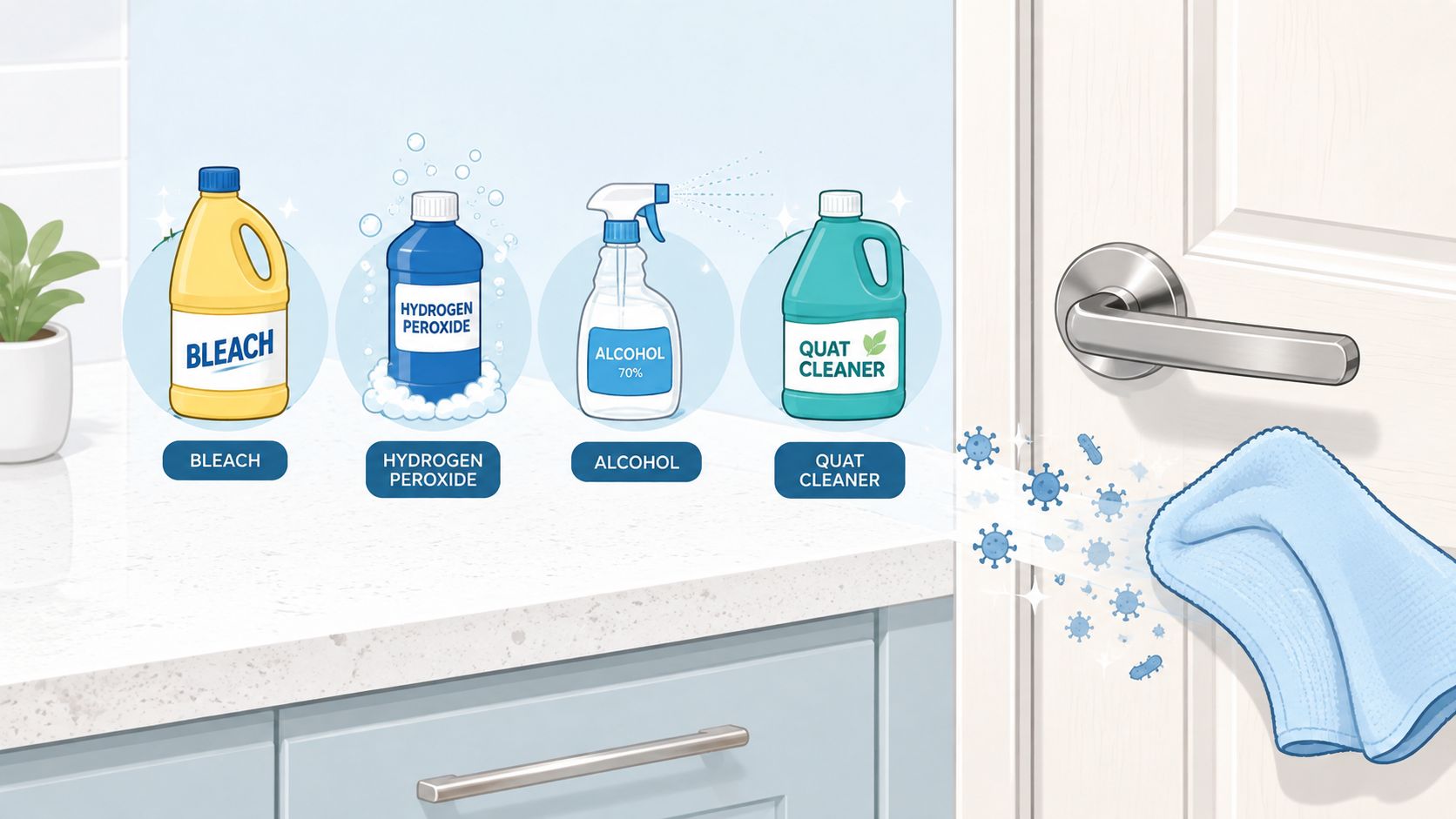
Sodium hypochlorite, or bleach, provides broad activity on many pre-cleaned, hard, nonporous surfaces. CDC athletic-facility guidance lists 1/4 cup of regular household bleach at 5.25% to 6.0% per gallon of water, or 1 ounce per gallon for 8.25% bleach. The product label controls the required wet-contact time. Bleach can corrode metals, damage fabrics, and become ineffective when mixed with incompatible substances. Never combine it with other cleaners.
Alcohols, commonly 70% isopropyl or ethyl alcohol, suit small, clean, hard surfaces. They evaporate quickly, so apply enough product to keep the surface visibly wet for the full label time. Alcohol performs poorly against heavy soil, does not suit many porous materials, and may damage some plastics or finishes.
Accelerated hydrogen peroxide appears in healthcare and institutional products with directions for particular surfaces. Its contact time depends on the registered formulation, so do not substitute a household timing assumption. This safe home cleaning comparison helps distinguish household peroxide uses from registered surface disinfectants. Ordinary hydrogen peroxide is not automatically a hospital-grade disinfectant.
Quaternary ammonium compounds, including benzalkonium chloride formulations, are common in wipes and ready-to-use sprays. They can support repeated equipment cleaning, provided the surface remains visibly wet for the full labeled period. Organic soil and early drying reduce reliability. Facility teams can review quaternary ammonium disinfectants when comparing their handling and surface-compatibility trade-offs.
Phenolics and iodophors are also recognized disinfectant classes, particularly in healthcare applications. Their usefulness depends on the formulation, target organism, surface, contact time, and material-compatibility directions.
The label is the final authority for dilution and exposure time. A stronger mixture is not a safe shortcut, and a product that dries before the required time has not received the stated disinfection conditions.
| Active Ingredient | Typical Dilution / Concentration | Wet Contact Time | Surface Compatibility | Key Limits |
|---|---|---|---|---|
| Sodium hypochlorite | CDC athletic guidance gives specified bleach dilutions for pre-cleaned hard surfaces | Use the product label | Hard, compatible surfaces | Can corrode metals and damage fabrics |
| Alcohol | Commonly 70% isopropyl or ethyl alcohol | Evaporates quickly, so follow the label | Small, clean, compatible hard surfaces | Limited by soil, evaporation, and material damage |
| Accelerated hydrogen peroxide | Ready-to-use or labeled dilution | Use the product label | Depends on formulation | Household peroxide isn't automatically a registered disinfectant |
| Quaternary ammonium compounds | Ready-to-use or labeled dilution | Often requires extended wet exposure | Many hard, nonporous surfaces | Soil and premature drying reduce reliability |
| Phenolics or iodophors | Product-specific | Use the product label | Product and surface dependent | Compatibility and residue require review |
Reading the EPA Label the Right Way
A disinfectant's front label may look convincing, but the directions for use determine whether it fits your MRSA-control task. Start by finding the EPA Reg. No. That number identifies the registered product and helps you verify the official label. A product that merely says “antibacterial” or “kills germs” may not provide the surface-disinfection claim you need.
Look for Staphylococcus aureus in the organism list. MRSA is a methicillin-resistant strain of S. aureus, and CDC guidance states that products effective against S. aureus are sufficient to kill MRSA when used correctly. Don't assume that every claim transfers across surfaces, however. The product may be labeled for hard, nonporous surfaces but not upholstery, fabric, rubber, or unfinished wood.
Four label checks
Confirm the use site. Hospital, healthcare, institutional, and residential directions may differ. A product labeled for a healthcare setting may have requirements that matter in a gym, school, home, or food-service area.
Find the dilution instruction. Ready-to-use wipes and sprays need no dilution, while concentrates require precise measuring. Never improvise a stronger or weaker mixture.
Record the wet-contact time. The surface must stay visibly wet for the full labeled period. If the product dries early, reapply enough solution to maintain wetness.
Check pre-cleaning and rinsing. Some products require soil removal first. Others require rinsing after use on food-contact surfaces or surfaces touched by children.

Treat “sanitizes,” “disinfects,” and “sterilizes” as different terms. Sanitizing reduces microorganisms to a level defined by the product claim. Disinfection targets specified pathogens on inanimate surfaces. Sterilization is a much higher level used for particular instruments and processes. For routine MRSA surface control, select a product whose label supports disinfection, not a vague sanitation promise.
Use EPA-registered disinfectant guidance as a starting point, then read the actual product label before deploying it.
Cleaning Before Disinfecting and Why It Matters
A disinfectant can't reliably reach organisms buried under sweat, skin oils, food residue, soap scum, or wound drainage. Cleaning removes that material physically, while disinfection uses a chemical process against microorganisms left behind. The CDC's MRSA guidance therefore places cleaning before disinfectant application when drainage or visible soil is present.
A practical two-step process
First, use a detergent-based, neutral, or enzymatic cleaner with a clean cloth or disposable wipe. Work from cleaner areas toward dirtier areas, and change cloths or wipes when they become visibly soiled. This step removes the material that can shield bacteria and helps the disinfectant contact the actual surface.
Second, apply an EPA-registered disinfectant at the exact labeled dilution. Keep the surface visibly wet for the entire contact time, then allow it to dry or rinse only when the label requires it.
Cleaning removes the barrier. Disinfection needs access to the surface underneath.
Biofilm makes this distinction especially important. Bacteria embedded in dried bodily fluids, oils, or soap residue can be harder for disinfectants to reach than organisms on a clean surface. A one-step cleaner-disinfectant can be useful, but “one-step” doesn't mean “skip the label.” These products still require adequate wetting, contact time, and compliance with any pre-cleaning instruction.
Common operational failure
The fastest-looking routine often fails first. A worker sprays a bench, wipes away visible moisture immediately, and records the task as complete. The bench may look clean, but the disinfectant hasn't had the exposure time required by its label. The same problem occurs when a wipe is too dry to wet the entire surface or when one cloth is dragged across multiple high-touch zones.
For MRSA control, soil removal and wetness are not cosmetic details. They are part of the antimicrobial process.
Step-by-Step Protocols for Homes and Institutions
A workable protocol begins with the people and surfaces most likely to connect. At home, prioritize doorknobs, light switches, faucets, remote controls, shared electronics, bathroom fixtures, and anything that contacted infected skin or drainage. The outcome depends on three controls: correct dilution, full wet-contact time, and removal of soil before disinfection.
- Map high-touch points. Make a short room-by-room list so the routine does not depend on memory.
- Remove visible soil. Use soap and water or a compatible detergent cleaner before applying disinfectant.
- Check the registered product. Confirm its surface and organism claims, dilution, and wet-contact time.
- Apply enough product. Keep the entire target area visibly wet for the full label time.
- Follow reuse instructions. Allow the surface to dry, or rinse when the label requires it, before people touch it again.
For a visible body-fluid spill on a compatible hard surface, the bleach option described earlier uses 1/4 cup of regular 5.25% to 6.0% household bleach per gallon of water, or 1 ounce per gallon for 8.25% bleach. Clean the spill first, prepare the solution accurately, and follow the product's contact-time instructions. Bleach can damage some materials, so verify compatibility before use.

Gyms and schools
Staff should clean benches, mats, handles, and exercise equipment between users when feasible. A more thorough end-of-day disinfection can then use a compatible quat or hydrogen-peroxide product. The product must keep the surface wet for its labeled time, not merely cover it briefly.
Keep a simple log with the area, product, dilution when applicable, contact time, and staff initials. These records reveal missed zones and show whether staff are measuring the process correctly.
Healthcare facilities
Healthcare teams should use facility-approved EPA-registered products and follow the site's room-cleaning schedule. High-touch patient-room items need defined cleaning responsibilities, while discharge cleaning requires a terminal process suited to the room and equipment.
Each setting should keep a checklist:
- PPE: Select protection required by the product label and contamination involved.
- Dilution: Measure concentrates with dedicated tools.
- Contact time: Keep the surface wet for the full label period.
- Drying and reuse: Allow drying or rinse when the label specifies it.
Handling Laundry, Towels, and Soft Surfaces
MRSA control often breaks down when a plan covers hard surfaces but ignores towels, bedding, athletic clothing, mats, and shared cloth items. Fabrics can carry skin debris and drainage, and shaking contaminated laundry can move that material into the surrounding air and onto nearby surfaces.
Handle used textiles gently. Place them in a laundry bag or hamper at the point of use, avoid sorting them in busy areas, and clean or disinfect the hamper according to its material and product label. Wash with standard detergent using the warmest water appropriate for the fabric, then complete the drying cycle. The dryer matters because thorough drying removes residual moisture that can support persistence.
| Item | Water Temperature | Detergent/Additive | Drying |
|---|---|---|---|
| Towels and bedding | Warm or hot, as fabric allows | Standard detergent; bleach when compatible | Complete drying cycle |
| Color-safe athletic clothing | Warm or hot, as care label permits | Standard detergent; oxygen-based alternative when appropriate | Complete drying cycle |
| Heavily contaminated washable items | Use the warmest suitable setting | Standard detergent and any label-approved additive | Dry thoroughly before reuse |
| Institutional linens | Follow facility reprocessing policy | Approved laundry chemistry | Use the validated institutional process |
Don't pour household bleach into every load. It can damage color and fibers, and the laundry label may call for an oxygen-based alternative instead. Institutional laundries should follow validated procedures rather than copying a home routine.
Non-washable items require special care. Clean visible soil first, then use a disinfectant specifically labeled for the material, such as a compatible hard-surface wipe for a sealed yoga mat or equipment panel. Porous padding, plush toys, and damaged foam may not be safely disinfectable. Remove them from use until the manufacturer or infection-control lead confirms a suitable reprocessing method.
A reusable textile can be useful for general cleaning, but it isn't a substitute for a labeled disinfectant process. For teams evaluating specialty cleaning textiles, EcoQuest Purifiers' antibacterial towel is a product example to assess against the actual surface, laundering, and infection-control requirements.
Key Habits and Common Mistakes to Avoid
The most reliable MRSA routine is built around three checks. Remove soil, measure dilution, and maintain wetness for the full contact time. Product selection matters, but a suitable product used incorrectly won't deliver its labeled performance.
Habits that improve consistency
- Dilute with precision. Use the manufacturer's measuring directions, not a visual estimate. Different bleach strengths require different volumes, and concentrated quats or peroxide products have their own instructions.
- Start with the dirty work. Remove visible residue before applying disinfectant. A clean-looking surface can still have transfer material in seams, handles, and textured areas.
- Keep the surface wet. Apply enough solution to cover the full area, then watch the clock. If the surface dries early, reapply according to the label.
- Target overlooked touch points. Faucet handles, shower controls, door hardware, remotes, shared phones, equipment grips, and light switches deserve deliberate attention.
- Use the right claim. An “antibacterial” wipe without an EPA registration number and an appropriate organism claim isn't automatically equivalent to a registered disinfectant.
Mistakes that undermine the process
Spraying and immediately wiping is the most visible error. The second is mixing bleach with ammonia, acids, or other cleaners, which can create dangerous fumes. Never combine products unless the label explicitly directs that combination.
Another mistake is assuming a hard-surface product works on fabric, unfinished wood, or foam. The label may authorize only nonporous surfaces, and forcing the chemistry onto an incompatible material can damage it without producing a valid disinfection result.
Emerging technologies may add value in selected healthcare or controlled environments. Recent reports describe more than 98% average MRSA CFU reduction at two sites and 99.99% mean MRSA surface CFU reduction with continuous technologies, while a 2025 NICU study associated pulsed-xenon UV plus standard cleaning with fewer MRSA cases. These findings come mainly from hospital or controlled settings, as summarized in the PubMed report, so cost, workflow, shadows, surface compatibility, and maintenance still matter before replacing routine cleaning.
BacteriaFAQ.com recommends a practical bottom line: clean high-touch surfaces routinely, use an EPA-registered product with an appropriate claim, follow the correct dilution, and keep surfaces wet for the full labeled contact time.
If you manage a home, school, gym, or care facility, review your current disinfectant labels today. Build a short high-touch checklist, verify every dilution and contact-time instruction, train staff to clean before disinfecting, and document completion so MRSA control becomes a dependable routine rather than an occasional reaction.
Leave a Reply