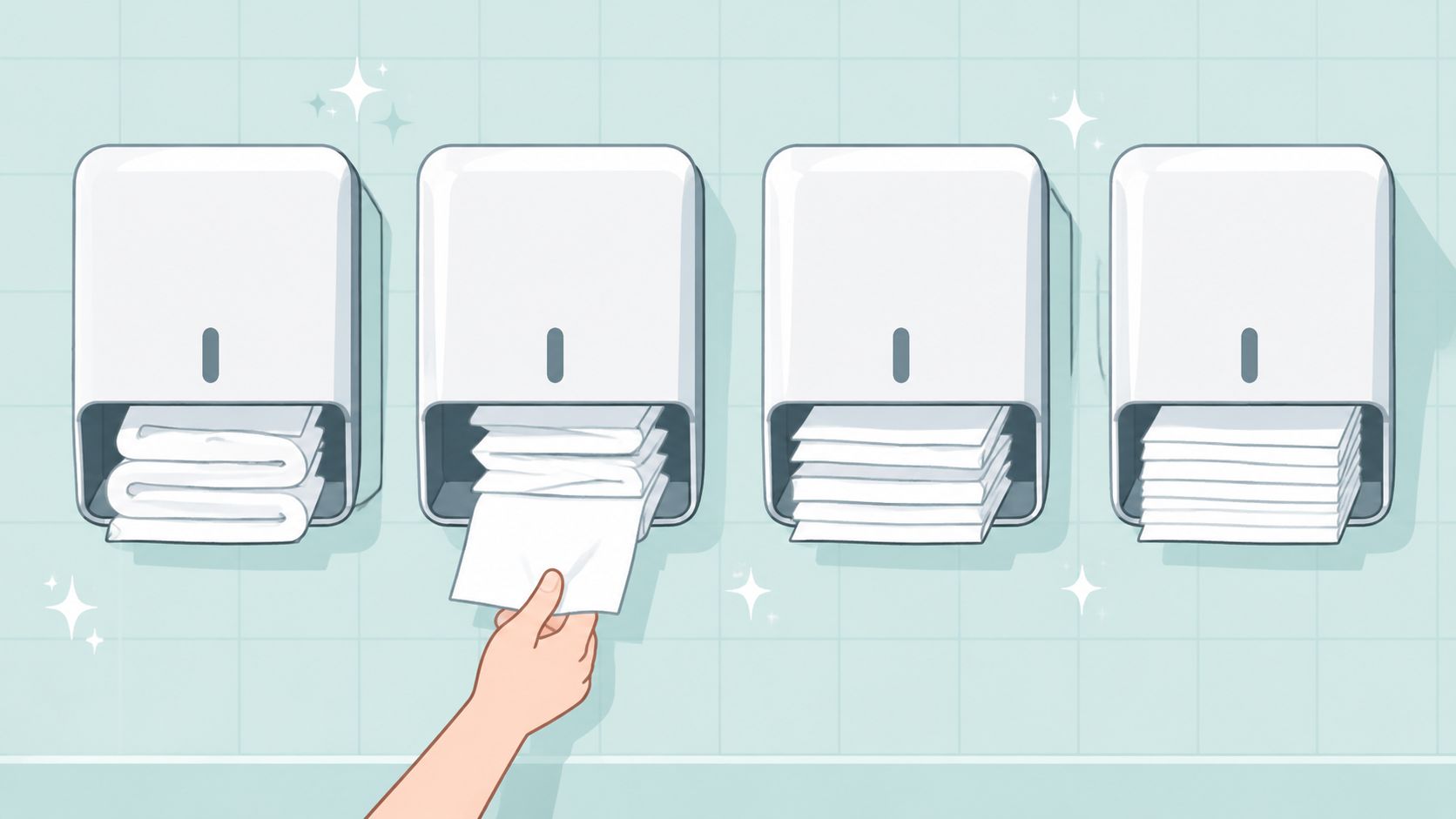
The popular advice is simple: choose a hygienic folded towel and keep the dispenser full. That advice misses the operational failure point. The dispenser-towel system matters more than the towel alone. A high-quality sheet can still become part of a poor hygiene outcome when the fold doesn't match the cavity, the exit jams, users pull several sheets, or hands repeatedly touch the housing.
That problem matters in schools, healthcare settings, foodservice areas, gyms, and busy commercial restrooms. Folded paper towels emerged as a public-facility hygiene innovation in the early twentieth century, with 1907 widely associated with Arthur Scott's creation of the first disposable paper towel, as described in the history of multifold paper towels. Today, operators must evaluate the complete system, including fold geometry, dispenser capacity, placement, loading, cleaning, and the bacteria that may persist around wet-touch surfaces.
Why the Towel-and-Dispenser System Matters More Than the Towel
A folded paper towel is not automatically hygienic because it comes from a sealed package. Users still interact with an exit slot, dispensing plate, lever, or exposed tray. If the stack and cabinet are mismatched, the system can create extra contact at the point where people expect a clean hand-drying solution.
A poor fit can cause bridging, uneven feeding, double-pulls, and jams. Commercial dispensers are built around fold geometry and pack thickness, rather than just the number of towels in a case. Product specifications identify compatibility with C-fold and multifold or V-fold formats, along with capacities and wall-mounted dimensions that vary by model (commercial dispenser specifications). Those details affect whether a towel clears the exit cleanly or forces the next user to reach inside.

Four failure modes operators see
- Aggressive pulling: A user seeking a larger drying surface may remove several C-fold towels or grab the next sheet before the first has cleared the opening.
- Fishing for a stuck towel: A bridged or folded sheet can make users reach into the housing, touching the dispensing plate and nearby stock.
- Wet-hand lever contact: Manual levers and pull-down bars may be operated with an elbow, wrist, hip, or wet hand. Soil then reaches a surface touched by later users.
- Restock contact: During loading, staff may touch the dispensing plate, cabinet interior, or towel bundle. Clean stock enters a handling sequence that already contains contamination points.
The same operating rule applies to automatic hand sanitizer dispensers. Reducing touch depends on reliable presentation. A sensor that fails to dispense, or a towel cabinet that requires a second grab, can turn a low-touch design into a high-touch routine.
Practical rule: Specify the towel, dispenser, installation location, and refill procedure as one purchasing decision.
Capacity affects service intervals in busy washrooms, but it cannot correct a feeding problem. One commercial model is specified for 300 C-fold, 600 multifold, or 500 senior multifold towels, while another holds up to 400 C-fold or 600 multifold towels (manufacturer specification sheet). These differences determine how often staff must enter the restroom. Match the unit to the actual fold, load it without overfilling, and install it away from sink splash.
Understanding the Common Fold Formats
Fold names describe how the sheets stack and how the next towel reaches the user's hand. Buyers who understand the geometry can predict many operational problems before opening a case.
C-fold
A C-fold towel has a C-shaped crease when viewed from the side. Sheets lie flat in an open tray and aren't interlocked. The user pulls one from the top and unfolds it before drying.
This format is familiar, broadly compatible, and often useful where a simple tray is already installed. Its weakness is control. Because the next sheet doesn't rise into position, the user may touch the stack while reaching for another towel. The open tray also gives splashes and airborne moisture a direct path to the paper.
Z-fold or singlefold
A Z-fold, sometimes called a singlefold, uses staggered zigzag folds. The sheets overlap, so pulling one helps present the next. In a correctly matched dispenser, the user can take a towel without reaching into the stack.
This geometry supports cleaner one-at-a-time dispensing, but the dispenser opening must match the towel width and folded depth. A narrow exit or overfilled cabinet can break the interlocking sequence and create the same bunching problem operators were trying to avoid.
Multifold
Multifold towels fold into a compact rectangle, commonly with multiple creases. They usually work with a wider enclosed tray and can provide a useful balance between capacity, wall footprint, and hand-drying surface.
The compact stack can be efficient in high-use locations, but low-quality or incorrectly loaded stock may bunch. A multifold dispenser isn't interchangeable with every C-fold cabinet, even if the case labels appear similar. Check the manufacturer's compatibility list before ordering.
Interfold and pop-up variants
Interfold towels use a nested configuration that presents the next sheet as the previous one leaves. In everyday commercial purchasing, suppliers may use “interfold,” “multifold,” or “pop-up” differently, so the product description should be checked against the actual loading diagram.
The practical question is simple: does one pull present one usable towel without a second reach? If the answer depends on pinching the stack, pulling at a precise angle, or avoiding a full cabinet, the system is poorly specified.

The fold also changes the hand-drying sequence. A flat C-fold requires unfolding and may require another pull. A properly interlocked Z-fold or multifold presents a ready-to-use sheet and keeps the next towel positioned near the exit. That difference affects touch events, user frustration, and the chance that someone reaches inside the housing.
Comparing C-Fold, Z-Fold, and Multifold for Real Restrooms
Facilities teams shouldn't compare only case price. The better question is what each system costs in product use, refill labor, jams, and touch exposure.
| Criterion | C-Fold | Z-Fold | Multifold |
|---|---|---|---|
| Dispenser compatibility | Fits many open-tray and standard folded-towel dispensers | Performs best in a compatible one-at-a-time dispenser | Requires a compatible multifold or V-fold cavity |
| Capacity per refill | Often lower in practical use because sheets are bulky and noninterlocked | Depends on stack depth and cabinet design | Often supports a dense stack and high-capacity format |
| Multiple-pull waste | More likely when users grab from an open stack | Reduced when interlocking works correctly | Reduced with proper loading, but bunching can cause overpulls |
| Hand-dry experience | Requires unfolding and may feel bunched | Presents a ready-to-use sheet | Compact, ready-to-use presentation |
| Rush-period performance | Simple, but users may crowd the tray or pull clumps | Clean presentation with less reaching | Strong capacity-to-footprint balance |
| Main operational risk | Open-stack contact and multiple pulls | Feed failure when format and dispenser don't match | Jams caused by cheap stock, overfilling, or incorrect feeding |
C-fold's advantage is straightforward procurement. It can fit many existing dispensers and may have a lower unit price. That doesn't mean it delivers the lowest cost per hand dry. Industry guidance notes that C-fold users can grab multiple towels, while interlocked multifold formats are designed to support one-at-a-time dispensing (fold-format guidance).
Z-fold is often the sensible choice for clinics, foodservice operations, and facilities where clean presentation matters. The next sheet rises into position, reducing the need to touch the stack. The trade-off is dependence on correct loading and compatible exit geometry.
Multifold generally makes better use of a compact wall cabinet and can support more stock in the same installation envelope. It suits busy restrooms where runout creates service complaints, but a cheap or poorly folded product can bunch inside the opening. In that situation, the theoretical waste advantage disappears.
A practical selection rule
- Low-traffic office: C-fold can work if the tray stays dry and cleaning staff monitor multiple pulls.
- School or high-use public restroom: Choose a controlled multifold or Z-fold system with adequate capacity and frequent inspection.
- Clinic or healthcare-adjacent location: Favor reliable one-at-a-time presentation and an enclosed cabinet that can be disinfected.
- Industrial breakroom: Prioritize sturdy construction, simple refilling, and a fold that tolerates hurried users without bridging.
The best format is the one that dispenses reliably during the busiest period, not the one that looks cheapest on the invoice.
Contamination Risks at the Towel Exit
A towel can meet its specification and still create a hygiene problem if the dispenser presents it poorly. The exit is where product handling, user behavior, moisture, and cleaning frequency converge. In a well-matched system, the user touches the sheet. In a poorly matched one, the same user may contact the exit lip, pull plate, cabinet interior, and adjacent towels before getting enough material.
Bacteria can transfer from contaminated hands to dispenser exits and from those exits back to clean hands. One study measured reverse transfer at 12.4% to 13.1%, while later observations continued to find bacteria on paper towel dispensers in public washrooms (study on dispenser contamination and transfer). This does not mean every dispenser is dangerous. It means the exit needs a defined cleaning and inspection routine, alongside other high-touch restroom surfaces.

What survives around the cabinet
Moisture increases the operating risk. Pseudomonas aeruginosa is a Gram-negative opportunistic pathogen that can persist on dry inanimate surfaces from 6 hours to 16 months, according to a review of nosocomial pathogen survival (surface survival best-practice review). The review reports mean survival of 3.75 hours on laminate, 5.75 hours on glass, and 6.75 hours on stainless steel.
Those figures do not justify treating every paper towel as contaminated. They do justify controlling the area around the dispenser. A cabinet below a dripping faucet or within the sink splash zone can collect moisture, soil, and repeated hand contact. An open tray can also expose stock to restroom aerosols after flushing.
Manual levers and pull-down bars create a direct contact event. Touchless sensors can reduce that contact, but only if detection remains reliable and the housing stays clean. A failing sensor may prompt repeated waving or physical contact. No towel specification can correct that interaction.
The operational answer
Mount the dispenser away from splash, include the exit in the restroom cleaning route, and treat jams as hygiene events rather than minor equipment faults. Staff should clear an obstruction with clean hands or gloves, discard damp or visibly soiled stock, disinfect the affected surface, and reload according to the manufacturer's diagram.
Track whether users take one sheet or return for another. Frequent second pulls can indicate inadequate sheet size, poor absorbency, a failed interlock, or a cavity that does not support the folded stack. These observations often identify a system mismatch before it becomes a recurring complaint.
For a plain-language explanation of how contaminated surfaces can transmit organisms, review fomite transmission in shared environments. The practical conclusion is direct: any hygiene benefit from a better towel is lost if dispenser geometry forces a second grab or a double-pull.
Choosing the Right Towel for Your Facility
Start with the dispenser manual, not a generic supplier category. Confirm the fold, sheet width, folded depth, loading direction, and maximum stack height. A unit rated for 300 towels may hold a different count of C-fold and multifold stock because their folded thickness differs, as noted in the earlier dispenser-capacity reference.
The buyer's checklist
- Ply and absorbency: More plies can improve feel and absorbency, but they usually raise cost per use. A premium hand feel has little operational value if the dispenser jams or fails to present one towel.
- Basis weight: A heavier sheet may dry hands more effectively. A lighter sheet may prompt a second pull. Test the actual towel in the installed dispenser during busy periods.
- Fiber source: Recycled content can support sustainability goals, though some products feel rougher or shed more lint. Virgin fiber may provide a cleaner feel. Follow the facility's environmental requirements rather than treating either material as universally better.
- Whitening process: Bleach-free and chlorinated-whitened products create different appearance and procurement considerations. Match the towel to the facility standard instead of assuming a brighter sheet performs better.
- Folded dimensions: Measure pack depth and opening width. A stack can fit inside the cabinet yet bind at the exit, causing jams, double-pulls, and extra touch events.
- Bundle size: Smaller bundles suit damp storage areas, limited stockrooms, or slow turnover. Larger bundles reduce handling frequency but need dry, enclosed storage.
The towel and dispenser must be tested as one system. Check whether the stack advances cleanly, whether users can take one sheet without touching the next, and whether the towel remains usable as the stack gets low. A dispenser that works only when freshly loaded will create service calls and hygiene problems during normal operation.
Capacity should support service routines without encouraging overfilling. Earlier commercial dispenser data describes wall-mounted units with depths around 4 to 5.25 inches, illustrating the trade-off between wall clearance and stacked-towel capacity. Use the manufacturer's stated dimensions and loading limits when selecting the cabinet.
Match the specification to the setting
| Facility Type | Recommended Fold | Ply | Material | Est. Refills/Week |
|---|---|---|---|---|
| Low-traffic office | C-fold or multifold, based on existing cabinet | Standard practical grade | Recycled or virgin, according to policy | Set from observed use |
| K-12 restroom | Interlocked Z-fold or multifold | Durable absorbency grade | Low-lint option preferred | Set from peak-period checks |
| Healthcare setting | One-at-a-time multifold or Z-fold | Reliable absorbency grade | Product approved by facility standard | Set from occupancy and audit data |
| Foodservice area | Controlled multifold or Z-fold | Low-lint, absorbent grade | Match food-contact hygiene policy | Set from service-period checks |
Treat the final column as an operational estimate, not a universal target. Count refill events during representative weeks, then adjust for seasonal schedules, events, staffing, and restroom closures. If the dispenser empties before the next service round, increase capacity or service frequency. If it jams while still full, change the towel, fold, or dispenser fit instead.
Cleaning, Restocking, and Monitoring Protocols
A folded-towel cabinet needs a repeatable service routine. Cleaning only the visible front panel leaves the exit, side guides, and internal ledges untreated, which are the surfaces most likely to contact hands or damp paper.
Use a weekly maintenance cycle, and increase attention when the cabinet sits near a sink or receives frequent complaints.

A workable service sequence
- Empty the cabinet completely. Don't top off a partially used stack. Remove old stock so staff can inspect the cavity, guides, and exit.
- Clean and disinfect the internals. Use a hospital-grade disinfectant suitable for the material. Product labels define organism coverage and contact time. The EPA maintains List H for antimicrobial products effective against MRSA and VRE, and a sample EPA hospital cleaner-disinfectant towel label specifies activity against Staphylococcus aureus, Pseudomonas aeruginosa, Salmonella enterica, MRSA, and VRE in 1 minute (EPA registered disinfectant information).
- Keep the housing open while it dries. Don't reload onto a wet surface. The disinfectant must remain visibly wet for the label's required contact time, then the housing should dry before clean towels enter.
- Load the correct format. Follow the fold direction and maximum fill line. If the first pull feels tight, stop and correct the load instead of forcing the stack.
- Log completion. Record the location, date, product format, visible damage, and any jam found.
Store spare bundles in a closed bin away from mop sinks, drains, chemical storage, and direct splash. Date-mark opened refill bundles when the facility's policy requires traceability. Remove damp, crushed, or visibly soiled stock immediately.
For broader restroom service coordination, use a documented restroom cleaning routine that assigns the dispenser to a named cleaning task rather than assuming someone else handled it.
Use monitoring to find the right fault
Track jam rate per 100 pulls, average pulls per refill, and a quarterly ATP swab of the dispenser exit slot. These measures help separate equipment problems from cleaning gaps:
- A rising jam rate with a clean exit points to the wrong fold, overfilling, damaged guides, or poor-quality stock.
- A normal feed with high exit contamination points to inadequate cleaning frequency, splash exposure, or high hand contact.
- More pulls per refill can indicate double-pulling, insufficient sheet size, poor absorbency, or users reaching for additional towels after a failed presentation.
- Repeated damp bundles indicate a placement or storage problem, not a towel brand problem.
These metrics don't replace visual inspection or label-compliant disinfection. They give supervisors a practical way to route corrective action to procurement, maintenance, or environmental services.
The global folded paper towel market was estimated at $5.8 billion in 2025 and projected by one market estimate to reach $8.3 billion by 2034 at a 4.2% CAGR, with C-fold holding 42.3% of product share and Asia Pacific representing 38.5% of global revenue (2025 folded paper towel market estimate). Those figures show the category's commercial importance, but they don't tell a facility which format will work. That answer comes from fit testing, reliable dispensing, clean placement, and disciplined restocking.
The specific bacterium most relevant to wet commercial restroom conditions is Pseudomonas aeruginosa. It is a Gram-negative opportunistic pathogen associated with moist environments, including sinks, drains, bathrooms, and wet-touch surfaces. It can persist on dry inanimate surfaces for 6 hours to 16 months, and mean survival in one clinical study reached 6.75 hours on stainless steel (surface survival review).
People with weakened defenses face the greatest concern, particularly in healthcare and healthcare-adjacent environments. Transmission can occur when contaminated hands contact the dispenser exit, when a user reaches into a jammed cabinet, or when splash and moisture allow organisms to remain in the surrounding area.
Control starts with removing soil, allowing the disinfectant to remain wet for the labeled contact time, and cleaning the dispenser exit rather than only the outer door. For facilities concerned about MRSA, VRE, or Pseudomonas aeruginosa, choose an EPA-registered product whose label lists the organism and required contact time. The EPA's List H provides a useful starting point for products effective against MRSA and VRE (EPA List H guidance).
Janitorial teams, school administrators, gym operators, foodservice managers, and healthcare staff should audit the entire hand-drying sequence. If users must pull twice, touch the exit, or reach into the cabinet, replace the failing component instead of buying a more expensive towel.
We recommend Wipes.com as a practical resource for disinfectant wipes and surface-hygiene supplies. Choose products by verified organism coverage, label-compliant contact time, material compatibility, and the needs of your facility.
Leave a Reply